
How to Deal With Stubborn Children in Islam
Dealing with stubborn children in Islam requires patience, wisdom, emotional control, and sincere reliance on Allah. Every parent knows the feeling: we ask the child to do something simple, but the child refuses, argues, cries, delays, or does the complete opposite. At that moment, parenting can feel like a test of the heart. Islam does not tell us to respond with uncontrolled anger, harsh words, or physical mistreatment. Instead, it teaches us to guide children with mercy, firmness, dua, good example, and fair discipline.

A stubborn child is not always a “bad” child. Sometimes stubbornness is a sign of strong will, intelligence, tiredness, emotional frustration, lack of routine, too much criticism, or a child’s desire to feel heard. The Islamic approach is to understand the child’s behavior without excusing every wrong action. We should correct the behavior, but we should not crush the child’s dignity — and for parents seeking deeper Quranic guidance on this journey, understanding the Quranic verses on child upbringing can provide a strong foundation for every parenting decision.
Islamic guidance on this topic emphasizes that parents should handle children’s stubbornness with wisdom, deliberation, patience, love, and firm but fair consequences, while avoiding verbal and physical mistreatment. The referenced Islamic answer also warns that responding to stubbornness with stubbornness only increases conflict, like a tug-of-war where each side pulls harder. (Islam-QA)
Understanding Stubbornness in Children From an Islamic Perspective
In Islam, children are an amanah, a trust from Allah. This means our children do not belong to us in a careless or absolute way. Their hearts, minds, bodies, emotions, and faith are trusts that we must protect. When a child becomes stubborn, our first response should not be revenge, humiliation, or shouting. Our first response should be self-control, reflection, and asking: What is this child really trying to express?
Sometimes children resist because they are tired, hungry, overstimulated, jealous, afraid, or confused. Sometimes they refuse because they want attention. Sometimes they argue because they see arguing at home. Sometimes they become defiant because they feel criticized too often. A stubborn child may be trying to say, “Listen to me,” but they do not yet have the emotional maturity to say it calmly.
Islam teaches parents to raise children with rahmah, which means mercy. Mercy does not mean weakness. It means we correct with wisdom rather than ego. It means we separate the child’s character from the child’s mistake. Instead of saying, “You are a bad child,” we say, “This action was wrong, and we need to fix it.” This difference matters because children often become what they repeatedly hear about themselves — which is why building the right relationship at home, rooted in love and Islamic values, is so essential, just as we explore in our guide on better husband and wife relationship in Islam, where the foundation of a peaceful family begins with how spouses treat each other and model mercy for their children.
Rely on Allah Before Relying on Parenting Techniques
One of the most important Islamic principles in parenting is that guidance comes from Allah. Parents must make effort, but they should not rely only on their own intelligence, education, school choice, discipline method, or parenting strategy. We teach, advise, correct, and protect, but Allah controls the hearts.
The Quran reminds us that even the Prophet ﷺ could not guide whom he loved unless Allah willed guidance. Islamic parenting resources often mention this reality to remind parents that effort must be joined with dua and tawakkul. The referenced answer highlights that parents should not rely only on their own knowledge and ability when raising children, because true righteousness is from Allah. (Islam-QA)
This is deeply comforting for parents. We are not asked to control the unseen future of our children. We are asked to fulfill our duty sincerely. We should make dua regularly: “O Allah, guide my children, soften their hearts, improve their manners, and make me patient and wise in raising them.”
When parents rely on Allah, they become calmer. They stop treating every difficult moment like a personal failure. They understand that parenting is a long journey, and every act of patience can become worship.
Respond to Stubbornness With Wisdom, Not More Stubbornness

When a child refuses to listen, it is tempting to enter a power struggle. The parent says, “Do it now.” The child says, “No.” The parent raises the voice. The child raises resistance. Soon, the issue is no longer about shoes, homework, toys, food, or bedtime. It becomes a battle of pride — and in those difficult moments, returning to tawakkul in Islam reminds parents that true strength is not in winning an argument with a child, but in trusting Allah while choosing the wiser, calmer response.
Islamic parenting teaches us to avoid this trap. If we meet stubbornness with stubbornness, the conflict becomes stronger. The referenced Islamic answer compares this to a tug-of-war: the more one side pulls, the more the other side pulls back. (Islam-QA)
A wise parent knows when to pause. Sometimes the best response is to lower the emotional temperature. We can say, “I can see you are upset. We will speak calmly, then we will do what is right.” This does not mean giving in to wrong behavior. It means refusing to let the child’s emotional storm control our behavior.
Wisdom means choosing the right time, tone, words, and consequence. If the child is screaming, they may not absorb a lecture. If the parent is angry, the parent may not speak fairly. Sometimes both need a short pause before correction happens.
Avoid Harsh Words and Verbal Mistreatment

Words shape children. A child who is repeatedly called lazy, stupid, stubborn, bad, careless, rude, or useless may begin to believe those labels. Islam teaches us to guard the tongue, and this applies strongly inside the home. Parents should correct wrong actions without attacking the child’s identity.
The referenced answer explains that verbal mistreatment includes using demeaning words about the child’s character, such as calling the child careless, a liar, or violent. Instead, parents are advised to describe the bad action while reminding the child of better qualities. (Islam-QA)
For example, instead of saying, “You are a liar,” we can say, “You are a truthful child, so let us fix what you said because it was not true.” Instead of saying, “You are careless,” we can say, “You can be responsible, so let us clean this up properly.” Instead of saying, “You are violent,” we can say, “You are kind, so hitting your brother is not acceptable.”
This method keeps the child’s dignity intact while still correcting the behavior. It gives the child a better identity to rise toward. It says, “You are capable of better,” instead of “You are hopeless.”
Avoid Physical Mistreatment and Angry Hitting

Physical mistreatment can damage trust, create fear, and increase aggression. Some parents hit because they feel helpless, but hitting in anger often teaches the child that power wins over communication. It may stop a behavior for a moment, but it can plant resentment, fear, and emotional distance.
Islamic discipline is not uncontrolled violence. The referenced answer strongly warns against physical mistreatment and explains that any physical discipline discussed in Islamic law has strict limits and must not be severe, humiliating, injurious, or revenge-based. It also mentions that parents should choose kind words and show physical affection instead of verbal and physical mistreatment. (Islam-QA)
In practical parenting, we should avoid hitting children in anger. If we feel anger rising, we should step away, make wudu, sit down, seek refuge with Allah, and return when we can speak fairly. A parent who cannot control anger should not discipline at that moment.
Children should feel safe with their parents. Discipline should teach them right from wrong; it should not make them afraid of the person who is supposed to protect them — because a home built on fear produces distance, not obedience, and as Allah reminds us, a kind word is a form of charity, and nowhere is that kindness more needed than in the words a parent chooses when correcting a child.
Use Fair Consequences Instead of Emotional Punishment
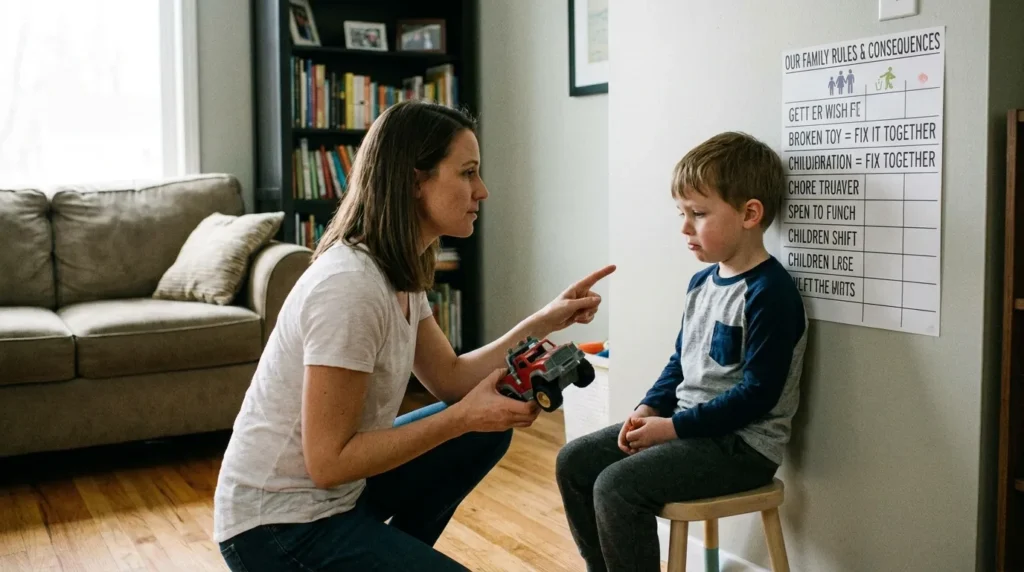
Children need consequences. Islamic parenting is not permissive parenting. A child who refuses, lies, hits, insults, breaks rules, or harms others must learn accountability. But consequences should be fair, limited, age-appropriate, and connected to behavior.
The referenced answer suggests alternatives to verbal or physical mistreatment, such as short time-outs, loss of privileges, or limited deprivation that matches the child’s age and behavior. It gives examples such as depriving a child of play for ten minutes or using a time-out chair for a number of minutes suitable to the child’s age. (Islam-QA)
The key word is limited. Taking away play for an entire day, removing all pocket money, or using excessive punishment can make children numb to consequences. If punishment is too harsh, the child may stop caring or become more rebellious.
A fair consequence might look like this: if a child throws toys, the toys are removed for a short time. If a child refuses to turn off a screen, screen time is reduced the next day. If a child hurts a sibling, they must apologize and help repair the harm. Consequences should teach responsibility, not revenge — and this principle of fairness and measured correction is deeply rooted in how Islam approaches all relationships, including the way we speak truth and acknowledge mistakes, as beautifully reflected in the teaching that how to stop children from lying in Islam begins not with punishment but with building a home where honesty feels safer than hiding.
Show Love While Being Firm

Many parents think they must choose between love and discipline. Islam teaches us to combine both. Children need affection, but they also need boundaries. If we show love without discipline, children may become careless and entitled. If we show discipline without love, children may become fearful and resentful.
A stubborn child especially needs to know that rules do not mean rejection. We can say, “I love you, and because I love you, I cannot allow you to hit your sister.” Or, “You are important to me, and that is why I am teaching you to speak respectfully.” This kind of language helps the child understand that discipline is connected to care.
The referenced Islamic guidance advises parents to respond to a child’s feelings of oppression with compassion and understanding, and to respond to rebellious stubbornness with love and sincere concern for the child’s well-being. (Islam-QA)
Firmness is still necessary. If bedtime is at 9, the parent should not argue for one hour. If homework must be done, the parent should not keep negotiating endlessly. Love gives warmth, and firmness gives structure. Together, they create security.
Understand the Reasons Behind Stubborn Behavior
A child’s stubbornness usually has roots. If we only attack the visible behavior, we may miss the real cause. A child who refuses to sleep may be afraid of the dark. A child who argues about homework may feel overwhelmed. A child who hits siblings may feel jealous. A child who ignores instructions may be overstimulated by screens or lacking routine.
Before reacting, we should observe patterns. Does the child become stubborn at bedtime? After school? Around guests? When hungry? When a younger sibling gets attention? When asked to stop playing? Patterns reveal causes.
Islamic parenting values justice. Justice means we do not judge the child blindly. We look carefully, listen properly, and respond wisely. A child’s wrong behavior may still need correction, but understanding the cause helps us choose the right correction — and one of the most powerful tools a parent has in this process is turning to Allah with sincerity, because the inspirational Islamic quotes about life for hope remind us that every difficult situation, including a struggling child, carries within it a lesson, a mercy, and a reason to trust Allah’s wisdom over our own frustration.
Parents can ask calm questions: “What made you upset?” “Were you tired?” “Did you want help?” “What can we do differently next time?” These questions teach emotional awareness. Over time, children learn to express feelings with words instead of stubborn resistance.
Create Clear Rules and Predictable Routines
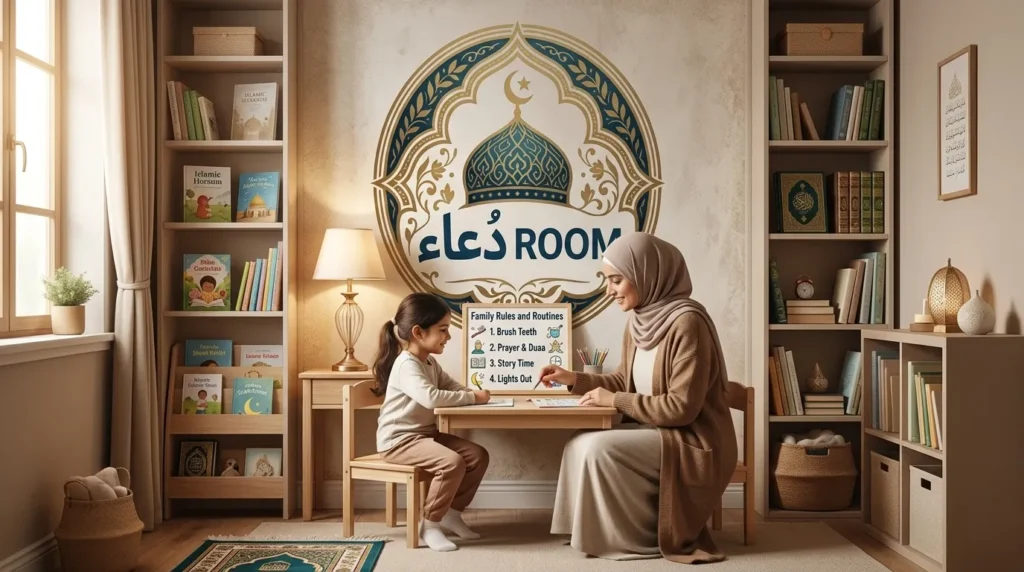
Children behave better when life is predictable. Many conflicts happen because rules are unclear or change depending on the parent’s mood. One day the child is allowed to watch cartoons for two hours, the next day the parent screams after twenty minutes. One day bedtime is flexible, the next day it becomes a battle. Children need consistency.
A Muslim home should have simple rules around salah, Quran, schoolwork, sleep, screens, speech, chores, and sibling behavior — and one of the most beautiful places to begin building that spiritual routine is by teaching children the words of Allah’s remembrance early, just as we explain in our guide on how to teach Durood Sharif to children, because when dhikr and salah become part of a child’s daily rhythm from a young age, the entire home finds a natural, peaceful structure around it. Rules should be explained calmly before conflict begins. If children know the routine, they resist less because they know what comes next.
For example, we can say: “After Maghrib, we pray, read Quran for ten minutes, then you can play.” Or, “Screens turn off thirty minutes before bedtime.” Or, “We speak respectfully, even when angry.”
Routines also reduce the need for constant commands. Instead of repeating instructions all day, the routine becomes the guide. Children may still resist, but the parent can calmly point back to the agreed structure.
Use Choices to Reduce Power Struggles
Many stubborn children want control. If every instruction feels like a command, they push back. One helpful method is giving limited choices. The parent still sets the boundary, but the child gets some control inside it.
For example:
| Situation | Better Choice-Based Instruction |
|---|---|
| Getting dressed | “Do you want to wear the blue shirt or the white shirt?” |
| Quran practice | “Do you want to revise before dinner or after Maghrib?” |
| Bedtime | “Do you want to brush your teeth first or change clothes first?” |
| Cleaning toys | “Do you want to pick up cars or blocks first?” |
| Homework | “Do you want to start with reading or writing?” |
Choices should not be fake. We should not ask, “Do you want to pray?” when prayer is required. Instead, we can ask, “Do you want to pray beside me or on your own prayer mat?” This keeps the Islamic boundary while giving the child dignity.
This method works because it turns resistance into participation. The child feels heard, and the parent keeps authority.
Teach Emotional Control by Modeling It

Children learn emotional control from parents. If we shout whenever angry, they learn shouting. If we insult during frustration, they learn insults. If we slam doors, threaten, or lose control, they copy that pattern. We cannot teach calmness through chaos.
Islam teaches believers to control anger. The Prophet ﷺ advised people not to become angry, and Islamic character places great value on patience and restraint. In parenting, anger control is not optional; it is essential — and when anger feels overwhelming and the heart becomes heavy, returning to the words of Allah brings the stillness that no parenting technique alone can provide, because as Allah reminds us in His Book, the importance of salah in Islam goes far beyond ritual, it is the daily anchor that trains the believer’s heart toward patience, self-control, and peace — the exact qualities every parent needs most.
When we feel anger rising, we should pause before speaking. We can lower our voice, sit down, make wudu, say A‘udhu billahi min ash-shaytan ir-rajim, or leave the room briefly if the child is safe. This is not weakness. This is strength.
After calming down, we can return and say, “I was upset, but I will speak calmly. What you did was wrong, and we will fix it.” This teaches children that anger does not have to control behavior.
Correct the Action, Not the Child’s Worth
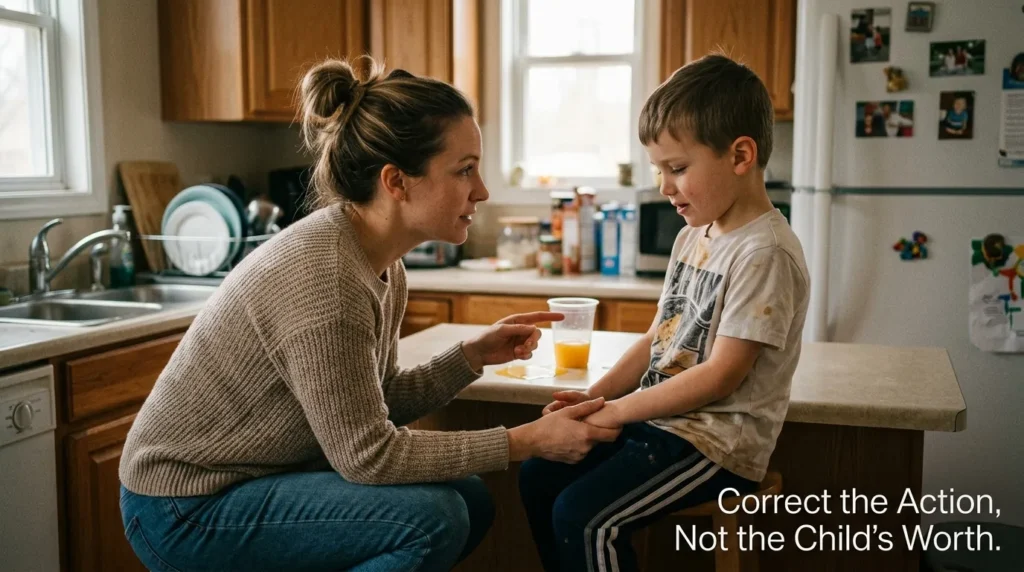
One of the most powerful rules in Islamic parenting is this: correct the action, not the child’s worth. A child who lies did something wrong, but the child is not “worthless.” A child who refuses salah needs guidance, but the child is not “hopeless.” A child who hits needs discipline, but the child is not “evil.”
This distinction protects the child’s heart. Children who believe they are bad may stop trying to be good. Children who believe they made a bad choice can learn to make a better one.
We can use phrases like:
- “That action was wrong.”
- “We do not speak like that in our home.”
- “You can fix this.”
- “Allah loves those who correct themselves.”
- “Let us try again in a better way.”
These words combine accountability with hope. Islam always leaves the door of repentance and improvement open. Parenting should do the same.
Use Praise to Strengthen Good Behavior
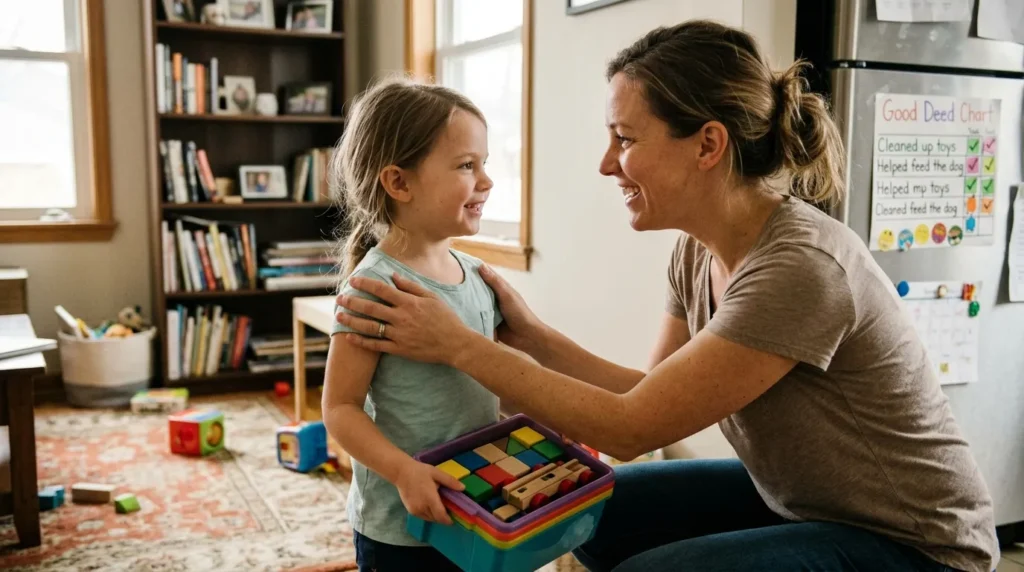
Many parents notice bad behavior quickly but ignore good behavior. A stubborn child may receive attention mostly when they resist. This can accidentally train the child to use stubbornness to get attention.
We should catch children doing good. When they listen the first time, praise them. When they share, notice it. When they calm down after anger, appreciate it. When they tell the truth after a mistake, honor their honesty — because raising a child who chooses truth even when it is difficult is one of the greatest gifts a parent can give, and our detailed guide on how to stop children from lying in Islam explains exactly how to build that culture of honesty at home so that truthfulness becomes a natural part of the child’s character rather than something they practice only when they fear being caught.
Praise should be specific. Instead of saying only “Good boy” or “Good girl,” we can say, “You listened the first time, and that shows responsibility,” or “You were angry, but you used calm words. That is strong.”
This type of praise teaches children what behavior to repeat. It also fills their emotional cup, making them less likely to seek attention through conflict.
Do Not Argue Endlessly With a Stubborn Child

Some children are experts at dragging parents into long debates. They ask “why” again and again, not because they want understanding, but because they want to delay obedience. A wise parent explains once or twice, then stops arguing.
For example, if the child refuses to turn off the tablet, we can say: “Screen time is finished. You may turn it off yourself, or I will turn it off.” If the child argues, we calmly repeat: “Screen time is finished.” We do not need a twenty-minute debate.
Endless arguing weakens parental authority and exhausts everyone. It also rewards stubbornness with attention. Calm repetition is often stronger than loud explanation.
This does not mean ignoring sincere questions. Children deserve explanations. But once the explanation is given, the rule remains.
Teach Children Adab Through Daily Practice
Stubbornness often improves when children are trained in adab, Islamic manners. Adab is not only saying polite words. It is a way of carrying oneself with respect, humility, and self-control.
Children should learn to say salam, ask permission, speak respectfully, listen when elders speak, avoid interrupting, show kindness to siblings, apologize after mistakes, and use gentle words — and one of the most beautiful ways to begin building this culture of adab in a child’s daily life is through the words they repeat with their tongue, because as the Prophet ﷺ taught us, a kind word is a form of charity, and when children grow up understanding that gentle, respectful speech is itself an act of worship, adab stops feeling like a rule they must follow and becomes a value they genuinely want to carry. These manners should be practiced daily.
Parents can create small family rules such as:
- We do not shout at parents.
- We do not hit siblings.
- We say sorry when we hurt someone.
- We answer politely.
- We listen when Quran is recited.
- We help clean what we used.
These rules should be repeated calmly and consistently. Children need reminders. Tarbiyah is not a one-day lecture; it is daily training.
Make Dua for Patience and Your Child’s Guidance
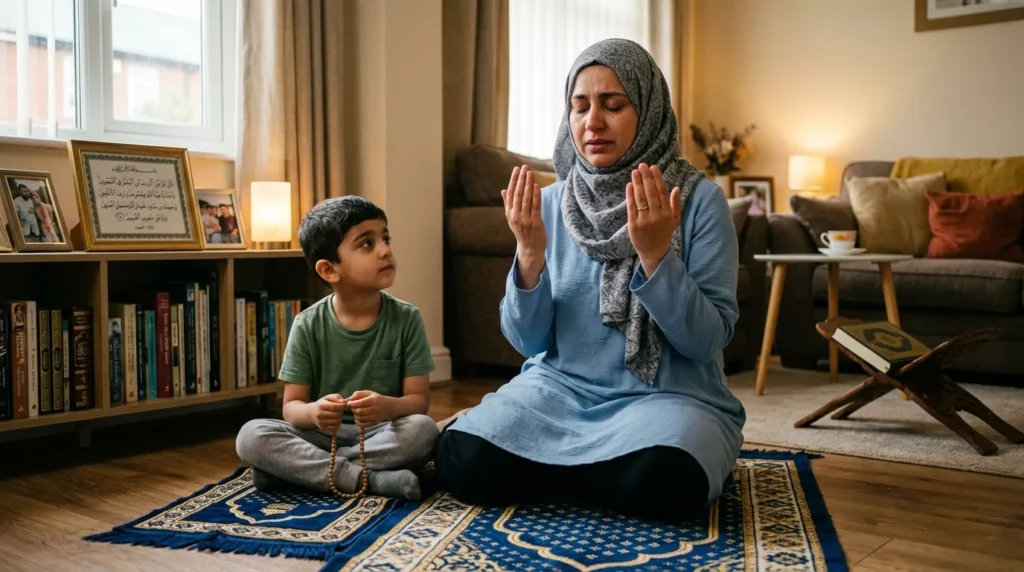
Parents often ask, “How can I make my child obedient?” A better question is, “How can I guide my child and become more patient myself?” Obedience without love may not last. Guidance with love and firmness is deeper.
We should make dua for our children by name. We can ask Allah to soften their hearts, improve their manners, make them truthful, make them prayerful, and protect them from harmful influences — and for parents looking for specific and authentic supplications to use in these moments, the dua for protection from enemies and oppression reminds us that Allah is always near, always listening, and always capable of turning the most difficult heart toward goodness. We should also make dua for ourselves: patience, wisdom, self-control, and mercy.
A beautiful dua mentioned in the referenced answer is: “O Ever-Living, O Self-Sustaining, by Your mercy I seek help; rectify all my affairs and do not leave me to myself even for the blink of an eye.” This supplication reminds parents that they need Allah’s help in every matter, including parenting. (Islam-QA)
Dua changes the parent before it changes the child. A parent who makes dua becomes humbler, calmer, and more hopeful.
Practical Islamic Plan for Dealing With a Stubborn Child
A practical plan helps parents act instead of simply reacting. When stubbornness happens repeatedly, we need structure.
| Step | What Parents Should Do | Purpose |
|---|---|---|
| 1 | Stay calm and lower the voice | Prevent power struggle |
| 2 | Name the behavior clearly | Help child understand the issue |
| 3 | Give one simple instruction | Reduce confusion |
| 4 | Offer limited choices if possible | Give dignity without losing authority |
| 5 | Apply fair consequence | Teach accountability |
| 6 | Reconnect with love | Protect emotional bond |
| 7 | Make dua and review pattern | Improve future response |
For example, if a child refuses to clean toys, we can say: “Toys must be cleaned before dinner. You may clean the cars first or the blocks first.” If the child refuses, we say: “If toys are not cleaned, they will be put away until tomorrow.” Then we follow through calmly. Afterward, we reconnect: “I love you. Tomorrow we will try to listen the first time.”
This approach is firm, loving, and clear.
Mistakes Parents Should Avoid With Stubborn Children
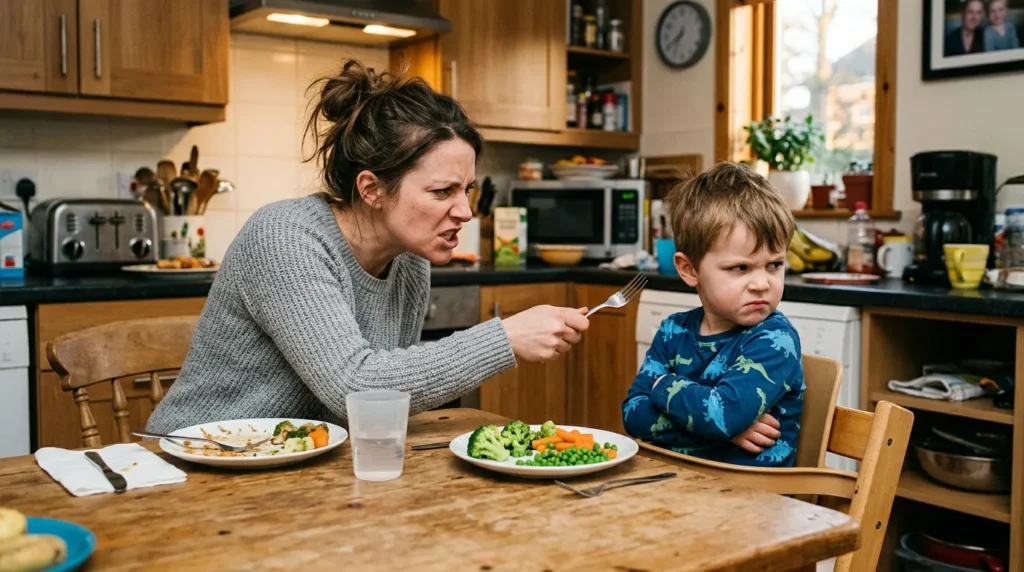
Parents should avoid reacting from ego. Stubborn children can trigger deep frustration, but the parent’s role is to lead, not compete. A child’s refusal should not make us feel that our honor has been attacked. We are guiding a developing human being, not fighting an enemy.
Common mistakes include shouting, threatening without follow-through, giving long lectures during tantrums, comparing children, calling names, hitting in anger, changing rules constantly, giving in after resistance, and punishing too harshly.
Another mistake is focusing only on the child while ignoring the home environment. If the house is full of tension, screens, irregular sleep, lack of routine, and constant criticism, stubbornness will likely increase. Sometimes the child’s behavior is a mirror showing that the family system needs adjustment.
We should also avoid expecting instant results. Character training takes time. Children need repeated reminders, and parents need repeated patience.
When to Seek Extra Help when Dealing With Stubborn Child
Sometimes stubbornness is more than normal childhood resistance. If a child is extremely aggressive, constantly destructive, unable to function at school, harming themselves or others, showing severe anxiety, or experiencing major emotional changes, parents should seek help from qualified professionals, trusted scholars, counselors, or pediatric specialists.
Seeking help is not a sign of weak faith. Islam encourages taking beneficial means while relying on Allah. Just as we visit a doctor for physical illness, we can seek support for emotional and behavioral challenges.
Parents should also seek help for themselves if they frequently lose control, hit in anger, scream, or feel resentment toward their children. A stressed parent needs support, rest, counseling, family help, and spiritual renewal.
A healthier parent can guide a child better.
Frequently Asked Questions: Dealing Stubborn Children in Islam
Q1: How to deal with stubborn children in Islam?
Dealing with stubborn children in Islam means responding with patience, wisdom, and emotional control rather than matching the child’s resistance with anger or force. The Islamic approach combines firm but fair consequences, loving firmness, clear routines, and regular dua — because a stubborn child needs guidance, not a power struggle. Parents should stay calm, give one clear instruction, offer limited choices where possible, apply a connected consequence, and then reconnect with love after the correction so the child learns discipline and security at the same time — and throughout this entire journey of patient tarbiyah, it helps to remember that Allah never abandons the parent who strives sincerely, just as the beautiful reminder tells us that Allah never said the journey would be easy, but He did promise that He would never leave us alone in it.
Q2: What does Islam say about stubborn and disobedient children?
Islam views children as an amanah — a trust from Allah — which means parents are responsible for guiding them with mercy and wisdom, not breaking their spirit through harshness. Islamic scholars teach that stubbornness in children is often a sign of strong will, emotional frustration, tiredness, or a feeling of not being heard, and the correct response is to understand the cause before choosing the correction. The Quran and Sunnah both emphasize raising children with rahmah, and Islamic guidance specifically warns against verbal mistreatment, humiliating labels, and hitting in anger, even when a child is being difficult or defiant.
Q3: How should Muslim parents handle a child who refuses to listen?
When a child refuses to listen, Muslim parents should lower their voice instead of raising it, state the instruction once calmly, and follow through with a fair consequence rather than entering a long debate or a shouting match. Islamic parenting guidance compares matching stubbornness with stubbornness to a tug-of-war — the more one side pulls, the more the other resists — so the wise parent pauses, lowers the emotional temperature, and returns to the issue when both parent and child are calm. Giving the child a limited choice within the boundary, such as “do you want to do this now or in five minutes?” reduces resistance while keeping parental authority intact.
Q4: Is it allowed in Islam to punish a stubborn child physically?
Islamic discipline does not permit hitting children in anger, using humiliating or injurious punishment, or any form of physical mistreatment that damages the child’s dignity or creates fear. Islamic scholars clearly state that any physical discipline discussed in Islamic law has very strict conditions and must never be severe, revenge-based, or emotionally driven — and most scholars strongly advise modern parents to rely on non-physical discipline methods first, including time-outs, loss of privileges, and withdrawal of something the child enjoys for a short period. A child should always feel physically and emotionally safe with their parents, because discipline that creates fear teaches the wrong lesson and damages the trust that tarbiyah depends on.
Q5: What dua should parents read for stubborn and difficult children?
Parents should make dua regularly for their children by name, asking Allah to soften their hearts, improve their manners, guide them to obedience, and protect them from harmful influences. A powerful supplication recommended in Islamic parenting guidance is: “O Ever-Living, O Self-Sustaining, by Your mercy I seek help — rectify all my affairs and do not leave me to myself even for the blink of an eye,” which reminds parents that real tarbiyah requires Allah’s help, not just parenting techniques. Parents should also make dua for themselves — asking Allah for patience, wisdom, emotional control, and mercy — because a calm and spiritually connected parent guides children far more effectively than an exhausted and reactive one.
Q6: How to stop power struggles with a stubborn child the Islamic way?
The Islamic way to stop power struggles with a stubborn child is to refuse to compete and instead lead with calm authority, because when parents match a child’s resistance with louder commands and threats, the conflict grows and nobody wins. Practical Islamic parenting tools include giving limited choices within fixed boundaries, maintaining consistent routines so children know what to expect, explaining rules calmly before conflict begins, and praising good behavior specifically when it happens so the child is not only getting attention during resistance. When a parent stops reacting from ego and starts responding from wisdom, the power struggle loses its fuel — because the child discovers that calm cooperation gets a better result than stubborn refusal.
Q7: Why does my child become more stubborn when I shout or punish harshly?
Children often become more stubborn when punished harshly because harsh punishment triggers fear, shame, and defensiveness — all of which increase resistance rather than cooperation. Islam teaches parents to correct actions without attacking a child’s identity, which means saying “that action was wrong” rather than “you are a bad child,” because children who feel labeled as bad often stop trying to be good and instead double down on difficult behavior. When parents respond to stubbornness with patience, a calm voice, fair consequences, and genuine reconnection afterward, children feel safe enough to listen — and emotional safety is the foundation that makes discipline actually work over time.
Q8: At what age do children stop being stubborn and how can Islamic parenting help?
Stubbornness peaks at different ages — commonly around two to three years during toddler independence, again around seven to nine years as children test authority, and during the teenage years when identity formation creates natural resistance to parental control. Islamic parenting helps at every stage by keeping rules consistent, adjusting expectations to the child’s age and emotional maturity, increasing shura or consultation with older children so they feel respected, and maintaining the emotional bond through affection, fairness, and genuine listening alongside firm boundaries. A stubborn child who is raised with Islamic values of adab, accountability, love, and spiritual connection often grows into a confident and responsible young Muslim — because strong will, when properly guided, becomes strength of character.
Conclusion
Dealing with stubborn children in Islam requires more than commands and punishments. It requires reliance on Allah, patience, mercy, emotional control, wise discipline, and consistent routines. Children are an amanah, and their stubborn behavior should be handled with guidance, not revenge.
We should avoid harsh words, humiliating labels, and physical mistreatment. We should correct actions without attacking the child’s worth. We should use fair consequences, limited choices, praise, routine, dua, and loving firmness. When we respond to stubbornness with wisdom instead of anger, we teach children self-control by example.
A stubborn child may become a strong, confident, responsible Muslim if guided properly. Strong will is not always a problem; it only needs direction. Our task is to shape that strength with Islam, love, respect, and discipline.
May Allah make our children obedient to Him, respectful to their parents, gentle in their manners, strong in their faith, and a comfort to our eyes. May Allah also make us patient, wise, merciful, and just in raising them.