How to Stop Children From Lying in Islam: A Practical Parenting Guide
Lying is one of the most worrying habits parents notice in children. A child may lie about homework, broken items, screen time, salah, fighting with siblings, or small everyday mistakes. For many Muslim parents, the concern is not only behavioral; it is spiritual. We know that truthfulness is a major Islamic value, and we want our children to grow up with honesty, trustworthiness, courage, and fear of Allah.
Islam teaches us to raise children with truth, but it also teaches us to use wisdom, mercy, patience, and good example. A child who lies is not always a corrupt child. Sometimes children lie because they are afraid, confused, trying to avoid punishment, copying adults, seeking attention, testing limits, or lacking problem-solving skills. Parenting resources on this topic repeatedly emphasize that parents must first understand the reason behind the lie, because a young child’s imagination, fear-based lie, and intentional deception should not all be handled in the same way. (Zakeeya Ali)
What Islam Teaches About Truthfulness
Truthfulness is a core part of Islamic character. A Muslim is expected to be honest with Allah, honest with people, and honest with themselves. The Quran commands believers to fear Allah and remain with the truthful, and Islamic parenting guidance often highlights this verse as a foundation for teaching honesty at home. (Islamweb)
When we teach children truthfulness, we are not only teaching them to avoid punishment. We are teaching them to build a heart that is clean, brave, and connected to Allah. A truthful child learns that honesty may feel difficult for a moment, but it brings peace in the long run. A lying child may escape trouble temporarily, but the lie creates fear, guilt, broken trust, and more problems.
We should explain honesty to children in simple language:
“Allah loves truth. When we tell the truth, our hearts feel clean, people trust us, and Allah is pleased with us.”
This explanation is better than only saying, “Lying is bad.” Children need to understand the beauty of truth, not only the ugliness of lying.
Why Children Lie: Understanding the Real Cause
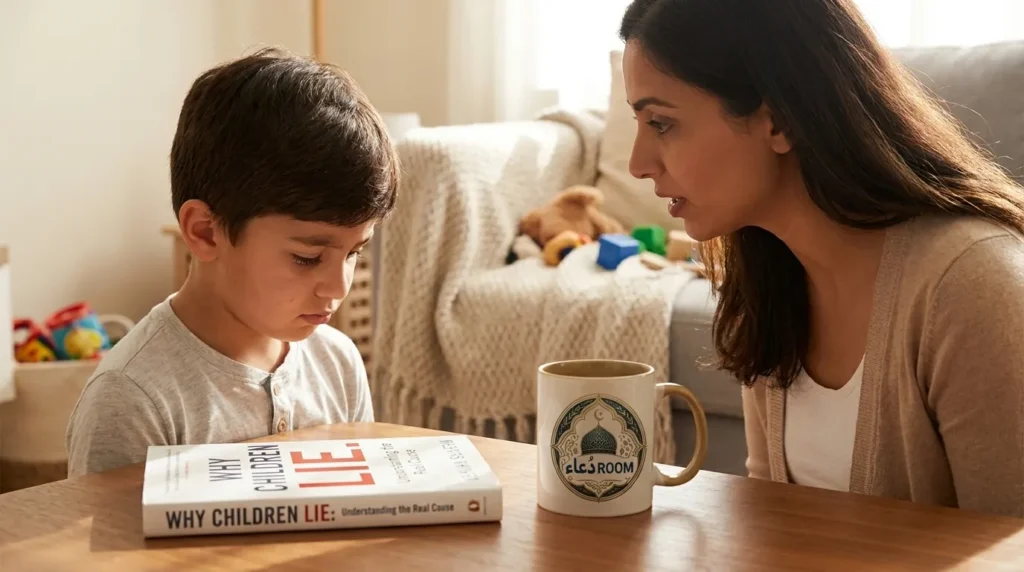
Before correcting lying, we should ask why the child lied. Children do not always lie for the same reason. A four-year-old may mix imagination with reality. A seven-year-old may lie because they fear being shouted at. A teenager may lie because they feel controlled or disconnected. A child may also lie because they do not know how to solve a problem honestly.
Some common reasons children lie include:
| Reason for Lying | What It May Mean |
|---|---|
| 😨 Fear of punishment | The child feels unsafe telling the truth. |
| ❤️ Desire for attention | The child wants parents to notice them. |
| 🚫 Avoiding responsibility | The child does not want to face the consequences. |
| 👨👩👧 Copying adults | The child has seen lying or dishonesty at home. |
| 🌈 Imagination | Young children may confuse stories with real facts. |
| 😔 Shame | The child feels embarrassed about making a mistake or failing. |
| 🎯 Pressure | The child wants to meet parents’ expectations or gain approval. |
| 💔 Jealousy | The child feels they are being treated unfairly compared to others. |
| 🔁 Habit | Lying has worked before, so the child continues using it. |
A helpful parenting approach is to identify the type of lie before deciding the response. One parenting article explains that a lie from imagination should not be handled the same way as a lie used to gain something or take revenge. (Zakeeya Ali)
Parents Must Become the First Example of Truthfulness

Children learn honesty by watching us before they listen to our lectures. If we tell small lies in front of them, they notice. If we say, “Tell them I am not home,” while we are sitting in the house, they learn that lying is acceptable when convenient. If we promise a reward and do not give it, they may see that as dishonesty.
Islamic parenting guidance strongly emphasizes that parents must examine their own truthfulness before demanding honesty from children. IslamWeb’s article on teaching children truthfulness says children learn to tell the truth when they see parents doing so, and without parental honesty, lectures may only teach hypocrisy rather than truthfulness. (Islamweb)
The Prophet ﷺ also warned against making false promises to children. One narration mentions a mother calling her child and saying she would give him something; when the Prophet ﷺ asked what she intended to give, she replied that it was dates, and he explained that if she had not intended to give anything, it would have been recorded as a lie. (Zakeeya Ali)
So, before asking, “Why does my child lie?” we should also ask, “What does my child see from me?”
Do Not Make Truth More Painful Than Lying

One of the biggest mistakes parents make is punishing truth so harshly that children learn to hide it next time. If a child admits a mistake and still receives screaming, humiliation, and extreme punishment, the child may think, “Next time, I should lie better.”
This does not mean there should be no consequences. Children must learn accountability. But honesty should be treated differently from deception. When a child tells the truth, we should acknowledge it:
“I am upset about what happened, but I am glad you told the truth. Now we will fix the mistake.”
This teaches the child that truth is safe, even when consequences remain. Zakeeya Ali’s parenting guidance recommends forgiving or reducing punishment when a child tells the truth, because if the child sees no benefit in honesty, they may return to lying to avoid punishment. (Zakeeya Ali)
| Situation | Better Parental Response |
|---|---|
| 🧹 Child admits breaking something | “Thank you for telling the truth. You will help clean it.” |
| 💬 Child lies first, then admits | “I appreciate that you corrected yourself. Now we need to rebuild trust.” |
| 🔁 Child lies repeatedly | “We will have a consequence, and we will practice telling the truth.” |
| ❤️ Child tells the truth about a serious mistake | “Telling the truth was brave. We will deal with the mistake together.” |
Teach Children That Allah Sees and Knows Everything
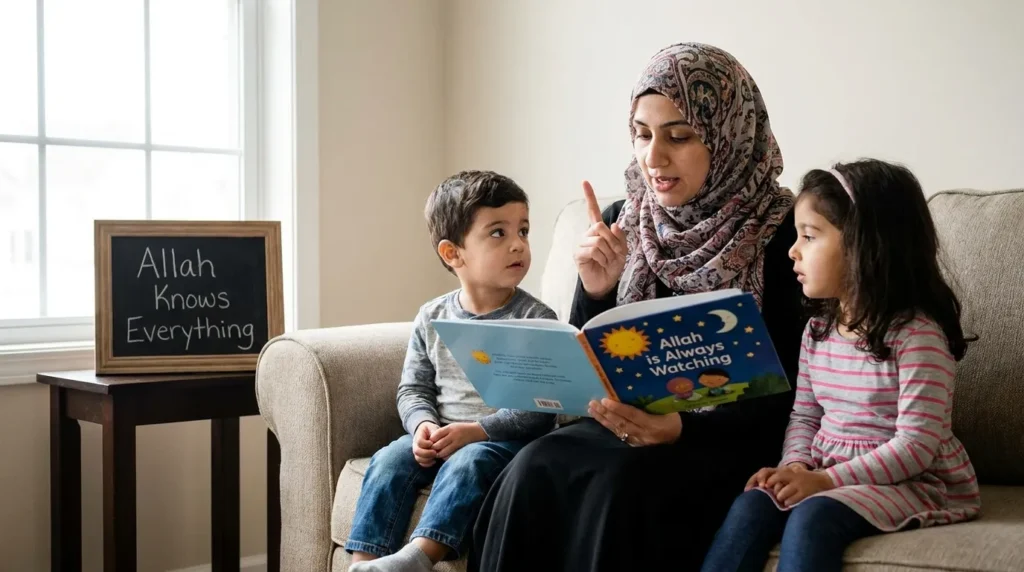
Children should not learn honesty only because parents may catch them. They should learn honesty because Allah sees them at all times. This builds taqwa, which is the real foundation of Islamic character.
We can explain this gently:
“Even when nobody sees us, Allah sees us. Allah loves when we choose truth.”
This should not be taught in a terrifying way. We are not trying to make children paranoid. We are helping them develop a conscience. A child who knows Allah sees them is more likely to become honest even when parents are not around.
We can connect honesty with the beautiful names of Allah, especially Al-Haqq, the Truth. IslamWeb’s article encourages believers to worship Allah by His name Al-Haqq and to examine their own speech, motives, and habits of truthfulness. (Islamweb) This idea can be simplified for children: Allah is the Truth, and He loves truthful hearts.
Use Quranic Guidance to Build Honesty

The Quran teaches truthfulness directly and indirectly. A powerful verse for children is:
“O you who believe, fear Allah and be with those who are truthful.”
Surah At-Tawbah 9:119
This verse teaches two important parenting lessons. First, honesty is connected to taqwa. Second, companionship matters. Children who spend time with truthful people are more likely to become truthful themselves.
Parents can use this verse in daily life. When choosing friends, stories, media, school environments, or family routines, we should ask: Does this help my child love truth? If a child is surrounded by joking lies, cheating, fake excuses, and dishonesty, truthfulness becomes harder.
Another useful Quranic reminder is that Allah knows what people hide and reveal. Children should understand that lying may fool people, but it never fools Allah. This awareness should be taught with hope: when they tell the truth and repent, Allah loves repentance.
Explain the Sin of Lying in an Age-Appropriate Way
Children need Islamic knowledge, but the explanation should match their age. A five-year-old does not need a long lecture about hypocrisy. A teenager can understand deeper religious consequences.
For young children, we can say:
“Lying makes Allah unhappy because it hides the truth. A Muslim tries to be truthful.”
For older children, we can explain that lying damages trust, weakens character, and is connected to sinful behavior. Parenting guidance on this topic recommends gently teaching older children about the religious consequences of lying, including the fact that lying is condemned in Islam and is associated with hypocrisy and immorality. (Zakeeya Ali)
The key word is gently. If we only scare children, they may hide more. If we teach with wisdom, they begin to understand.
Build a Home Where Children Feel Safe Telling the Truth
Children lie more in homes where they feel afraid, unheard, or constantly criticized. If every mistake becomes a crisis, children may choose lying as self-protection. A peaceful home does not mean there are no rules. It means children know they can tell the truth without being emotionally destroyed.
We should avoid:
- shouting immediately after every mistake
- calling children names
- comparing them with siblings
- embarrassing them in front of others
- asking trap questions when we already know the answer
- punishing honest confession the same as lying
- making children feel they are “bad” instead of correcting the action
A better approach is to stay calm and say:
“I want the truth. You may be in trouble for the mistake, but lying will make it worse. I will listen first.”
When children trust that parents will listen, they are more likely to speak honestly.
Avoid Trap Questions That Invite Lies
Sometimes parents already know what happened, but they ask in a way that pressures the child to lie.
For example, the parent sees chocolate on the child’s face and asks angrily, “Did you eat the chocolate?” The child panics and says, “No.” Now there are two problems: eating without permission and lying.
A better approach is:
“I can see you ate the chocolate. We need to talk about asking permission and telling the truth.”
This removes the trap. It teaches accountability without pushing the child into defensive lying.
When we already know the truth, we should state what we know calmly. Then we should focus on correction, repair, and honesty.
Teach Problem-Solving Instead of Excuse-Making
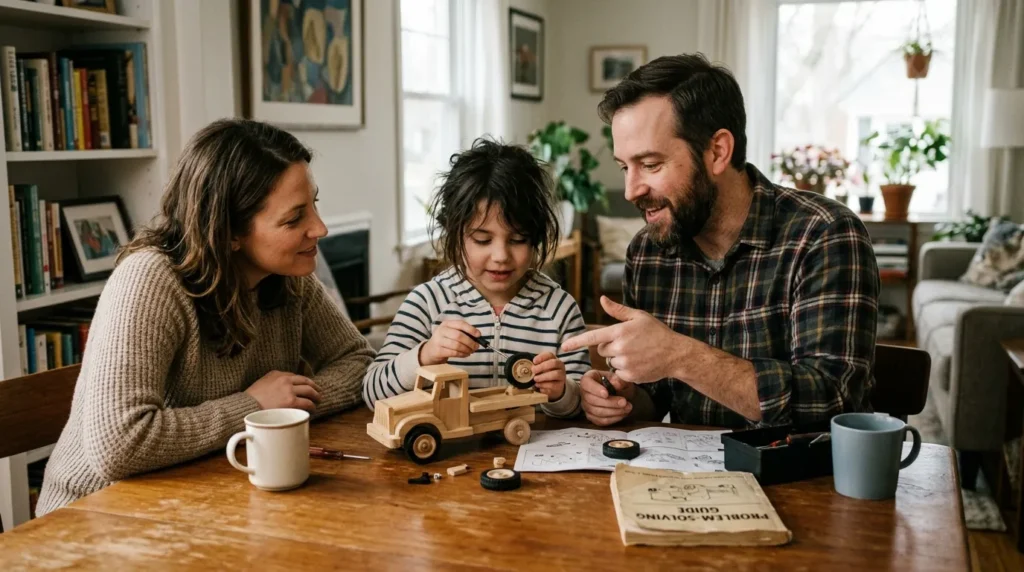
Many children lie because they do not know how to fix a problem. They spilled water, lost homework, broke a toy, forgot salah, or made a mistake at school. Instead of asking for help, they cover it with a lie.
We should teach children what to do after mistakes:
- Stop.
- Tell the truth.
- Say sorry.
- Fix what can be fixed.
- Learn what to do next time.
A helpful question is:
“What can we do to fix this?”
Parenting guidance recommends problem-solving questions because they reduce power struggles and help children focus on action instead of inventing excuses. (Zakeeya Ali)
This method teaches children that mistakes are repairable. When children believe mistakes can be repaired, they have less need to lie.
Separate Imagination From Intentional Lying
Young children often tell stories that are not true. A small child may say, “A dinosaur came into my room,” or “I flew to the moon.” This may not be sinful lying in the same way as deliberate deception. It may be imagination, storytelling, or confusion between fantasy and reality.
Parents should gently guide them:
“That is a fun story. Now tell me what really happened.”
This teaches the difference between pretend and truth. We do not need to shame a young child for imagination. But we should still train them to recognize reality.
As children grow older, they become more capable of understanding intentional lying. The response should then become firmer, especially when lying is used to harm others, avoid responsibility, or gain unfair advantage.
Correct the Lie Without Crushing the Child
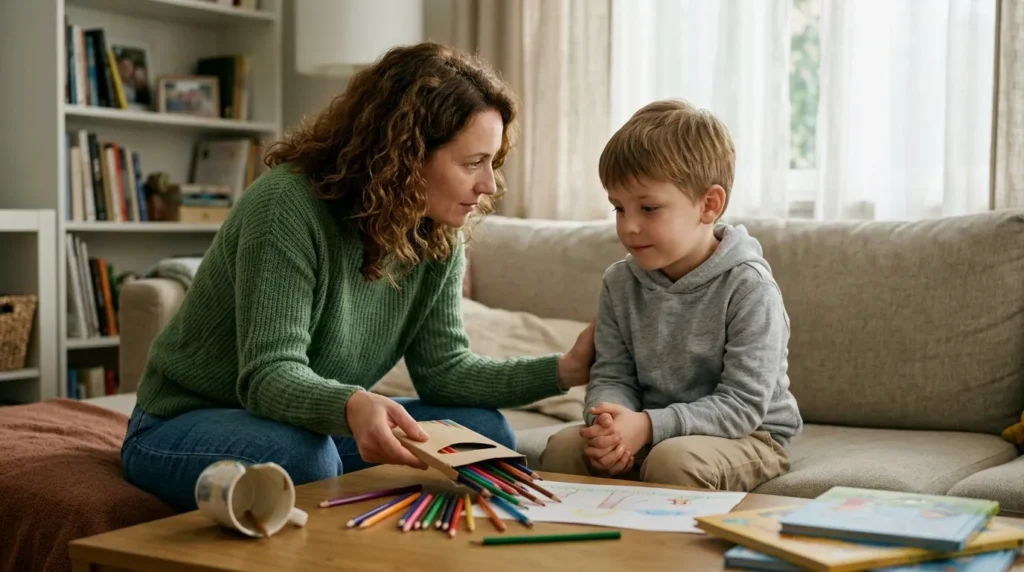
When a child lies, our words matter. We should avoid saying:
“You are a liar.”
“I can never trust you again.”
“You are becoming a bad Muslim.”
These labels can damage the child’s identity. Instead, we should say:
“You told a lie, and that is wrong. But you can correct it by telling the truth now.”
This approach separates the child from the action. The child learns that lying is wrong, but repentance and correction are possible.
Islam is a religion of repentance. We should teach children that after sin comes tawbah, repair, and improvement. A child who believes they can become better is more likely to change.
Use Fair Consequences for Repeated Lying
If lying becomes repeated, parents should apply fair consequences. Mercy does not mean ignoring the problem. If a child lies and gains something from it, the habit may grow.
Consequences should be connected to the behavior. For example:
| Lying Behavior | Fair Consequence |
|---|---|
| 📱 Lied about screen time | Reduce screen time temporarily. |
| 📚 Lied about homework | Parent checks homework daily for a period. |
| 🛠️ Lied about breaking something | Help repair, clean, or replace it if possible. |
| 👧 Lied to blame a sibling | Apologize sincerely and lose a privilege. |
| 🔁 Lied repeatedly | Trust is rebuilt through supervised responsibility. |
The consequence should teach responsibility, not revenge. We should avoid extreme punishments that create fear and more lying.
Fulfill Promises to Children
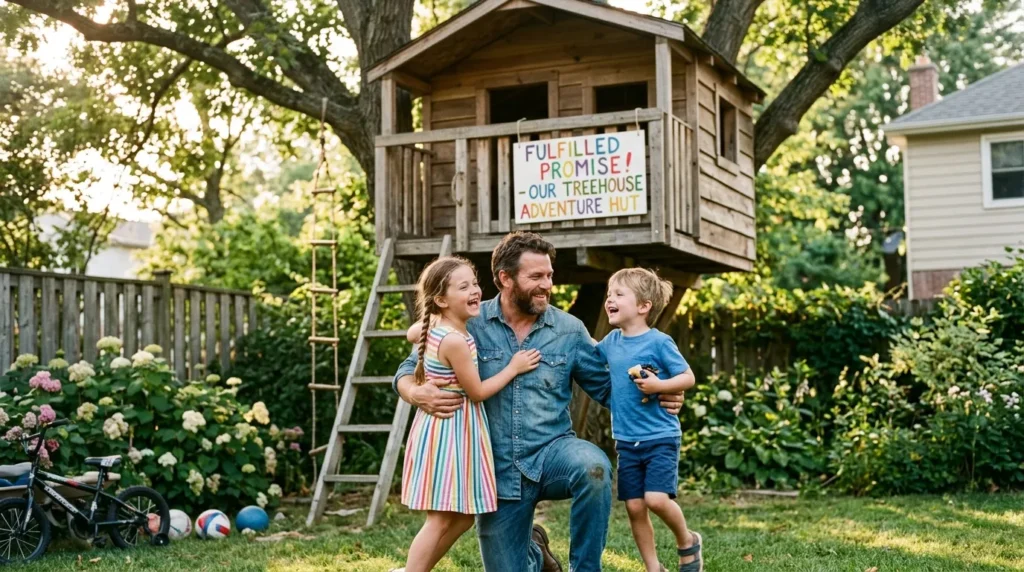
If parents frequently break promises, children may learn that words do not matter. Sometimes adults make casual promises to calm children: “I will buy it tomorrow,” “We will go next week,” “I will give you this if you stop crying.” Then they forget.
Children remember.
Islamic parenting advice strongly warns parents not to make promises they do not intend to fulfill. A child may interpret broken promises as lies, and this weakens the parent’s credibility. (Zakeeya Ali)
A better habit is to say:
“I cannot promise, but I will try.”
“I will tell you after I check.”
“No, we cannot do that today.”
Honest disappointment is better than false hope.
Treat Children Fairly to Reduce Lying
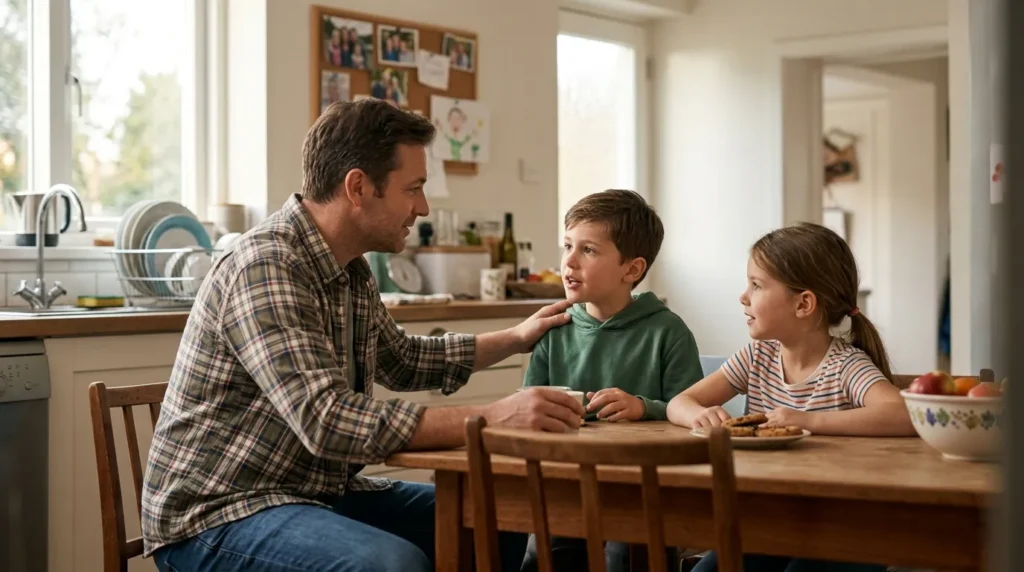
Children may lie when they feel unfairly treated. If one child is always blamed, they may lie to protect themselves. If one sibling is favored, another child may lie to get attention or avoid comparison.
Fairness is a major Islamic value. Parents should be careful in gifts, praise, discipline, affection, and listening. Zakeeya Ali’s guidance also advises parents not to favor one child over another because resentment can push children toward lying to get their needs met. (Zakeeya Ali)
Fairness does not mean identical treatment in every detail. A toddler and a teenager need different things. But every child should feel equally loved, heard, and valued.
Create a Truth-Telling Routine at Home

Honesty becomes easier when it is part of family culture. We can create small routines that make truth normal.
For example, once a day, during dinner or bedtime, we can ask:
“What is one honest thing you did today?”
“Was there a moment when truth was hard?”
“Did we make any mistakes we need to fix?”
Parents should also participate. A parent might say:
“Today I almost gave an excuse, but I chose to tell the truth.”
This shows children that truthfulness is a lifelong effort, not just a rule for kids.
IslamWeb recommends self-evaluation, or muhaasabah, as part of developing truthfulness, including reviewing speech, motives, and interactions. (Islamweb) Families can adapt this into simple child-friendly reflection.
Practical Islamic Plan to Stop Children From Lying
| Step | What Parents Should Do | Why It Works |
|---|---|---|
| 1 | Stay calm when discovering a lie | Reduces fear-based lying. |
| 2 | Identify why the child lied | Helps choose the right response. |
| 3 | Teach that Allah loves truth | Builds spiritual conscience. |
| 4 | Praise honesty when it happens | Makes truth feel safe. |
| 5 | Apply fair consequences | Teaches accountability. |
| 6 | Model honesty as parents | Children copy what they see. |
| 7 | Keep promises | Builds trust in words. |
| 8 | Teach problem-solving | Reduces excuse-making. |
| 9 | Avoid labels like “liar” | Protects the child’s identity. |
| 10 | Make dua for truthful character | Seeks Allah’s help. |
What to Say When a Child Lies
Parents often know what not to say, but they struggle with what to say. These phrases can help:
“I care more about truth than hiding mistakes.”
“You made a wrong choice, but you can fix it by telling the truth.”
“Allah loves when we are truthful, even when truth is hard.”
“I will listen calmly. Tell me what really happened.”
“Because you lied, we need to rebuild trust. Here is how we will do that.”
“Thank you for correcting yourself. That was brave.”
These words combine love, faith, and accountability.
When Lying Becomes a Serious Habit
If a child lies repeatedly, steals, manipulates, harms others, shows no remorse, or lies in serious matters, parents should take the issue more seriously. This may require more structure, less unsupervised freedom, closer school communication, counseling, or advice from a trusted Islamic teacher.
Sometimes frequent lying is connected to anxiety, harsh parenting, peer pressure, trauma, attention-seeking, or emotional disconnection. In such cases, parents should not only punish the lie; they should also address the deeper problem.
Seeking help is not shameful. Islam encourages taking beneficial means while relying on Allah.
Faqs
Q1: How to stop children from lying in Islam?
Parents should model truthfulness themselves, create emotional safety by staying calm and reducing punishment for honest confession, and teach that Allah sees everything to build inner taqwa. Identify the reason behind the lie, use age-appropriate Islamic reminders, apply fair consequences, and make regular dua for Allah to instill honesty. This seven-step approach combines Prophetic example with consistent guidance.
Q2: What does Islam say about children lying?
Islam views truthfulness as a core trait parents must develop early, based on Quran 9:119 which commands fearing Allah and staying with the truthful. The Prophet ﷺ warned against false promises to children as they teach dishonesty. Scholars emphasize correcting lies with wisdom, mercy, and patience, distinguishing imagination from deliberate deception, rather than harsh punishment or labeling.
Q3: Why do Muslim children lie and how can parents deal with it Islamically?
Children lie due to fear of punishment, seeking attention, avoiding shame, copying adults, or feeling unfairly treated. Islamically, parents must first examine their own honesty, understand the root cause, stay calm, avoid trap questions, and separate the act (“you told a lie”) from identity. Model the Prophet’s ﷺ honesty, ensure fairness at home, and connect truthfulness to Islamic values for positive change.
Q4: What Quran verses and hadith can help teach children about lying?
Key verses include Surah At-Tawbah 9:119 (be with the truthful) and Surah Al-Ahzab 33:70 (speak the truth). The Prophet ﷺ taught that truthfulness leads to righteousness and Paradise, while lying leads to the Fire. He also forbade false promises to children. Use these to show truthfulness as beloved to Allah, encouraging children positively rather than through fear.
Q5: How should Muslim parents react when their child lies?
Stay calm to avoid teaching that truth is dangerous, state facts instead of asking trap questions, listen to understand the reason, and avoid labels like “you are a liar.” Apply fair, connected consequences, acknowledge honesty shown, and turn it into a teaching moment linked to Allah’s love for truth. This Prophetic approach balances accountability with mercy.
Q6: How to raise honest children in Islam according to the Quran and Sunnah?
Build truthfulness as family culture by modeling honesty, fulfilling promises, admitting mistakes, and creating emotional safety for confession. Teach that Allah is Al-Haqq and loves truthful hearts, praise difficult honesty, equip children with honest problem-solving skills, and make regular dua. Quran and Sunnah emphasize taqwa-linked honesty and the Prophet ﷺ as the perfect example.
Q7: Is it normal for Muslim children to lie and at what age should parents be more concerned?
Yes, it is normal under age 5 as children mix imagination with reality; gently teach the difference without harsh punishment. Between 6-10, occasional lies are common but require calm correction. Be concerned if lying is frequent, harmful, remorseless, or paired with other issues despite consistent efforts—then seek help from Islamic teachers or professionals.
Conclusion
Teaching children to tell the truth in Islam requires more than saying, “Do not lie.” It requires a truthful home, honest parents, emotional safety, Islamic reminders, fair consequences, and patient training. Children must learn that truthfulness is loved by Allah, respected by people, and necessary for a peaceful heart.
When children lie, we should stay calm, understand the reason, correct the behavior, and guide them toward repair. We should not label them as liars or make honesty more painful than lying. We should model truth, keep promises, avoid trap questions, teach problem-solving, and praise truthful courage.
A truthful child is not raised in one lecture. Truthfulness is planted through daily example, watered with mercy, protected with discipline, and strengthened through dua. May Allah make our children truthful in speech, pure in heart, trustworthy in action, and firm upon the character loved by Him.