Allah Never Said the Journey Would Be Easy, But He Promised His Help to the Patient
The Journey of Life Was Never Meant to Be Without Tests
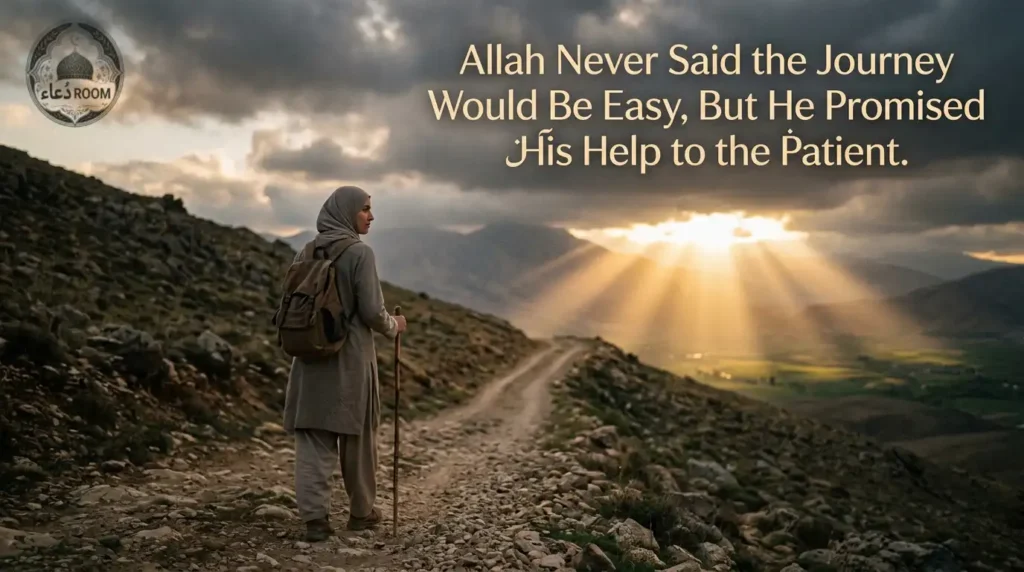
Life is not always smooth, simple, or free from pain. We pass through moments that feel heavy on the heart, confusing to the mind, and exhausting to the soul. At times, we may wonder why the road is so difficult, why our prayers seem delayed, and why patience is demanded from us again and again. Allah Never Said the Journey of life Would Be Easy,
Yet as believers, we do not see hardship as empty suffering. We see it through the light of faith. We understand that Allah does not abandon His servants in their struggles. The path may be difficult, but the mercy of Allah is greater than every difficulty. The burden may feel heavy, but Allah knows the strength He has placed within us.
The powerful reminder, “Allah never said the journey would be easy, but He said He would be with those who are patient,” reflects a deep Islamic truth: ease is not always the absence of hardship; sometimes ease is the presence of Allah’s help within hardship.
“So, surely with hardship comes ease. Surely with that hardship comes more ease.” (Quran.com)
This verse teaches us that hardship and ease are not always separate chapters. Sometimes they arrive together. While the trial is still present, Allah opens doors of strength, guidance, patience, forgiveness, and inner peace.
The Meaning of “Allah Never Said the Journey Would Be Easy”
The phrase does not mean that life will only be painful. It means that we should not expect this world to be a place of permanent comfort. The dunya is a place of tests, choices, growth, worship, and return to Allah.
We are tested through delay, loss, illness, fear, family problems, financial stress, emotional pain, and unanswered questions. But every test comes with divine wisdom. Allah sees what we cannot see. Allah knows what we cannot understand. Allah plans what we cannot imagine.
When we say, “Allah never said the journey would be easy,” we are reminding ourselves that struggle is part of the believer’s path. When we say, “but He is with the patient,” we are reminding ourselves that no hardship is faced alone when the heart remains connected to Allah.
Allah says:
“Allah does not require of any soul more than what it can afford.” (Quran.com)
This verse gives us comfort. It does not mean we will never feel weak. It means Allah knows our capacity better than we know ourselves. Even when we feel broken, Allah can place strength in our hearts that we did not know existed.
Allah Is With Those Who Are Patient
Patience in Islam is not weakness. It is spiritual strength. It is the ability to remain faithful when life becomes painful. It is the courage to obey Allah when the nafs wants to give up. It is the discipline to avoid sin when emotions become intense.
Patience means we continue making dua even when the answer is delayed. We continue praying even when our heart is tired. We continue trusting Allah even when the outcome is unclear. We continue doing what is right even when life feels unfair.
The Qur’an repeatedly connects patience with Allah’s help, mercy, and reward. A believer does not practice patience because the pain is small. A believer practices patience because Allah is greater than the pain.
Patience does not always remove the trial immediately, but it changes the believer during the trial. It protects the tongue from complaint, the heart from despair, and the soul from losing hope in Allah.
With Hardship Comes Ease: The Promise of Relief

One of the most comforting verses in the Qur’an is found in Surah Ash-Sharh:
“So, surely with hardship comes ease.” (Quran.com)
Allah does not say that ease comes only after hardship. The wording teaches us that ease can exist with hardship. This means even inside pain, there may be hidden mercy.
We may lose something, but gain closeness to Allah. We may be delayed from one path, but protected from harm. We may feel rejected by people, but invited toward deeper reliance on our Creator. We may cry in private, but those tears may become a reason for forgiveness, purification, and elevation.
Hardship is not always punishment. Sometimes hardship is protection. Sometimes it is purification. Sometimes it is preparation. Sometimes it is a redirection toward something better.
Why Allah Tests the People He Loves

Tests reveal what is inside the heart. They expose our dependence, our sincerity, our patience, and our trust. When life is easy, many people speak about faith. When life becomes difficult, true faith begins to show.
A test can bring a person back to prayer. A test can soften arrogance. A test can remove attachment to the dunya. A test can teach gratitude. A test can make us call upon Allah with honesty that we never had before.
We often ask Allah for strength, but strength is built through difficulty. We ask Allah for patience, but patience is developed through waiting. We ask Allah for closeness, but closeness often grows when we have nowhere else to turn except Him.
This is why the believer’s hardship is never wasted. The Prophet Muhammad ﷺ taught that the affair of the believer is amazing because every condition can become good: when blessed, the believer is grateful; when tested, the believer is patient. (Sunnah)
The Difference Between Patience and Giving Up

Patience does not mean doing nothing. Patience does not mean accepting injustice silently when action is possible. Patience does not mean abandoning effort, planning, treatment, work, or responsibility.
True patience includes three things:
- Patience in obeying Allah
We continue praying, making dua, staying honest, and fulfilling our duties. - Patience in avoiding sin
We do not allow pain to push us into haram, bitterness, revenge, or hopelessness. - Patience during Allah’s decree
We accept what has happened while still seeking halal solutions and trusting Allah’s wisdom.
Patience is active. It is faith in motion. It is not surrendering to despair; it is surrendering to Allah.
When the Journey Feels Too Heavy

There are moments when even the strongest believer feels tired. We may feel emotionally drained, spiritually weak, or mentally overwhelmed. In those moments, we should not think that weakness means failure.
Even prophets faced grief, fear, loneliness, and rejection. Their hearts were tested, but they remained connected to Allah. We are not expected to be emotionless. We are expected to return to Allah with our emotions.
When the journey feels too heavy, we should slow down and return to the foundations:
- Pray even if our concentration is weak.
- Make dua even if our words are simple.
- Read Qur’an even if only a few verses.
- Seek forgiveness even if we feel distant.
- Speak to Allah honestly in sujood.
- Take halal means to solve the problem.
- Stay close to righteous people.
- Avoid isolation that increases despair.
Allah does not ask us to carry tomorrow’s burden today. We are responsible for the step in front of us. One prayer. One dua. One act of patience. One moment of trust.
Trusting Allah When We Do Not Understand His Plan

One of the hardest parts of faith is trusting Allah when life does not make sense. We may ask: Why this delay? Why this loss? Why this pain? Why this closed door?
But our understanding is limited. We see one page; Allah knows the entire book. We see the present; Allah knows the future. We see the pain; Allah knows the wisdom hidden inside it.
A closed door may be mercy. A delayed dua may be protection. A painful ending may be the beginning of a better path. A broken plan may be saving us from a greater harm.
Trusting Allah means we believe that His knowledge is perfect even when our understanding is incomplete.
The Role of Dua During Difficult Times

Dua is not only a request; it is a relationship. When we raise our hands, we are admitting that we need Allah. We are returning our worries to the One who controls every outcome.
In hardship, dua becomes more sincere. The heart becomes softer. The words become deeper. The servant realizes that no person, position, money, or plan can replace Allah’s help.
We should ask Allah for ease, but we should also ask Him for patience, wisdom, strength, forgiveness, and a good ending. Sometimes we ask only for the trial to end, but Allah gives us something greater: a heart that becomes closer to Him.
A beautiful dua from the end of Surah Al-Baqarah includes asking Allah for pardon, forgiveness, mercy, protection, and help. (Quran.com) This teaches us that in difficulty, we should not only seek relief from the burden; we should seek closeness to the One who removes burdens.
How Patience Changes the Heart

Patience polishes the heart. It teaches humility. It removes the illusion that we control everything. It reminds us that every blessing is from Allah and every solution comes by His permission.
A patient heart becomes less reactive. It complains less to people and speaks more to Allah. It stops measuring life only by worldly success and starts measuring success by faith, sincerity, and obedience.
Through patience, we learn that peace does not always come from changed circumstances. Sometimes peace comes from a changed heart.
When Allah gives a believer patience, He gives a form of strength that no worldly possession can replace.
Practical Ways We Can Stay Patient During Hardship

1. We Remember That Allah Knows Our Pain
No tear is hidden from Allah. No silent dua is ignored. No private struggle is unseen. Even when people misunderstand us, Allah knows the full truth.
2. We Stop Comparing Our Journey With Others
Every person is tested differently. Some are tested with poverty, others with wealth. Some with loneliness, others with family. Some with delay, others with responsibility. Comparison weakens gratitude and increases sadness.
3. We Keep Our Tongue Moist With Dhikr
Dhikr brings calm to the heart. Saying Alhamdulillah, Astaghfirullah, SubhanAllah, and HasbunAllahu wa ni‘mal wakeel reminds us that Allah is near and in control.
4. We Take Halal Action
Patience does not cancel effort. We seek treatment, apply for work, repair relationships, ask for advice, and take responsible steps while trusting Allah for the result.
5. We Protect Our Prayer
Salah is the believer’s anchor. When life shakes us, prayer holds us. Even if we feel distracted, we keep showing up before Allah.
6. We Believe Relief Can Arrive Suddenly
Allah can change a situation in a moment. A door that seemed permanently closed can open by His command. A heart that felt heavy can become light. A problem that looked impossible can be solved.
From Hardship to Stronger Faith
A peaceful reminder that every hardship can become a path toward sabr, dua, trust, growth, and deeper reliance on Allah.
Hardship Begins
A test, difficulty, loss, delay, or confusion enters life.
Heart Feels Pain and Confusion
The heart feels heavy, worried, and unsure about what will happen next.
Return to Allah Through Salah and Dua
Turn back to Allah with prayer, sincere dua, repentance, and hope.
Practice Sabr and Avoid Despair
Stay patient, control negative thoughts, and do not lose hope in Allah’s mercy.
Take Halal Action and Seek Wise Help
Make effort through permissible means and take advice from sincere, wise people.
Trust Allah’s Timing and Wisdom
Believe that Allah knows what is best, even when the reason is not clear yet.
Ease, Growth, Forgiveness, or Redirection
The hardship may bring relief, maturity, forgiveness, protection, or a better direction.
Stronger Faith and Deeper Reliance on Allah
The believer becomes stronger, calmer, wiser, and more connected to Allah.
Lessons From the Reminder: The Journey May Be Hard, But Allah Is Near
This reminder teaches us several important lessons.
First, hardship is part of life, not proof that Allah has abandoned us. Second, patience is not passive weakness; it is active faith. Third, Allah’s help may come in ways we do not expect. Fourth, ease may be hidden inside the hardship itself. Fifth, the believer’s final success is not only comfort in this world, but closeness to Allah and success in the Hereafter.
We should not judge Allah’s love by the ease of our circumstances. Many people have comfort but no peace. Many people have wealth but no contentment. Many people have success but no guidance. The greatest blessing is not a problem-free life; it is a heart that remains connected to Allah in every condition.
“Allah Does Not Burden a Soul Beyond What It Can Bear”
This Qur’anic reminder gives hope to every tired heart. Allah knows the weight of our test. Allah knows our emotional limits, our hidden wounds, our fears, and our strength.
When the burden feels too much, we should remember that Allah is not unjust. He is Ar-Rahman, the Most Merciful. He is Al-Lateef, the Most Subtle. He is Al-Wakeel, the Best Disposer of affairs.
We may not understand why we are facing a certain test, but we can be certain that Allah’s knowledge is perfect and His mercy is vast.
The believer does not say, “I can handle this alone.” The believer says, “I cannot handle anything without Allah, and with Allah’s help, I can continue.”
A Message to the Tired Heart
To the heart that feels exhausted: Allah has not forgotten you.
To the soul that feels alone: Allah knows where you are.
To the person waiting for relief: Allah’s timing is never late.
To the one crying in silence: your tears are seen by the Most Merciful.
To the one struggling to stay patient: every moment of sincere patience is known to Allah.
The road may be long, but Allah is near. The test may be painful, but Allah is wise. The night may feel dark, but dawn comes by the command of Allah.
Do not let one difficult chapter make you forget the mercy of the One who wrote your entire story.
FAQs
1. What does “Allah never said the journey would be easy” mean?
It means life in this world is a place of tests, growth, worship, and return to Allah. The journey may include pain, delay, loss, and confusion, but Allah’s help, mercy, and wisdom are always with the patient believer.
2. Does Islam teach that hardship is part of life?
Yes, Islam teaches that hardship is part of the believer’s journey. Tests can come through fear, loss, illness, financial stress, emotional pain, and delayed duas, but no hardship is meaningless when faced with faith and patience.
3. What does the Qur’an say about hardship and ease?
The Qur’an reminds us: “Surely with hardship comes ease.” This teaches that ease may come after hardship, and sometimes Allah places ease, strength, patience, and guidance within the hardship itself.
4. How can a believer stay patient during difficult times?
A believer can stay patient by praying regularly, making dua, remembering Allah through dhikr, avoiding despair, taking halal action, seeking wise help, and trusting Allah’s timing.
5. Does patience mean doing nothing?
No, patience does not mean giving up or doing nothing. True patience means continuing to obey Allah, avoiding haram, taking responsible halal steps, and trusting Allah for the final result.
6. Why does Allah test the people He loves?
Tests can purify the heart, strengthen faith, remove sins, increase humility, and bring a person closer to Allah. A hardship may be protection, preparation, purification, or redirection toward something better.
7. How does dua help during hardship?
Dua connects the heart to Allah. It is not only a request for relief, but also a way to seek strength, patience, forgiveness, wisdom, mercy, and a good ending.
8. Can Allah change a difficult situation suddenly?
Yes, Allah can change any situation in a moment. A closed door can open, a heavy heart can become light, and a problem that seems impossible can be solved by Allah’s command.
9. What should I do when life feels too heavy?
Return to the basics: pray even with weak concentration, make simple duas, read a few verses of Qur’an, seek forgiveness, speak to Allah in sujood, take halal action, and stay close to righteous people.
10. What is the main lesson of this Islamic reminder?
The main lesson is that life may not always be easy, but Allah never abandons the patient believer. With faith, dua, sabr, and trust in Allah, every hardship can become a path toward stronger faith and deeper reliance on Him.
Conclusion: The Journey Is Difficult, But the Destination Is With Allah
Allah never promised that life would be easy. He promised guidance, mercy, help, reward, and nearness for those who believe, trust, and remain patient.
The journey may include tears, delays, losses, and unanswered questions. But it also includes hidden blessings, spiritual growth, forgiven sins, stronger faith, and moments of divine relief.
We do not walk through hardship as people without hope. We walk with faith. We walk with dua. We walk with patience. We walk knowing that Allah is with those who remain steadfast.
The road may not always be easy, but with Allah, it is never meaningless.