Better Husband and Wife Relationship in Islam
A better husband and wife relationship in Islam begins with the understanding that marriage is not only a legal contract, romantic bond, or family arrangement. It is a sacred relationship built on sakinah, mawaddah, and rahmah: tranquility, love, and mercy. Islam does not treat marriage as a battlefield where one spouse must dominate the other. It teaches that husband and wife should become a source of comfort, protection, dignity, and spiritual support for one another.
The Quran describes marriage as one of Allah’s signs, saying that He created spouses so that they may find tranquility in one another and placed love and mercy between them. AboutIslam explains that this verse establishes the ideal relationship between spouses: mutual support, mutual comfort, and mutual protection. (About Islam) A marriage that follows this Quranic model does not depend only on feelings. It depends on faith, character, patience, responsibility, forgiveness, and daily effort.
A strong Muslim marriage is not perfect every day. Husband and wife may disagree, feel tired, misunderstand each other, or face pressure from money, children, relatives, work, and personal struggles. But Islam gives us a roadmap. It teaches us to speak with kindness, fulfill rights, forgive mistakes, protect privacy, consult each other, avoid oppression, and return to Allah when the heart becomes hard.
The Islamic Foundation of a Strong Marriage
Islamic marriage is founded on rights, responsibilities, mercy, and accountability before Allah. A husband is not free to treat his wife harshly because he has authority. A wife is not free to neglect her responsibilities because marriage requires cooperation. Both spouses must remember that Allah sees how they speak, how they behave in private, and how they handle conflict when no one else is watching.
SoundVision summarizes the spirit of a good Muslim marriage with a simple principle: treat your spouse the way you would like to be treated. It also lists qualities such as patience, kindness, humility, sacrifice, empathy, love, understanding, forgiveness, and hard work as essential for a better husband and wife relationship. (SoundVision.com) This principle is powerful because it turns marriage from a list of demands into a practice of character.
A husband and wife should ask themselves regularly: Would I be happy if my spouse spoke to me the way I speak to them? Would I feel loved if my spouse treated my feelings the way I treat theirs? Would I feel safe if my spouse used my mistakes against me the way I use theirs? These questions expose the truth of our character. Many marriages improve when both spouses stop asking only, “What am I getting?” and start asking, “What am I giving for the sake of Allah?”
Quranic Guidance for Husband and Wife Relationship
The Quran gives beautiful and practical guidance for married life. One of the most famous verses says:
“They are clothing for you and you are clothing for them.”
Surah Al-Baqarah 2:187
This verse teaches that husband and wife should protect, cover, beautify, and comfort one another. Clothing stays close to the body, covers faults, gives warmth, and protects from harm. In the same way, spouses should not expose each other’s private matters, mock each other’s weaknesses, or use personal secrets as weapons during arguments.
The Quran also states that wives have rights similar to their obligations in a fair manner. AboutIslam notes that Islam treats marriage as a bilateral contract in which both husband and wife have rights and obligations, citing Surah Al-Baqarah 2:228. (About Islam) This means marriage is not one-sided. A peaceful home requires both spouses to fulfill responsibilities with justice and ihsan.
MyIslam’s Quran verse collections also show how often the Quran discusses marriage, wives, love, and family responsibilities, gathering many verses related to wife and spouse themes. (My Islam) These verses remind us that marriage is not outside religion. It is part of worship, morality, and social stability.
How Should a Husband Treat His Wife in Islam?
A husband should treat his wife with compassion, respect, justice, protection, emotional care, and kindness. He should not see her as an outsider after marriage. She becomes his family, his companion, his amanah, and the mother of his children if Allah grants them children. A husband who worries only about his parents, siblings, or outside responsibilities while emotionally neglecting his wife has misunderstood the balance Islam requires.
IslamQA explains that a husband must treat his wife kindly, spend on her according to his means, protect her rights, and live with her honorably. (Islam-QA) AboutIslam also emphasizes that a husband must treat his wife with compassion, respect, and justice, and that marriage should be based on tranquility, love, and mercy. (About Islam) These principles are not optional decorations. They are part of Islamic responsibility.
A good husband does not measure his success only by income. Provision matters, but emotional safety also matters. A wife needs kind words, time, attention, protection from humiliation, and reassurance that she is valued. A husband who provides money but constantly insults, ignores, threatens, or belittles his wife is not fulfilling the Prophetic model of good character.
Practical Ways a Husband Can Improve the Relationship
| Area | Islamic Practice |
|---|---|
| Speech | Speak gently and avoid insults |
| Time | Spend meaningful time with wife |
| Provision | Provide according to ability |
| Protection | Protect her dignity and privacy |
| Emotions | Care about her feelings |
| Conflict | Resolve issues without humiliation |
| Faith | Help her grow spiritually |
| Family Balance | Respect parents without neglecting wife |
A husband should remember that leadership in Islam is not tyranny. It is responsibility. The stronger spouse is not the one who shouts louder; it is the one who controls anger for Allah.
How Should a Wife Treat Her Husband in Islam?
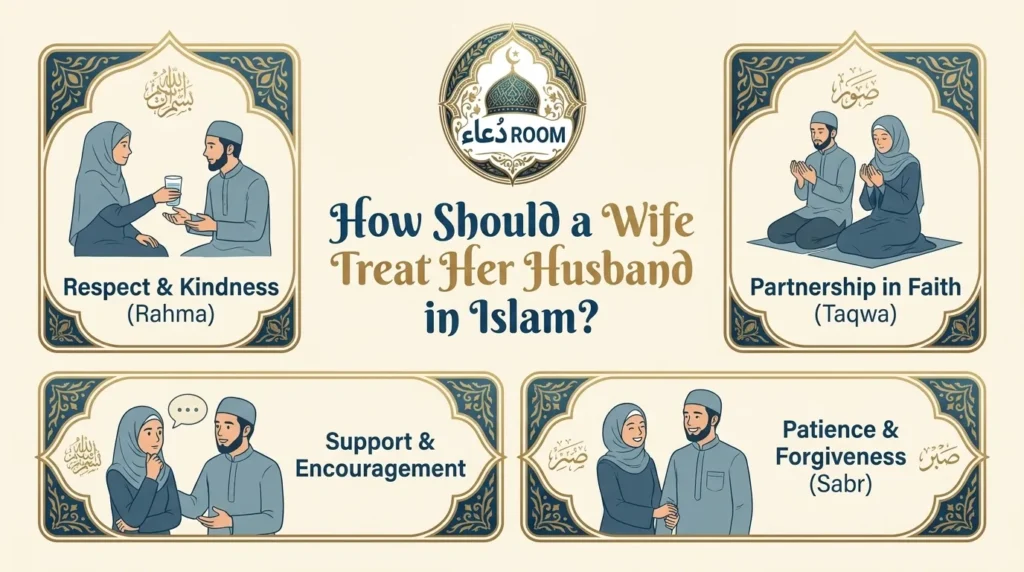
A wife should treat her husband with respect, kindness, loyalty, cooperation, honesty, and sincere advice. She should help create peace in the home, guard the private matters of the marriage, support good decisions, and remind her husband of Allah with wisdom. A righteous wife is not silent in the face of wrong, but she chooses the right time, tone, and method when giving advice.
Islamic marriage is not built on humiliation from either side. Just as a husband must not belittle his wife, a wife should not mock, insult, expose, or constantly compare her husband. Respect is a two-way road. When husband and wife both protect each other’s dignity, emotional trust grows.
A wife’s role is not limited to housework, and her value is not reduced to service. AboutIslam notes that Islamic marriage is a bilateral relationship with rights and obligations for both spouses. (About Islam) This balance matters because a healthy marriage does not treat either spouse as a machine. Both are human beings with emotions, fatigue, hopes, weaknesses, and rights.
A wife can strengthen the marriage by appreciating halal efforts, communicating needs clearly, avoiding unnecessary criticism, encouraging worship, and keeping the home emotionally safe. When both husband and wife serve each other for Allah’s sake, ordinary daily tasks become acts of worship.
Communication: The Heart of a Better Husband and Wife Relationship
Many marriages suffer not because the couple does not love each other, but because they do not know how to communicate. They speak when angry, stay silent when they should explain, criticize instead of requesting, and listen only to reply. Islam teaches dignity in speech, and that principle must begin at home.
SoundVision warns that couples are often more courteous to strangers than they are to their loved ones, and advises spouses to be careful not to hurt each other’s feelings and to apologize quickly when they do. (SoundVision.com) This is a simple but powerful marriage rule. If we can control our tone with a guest, boss, customer, or neighbor, we can control it with our spouse.
Good communication means saying what we need without attacking. Instead of saying, “You never care about me,” we can say, “I feel lonely when we do not spend time together.” Instead of saying, “You are irresponsible,” we can say, “I need us to plan this responsibility together.” The first style creates defense. The second style opens a door.
Healthy Communication Habits
- Speak when calm, not when anger is burning.
- Use respectful words even during disagreement.
- Listen fully before answering.
- Avoid sarcasm, mockery, and name-calling.
- Do not bring up old mistakes in every argument.
- Apologize quickly when wrong.
- Discuss problems privately, not in front of children or relatives.
Good communication does not mean every discussion becomes easy. It means both spouses feel safe enough to speak and mature enough to listen.
Love and Mercy: The Quranic Formula for Marriage
A marriage cannot survive on rules alone. It needs mercy. Love may begin with attraction and affection, but mercy keeps the relationship alive when life becomes difficult. There will be days when one spouse is tired, sick, stressed, pregnant, grieving, unemployed, overwhelmed, or emotionally weak. Mercy is what keeps the other spouse from becoming cruel during those moments.
AboutIslam highlights that tranquility, love, and mercy summarize the ideals of Islamic marriage. (About Islam) This means a Muslim marriage should not become a place of fear. A wife should not fear her husband’s anger every day. A husband should not fear constant humiliation. Children should not grow up watching marriage as a war zone.
Mercy means we correct without destroying. It means we forgive human mistakes. It means we remember good qualities during bad moments. It means we ask, “Is my response bringing us closer to Allah or closer to Shaytan?”
A powerful habit for spouses is to make dua for each other instead of only complaining about each other. A husband can ask Allah to bless his wife, soften her heart, and increase love between them. A wife can ask Allah to guide her husband, protect him, and make him a source of peace. Dua changes the way we see each other.
Trust and Honesty Between Husband and Wife

Trust is one of the strongest pillars of marriage. Without trust, love becomes anxious. A spouse who constantly lies, hides, manipulates, or breaks promises damages emotional safety. Islam values truthfulness, and truthfulness must begin in the home.
SoundVision’s guidance on building trust states clearly that spouses should never lie to each other and should have zero tolerance for lies, whether big or small, in the family. (SoundVision.com) This is important because “small lies” often become the cracks through which bigger doubts enter.
Trust is built by consistency. If a husband says he will do something, he should try to do it. If a wife promises something, she should honor it. If plans change, spouses should communicate honestly. Hidden spending, secret conversations, emotional affairs, online deception, and false excuses can deeply damage a marriage.
Trust also means protecting secrets. A spouse should not expose private marital issues to friends, social media, or relatives just to win sympathy. Seeking genuine help from a qualified scholar, counselor, or trusted elder is different from spreading private matters. The first seeks repair; the second often increases harm.
Appreciation: A Simple Habit That Saves Marriages
Many spouses feel unloved not because their partner does nothing, but because their efforts are never noticed. A husband works hard, but hears only complaints. A wife cares for the home, children, emotions, and daily responsibilities, but hears only criticism. Over time, lack of appreciation creates resentment.
SoundVision recommends thanking your spouse because they care, not merely because “it’s their job.” It gives examples such as appreciating chores, groceries, feeding the baby, or taking out garbage as signs of care and thoughtfulness. (SoundVision.com) This advice may look small, but small daily appreciation can soften a marriage.
A husband can say, “Jazakillah khair for taking care of the house today.” A wife can say, “JazakAllah khair for working hard for us.” These words cost nothing, but they nourish the heart. Appreciation teaches the spouse that their effort is seen.
Simple Appreciation Phrases
| Instead of Silence | Say This |
|---|---|
| After a meal | “Jazakillah khair, this was thoughtful.” |
| After work | “I appreciate how hard you try for us.” |
| After childcare | “Thank you for taking care of the children.” |
| After emotional support | “Your words helped me today.” |
| After a small favor | “I noticed that. May Allah reward you.” |
Gratitude is not weakness. It is Islamic character.
Spiritual Growth as a Couple
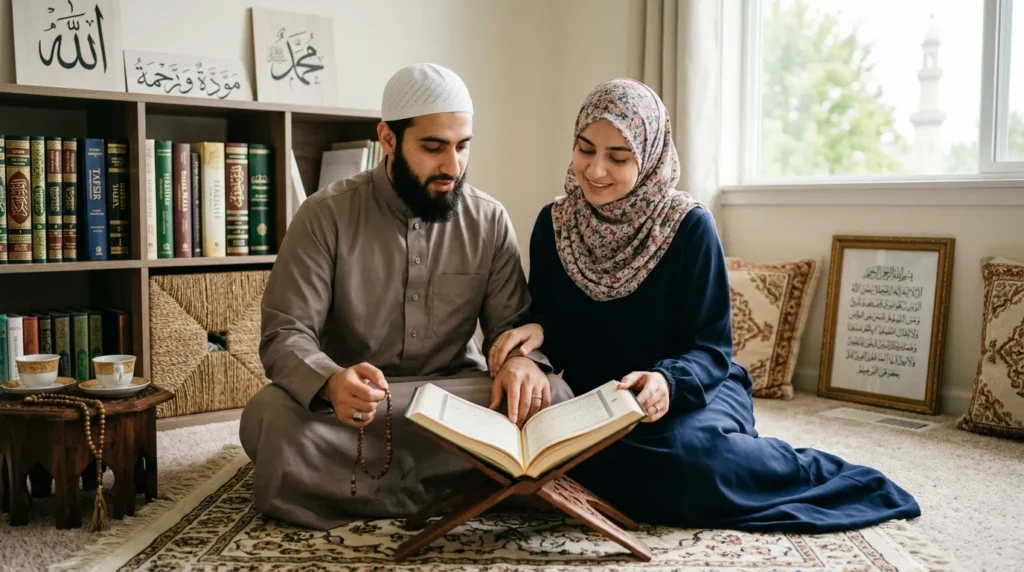
A better husband and wife relationship in Islam is not only about romance, money, chores, and communication. It is also about helping each other reach Allah. A righteous spouse is one who makes worship easier, not harder.
SoundVision suggests simple ways to boost a spouse’s spirituality, such as reminding them about prayer, sharing spiritual time, and bringing remembrance of Allah into everyday communication. (SoundVision.com) This does not mean one spouse should act superior or constantly lecture the other. Spiritual reminders must be gentle, loving, and humble.
A couple can pray together, read Quran together, attend Islamic classes, remind each other of salah, give charity together, fast together, and make dua together. Even a short reminder like “It is Maghrib; let us pray first” can bring barakah into the relationship.
When both spouses are connected to Allah, they are more likely to forgive, control anger, avoid haram, and fulfill rights. A marriage with Allah at the center has a stronger foundation than a marriage based only on emotion.
Handling Conflict Without Destroying the Relationship
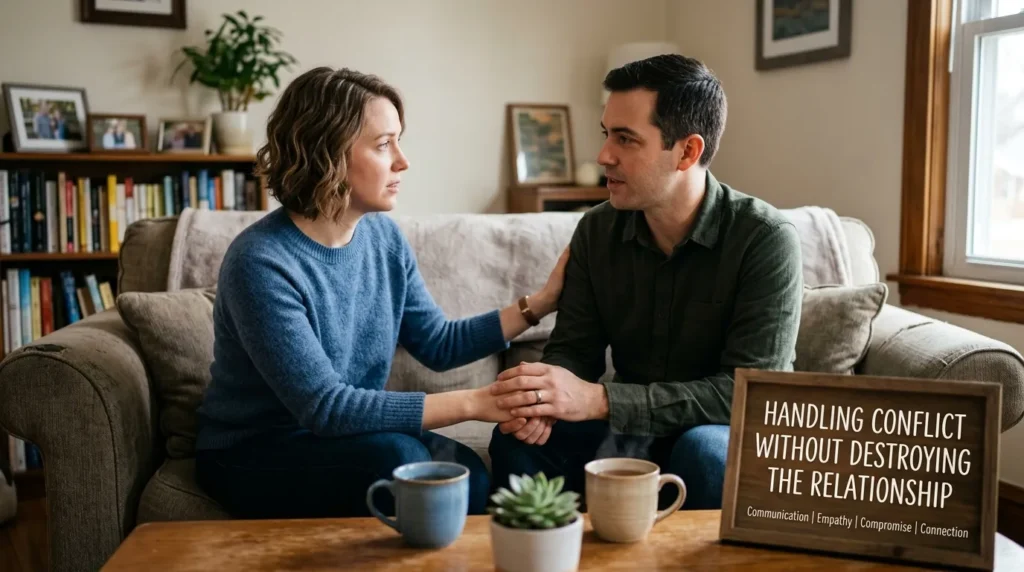
Every marriage has conflict. The goal is not to avoid every disagreement. The goal is to disagree without oppression, humiliation, or emotional damage. Many couples do not separate because of one argument; they break down because of repeated disrespect during arguments.
Islam teaches justice even when emotions are high. A husband should not use anger as an excuse to threaten divorce repeatedly, insult his wife’s family, or scare her. A wife should not use anger as an excuse to expose private matters, curse, or attack her husband’s dignity.
AboutIslam states that Islam prohibits physical and emotional abuse and requires spouses to treat each other with love and mercy. (About Islam) This matters because some people wrongly use religion to excuse harm. Abuse is not Islamic leadership. Cruelty is not discipline. Humiliation is not correction.
Conflict Rules for Muslim Couples
- Do not insult.
- Do not threaten divorce casually.
- Do not involve relatives in every small issue.
- Do not argue in front of children.
- Do not expose secrets.
- Do not use past mistakes as weapons.
- Pause when anger becomes too high.
- Return to the issue when both can speak calmly.
A marriage becomes safer when both spouses know that disagreement will not become destruction.
Balancing Parents, In-Laws, and Spouse Rights
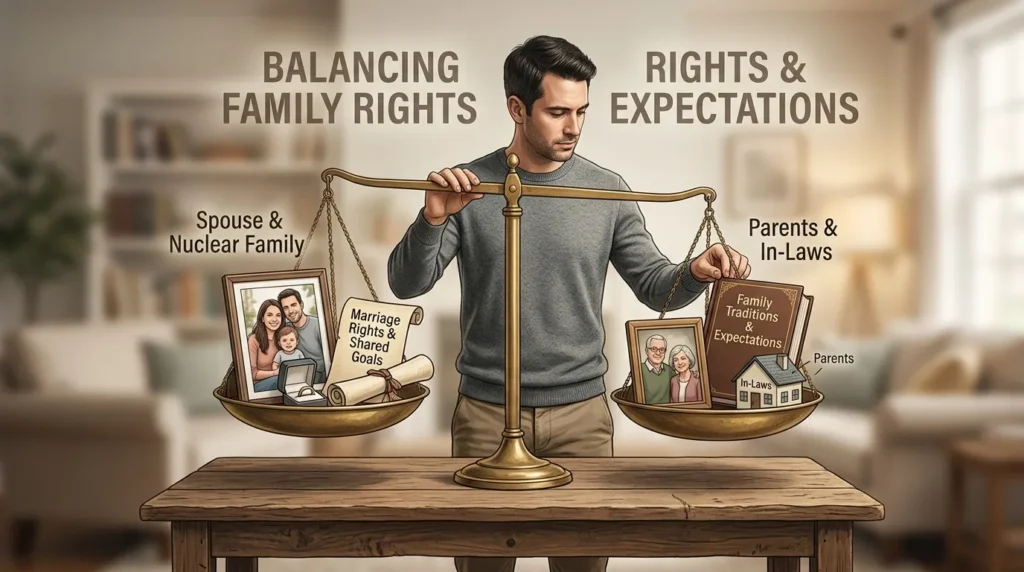
One common reason for marital tension is imbalance between spouse and extended family. Islam commands kindness to parents, but it also gives the spouse rights. A husband should honor his parents, but he should not neglect his wife or allow injustice against her. A wife should respect her husband’s family, but she should not be expected to tolerate humiliation or unfair treatment.
The question in the IslamQA reference specifically mentions a wife feeling that her husband cares only about his parents and sisters while not treating her as family. IslamQA responds by explaining the husband’s duties toward his wife, including kind treatment and care. (Islam-QA) This is a common real-life issue. Many marriages suffer when one spouse feels like an outsider.
A balanced husband protects his wife’s rights while maintaining kindness to parents. A balanced wife supports her husband’s family ties while communicating her own needs respectfully. The solution is not to compete for love. The solution is justice, boundaries, and wisdom.
A spouse should never be forced into emotional neglect in the name of family duty. Islam does not teach injustice under the cover of obedience.
Housework, Responsibility, and Fair Cooperation
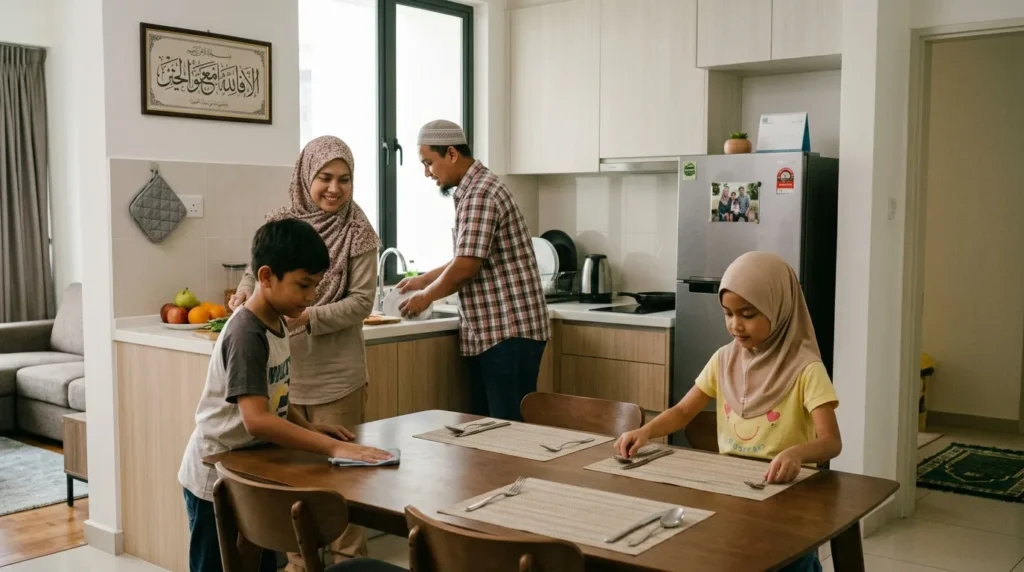
Housework is another common area of conflict. Some couples argue over cooking, cleaning, childcare, shopping, finances, and emotional labor. Islam recognizes marriage as a relationship of rights and obligations, but successful couples often go beyond minimum legal duties and practice ihsan.
AboutIslam explains that Islamic marriage is a bilateral contract and that each spouse has rights and obligations. (About Islam) In real life, cooperation is essential. A husband who helps at home is not losing status. A wife who appreciates his effort is not lowering herself. Both are practicing mercy.
The Prophet ﷺ helped his family, and this example should soften the attitude of Muslim husbands who think domestic contribution is beneath them. At the same time, spouses should discuss responsibilities clearly instead of assuming the other person understands everything.
A practical approach is to ask: What needs to be done? Who has capacity? What is fair in our situation? A couple with young children, illness, pregnancy, work stress, or financial hardship may need a different arrangement than another couple. Fairness requires context.
Emotional Care in Marriage
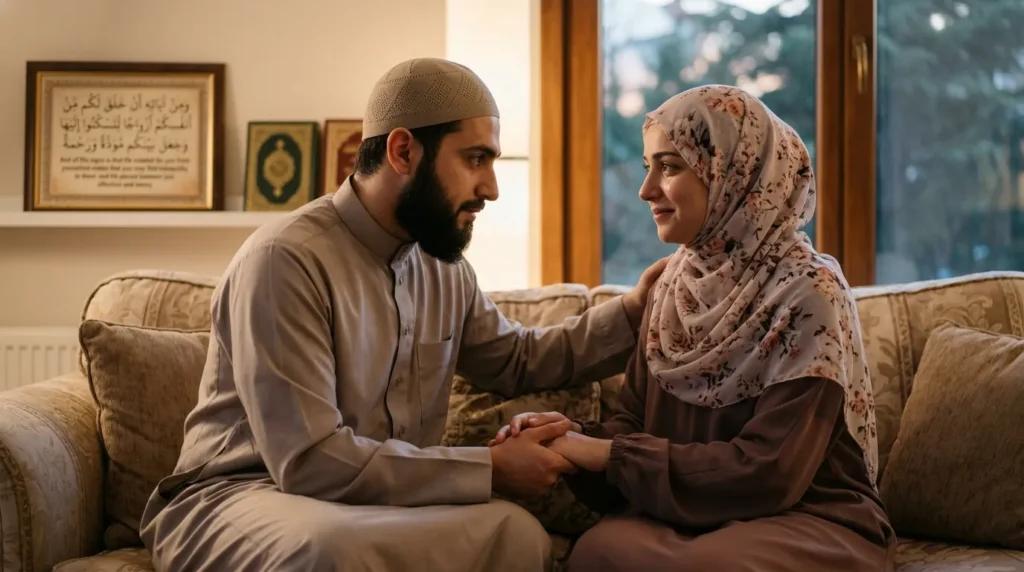
Emotional care is not a luxury. It is part of living together honorably. A spouse may have food, clothing, and shelter but still feel lonely, unseen, or unloved. Islam values feelings because the Prophet ﷺ showed deep emotional intelligence with his family.
AboutIslam’s guidance on caring for a wife’s feelings states that a Muslim husband should be thoughtful, caring, and respectful toward his wife’s feelings and should not treat her scornfully. (About Islam) This applies both ways. A wife should also care about her husband’s emotional state, stress, dignity, and need for respect.
Emotional care includes asking how the other person feels, noticing tiredness, giving reassurance, apologizing when hurtful, and spending meaningful time together. It also means not dismissing concerns with phrases like “You are too sensitive” or “You always complain.”
A spouse who feels emotionally safe becomes more open, loving, and cooperative. A spouse who feels constantly dismissed may become distant.
Practical Daily Habits for a Better Marriage
A strong marriage is not built only during vacations, anniversaries, or major life events. It is built in daily habits. Small actions repeated over time create either love or resentment.
Daily Marriage Habits in Islam
| Habit | Benefit |
|---|---|
| Say salam warmly | Begins interaction with peace |
| Pray together when possible | Builds spiritual unity |
| Thank each other daily | Reduces resentment |
| Speak respectfully | Protects emotional safety |
| Share one meal or tea | Builds connection |
| Ask about each other’s day | Shows care |
| Avoid phones during key moments | Improves attention |
| Make dua for each other | Invites barakah |
| Apologize quickly | Prevents emotional distance |
| Sleep without hatred when possible | Softens the heart |
These habits are simple, but they are powerful because marriage is lived in small moments. A kind tone at breakfast, a gentle text during the day, help with a tired child, a sincere apology after a mistake, and a dua after salah may do more for a marriage than expensive gifts without character.
Common Mistakes That Harm Husband and Wife Relationships
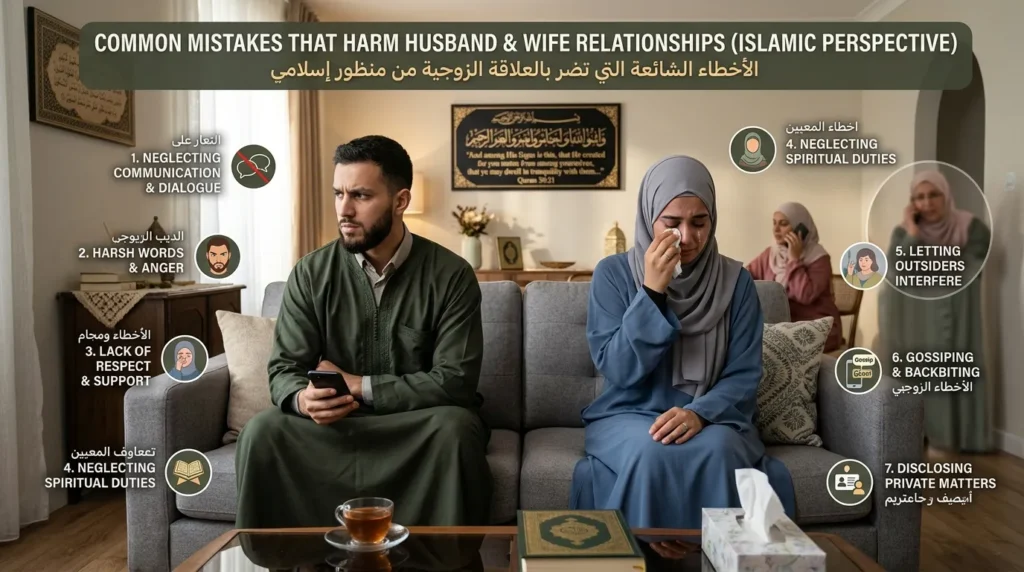
Many marriages are weakened by repeated small mistakes. These mistakes may not seem serious at first, but over time they build emotional walls.
Mistakes to Avoid
- Taking the spouse for granted.
- Speaking kindly to outsiders but harshly at home.
- Comparing the spouse with others.
- Letting in-laws control private marital decisions.
- Ignoring emotional needs.
- Using silent treatment as punishment for too long.
- Threatening divorce during arguments.
- Exposing private matters publicly.
- Neglecting salah and spiritual growth.
- Refusing to apologize.
- Treating the spouse as an enemy instead of a partner.
SoundVision’s marriage advice repeatedly emphasizes kindness, empathy, forgiveness, appreciation, and effort as necessary for marital success. (SoundVision.com) These are not complicated ideas, but they require humility. Many couples know what is right but struggle to practice it because ego gets in the way.
When a Marriage Needs Outside Help
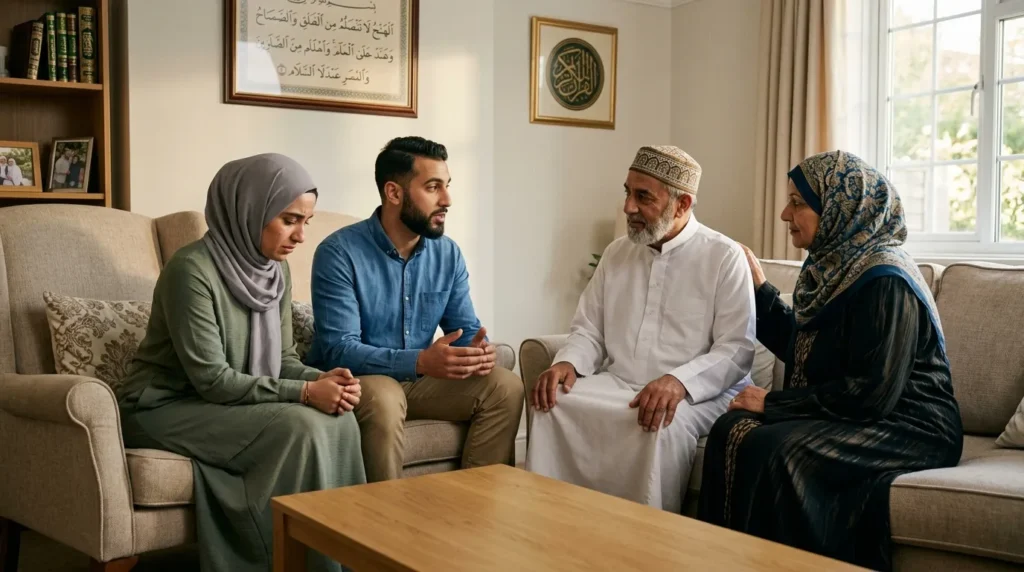
Some problems require help. If a couple is stuck in repeated conflict, emotional distance, abuse, addiction, betrayal, financial irresponsibility, or severe communication breakdown, they should not pretend everything is fine. Islam encourages reconciliation, justice, and wise intervention.
Outside help may include a trusted scholar, qualified marriage counselor, mature family mediator, or professional therapist. The goal should be repair, not public shame. However, in cases of abuse or danger, safety must be prioritized. No spouse should be told to silently endure harm without support.
AboutIslam clearly states that Islam prohibits physical and emotional abuse. (About Islam) This is important because reconciliation does not mean forcing someone to remain unsafe. Mercy and justice must go together.
Better Husband & Wife Relationship in Islam
- Pray Together
- Make Dua for Each Other
- Speak Kindly
- Forgive Mistakes
- Provide & Protect
- Respect & Cooperate
- Listen Calmly
- Express Needs Clearly
- Avoid Lies
- Protect Privacy
- No Abuse
- Seek Help When Needed
- Say Thank You
- Notice Small Efforts
Frequently Asked Questions: Husband and Wife Relationship in Islam
Q1: What does Islam say about husband and wife relationship?
Islam describes the husband and wife relationship as one of the greatest signs of Allah. The Quran says that Allah created spouses so they may find tranquility in one another and placed love and mercy between them (Surah Ar-Rum 30:21). Islam does not treat marriage as a contract of ownership or domination. It is a sacred bond built on three foundations: sakinah (tranquility), mawaddah (love), and rahmah (mercy). Both husband and wife have clearly defined rights and responsibilities, and both are accountable to Allah for how they treat each other. The Prophet Muhammad ﷺ said the best of you are those who are best to their wives, which confirms that character within marriage is a measure of faith.
Q2: How should a husband treat his wife in Islam?
A husband should treat his wife with kindness, respect, emotional care, fairness, and protection. Islam requires a husband to provide for his wife according to his means, speak to her gently, protect her dignity in public and private, care about her feelings, and live with her honorably. The Quran commands husbands to live with their wives in kindness (Surah An-Nisa 4:19). The Prophet ﷺ helped with household tasks, expressed love openly, and never humiliated his wives. A husband in Islam is not permitted to insult, physically harm, emotionally abuse, belittle, or neglect his wife. Authority in Islamic marriage means responsibility, not domination.
Q3: What are the rights of a wife in Islam?
A wife in Islam has the right to financial provision, kind and respectful treatment, emotional care, physical protection, privacy of marital matters, fair treatment if the husband has more than one wife, and the right not to be harmed physically or emotionally. She also has the right to her mahr (dowry), to maintain her own wealth, to practice her religion, and to ask for separation through khul if the marriage becomes harmful. The Quran states that wives have rights similar to their obligations in a fair manner (Surah Al-Baqarah 2:228). These rights are not requests — they are obligations the husband must fulfill before Allah.
Q4: How can husband and wife improve their relationship in Islam?
Husband and wife can improve their relationship in Islam through seven consistent practices. First, make dua for each other daily — asking Allah to place love and mercy in the marriage. Second, communicate with respect even during disagreement, choosing calm words over harsh criticism. Third, express appreciation for small daily efforts rather than only noticing what is missing. Fourth, pray together when possible to build spiritual connection. Fifth, protect each other’s privacy and never expose marital issues publicly. Sixth, forgive mistakes quickly instead of holding onto resentment. Seventh, fulfill each other’s emotional needs by asking, listening, and showing care through actions. A marriage improves when both spouses ask what they are giving rather than only what they are receiving.
Q5: What does the Quran say about husband and wife?
The Quran describes husband and wife as garments for one another in Surah Al-Baqarah 2:187, meaning each spouse should protect, cover, comfort, and beautify the other. In Surah Ar-Rum 30:21, the Quran says that Allah created spouses so that they may find tranquility in one another and placed love and mercy between them as a sign for people who reflect. The Quran also states in Surah An-Nisa 4:19 that husbands must live with their wives in kindness. These verses establish that marriage in Islam is not built on power but on mutual mercy, mutual protection, and mutual spiritual support.
Q6: Is it haram for a husband to disrespect his wife in Islam?
Yes, it is haram for a husband to disrespect, insult, humiliate, physically harm, or emotionally abuse his wife in Islam. The Prophet Muhammad ﷺ explicitly warned against harming women and described the best Muslim men as those who are best to their wives. Islam prohibits both physical and emotional abuse within marriage. A husband who uses harsh speech, threats, public humiliation, or cruelty toward his wife is violating Islamic obligation and sinning before Allah. The Quran commands husbands to live with their wives in kindness or release them honorably — there is no Islamic justification for staying in a marriage while treating a wife harmfully.
Q7: How does Islam resolve conflict between husband and wife?
Islam provides a structured approach to resolving conflict between husband and wife. First, both spouses should cool down before discussing the issue, as the Prophet ﷺ advised sitting when angry and lying down if anger continues. Second, both should speak respectfully without insults, name-calling, or bringing up past mistakes as weapons. Third, private matters should stay private — not shared with relatives or social media. Fourth, if the couple cannot resolve the issue alone, the Quran recommends appointing a mediator from each family to help reconcile (Surah An-Nisa 4:35). Fifth, if the conflict involves abuse, injustice, or persistent harm, a qualified Islamic scholar, counselor, or appropriate authority should be consulted. The goal of Islamic conflict resolution is repair, not public victory.
Q8: What is the role of a wife in Islam according to the Quran and Sunnah?
The role of a wife in Islam according to the Quran and Sunnah includes being a source of tranquility and emotional safety for her husband, guarding the home and family in her husband’s absence, cooperating in building a household of faith and good character, communicating her needs respectfully, supporting her husband’s spiritual and worldly wellbeing, and protecting the privacy and dignity of the marriage. Islam does not reduce a wife’s role to housework or servitude. She is a partner, a protector of the family, and a person with her own rights, wealth, opinions, and spiritual accountability. The Quran describes the righteous wife as among the greatest blessings of this world.
Conclusion
A better husband and wife relationship in Islam is built through faith, mercy, respect, honesty, appreciation, communication, and sincere effort. The Quran teaches that marriage should bring tranquility, love, and mercy. It describes spouses as garments for one another, meaning they protect, comfort, and cover each other. The Sunnah teaches kindness, good character, and emotional care within the home.
A successful Muslim marriage is not created by one spouse demanding rights while ignoring duties. It is created when both husband and wife fear Allah, speak gently, fulfill responsibilities, forgive mistakes, protect privacy, and help each other grow spiritually. Marriage becomes beautiful when both spouses stop treating each other as opponents and begin treating each other as an amanah from Allah.
May Allah place love and mercy between every husband and wife, heal struggling marriages, protect homes from injustice, and make our families a source of peace in this world and success in the Hereafter.