Quranic Verses on Child Upbringing: A Complete Islamic Parenting Guide
Raising children is one of the greatest trusts Allah gives to parents. In Islam, child upbringing is not limited to food, clothes, school fees, and daily care. It is a complete responsibility that includes faith, manners, emotional safety, education, discipline, worship, character, and preparation for the Hereafter. The Quran gives parents deep guidance on how to raise children with tawheed, mercy, justice, patience, responsibility, and love for Allah.
The Quran reminds believers to protect themselves and their families from the Fire, showing that parenting is tied to eternal accountability, not only worldly success. A recent article on Quranic verses for child upbringing highlights Surah At-Tahrim 66:6 as a central verse for family responsibility, while other Islamic parenting resources also point to verses about faith, prayer, provision, gratitude, and moral training. (Quranica)
In this guide, we will study the most important Quranic verses on child upbringing and explain how Muslim parents can apply them in daily family life. The goal is to raise children who know Allah, love the Quran, respect their parents, pray regularly, speak truthfully, show mercy, and grow into responsible Muslims.
What the Quran Teaches About Child Upbringing
The Quran presents children as both a blessing and a responsibility. Children bring joy, love, and hope into a family, but they also require careful guidance. Islam does not teach careless parenting or harsh parenting. It teaches balanced parenting: mercy with discipline, love with boundaries, and freedom with responsibility.
The Quranic model of parenting begins with the parent’s own faith. We cannot guide children toward Allah while we ourselves ignore Allah’s commands. We cannot teach them prayer if they never see us pray. We cannot teach them patience if we shout at every mistake. Quranic parenting starts with our own reform.
Children learn from what we repeat, what we value, and what we live. When the Quran becomes part of family life, children absorb it naturally. When salah is respected at home, children understand its importance. When parents speak kindly, children learn kindness. When parents trust Allah during hardship, children learn tawakkul.
1. Protect Yourselves and Your Families
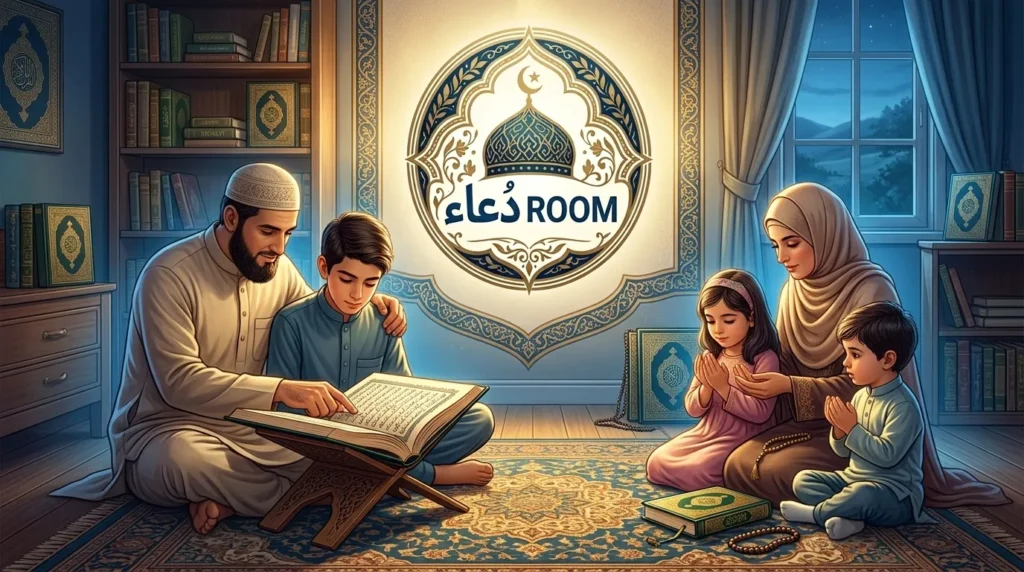
One of the strongest Quranic verses about parenting is:
“O you who believe, protect yourselves and your families from a Fire whose fuel is people and stones.”
Surah At-Tahrim 66:6
This verse places a serious responsibility on parents. We are not only responsible for our own faith; we are also responsible for guiding our families. This does not mean we control every detail of a child’s life with fear. It means we create a home where Islam is taught, practiced, loved, and protected.
To protect our children spiritually, we teach them about Allah, salah, Quran, halal and haram, good manners, modesty, truthfulness, and accountability. We also protect them from harmful influences that damage faith and character.
In today’s world, this includes monitoring what children watch, what they learn online, who they spend time with, and what values enter their hearts. Protection is not only about physical safety. It is also about protecting the soul.
A practical way to apply this verse is to build a family routine around worship. We can pray together, read Quran together, discuss Islamic manners, and make dua for guidance. A protected family is not a perfect family, but it is a family that keeps returning to Allah.
2. Teach Children Tawheed First
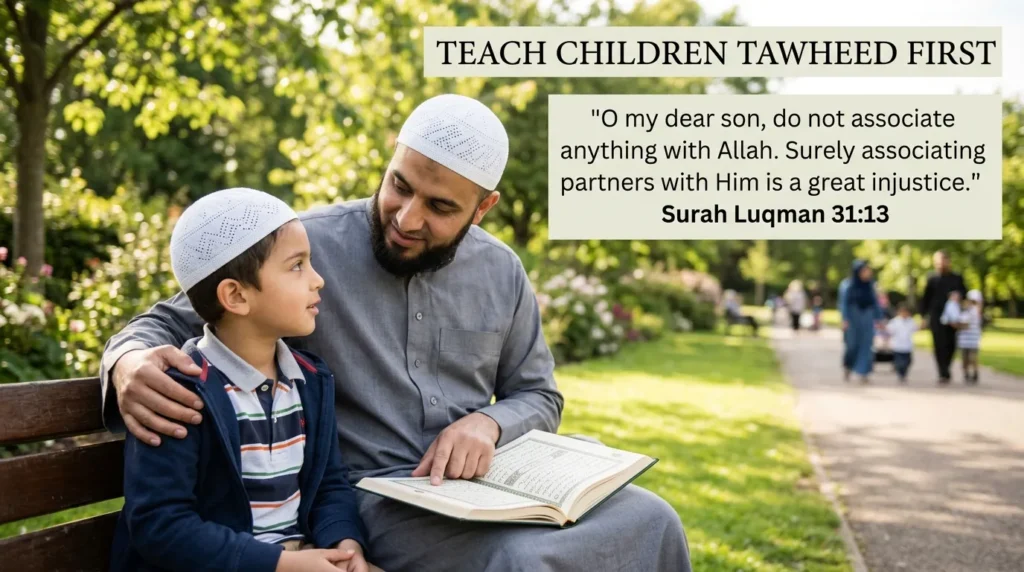
The Quran records the advice of Luqman to his son:
“O my dear son, do not associate anything with Allah. Surely associating partners with Him is a great injustice.”
Surah Luqman 31:13
This verse teaches us that the first lesson in child upbringing is tawheed, the oneness of Allah. Before children learn complex rulings, they should know who Allah is. They should know that Allah created them, provides for them, hears their duas, sees their actions, loves goodness, and forgives those who repent.
Luqman’s parenting style is also beautiful. He begins with “O my dear son”, a phrase of love and closeness. This shows that Islamic teaching should not be cold or harsh. Guidance enters the heart more easily when it comes with affection.
We can teach tawheed in simple daily language. When children eat, we say, “Allah gave us this food.” When they feel afraid, we say, “Allah protects us.” When they succeed, we say, “Say Alhamdulillah; Allah helped you.” When they make dua, we remind them that Allah hears every sincere prayer.
Tawheed should not be taught only as information. It should become the way children understand life.
3. Command Prayer With Patience

Allah says:
“And command your family to pray, and be steadfast in it.”
Surah Taha 20:132
This verse gives parents a clear instruction: teach the family salah. Prayer is not optional in Islamic upbringing. It is the foundation of Muslim life. But the verse also includes patience. Parents must be consistent, gentle, and firm without becoming harsh or hopeless.
Children learn salah gradually. At first, they watch parents pray. Then they imitate movements. Then they learn wudu, prayer times, short surahs, and basic duas. Over time, they learn responsibility.
We should make salah feel like a meeting with Allah, not a daily punishment. If children only hear shouting around prayer time, they may associate salah with stress. But if they see prayer bringing peace, routine, family unity, and closeness to Allah, they are more likely to love it.
A useful family practice is to call children gently before prayer, pray together when possible, and praise them for effort. We should also avoid delaying our own prayers, because children notice hypocrisy quickly. If salah matters to us, it will matter more to them.
4. Make Dua for Righteous Children
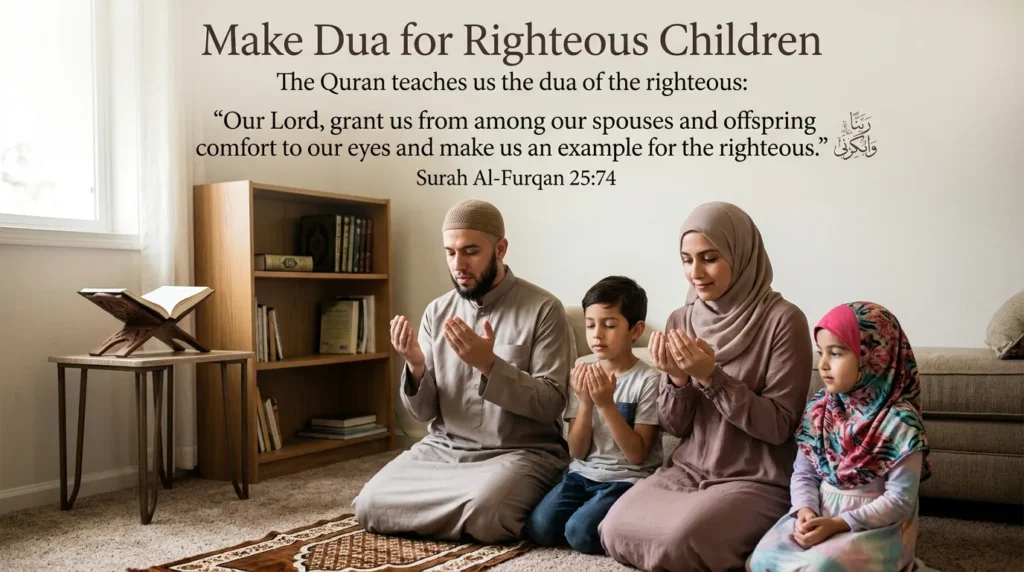
The Quran teaches us the dua of the righteous:
“Our Lord, grant us from among our spouses and offspring comfort to our eyes and make us an example for the righteous.”
Surah Al-Furqan 25:74
This verse reminds us that righteous children are a gift from Allah. Parenting techniques matter, but guidance comes from Allah. We teach, advise, discipline, love, and protect, but we must also make sincere dua.
The phrase “comfort to our eyes” means children who bring peace, joy, and spiritual happiness to their parents. This does not mean children will never make mistakes. It means we ask Allah to make them a source of goodness, faith, and comfort.
Parents should make dua for children daily. We can make dua after salah, during sujood, at tahajjud, on Fridays, during Ramadan, and at any moment when the heart is soft. We should also make dua in front of children so they learn that success comes from Allah.
Instead of only worrying about grades, careers, and worldly achievements, we should ask Allah to protect their iman, guide their hearts, make them love salah, make them love the Quran, and give them good character.
5. Teach Gratitude Like Luqman Taught His Son
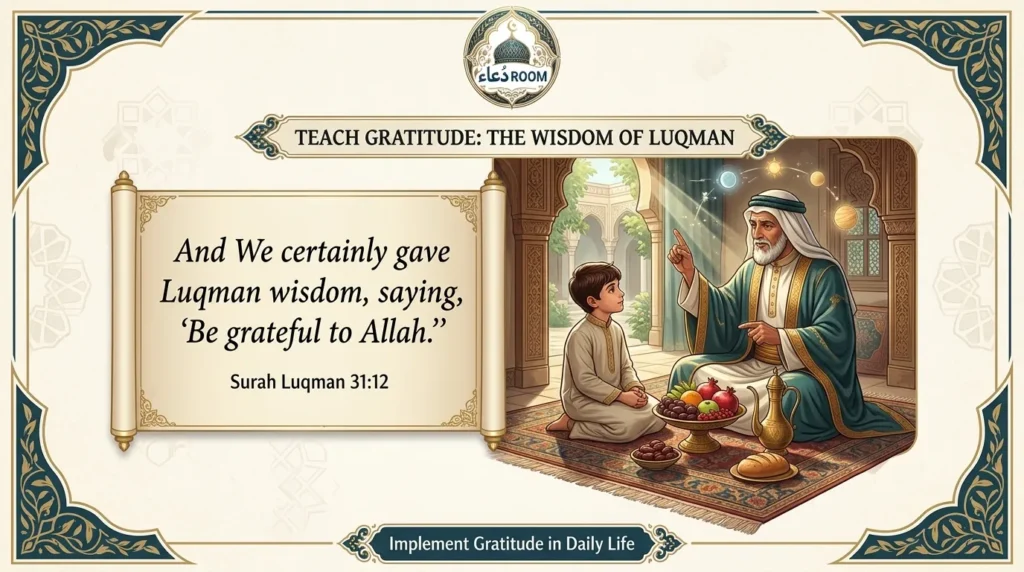
Allah says about Luqman:
“And We certainly gave Luqman wisdom, saying, ‘Be grateful to Allah.’”
Surah Luqman 31:12
Gratitude is a major part of Islamic child upbringing. A grateful child recognizes blessings, respects parents, avoids waste, and feels content. An ungrateful child may become demanding, jealous, wasteful, and entitled.
We can teach gratitude through daily practice. When children eat, they say Alhamdulillah. When someone helps them, they say thank you. When they receive a gift, they appreciate it. When they see someone with less, they learn compassion instead of arrogance.
Gratitude is not taught through lectures only. It is taught through family culture. If parents complain constantly, children learn complaint. If parents thank Allah often, children learn thankfulness.
We can create simple family habits such as asking each child at dinner, “What blessing are we thankful for today?” This small practice can train the heart to notice Allah’s favors.
6. Teach Respect and Kindness Toward Parents
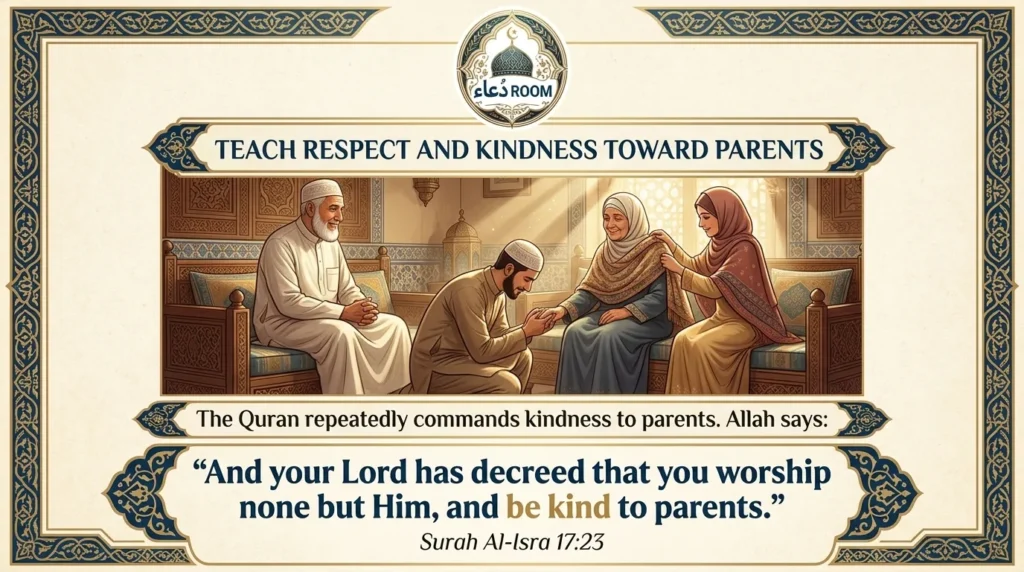
The Quran repeatedly commands kindness to parents. Allah says:
“And your Lord has decreed that you worship none but Him, and be kind to parents.”
Surah Al-Isra 17:23
This verse connects worship of Allah with kindness to parents. It shows the high status of parents in Islam. Children should be raised to respect, serve, and speak kindly to their parents.
However, parents must also remember that respect is best taught through respect. If we insult children, humiliate them, ignore their feelings, or shout constantly, we weaken the very respect we want to build.
We should teach children to speak politely, help parents, make dua for parents, avoid rude tones, and show gratitude. At the same time, we should model mercy, patience, fairness, and emotional maturity.
A child who feels loved and respected is more likely to respect parents from the heart, not only out of fear.
7. Teach Children Humility and Good Manners
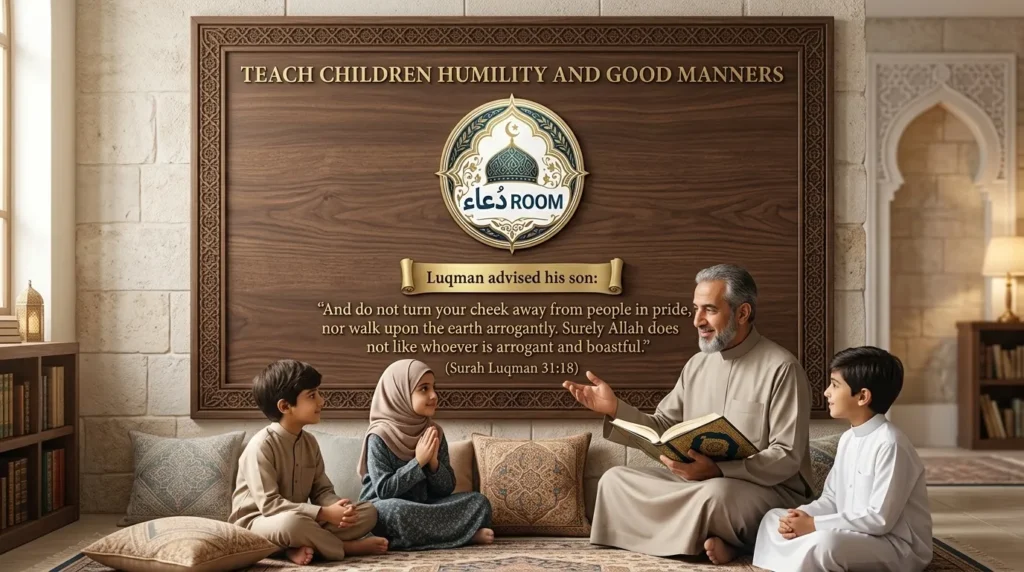
Luqman advised his son:
“And do not turn your cheek away from people in pride, nor walk upon the earth arrogantly. Surely Allah does not like whoever is arrogant and boastful.”
Surah Luqman 31:18
This verse teaches children humility. Islamic upbringing is not only about worship rituals; it is also about character. A child may pray and recite Quran, but if they are arrogant, rude, and disrespectful, their tarbiyah is incomplete.
Parents should teach children to greet people with salam, speak gently, avoid mocking others, respect elders, show mercy to younger children, and treat workers, classmates, relatives, and neighbors with dignity.
Humility also means not showing off wealth, grades, beauty, clothing, or achievements. Children should learn that every blessing comes from Allah. Intelligence, talent, money, and status are tests, not reasons for pride.
We can apply this verse by correcting arrogance early. If a child mocks another child, we should not laugh. We should explain that Allah does not love arrogance and that every person deserves respect.
8. Teach Balanced Speech and Self-Control
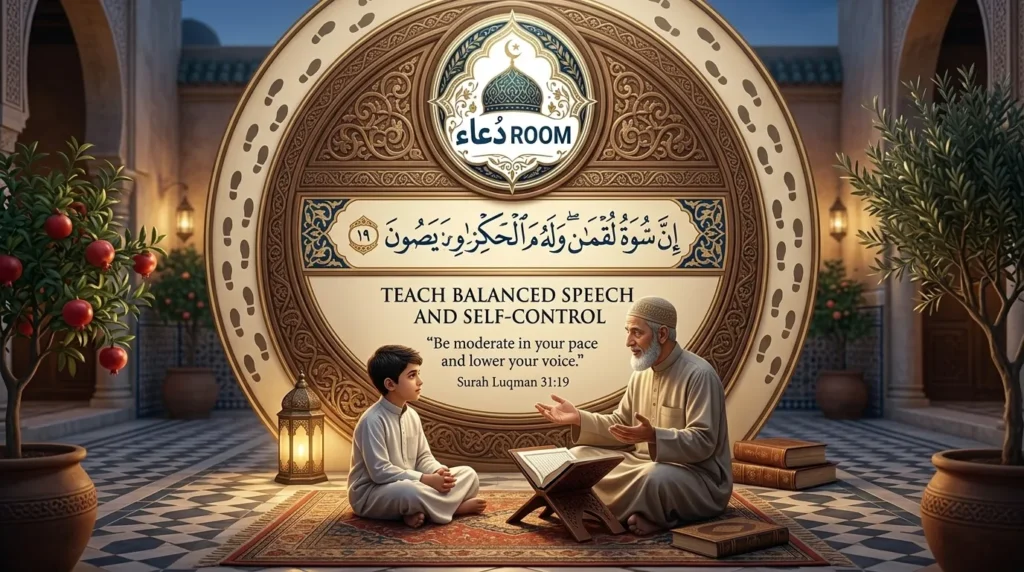
Luqman continues:
“Be moderate in your pace and lower your voice.”
Surah Luqman 31:19
This verse teaches social manners, emotional control, and respectful communication. Children need to learn how to speak, when to speak, and how loudly to speak. In many homes, children are corrected for behavior but not trained in communication.
Lowering the voice does not mean children can never be excited or expressive. It means they should not shout disrespectfully, speak aggressively, or use harsh tones. Islam values calmness and dignity.
Parents can teach this by modeling it. If we shout all day and then tell children not to shout, the message becomes weak. Children copy tone before they understand rules.
We can say, “Use a respectful voice,” instead of “Stop being bad.” We can teach children to pause when angry, take a breath, and speak with words instead of screaming. This is Quranic emotional training.
9. Do Not Fear Poverty When Raising Children
Allah says:
“Do not kill your children for fear of poverty. We provide for them and for you.”
Surah Al-Isra 17:31
This verse was revealed against a severe pre-Islamic practice, but it also carries a broader lesson about trusting Allah’s provision. Children are not a financial burden to be resented. They are a trust, and Allah is the Provider.
Modern parents may worry deeply about school fees, food, clothing, housing, healthcare, and future expenses. Planning is wise, but fear should not make parents harsh, hopeless, or resentful toward children.
The Quran teaches us that rizq comes from Allah. This does not mean we avoid work or planning. It means we work responsibly while trusting Allah.
Children should also be raised with a healthy understanding of money. We teach them gratitude, contentment, saving, sharing, avoiding waste, and giving charity. Financial responsibility is part of Islamic upbringing.
A modern Islamic parenting article also highlights Surah Al-Isra 17:31 as a verse that reassures parents about Allah’s provision while emphasizing the sanctity and protection of children. (AlHiqma)
10. Raise Children With Justice and Fairness
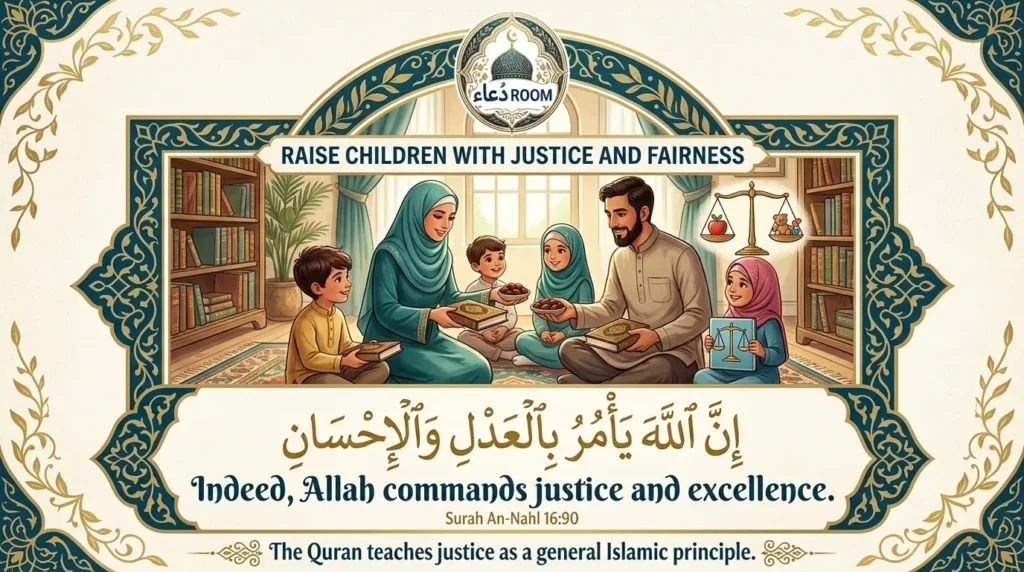
The Quran teaches justice as a general Islamic principle:
“Indeed, Allah commands justice and excellence.”
Surah An-Nahl 16:90
Justice must begin at home. Parents should treat children fairly in love, gifts, attention, discipline, praise, and opportunities. Favoritism can create deep wounds between siblings and long-term resentment toward parents.
Fairness does not always mean identical treatment. A toddler and a teenager do not need the same things. A sick child may need more care than a healthy child. But every child should feel valued, loved, heard, and respected.
Parents should avoid comparing children with siblings, cousins, or classmates. Comparison often creates jealousy and insecurity. Instead, we should recognize each child’s strengths and guide each child according to their nature.
A fair home creates emotional safety. When children trust that parents are just, they are more open to correction and advice.
11. Teach Children Responsibility for Their Actions
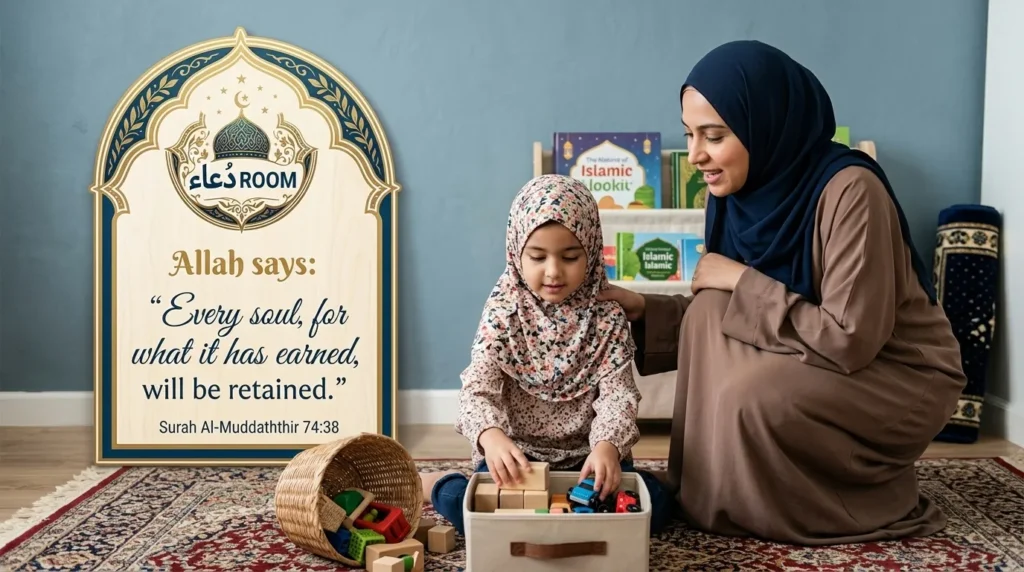
Allah says:
“Every soul, for what it has earned, will be retained.”
Surah Al-Muddaththir 74:38
This verse teaches personal responsibility. Children should gradually understand that actions have consequences. Good deeds matter. Bad choices matter. Words matter. Time matters. Allah sees everything.
Responsibility should be taught with mercy, not fear alone. A child who breaks something should learn to apologize and help fix it. A child who lies should learn honesty and consequences. A child who wastes time should learn discipline.
We should not rescue children from every result of their choices. If they forget homework, they should learn planning. If they hurt a sibling, they should apologize. If they waste money, they should learn budgeting.
This prepares children for adulthood. Islamic parenting is not about creating children who obey only when watched. It is about raising children who develop conscience and taqwa.
12. Teach Children to Avoid Blind Following
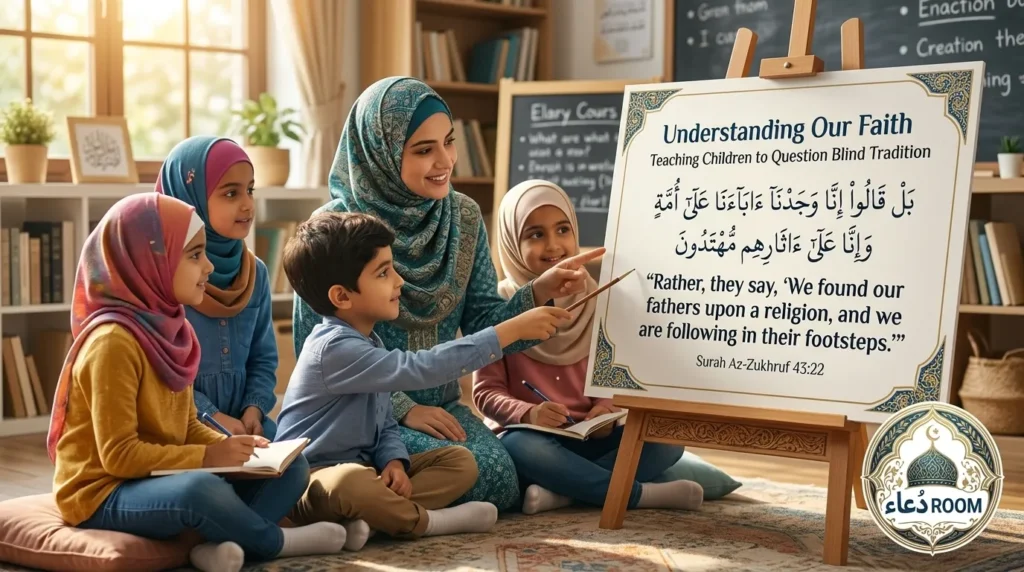
Allah criticizes people who blindly follow wrong traditions:
“Rather, they say, ‘We found our fathers upon a religion, and we are following in their footsteps.’”
Surah Az-Zukhruf 43:22
This verse teaches parents an important lesson: children should not only inherit Islam culturally; they should understand it. We should raise children who know why they believe, why they pray, why they avoid haram, and why the Quran matters.
This is especially important for older children and teenagers. They may face doubts, peer pressure, online arguments, and confusing ideologies. If they only know “because we said so,” their foundation may be weak.
We should welcome sincere questions. When children ask about Allah, prayer, hijab, halal, haram, or Islamic values, we should answer calmly. If we do not know, we should say, “Let us learn from a reliable source.”
A child who understands Islam is more likely to hold onto it with confidence.
13. Build a Home of Quran and Remembrance
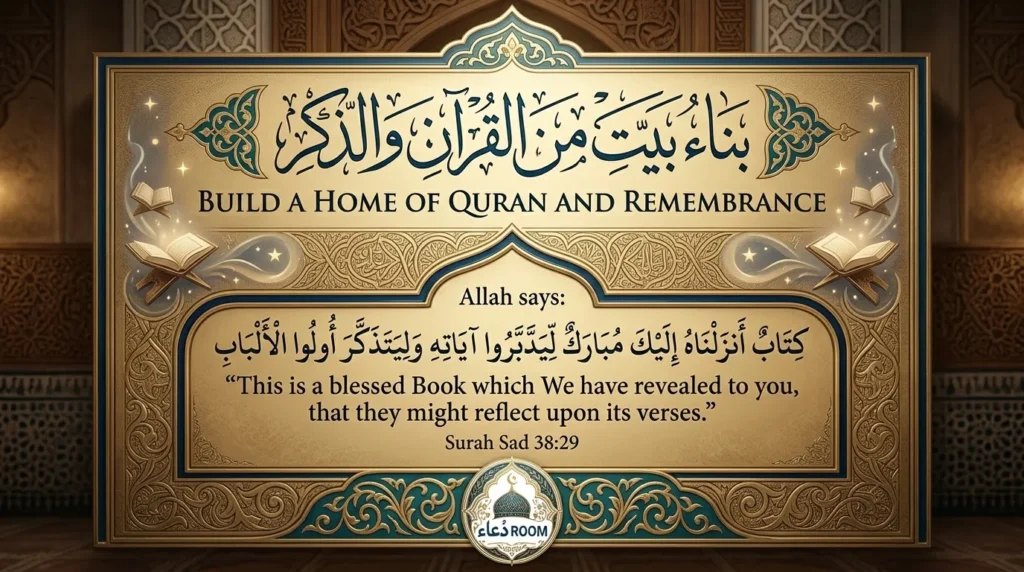
Allah says:
“This is a blessed Book which We have revealed to you, that they might reflect upon its verses.”
Surah Sad 38:29
The Quran is not only for recitation; it is for reflection and guidance. Children should grow up seeing the Quran as a living source of wisdom. They should hear it, read it, memorize it, understand it, and apply it.
A Quran-centered home does not need to be perfect. It needs consistency. We can recite a short surah after Maghrib, listen to Quran in the morning, share one ayah at dinner, or tell Quranic stories before bed.
Children should also learn simple meanings. When they recite Surah Al-Fatihah, they should know they are asking Allah for guidance. When they recite Surah Al-Ikhlas, they should know it teaches tawheed. When they recite Surah Al-Falaq and Surah An-Nas, they should know they are seeking Allah’s protection.
Quran learning becomes more powerful when it touches the heart, not only the tongue.
14. Teach Children Through Stories From the Quran
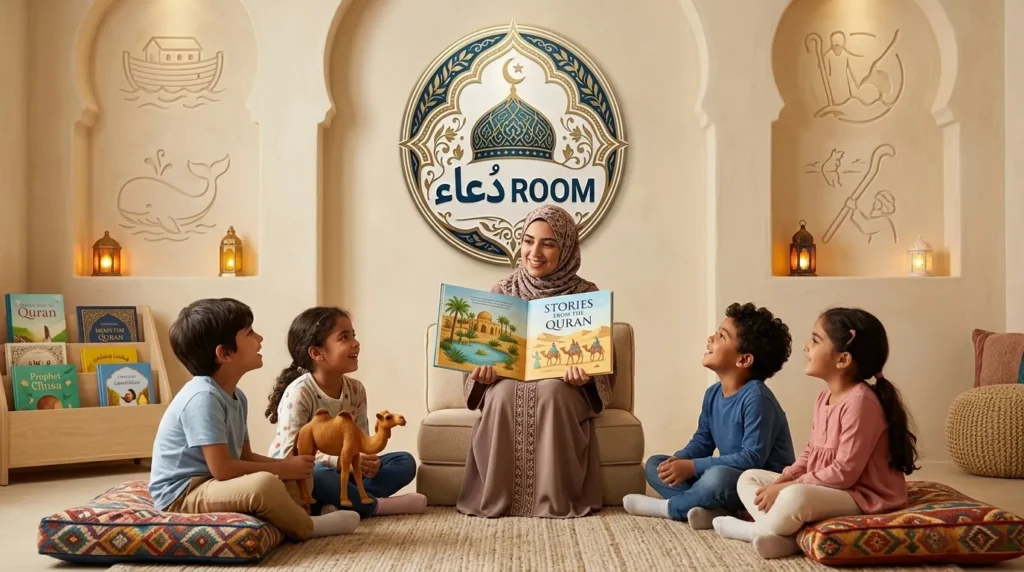
The Quran uses stories to teach faith, patience, courage, repentance, gratitude, and trust in Allah. Children naturally love stories, so Quranic storytelling is one of the best parenting tools.
Stories of Prophet Yusuf teach patience and forgiveness. Stories of Prophet Musa teach courage and reliance on Allah. Stories of Prophet Ibrahim teach tawheed and sacrifice. The story of Prophet Yunus teaches repentance and hope. The story of Maryam teaches purity and trust.
When telling Quranic stories, we should focus on lessons rather than unnecessary details. After the story, we can ask, “What did we learn?” or “How can we use this lesson today?”
This method turns Quran stories into character education. It helps children see that the Quran speaks to real life.
15. Make Islamic Upbringing Practical in Daily Life
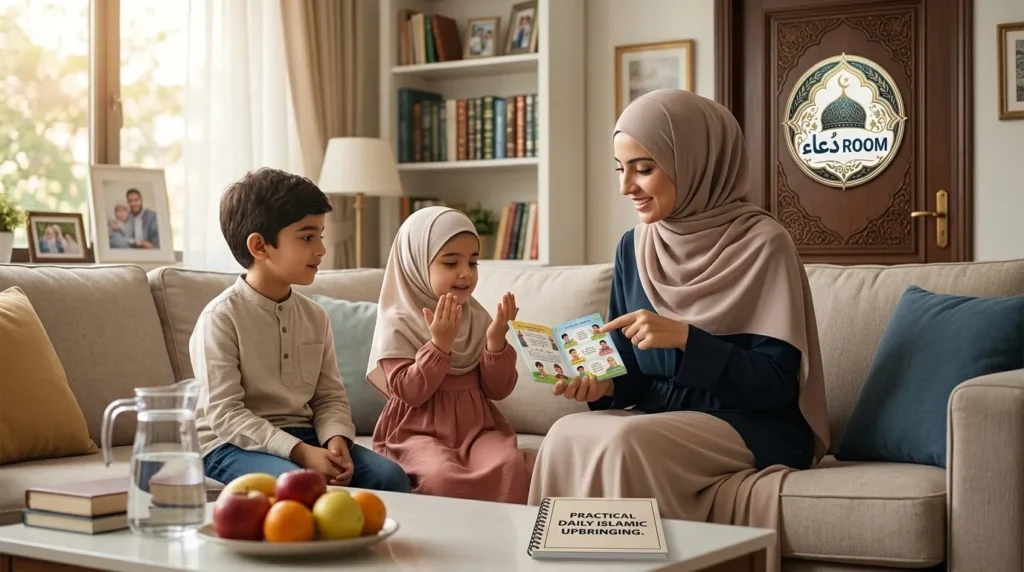
Quranic parenting should not remain in books and lectures. It should appear in daily family habits. Children need to see Islam at breakfast, in the car, at school, during arguments, while using phones, when spending money, and when dealing with mistakes.
If a child lies, we teach truthfulness. If siblings fight, we teach forgiveness. If a child wastes food, we teach gratitude. If they feel afraid, we teach dua. If they succeed, we teach humility. If they fail, we teach patience and tawakkul.
This is how Quranic verses become living guidance. We do not simply quote verses; we use them to shape behavior, emotions, and choices.
Parents should keep Islamic reminders short and relevant. A small reminder at the right moment is often more powerful than a long lecture at the wrong time.
Quranic Parenting Themes at a Glance
| Quranic Theme | Key Lesson for Parents | Practical Application |
|---|---|---|
| Protect the Family | Parents are responsible for guidance | Teach faith, salah, Quran, and boundaries |
| Tawheed | Begin with belief in Allah | Connect daily blessings to Allah |
| Salah | Prayer must be trained patiently | Pray together and build routine |
| Dua | Guidance comes from Allah | Make daily dua for children |
| Gratitude | Children should recognize blessings | Practice Alhamdulillah and avoid waste |
| Kindness to Parents | Respect begins at home | Teach polite speech and service |
| Humility | Arrogance damages character | Correct pride and encourage respect |
| Justice | Fairness protects family bonds | Avoid favoritism and comparisons |
| Responsibility | Actions have consequences | Teach accountability gently |
| Reflection | Quran must be understood | Explain simple meanings and stories |
Quranic Framework for Child Upbringing
Quranic Child Upbringing
Frequently Asked Questions (FAQs)
1. What does the Quran say about raising children?
The Quran teaches parents to raise children with faith, prayer, good character, gratitude, responsibility, and love for Allah. It emphasizes teaching tawheed, establishing salah, showing kindness, practicing justice, and guiding children toward righteous behavior.
2. Which Quran verse is most important for Islamic parenting?
One of the most important verses is Surah At-Tahrim (66:6): “Protect yourselves and your families from a Fire whose fuel is people and stones.” This verse highlights the responsibility of parents to guide their families spiritually and morally.
3. How did Luqman teach his son according to the Quran?
Luqman taught his son with wisdom, love, and gentle advice. He began by teaching tawheed, warned against shirk, encouraged gratitude, promoted humility, and instructed him to establish prayer and maintain good manners.
4. Why is teaching prayer important in child upbringing?
Prayer is the foundation of a Muslim’s relationship with Allah. The Quran instructs parents to command their families to pray and remain patient in doing so. Teaching salah from an early age helps children develop faith, discipline, and spiritual awareness.
5. How can parents teach Islamic values to children?
Parents can teach Islamic values by practicing them daily. Children learn through observation, so parents should model honesty, kindness, patience, gratitude, respect, and regular worship while explaining Quranic teachings in simple ways.
6. Does the Quran encourage parents to make dua for their children?
Yes. The Quran records several supplications for righteous offspring. One famous dua is found in Surah Al-Furqan (25:74), where believers ask Allah to make their spouses and children a source of comfort and joy.
7. What character traits should Muslim parents develop in their children?
The Quran encourages parents to nurture humility, gratitude, patience, honesty, self-control, respect for parents, kindness toward others, and trust in Allah. These qualities help children become responsible and righteous Muslims.
8. How can Quranic stories help in child upbringing?
Quranic stories teach important life lessons in a way children can easily understand. Stories of Prophets such as Yusuf, Musa, Ibrahim, and Yunus help children learn patience, courage, repentance, gratitude, and reliance on Allah.
Conclusion For Quranic Verses on Child Upbringing
Quranic verses on child upbringing give parents a complete roadmap for raising righteous, balanced, and emotionally secure Muslim children. The Quran teaches us to protect our families, begin with tawheed, establish salah, make dua, teach gratitude, show kindness to parents, build humility, speak with respect, trust Allah’s provision, act with justice, and raise children with responsibility.
Islamic parenting is not built on fear alone. It is built on love for Allah, love for the Prophet ﷺ, respect for the Quran, mercy, wisdom, patience, and consistent example. Children need parents who guide them, listen to them, correct them gently, and show them how Islam is lived every day.
When Quranic guidance enters the home, parenting becomes more purposeful. We stop raising children only for grades, careers, and worldly success. We begin raising them for iman, character, worship, service, and eternal success.
May Allah make our children righteous, protect their hearts, guide them to the Quran, establish them upon salah, and make them a comfort to our eyes in this world and the Hereafter.
“`