Allahumma Inni As’aluka Bi Annaka Antallah Full Dua, Meaning & Hadith
Do you want a dua that Allah promises to answer? There is one dua the Prophet ﷺ called the greatest name of Allah. It is called Allahumma inni as’aluka bi annaka Antallah. In this article, you will learn the full Arabic text, the English meaning, and the real hadith behind it.
What Is “Allahumma Inni As’aluka Bi Annaka Antallah”?
This dua is a short prayer. In it, you ask Allah by saying that He alone is Allah. The Prophet ﷺ said this dua uses Allah’s greatest name (Ism al-A’zam). That means Allah answers it in a special way.
There are two close forms of this dua in the hadith books. Both come from the same two men, a father and son named Buraidah. Let’s look at each one.
Form 1: “Bi Anni Ashhadu” (I Bear Witness)
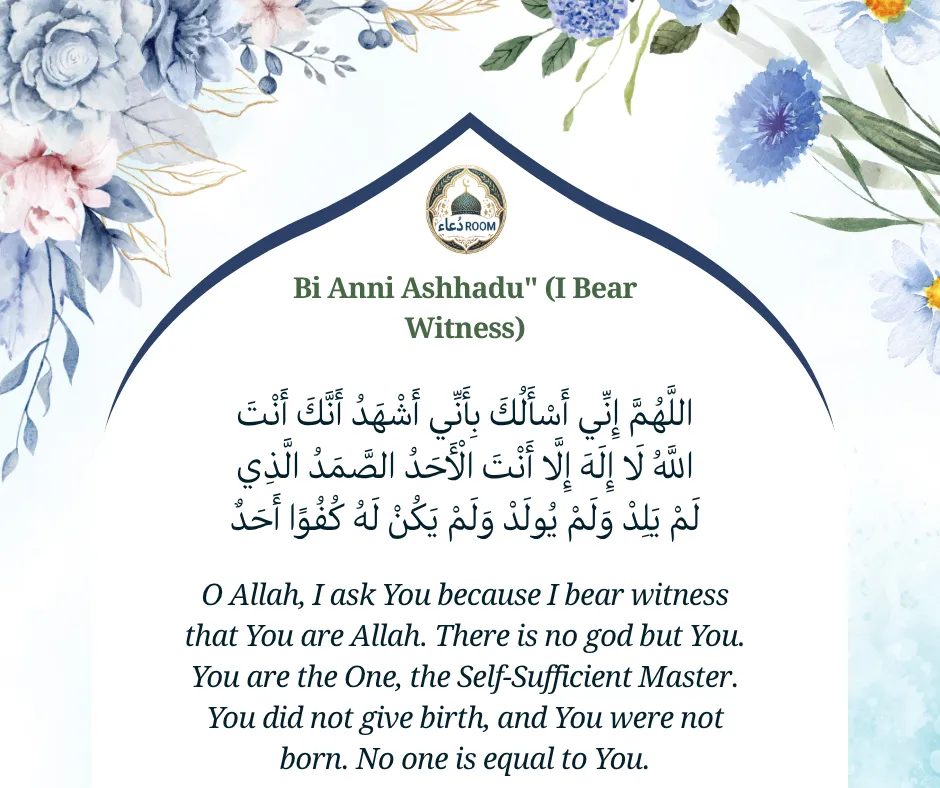
This is the version most people search for. A man in the mosque said this dua. The Prophet ﷺ heard him and told him he had just called Allah by His greatest name.
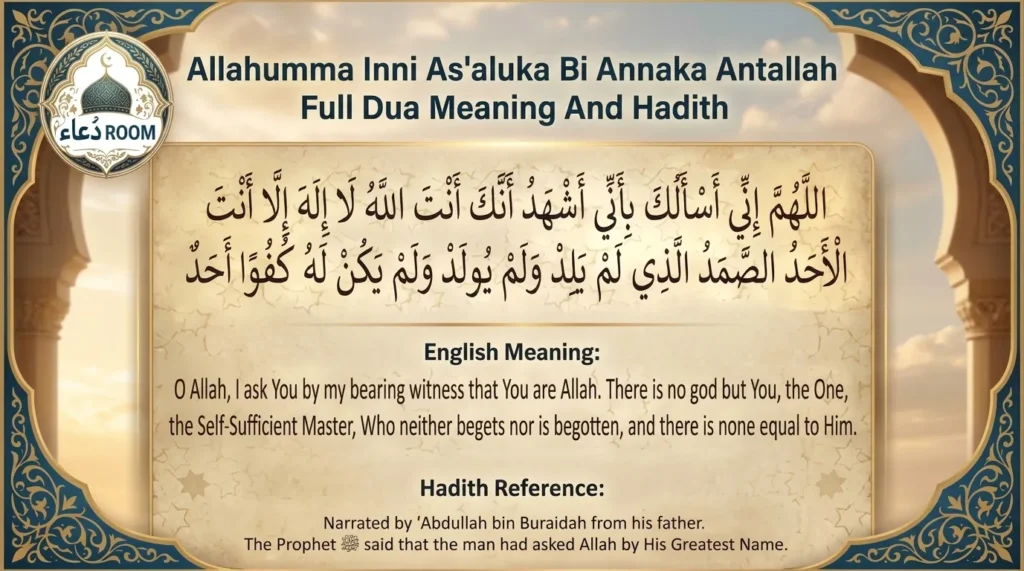
Arabic: اللَّهُمَّ إِنِّي أَسْأَلُكَ بِأَنِّي أَشْهَدُ أَنَّكَ أَنْتَ اللَّهُ لَا إِلَهَ إِلَّا أَنْتَ الْأَحَدُ الصَّمَدُ الَّذِي لَمْ يَلِدْ وَلَمْ يُولَدْ وَلَمْ يَكُنْ لَهُ كُفُوًا أَحَدٌ
Transliteration: Allahumma inni as’aluka bi anni ashhadu annaka antallah, la ilaha illa ant, al-ahadus-samad, alladhi lam yalid wa lam yulad, wa lam yakun lahu kufuwan ahad.
English meaning: O Allah, I ask You because I bear witness that You are Allah. There is no god but You. You are the One, the Self-Sufficient Master. You did not give birth, and You were not born. No one is equal to You.
This exact wording is recorded in Jami’ at-Tirmidhi, Hadith 3475, graded Sahih (authentic) by Darussalam.
Form 2: “Bi Annaka Anta” (That You Are)
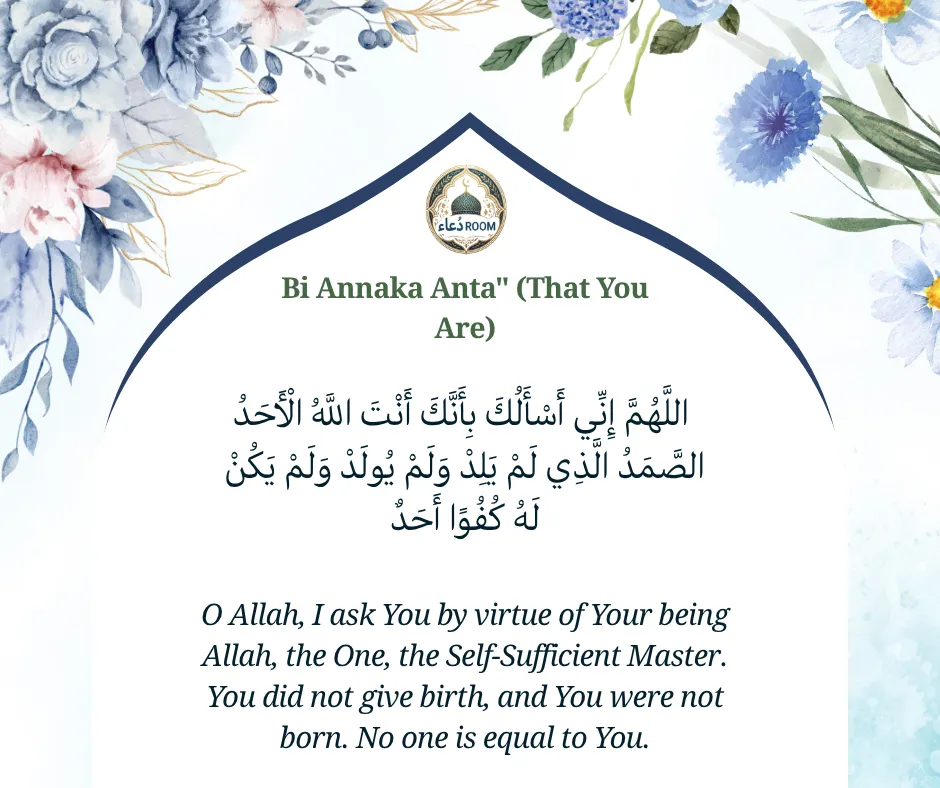
This short form skips the “I bear witness” part. It goes straight to praising Allah.
Arabic: اللَّهُمَّ إِنِّي أَسْأَلُكَ بِأَنَّكَ أَنْتَ اللَّهُ الْأَحَدُ الصَّمَدُ الَّذِي لَمْ يَلِدْ وَلَمْ يُولَدْ وَلَمْ يَكُنْ لَهُ كُفُوًا أَحَدٌ
Transliteration: Allahumma inni as’aluka bi annaka Antallahu al-ahadus-samad, alladhi lam yalid wa lam yuwlad, wa lam yakun lahu kufuwan ahad.
English meaning: O Allah, I ask You by virtue of Your being Allah, the One, the Self-Sufficient Master. You did not give birth, and You were not born. No one is equal to You.
This wording is recorded in Sunan Ibn Majah, Hadith 3857, also graded Sahih.
Both duas mean almost the same thing. Both come from the same event. Some scholars use one; some use the other. You can recite whichever one you memorize first.
The Hadith Behind This Dua
It helps to know the full story. This makes the dua feel real, not just words.
‘Abdullah bin Buraidah said his father told him this story. The Prophet ﷺ heard a man praying. The man said this dua out loud. When the Prophet ﷺ heard him, he said:
“He has asked Allah by His Greatest Name, which if He is asked thereby, He gives, and if He is called upon thereby, He answers.”
This hadith is found in two places:
- Sunan Ibn Majah 3857 — Chapter: The Greatest Name of Allah
- Jami’ at-Tirmidhi 3475 — Chapters on Supplication
Both are graded Sahih (authentic) by Darussalam. This means scholars trust the chain of people who passed down this hadith.
Why Is This Dua Called the “Greatest Name” of Allah?
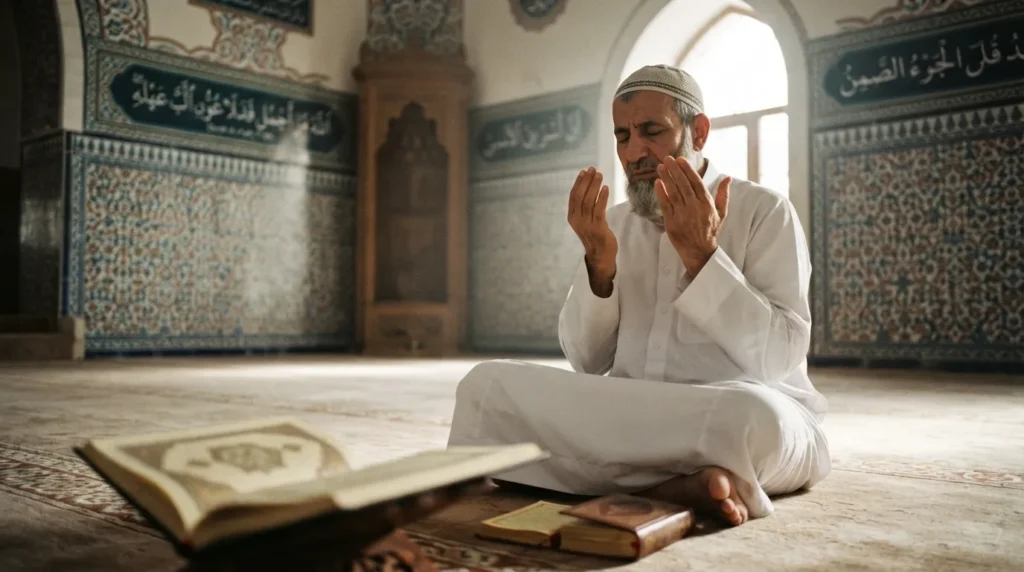
Short answer: The Prophet ﷺ said so directly. He did not just call this dua “good.” He said it holds Allah’s greatest name — the name that, when used to ask, Allah gives; and when used to call, Allah answers.
Muslims believe Allah has many beautiful names. The Quran says:
“Allah has the Most Beautiful Names. So call upon Him by them.” — Surah Al-A’raf, 7:180
But scholars teach that among all His names, some hold more weight than others when used in dua. This dua is one of the few the Prophet ﷺ pointed to by name as containing that greatest name. Scholars have not agreed on one single word that is “the” greatest name. Instead, they point to several duas — including this one — where the Prophet ﷺ confirmed its power.
Is There Another Version of This “Greatest Name” Dua?
Yes. It’s worth knowing this so you don’t get confused when you see a different wording online.
Anas bin Malik reported a separate event. He was sitting with the Prophet ﷺ. A man was praying nearby. In his tashahhud (the sitting part of prayer), the man said:
Allahumma inni as’aluka bi-anna lakal-hamd, la ilaha illa Anta, al-Mannan, Badi’us-samawati wal-ard, Dhul-Jalali wal-Ikram.
This means: “O Allah, I ask You because all praise belongs to You. There is no god but You, the Giver, the Creator of the heavens and the earth, the Owner of Glory and Honor.”
The Prophet ﷺ said the same thing about this dua — that the man had asked Allah by His greatest name. This version is recorded right after the first one, in Sunan Ibn Majah 3858.
So there are at least two separate duas the Prophet ﷺ called “the greatest name.” This is not a mistake. It shows Allah’s greatest name can appear in more than one form of praise.
Side-by-Side Comparison Table
This table is a quick way to compare the two closest versions of the dua. No other article on this topic lays it out this clearly.
| Feature | Form 1 (Tirmidhi 3475) | Form 2 (Ibn Majah 3857) |
|---|---|---|
| Opening phrase | “bi anni ashhadu” (because I bear witness) | “bi annaka” (because You are) |
| Length | Slightly longer | Slightly shorter |
| Source | Jami’ at-Tirmidhi 3475 | Sunan Ibn Majah 3857 |
| Grade | Sahih (Darussalam) | Sahih (Darussalam) |
| Narrator | ‘Abdullah bin Buraidah, from his father | ‘Abdullah bin Buraidah, from his father |
| Core meaning | Testifying to Allah’s oneness, then asking | Directly asking by Allah’s oneness |
| Contains Surah Al-Ikhlas theme | Yes (Al-Ahad, As-Samad, lam yalid…) | Yes (Al-Ahad, As-Samad, lam yalid…) |
How to Recite This Dua Correctly

Short answer: Say it slowly, understand the words, and use it before you ask Allah for something specific.
Here is a simple way to use this dua in daily life:
- Learn the Arabic first, even a little at a time. Arabic carries the exact words the Prophet ﷺ taught.
- Say the transliteration until the Arabic feels natural on your tongue.
- Pause after it. Then make your own personal dua — for guidance, for a need, for forgiveness.
- Use it any time, not just in salah. You can say it in sujood (prostration), right before ending your prayer, in Tahajjud (the night prayer), or in daily life whenever you turn to Allah.
- Say it with meaning. The Prophet ﷺ did not say any random words work. He praised this exact dua because of what it says about Allah.
This dua also carries half the meaning of Surah Al-Ikhlas, the short chapter that describes Allah as One, Self-Sufficient, with no children and no equal. That is why many scholars say memorizing this dua is easy — you likely already know Surah Al-Ikhlas by heart.
Common Questions About This Dua
What is the full dua “Allahumma inni as’aluka bi-anni ashhadu annaka Antallah”?
The full dua is: Allahumma inni as’aluka bi anni ashhadu annaka antallah, la ilaha illa ant, al-ahadus-samad, alladhi lam yalid wa lam yulad, wa lam yakun lahu kufuwan ahad. It means, “O Allah, I ask You because I bear witness that You are Allah, there is no god but You, the One, the Self-Sufficient Master, who was not born and does not give birth, and no one is equal to Him.” It is recorded in Jami’ at-Tirmidhi 3475.
What does “Allahumma inni as’aluka bi anni ashhadu” mean?
It means “O Allah, I ask You because I bear witness.” The speaker is telling Allah that his request is built on his own testimony of faith — that he truly believes Allah is One. This is why the Prophet ﷺ called it a way of asking by Allah’s greatest name.
Is “Allahumma inni as’aluka” a dua for acceptance?
Yes, in a sense. The hadith says this exact wording, when used to ask Allah for something, leads Allah to give what is asked. It is not a magic formula, but the Prophet ﷺ confirmed it holds special weight. Muslims still need sincerity, patience, and trust that Allah answers in the way that is best for them.
When should I recite “Allahumma inni as’aluka bi annaka Antallah”?
You can recite it any time you make dua — in sujood, before ending your prayer with tasleem, during Tahajjud, or in daily moments of need. There is no fixed time required. The hadith only describes a man saying it during his personal prayer, which shows it fits naturally into salah or private dua.
What is the difference between “Allahumma inni as’aluka” and “Allahumma inni a’udhu bika”?
“As’aluka” means “I ask You” — it is used when requesting something from Allah, like guidance, mercy, or provision. “A’udhu bika” means “I seek refuge in You” — it is used when asking Allah for protection from something harmful, like Hellfire or bad character. Both are dua patterns, but they serve different purposes: one asks for good, the other asks to be kept safe from harm.
Can I recite this dua before my own personal requests?
Yes. Many scholars recommend saying this dua first, then adding your own personal requests right after. Since the Prophet ﷺ said this dua carries Allah’s greatest name, using it as an opening before your own needs is a common and encouraged practice.
What is the full dua “Allahumma inni as’aluka jannah wa a’udhu bika min an-naar”?
This is a different, well-known dua: Allahumma inni as’aluka al-jannah wa a’udhu bika min an-nar — “O Allah, I ask You for Paradise, and I seek refuge in You from the Fire.” It follows the same “as’aluka” pattern but asks for a different goal. It is often recited after reciting Ayat al-Kursi or at the end of salah.
A Short, Sincere Close
This dua is short, but it carries deep meaning. It reminds you who Allah is before you ask Him for anything. Learn it well. Say it with your heart present, not just your tongue. Then bring your own needs to Allah, trusting that He hears you.
If you want to build a daily habit of short, powerful duas like this one, start by learning short durood shareef in English, the first Kalma Tayyab, or how to make the dua for entering and leaving the masjid. If you’re teaching children, this is also a great dua to add after you teach your child salah. You may also enjoy learning subhanallahi wa bihamdihi, another short and powerful phrase of remembrance, or the very powerful dua for rizq if you’re seeking provision.
May Allah accept our duas, and may He answer us by His greatest name. Ameen.