Dua After Adhan: What to Say After Adhan (Arabic & Meaning)
You just heard the azan. Now what do you say? Many Muslims repeat the call to prayer but miss the short dua that comes right after it — the one the Prophet Muhammad ﷺ said carries his own promised intercession.
This guide gives you the exact dua after adhan in Arabic, transliteration, and plain English. Every hadith here is checked against Sahih al-Bukhari, Sahih Muslim, and Sunan Abi Dawud, so you can trust what you’re reading and reciting.
Dua After Adhan — At a Glance
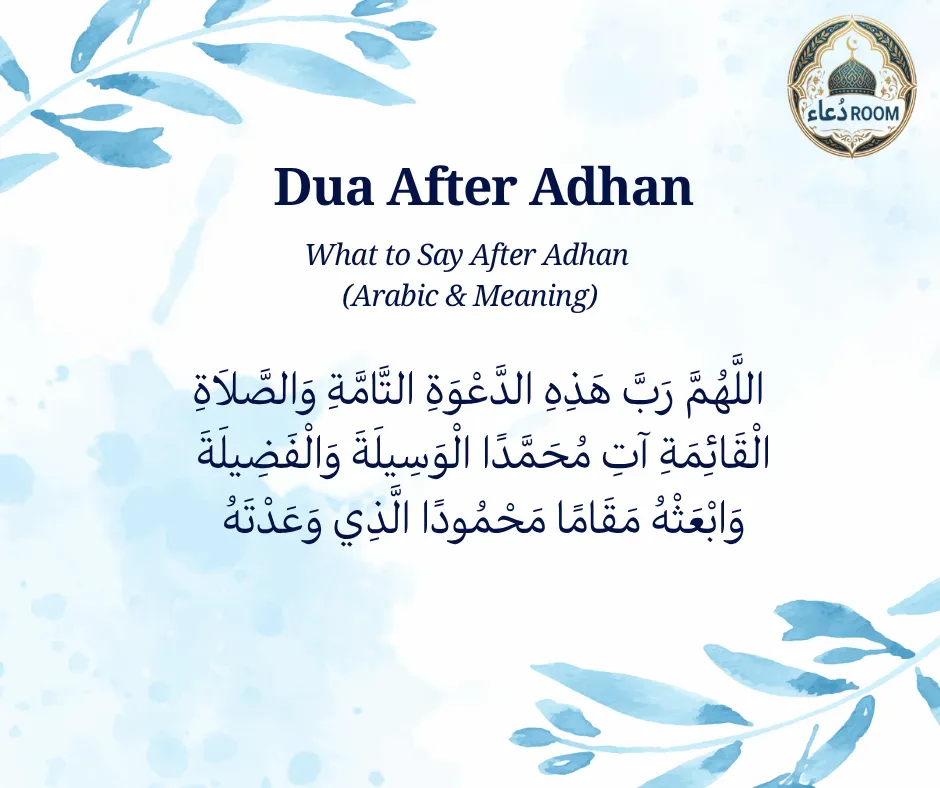
Arabic: اللَّهُمَّ رَبَّ هَذِهِ الدَّعْوَةِ التَّامَّةِ وَالصَّلاَةِ الْقَائِمَةِ آتِ مُحَمَّدًا الْوَسِيلَةَ وَالْفَضِيلَةَ وَابْعَثْهُ مَقَامًا مَحْمُودًا الَّذِي وَعَدْتَهُ
Transliteration: Allahumma Rabba hadhihi-d-da’watit-tammah, was-salatil-qa’imah, ati Muhammadan al-wasilata wal-fadilah, wab’ath-hu maqaman mahmudan-il-ladhi wa’adtah.
Meaning: “O Allah, Lord of this perfect call and the prayer about to be performed, give Muhammad the right of intercession and give him honor, and raise him to the highest, praised place that You promised him.”
Source: Sahih al-Bukhari 614
What Is the Dua After Adhan?

The dua after adhan is a short prayer you say right after the azan ends. It asks Allah to give Prophet Muhammad ﷺ a high rank called Al-Wasilah. The Prophet ﷺ said that his intercession would be allowed for the person who says it.
Adhan (also spelled azan or adzan) is the Muslim call to prayer. A man called a muadhin says it out loud, usually from a mosque, five times a day. It tells people it is time to pray.
Here is the full dua, straight from Sahih al-Bukhari.
Arabic: اللَّهُمَّ رَبَّ هَذِهِ الدَّعْوَةِ التَّامَّةِ وَالصَّلاَةِ الْقَائِمَةِ آتِ مُحَمَّدًا الْوَسِيلَةَ وَالْفَضِيلَةَ وَابْعَثْهُ مَقَامًا مَحْمُودًا الَّذِي وَعَدْتَهُ
Transliteration: Allahumma Rabba hadhihi-d-da’watit-tammah, was-salatil-qa’imah, ati Muhammadan al-wasilata wal-fadilah, wab’ath-hu maqaman mahmudan-il-ladhi wa’adtah.
English Meaning: “O Allah, Lord of this perfect call and the prayer about to be performed, give Muhammad the right of intercession and give him honor, and raise him to the highest, praised place that You promised him.”
This exact wording comes from a chain going through ʿAlī b. ʿAyyāsh, Shuʿayb b. Abū Ḥamzah, and Muḥammad b. al-Munkadir, back to Jābir b. ʿAbdullāh, recorded as Sahih al-Bukhari 614.
The Proof: Why This Dua Matters So Much
The Prophet ﷺ promised his intercession on the Day of Resurrection for the person who says this dua after the adhan.
The full hadith, narrated by Jabir bin Abdullah, states that Allah’s Messenger ﷺ said: “Whoever after listening to the Adhan says [this dua], then my intercession for him will be allowed on the Day of Resurrection.” (Sahih al-Bukhari 614)
The hadith gives a specific promise of the Prophet’s ﷺ intercession to the person who says this dua after the adhan.
Al-Wasilah, the word at the heart of this dua, is a special rank in Paradise that will belong to only one of Allah’s servants. The Prophet ﷺ expressed hope that he would be that person.
Step-by-Step: How to Say the Dua After Adhan
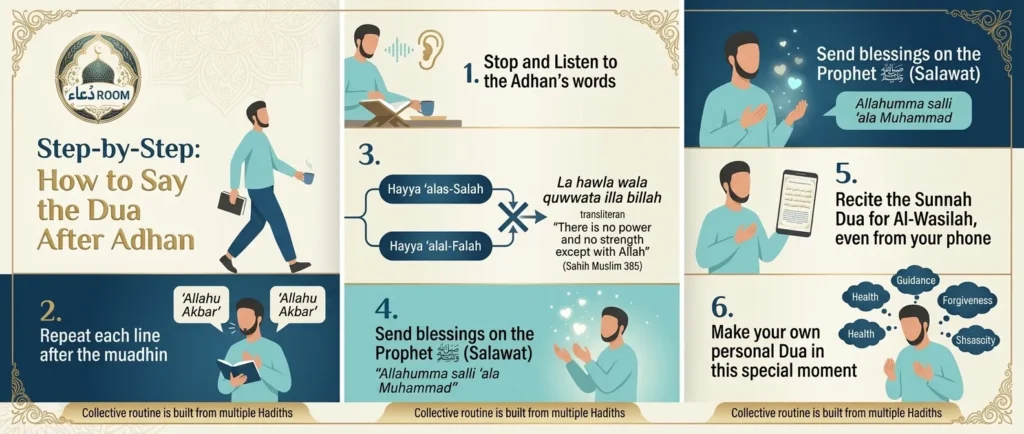
Follow these steps in order every time you hear the azan. This full routine is built from three separate, connected hadiths — not just one.
- Stop what you are doing and listen. Listen to the adhan and pay attention to its words.
- Repeat each line after the muadhin. Say the same words he says, quietly, as he says them (Sahih al-Bukhari 613).
- Skip two lines and swap in a different reply. The Prophet ﷺ instructed us to say something else when responding to “Hayya ‘alas-Salah” (come to prayer) and “Hayya ‘alal-Falah” (come to success). Instead of repeating those words, say: La hawla wala quwwata illa billah — “There is no power and no strength except with Allah” (Sahih Muslim 385).
- Send blessings on the Prophet ﷺ (salawat). After the azan ends, say something like Allahumma salli ‘ala Muhammad, meaning “O Allah, send blessings on Muhammad.” A related hadith says whoever sends a blessing on the Prophet ﷺ once will receive ten blessings back from Allah (Sahih Muslim 384).
- Recite the dua for Al-Wasilah. The Sunnah wording is in Arabic. If you are still learning it, you can read the Arabic from your phone or a card until you memorize it.
- Make your own personal dua. You can also use the time before iqamah to make your own personal dua. Keep reading below to see why this moment is so special.
Why the Time Between Adhan and Iqamah Is So Special
This gives you a special opportunity to make dua between the adhan and iqamah.
The Prophet ﷺ said that the supplication between the adhan and iqamah is not rejected. This is recorded in Sunan Abi Dawud 521.
This connects to a promise in the Quran. Allah says: “Call upon Me; I will respond to you” (Surah Ghafir, 40:60). Use this window before iqamah for your personal dua, alongside the Wasilah dua covered above.
The Salawat and Wasilah Hadith (Sahih Muslim)
There is a second major hadith on this topic, and it adds detail the Bukhari version does not spell out on its own. It comes from Abdullah bin Amr bin al-‘As, recorded in Sahih Muslim 384.
He heard the Messenger of Allah ﷺ say: “When you hear the Mu’adhdhin, repeat what he says, then invoke a blessing on me, for everyone who invokes a blessing on me will receive ten blessings from Allah; then beg from Allah al-Wasila for me, which is a rank in Paradise fitting for only one of Allah’s servants, and I hope that I may be that one. If anyone who asks that I be given the Wasila, he will be assured of my intercession.”
This hadith is where the full order comes from: repeat the azan, then send blessings (salawat), then ask for Al-Wasilah. Sahih al-Bukhari 614 gives you the exact words of the Wasilah dua itself.
Common Questions About the Words You Say
Table: What to Say at Each Part of the Adhan
| When the Muadhin Says… | What You Say | Why |
|---|---|---|
| Allahu Akbar (most lines) | Repeat the exact same words | Sunnah, based on Sahih al-Bukhari 612. |
| Hayya ‘alas-Salah (come to prayer) | La hawla wala quwwata illa billah | The Prophet ﷺ instructed us to say this instead, recorded in Sahih Muslim 385. |
| Hayya ‘alal-Falah (come to success) | La hawla wala quwwata illa billah | Same instruction, Sahih Muslim 385. |
| As-salatu khayrun minan-nawm (Fajr only) | As-salatu khayrun minan-nawm | Repeat this Fajr-only line as normal. |
| Adhan ends completely | Send salawat, then say the Wasilah dua, then make personal dua | This is the main topic of this guide. |
This kind of clear, line-by-line breakdown is often missing from other guides on this topic, so keep it handy the next few times you hear the azan.
Is the Dua After Adhan the Same as the Dua After Iqamah?
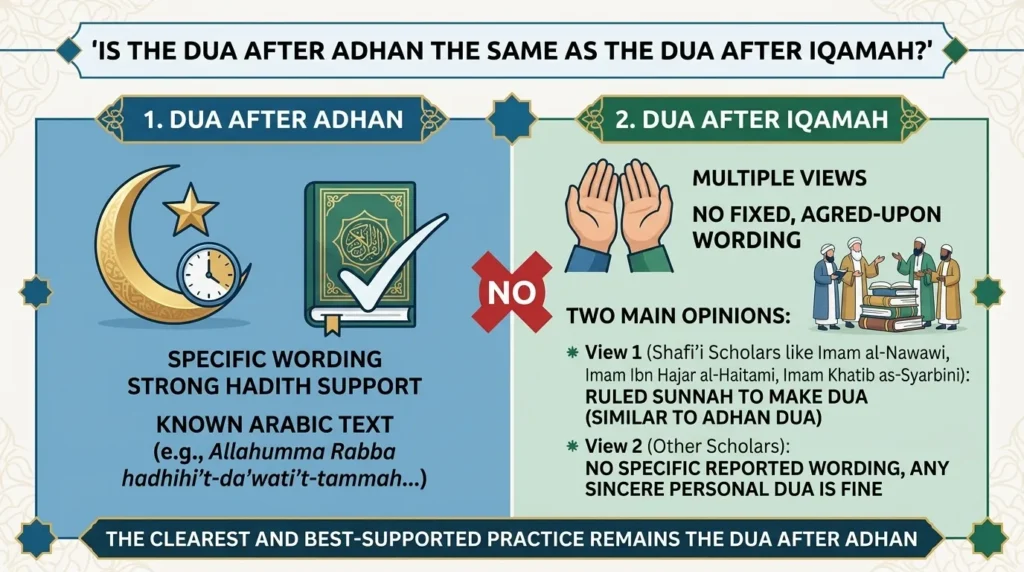
No, they are two different moments with two different rulings. The dua after adhan has a specific wording backed by a strong hadith. The dua after iqamah does not have one fixed, agreed-upon wording in the same way.
Scholars from the Shafi’i school, including Imam al-Nawawi, Imam Ibn Hajar al-Haitami, and Imam Khatib as-Syarbini, ruled it is Sunnah to also make dua after the iqamah, similar to after the adhan. Other scholars say there is no specific reported wording for after the iqamah, so any sincere personal dua is fine there. Either way, the clearest and best-supported practice remains the dua after adhan covered in this guide.
Do Women Say the Same Dua After Adhan?
The hadiths that prescribe this dua do not give a separate wording for women, so women may say the same dua after hearing the adhan. The only adhan-related rulings that differ by gender relate to who is required to call the adhan itself, not to the dua said afterward.
A Short Prayer, A Big Reward
This dua takes less than thirty seconds to say. You can make this short Sunnah part of your routine whenever you hear the adhan.
If you are working on other parts of your prayer life, it also helps to review the etiquette of entering and leaving the masjid, understand the importance of salah in Islam, or learn how to teach your child salah so this habit carries into the next generation. If you want more short, memorable duas for daily life, see this guide on la hawla wala quwwata illa billah, the very phrase you say during the azan itself. And if you want to use the open dua window before iqamah for something specific, this guide to salatul hajat covers how to ask Allah for a pressing need.
FAQ: Dua After Azan
Is saying the dua after adhan obligatory?
No, it is Sunnah, not obligatory. You will not be sinful for skipping it. But given the reward tied to it — the Prophet’s ﷺ own intercession — it is one of the easiest, most valuable habits to build into your day.
What is Al-Wasilah in the dua after adhan?
Al-Wasilah is a specific rank in Paradise fitting for only one of Allah’s servants. The Prophet ﷺ said he hopes to be that person, and asked his followers to pray for him to receive it.
Can I say the dua after adhan in English instead of Arabic?
The Sunnah wording is in Arabic. If you are still learning it, you can read the Arabic from your phone or a card until you memorize it, and reflect on the English meaning so you understand what you are asking Allah for.
What do I say instead of “Hayya ‘alas-Salah” during the adhan?
Say “La hawla wala quwwata illa billah,” meaning “There is no power and no strength except with Allah.” This reply is used for both “Hayya ‘alas-Salah” and “Hayya ‘alal-Falah.”
Can I make dua after adhan from my phone or a printed card?
Reading the dua from a phone screen, an app, or a printed card is a common and practical way to learn it while you are still memorizing it by heart.
Is the dua after adhan different for Fajr?
The dua itself is the same for every prayer, including Fajr. Only the adhan wording changes slightly for Fajr, with the added line “As-salatu khayrun minan-nawm” (prayer is better than sleep).
What should I ask for during the personal dua time after adhan?
You can ask Allah for anything good you need, such as guidance, forgiveness, family, provision, and well-being in this life and the Hereafter. The time between adhan and iqamah is a special time for making dua.
The time between adhan and iqamah is a valuable opportunity to make dua. Once you learn this short Sunnah, you can make it part of your daily prayer routine.