La Hawla Wala Quwwata Illa Billah: Meaning, Arabic Text, and When to Say It

You have heard Muslims say this phrase during hard times, and you want to know what it means and why it matters so much. La Hawla Wala Quwwata Illa Billah is one of the most repeated phrases in Islam. Below, you will find the exact meaning, the correct Arabic text, the real hadith behind it, and clear guidance on when and how often to say it.
What Does La Hawla Wala Quwwata Illa Billah Mean?
La Hawla Wala Quwwata Illa Billah means “There is no power and no strength except with Allah.” It is a short phrase Muslims say to admit that all real power belongs to Allah alone, not to us.
Breaking down the words helps this stick in your mind. La means “no” or “there is not.” Hawla means “power” or “ability to change things.” Quwwata means “strength.” Illa means “except.” Billah means “with Allah.” So the full line says: no power, and no strength, except with Allah. This phrase is often called Hawqala, a short nickname Muslim scholars use for it, made by joining parts of the Arabic words together.
Arabic Text, Transliteration, and Meaning
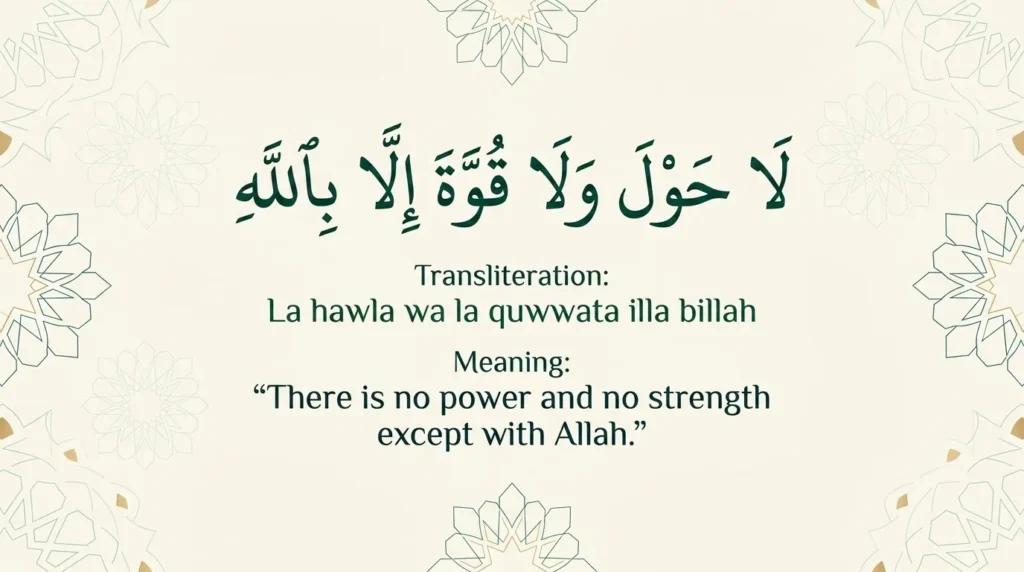
Here is the phrase written in Arabic script, in English letters, and translated into plain English. Saying it out loud from this order will help you get the pronunciation right.
Arabic: لَا حَوْلَ وَلَا قُوَّةَ إِلَّا بِٱللَّٰهِ
Transliteration: La hawla wa la quwwata illa billah
Meaning: “There is no power and no strength except with Allah.”
La Hawla Wala Quwwata Illa Billah
Arabic, transliteration, meaning, spellings, and hadith references.
| Detail | Information |
|---|---|
| Arabic | لَا حَوْلَ وَلَا قُوَّةَ إِلَّا بِٱللَّٰهِ |
| Transliteration | La hawla wa la quwwata illa billah |
| Common spellings |
La hawla wala quwwata illa billah
La haula walakuata illabillah
Lahaula walakuata illabillah
|
| Meaning | There is no power and no strength except with Allah. |
| Also called | Hawqala |
| Main hadith source | Sahih al-Bukhari 6384, Sahih Muslim 2704 |
| Narrated by | Abu Musa al-Ash’ari (RA) |
You may have seen this dua written in many different ways, like “la haula walakuata illabillah” or “la hawla wala quwwata illallah.” These are all attempts to spell the same Arabic words using English letters. The Arabic text above is the one true, correct version.
The Extended Version: “…Al-Aliyyil Azeem”
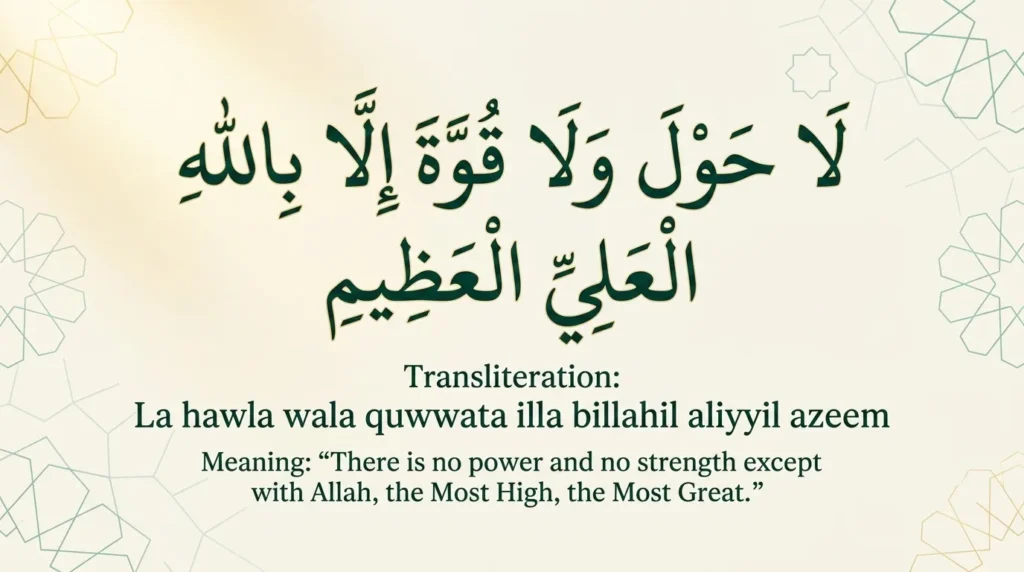
Many Muslims add two more words at the end: “al-Aliyyil Azeem,” meaning “the Most High, the Most Great.” This longer form praises Allah’s greatness right after admitting our own weakness.
Arabic: لَا حَوْلَ وَلَا قُوَّةَ إِلَّا بِاللَّهِ الْعَلِيِّ الْعَظِيمِ
Transliteration: La hawla wala quwwata illa billahil aliyyil azeem
Meaning: “There is no power and no strength except with Allah, the Most High, the Most Great.”
Both the short form and this longer form are used by Muslims. You can say either one. The core meaning stays the same: only Allah truly has power.
Is La Hawla Wala Quwwata Illa Billah in the Quran?
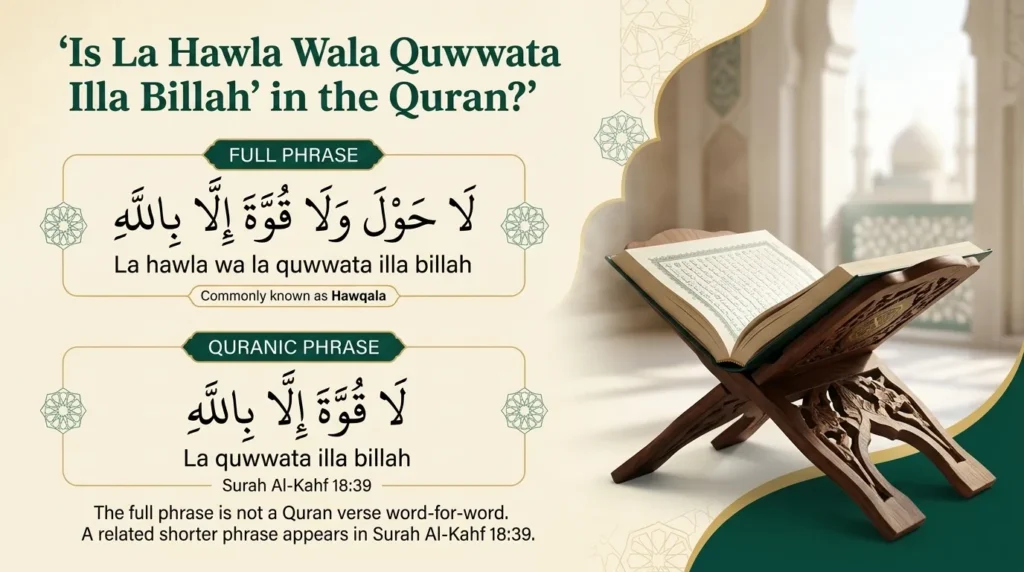
A related, shorter phrase appears in the Quran, but the exact full phrase Muslims say today comes from hadith, not directly from a Quran verse. This is an important point many articles get wrong.
In Surah Al-Kahf, verse 39, Allah tells the story of a proud man with a large garden. A wiser companion tells him he should have said, when entering his garden: “Ma sha Allah, la quwwata illa billah,” meaning “What Allah has willed [has happened]; there is no power except in Allah” (Quran 18:39). Notice this verse says “la quwwata illa billah,” without the word “hawla.” The fuller phrase, “la hawla wa la quwwata illa billah,” comes from what the Prophet Muhammad ﷺ taught his companions, which you will read about next. Many scholars connect this Quran verse to protection from the evil eye (nazar, meaning harmful envy some believe can affect a person or their belongings), since it teaches gratitude instead of pride when we are given something good.
The Hadith: “A Treasure From the Treasures of Paradise”

The Prophet Muhammad ﷺ personally taught this phrase to a companion and called it a treasure of Paradise. This is the strongest and most well-known source for the dua.
Abu Musa al-Ash’ari (RA) said he was quietly reciting “La hawla wa la quwwata illa billah” to himself while traveling with the Prophet ﷺ. The Prophet ﷺ heard him and said:
“O Abdullah bin Qais! Say: La hawla wa la quwwata illa billah, for it is one of the treasures of Paradise.”
This hadith is recorded in Sahih al-Bukhari, hadith 6384, and in Sahih Muslim, hadith 2704. Because it appears in both of these two most trusted hadith collections, scholars agree this hadith is authentic (sahih, meaning verified as reliable). Being called a “treasure of Paradise” means this short phrase carries a reward far bigger than its size suggests.
When Should You Say La Hawla Wala Quwwata Illa Billah?
Muslims say this phrase during hardship, fear, anger, or any moment that feels too big to handle alone, as well as at set points during daily worship. It is not limited to only sad or difficult moments.
When to Say La Hawla Wala Quwwata Illa Billah
Common occasions and the meaning behind saying this powerful dhikr.
| Occasion | Why |
|---|---|
| Replying to the call to prayer (adhan) | When the muadhin says “Hayya ‘ala-s-salah” and “Hayya ‘ala-l-falah,” the listener replies with this phrase instead of repeating the muadhin’s words (Sahih Muslim 385). |
| Leaving the house | Said along with “Bismillah, tawakkaltu ala Allah” (In the name of Allah, I put my trust in Allah), asking for protection on the way out. |
| During hardship or calamity | To remind the heart that only Allah can truly change the situation. |
| Facing a difficult task | Before starting something hard, as a way of asking Allah for real strength. |
| Feeling angry, anxious, or overwhelmed | To calm the heart by handing the worry over to Allah. |
| As daily dhikr (remembrance of Allah) | Many Muslims repeat it after prayer or in the morning and evening as regular worship. |
For the habit of saying it when leaving the house, the wording is slightly longer: “Bismillah, tawakkaltu ala Allah, la hawla wa la quwwata illa billah.” This hadith is recorded by At-Tirmidhi and graded hasan (good, meaning reliable though not at the very highest level of authenticity). You can read more detail on this specific hadith on IslamQA’s answer about it.
How Many Times Should You Say It?
There is no single fixed number written in the Quran or an authentic hadith for daily repetition. Some people say it a set number of times as a personal habit, especially after prayer, but this is not a strict religious rule. What actually matters is saying it with a present heart, truly meaning the words, not just repeating sounds quickly.
The Deeper Meaning: Letting Go of False Control
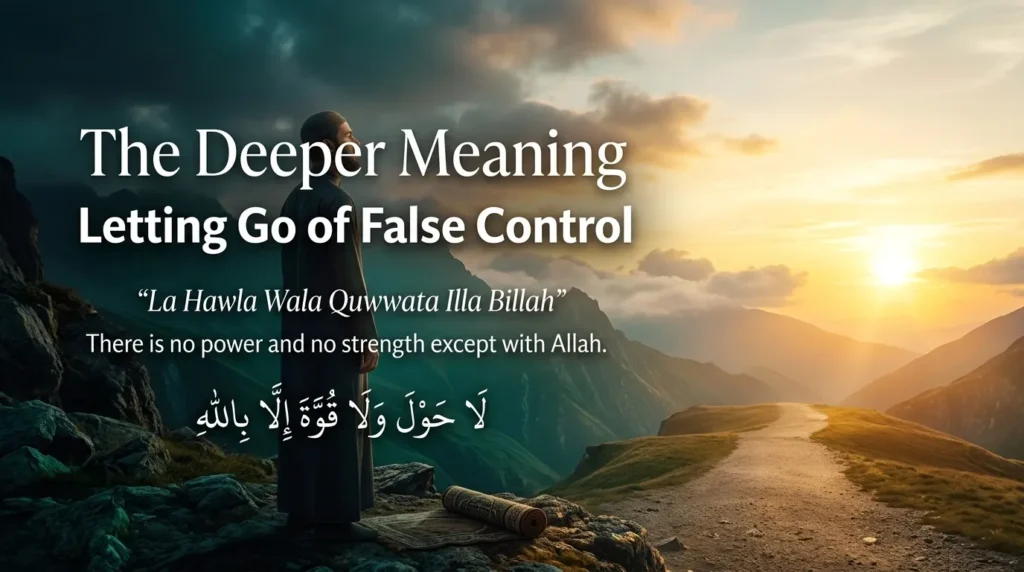
This phrase is really about tawakkul, meaning full trust and reliance on Allah. Saying it is a way of admitting we cannot control outcomes on our own, no matter how hard we try or plan.
Life brings moments where our own effort clearly isn’t enough: illness, loss, a problem at work, or a fear we cannot shake. In these moments, “La hawla wa la quwwata illa billah” reminds the heart that strength was never truly ours to begin with. It belonged to Allah the whole time. This is also why the dua is closely tied to tawakkul as a wider concept in Islam. If you want to go deeper into what full trust in Allah looks like day to day, our guide on tawakkul in Islam walks through it with more Quranic examples.
This phrase also pairs naturally with other short duas Muslims lean on during hard times, such as Hasbunallahu wa Ni’mal Wakeel, which means “Allah is sufficient for us, and He is the best disposer of affairs.” Many Muslims say both together when facing a real trial, and some use it alongside a dua for protection from enemies and oppression when they feel unsafe or wronged.
If your worry is more about provision than protection, you may also find our piece on a powerful dua for rizq (sustenance) useful, since many people say “la hawla wa la quwwata illa billah” while also asking Allah for their daily needs. And because this phrase is part of daily dhikr, it fits naturally into a habit built around the importance of salah in Islam, since many Muslims say it right after finishing their prayer.
Frequently Asked Questions
What does La Hawla Wala Quwwata Illa Billah mean in English?
It means “There is no power and no strength except with Allah.” It is a phrase admitting that all true strength and control belong only to Allah.
Is La Hawla Wala Quwwata Illa Billah a Quran verse?
Not exactly. A shorter, related phrase, “la quwwata illa billah,” appears in Surah Al-Kahf 18:39. The full phrase Muslims say today comes from an authentic hadith, not word-for-word from the Quran.
What hadith is La Hawla Wala Quwwata Illa Billah from?
It comes from Sahih al-Bukhari, hadith 6384, and Sahih Muslim, hadith 2704. The Prophet ﷺ told his companion Abu Musa al-Ash’ari that this phrase is a treasure of Paradise.
When should I say La Hawla Wala Quwwata Illa Billah?
Common times include replying to the call to prayer, leaving your house, facing hardship, starting a hard task, or as daily dhikr after salah. There is no single required time; you can say it whenever you feel weak or worried.
How many times should I recite La Hawla Wala Quwwata Illa Billah?
There is no fixed number set by the Quran or an authentic hadith. Say it with sincerity as often as you feel the need, whether once during a hard moment or repeatedly as daily dhikr.
What is the difference between the short and long versions of this dua?
The short version is “La hawla wa la quwwata illa billah.” The longer version adds “al-Aliyyil Azeem” at the end, meaning “the Most High, the Most Great.” Both are correct and commonly used.
Can this phrase protect me from the evil eye?
The related Quran verse in Surah Al-Kahf is often linked by scholars to protection from envy and the evil eye, since it teaches humility instead of pride. It is a phrase of trust in Allah, and Muslims often say it for comfort and protection in many difficult situations.
A Final Word
Seven simple words carry more weight than most of us realize. When Abu Musa al-Ash’ari quietly said this phrase to himself, the Prophet ﷺ stopped to tell him what it truly was: a treasure of Paradise. The next time life feels too heavy to carry, remember those words are still there for you, exactly as they were for him. Say them, mean them, and let go of what was never yours to control in the first place.