Surah Baqarah Last 2 Ayat: Full Text, Meaning & Benefits
Do you want to know why so many Muslims recite the surah baqarah last 2 ayat every single night? These two verses close out the longest chapter of the Quran, and the Prophet Muhammad (ﷺ) gave a special virtue to them in an authentic hadith. In this guide, you will get the exact Arabic text, a clear English meaning, and proof from real hadith — not guesses.
What Are the Surah Baqarah Last 2 Ayat?
The surah baqarah last two verses are verses 285 and 286 of Surah Al-Baqarah, the second chapter of the Quran. Verse 285 is a short, powerful statement of faith. Verse 286 teaches a comforting truth and closes with a heartfelt dua (a personal prayer to Allah). Together, they are often called Amanar Rasool, taken from the first two words of verse 285.
These two ayat close the longest surah in the Quran. Surah Al-Baqarah has 286 verses in total, so these are truly the final words of the chapter.
Surah Baqarah Last 2 Ayat in Arabic
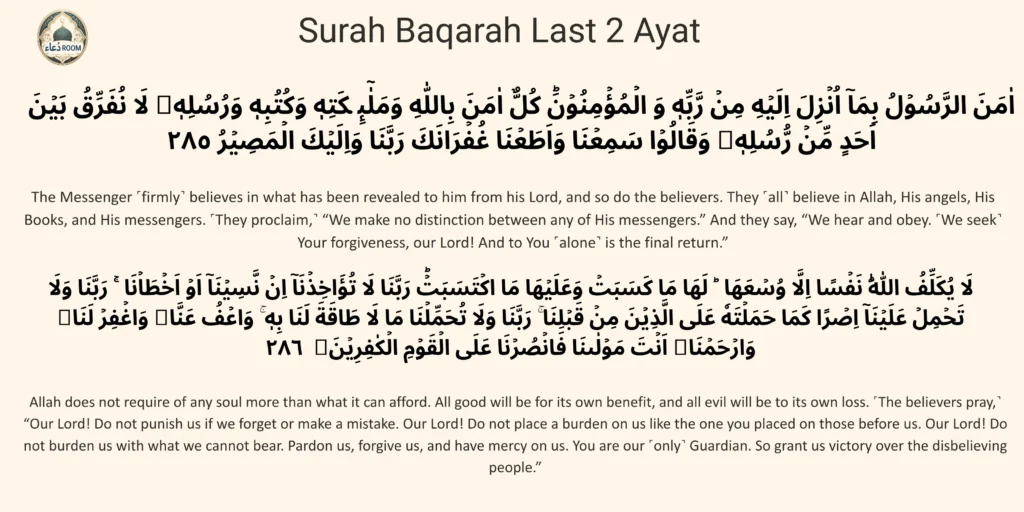
Here is the Arabic text of verses 285 and 286:
آمَنَ الرَّسُولُ بِمَا أُنزِلَ إِلَيْهِ مِن رَّبِّهِ وَالْمُؤْمِنُونَ ۚ كُلٌّ آمَنَ بِاللَّهِ وَمَلَائِكَتِهِ وَكُتُبِهِ وَرُسُلِهِ لَا نُفَرِّقُ بَيْنَ أَحَدٍ مِّن رُّسُلِهِ ۚ وَقَالُوا سَمِعْنَا وَأَطَعْنَا ۖ غُفْرَانَكَ رَبَّنَا وَإِلَيْكَ الْمَصِيرُ
لَا يُكَلِّفُ اللَّهُ نَفْسًا إِلَّا وُسْعَهَا ۚ لَهَا مَا كَسَبَتْ وَعَلَيْهَا مَا اكْتَسَبَتْ ۗ رَبَّنَا لَا تُؤَاخِذْنَا إِن نَّسِينَا أَوْ أَخْطَأْنَا ۚ رَبَّنَا وَلَا تَحْمِلْ عَلَيْنَا إِصْرًا كَمَا حَمَلْتَهُ عَلَى الَّذِينَ مِن قَبْلِنَا ۚ رَبَّنَا وَلَا تُحَمِّلْنَا مَا لَا طَاقَةَ لَنَا بِهِ ۖ وَاعْفُ عَنَّا وَاغْفِرْ لَنَا وَارْحَمْنَا ۚ أَنتَ مَوْلَانَا فَانصُرْنَا عَلَى الْقَوْمِ الْكَافِرِينَ
Surah Baqarah Last 2 Ayat: Verse Numbers
The last two verses of Surah Al-Baqarah are Ayat 285 and 286. They appear at the very end of the second chapter of the Quran, right after verse 284.
| Verse | Main Theme |
|---|---|
| 2:285 | Faith and submission |
| 2:286 | Allah’s mercy, forgiveness, and dua |
Surah Baqarah Last 2 Ayat Transliteration
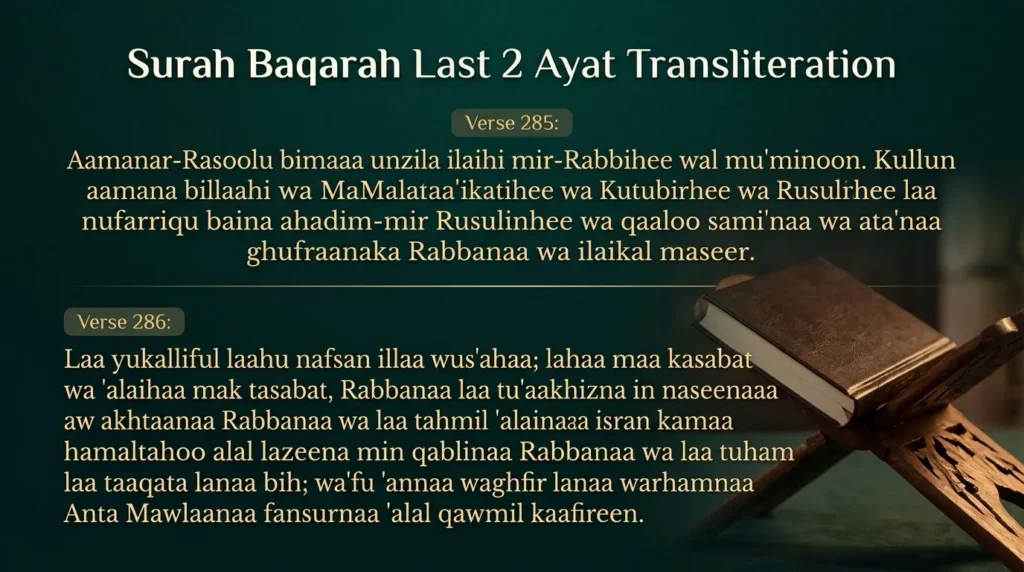
If you can’t read Arabic yet, this transliteration helps you sound out the words.
Aamanar-Rasoolu bimaaa unzila ilaihi mir-Rabbihee wal mu’minoon. Kullun aamana billaahi wa Malaaa’ikatihee wa Kutubihee wa Rusulihee laa nufarriqu baina ahadim-mir Rusulihee wa qaaloo sami’naa wa ata’naa ghufraanaka Rabbanaa wa ilaikal maseer.
Laa yukalliful laahu nafsan illaa wus’ahaa; lahaa maa kasabat wa ‘alaihaa mak tasabat, Rabbanaa laa tu’aakhizna in naseenaaa aw akhtaanaa Rabbanaa wa laa tahmil ‘alainaaa isran kamaa hamaltahoo alal lazeena min qablinaa Rabbanaa wa laa tuhammilnaa maa laa taaqata lanaa bih; wa’fu ‘annaa waghfir lanaa warhamnaa Anta Mawlaanaa fansurnaa ‘alal qawmil kaafireen.
Surah Baqarah Last 2 Ayat in English
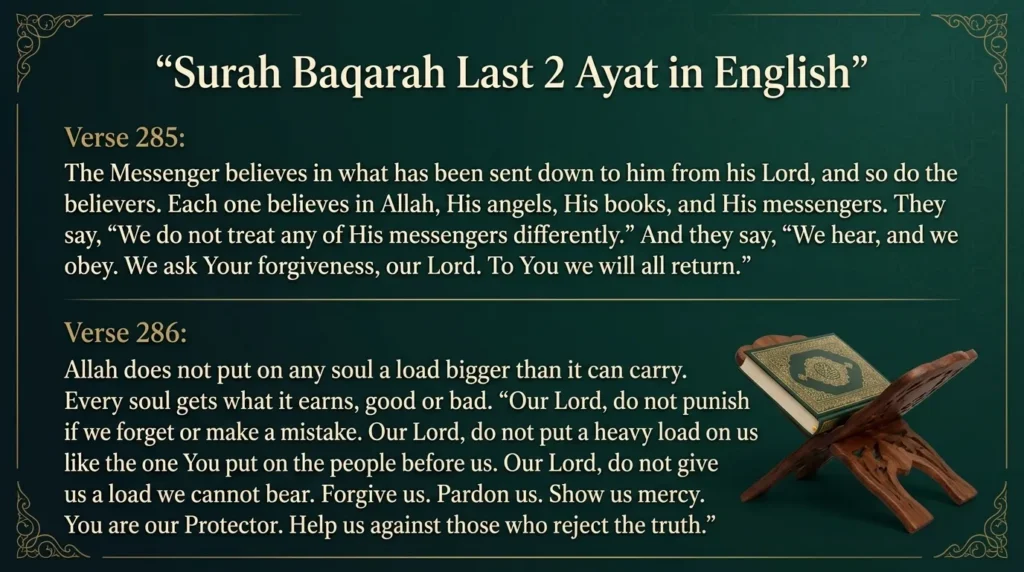
Here is the meaning, based on the translation used on Quran.com.
The Messenger believes in what has been sent down to him from his Lord, and so do the believers. Each one believes in Allah, His angels, His books, and His messengers. They say, “We do not treat any of His messengers differently.” And they say, “We hear, and we obey. We ask Your forgiveness, our Lord. To You we will all return.”
Allah does not put on any soul a load bigger than it can carry. Every soul gets what it earns, good or bad. “Our Lord, do not punish us if we forget or make a mistake. Our Lord, do not put a heavy load on us like the one You put on the people before us. Our Lord, do not give us a load we cannot bear. Forgive us. Pardon us. Show us mercy. You are our Protector. Help us against those who reject the truth.”
What Do the Surah Baqarah Last 2 Ayat Mean?
In short: verse 285 declares belief, and verse 286 teaches Allah’s mercy before closing with a dua. Let’s break both verses down piece by piece.
Verse 285 highlights the core beliefs mentioned in the verse:
- Belief in Allah
- Belief in His angels
- Belief in His books (like the Quran, Torah, and Gospel in their original form)
- Belief in His messengers (like Muhammad, Musa, and Isa, peace be upon them)
- Belief in all the messengers, without rejecting any one of them
- Submission expressed through the words “we hear and we obey”
Verse 286 teaches that Allah does not burden a soul beyond its capacity. This one line alone can lift heavy worry off a tired heart. The verse then moves into a dua, asking Allah to:
- Forgive us when we forget or slip up
- Not place a heavy burden on us, like He did on nations before us
- Not give us a test we cannot bear
- Pardon, forgive, and show us mercy
- Give us strength and support against those who reject faith
Why Are These Verses So Special? The Hadith Proof
Many Muslims recite the surah baqarah last 2 ayat because of a real narration from the Prophet Muhammad (ﷺ). This is not a guess — it comes straight from Sahih al-Bukhari, one of the most authoritative hadith collections.
Abu Mas’ud reported that the Prophet (ﷺ) said:
“Whoever recites the last two verses of Surat Al-Baqarah at night, that will be sufficient for him.” — Sahih al-Bukhari 5009
The exact wording in the hadith is that these two verses “suffice” the person who recites them at night. Scholars have discussed what “suffice” means. Imam al-Nawawi explained it could mean the reward stands in for night prayer, it gives protection from the whispers of Shaytan (the devil), or it covers general harm through the night. He noted it may include all of these meanings together, though the hadith itself does not spell out one single meaning.
There is a second hadith that adds to the special status of these verses. Ibn Abbas reported that the angel Jibreel (Gabriel) heard a sound like a door opening in the sky. He told the Prophet (ﷺ):
“Receive the good news of two lights given to you, which no prophet before you was given: the Opening of the Book [Al-Fatihah] and the last verses of Surat Al-Baqarah.” — Sunan an-Nasa’i 912 (graded Sahih)
This hadith highlights the special status of Al-Fatihah and the closing verses of Al-Baqarah for the Prophet ﷺ and his Ummah.
When and How to Recite the Last 2 Ayat of Surah Baqarah
The short answer: recite them at night, right before you go to sleep. Many scholars also encourage reading them alongside Ayatul Kursi, since both verses come from the same closing section of Surah Al-Baqarah and both are recommended for the night.
You do not need special conditions to recite them. You can:
- Say them from memory once you learn them
- Read them from the Quran or a phone app before bed
- Recite them after wudu (washing before prayer), though this is not required
- Teach them to your children, since the Prophet (ﷺ) encouraged families to learn and pass on Quran verses together — a great place to start is teaching your child salah alongside short passages like this one
Surah Baqarah Last 2 Ayat: Quick Reference Table
| Detail | Information |
|---|---|
| Verse numbers | 2:285 and 2:286 |
| Surah | Al-Baqarah (The Cow), Chapter 2 |
| Also called | Amanar Rasool, Khawatim Surah Al-Baqarah |
| Main hadith source | Sahih al-Bukhari 5009, Sahih Muslim 807 |
| Best time to recite | At night, before sleeping |
| Main virtue | They suffice for the person who recites them at night. |
| Verse 285 topic | Belief in Allah, angels, books, and messengers. |
| Verse 286 topic | Allah’s mercy, plus a dua for forgiveness and ease. |
| Special status | Reported as a gift given to the Ummah of Prophet Muhammad (ﷺ), per Sunan an-Nasa’i 912. |
The Deeper Lesson: You Are Never Given More Than You Can Carry
The line “Allah does not put on any soul a load bigger than it can carry” is one of the most repeated lines of comfort in all of Islam. When life feels too hard, this verse is a reminder that your struggle has a limit, and Allah knows exactly what you can bear. This ties closely with the idea of tawakkul, or full trust in Allah, a topic covered in more depth in this guide on tawakkul in Islam.
When hard moments come, many Muslims also turn to short duas of full reliance, such as Hasbunallahu wa Ni’mal Wakeel or La hawla wala quwwata illa billah, both of which carry the same spirit of trust found in verse 286.
The dua in verse 286 also reflects Allah’s promise found elsewhere in this same surah: so remember Me, I will remember you (2:152).
Frequently Asked Questions
Is it Sunnah to recite the last 2 ayat of Surah Baqarah every night?
Yes. The Prophet ﷺ specifically encouraged reciting the last two verses of Surah Al-Baqarah at night. Sahih al-Bukhari and Sahih Muslim both report that they suffice for the person who recites them at night.
What does “sufficient for him” mean in the hadith?
The hadith itself does not explain the word further. Scholars like Imam al-Nawawi discuss a few possible meanings, including protection through the night, a reward like standing in night prayer, or safety from the whispers of Shaytan.
Can I read Surah Baqarah’s last 2 ayat in English instead of Arabic?
For daily reflection and understanding, yes, reading the English meaning is very helpful. For the specific hadith reward tied to recitation, scholars recommend reciting the original Arabic, since that is what the hadith describes.
Why are these verses described as a gift only for this Ummah?
Because of the hadith in Sunan an-Nasa’i 912, where an angel told the Prophet ﷺ that Al-Fatihah and the last verses of Al-Baqarah were given to him, and to no prophet before him.
Do I need wudu to recite the last 2 ayat of Surah Baqarah?
No. You can recite Quran verses from memory without wudu. Wudu is required in most schools of thought only to touch and physically hold the Arabic text of the Mus’haf (the Quran book).
What is the difference between Ayatul Kursi and the last 2 ayat of Surah Baqarah?
Ayatul Kursi is verse 2:255, found earlier in the same surah, and focuses on the greatness and power of Allah. The last 2 ayat (2:285-286) come at the very end of the surah and focus on faith and a personal dua. Many Muslims recite both together at night. You can read more in this guide on Ayatul Kursi’s meaning and benefits.
How long does it take to recite the last 2 ayat of Surah Baqarah?
Most reciters finish both verses in under two minutes, making them easy to add to your nightly routine even on your busiest days.
Final Thoughts
The surah baqarah last 2 ayat are short, but they carry the weight of a whole life of faith. In two verses, you declare what you believe, and you ask Allah for exactly what your heart needs — forgiveness, mercy, and strength to carry on. Try reading them tonight before you sleep, and let them be the last words on your tongue before you close your eyes.