
Rabi ul Sani Month Importance, Duas, Prayers & Islamic Events

Is there a special prayer for Rabi ul Sani? Many people search for this and get confused answers. This guide gives you a clear answer, authentic duas.
Quick answer: Rabi ul Sani (also called Rabi al-Thani or Rabi ul Akhir) is the fourth month of the Islamic calendar. No special prayer, fast, or wazifa is proven for this month alone. You can use it to keep up your Salah, Quran reading, dua, and good deeds — just like any other month.
What Is Rabi ul Sani?
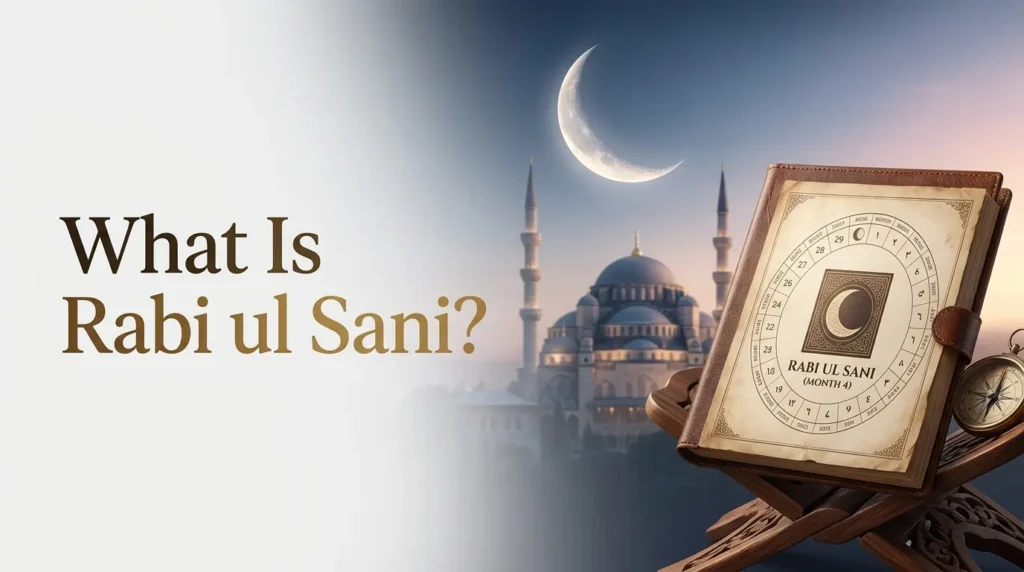
Rabi ul Sani is the fourth month in the Islamic (Hijri) calendar. It comes right after Rabi ul Awwal, the month linked to the Prophet Muhammad’s ﷺ birth.
Here are the basic facts:
- Arabic name: رَبِيعُ الثَّانِي
- Other names: Rabi al-Thani, Rabi al-Akhir, Rabi ul Akhir
- Position: 4th month of 12 in the Hijri year
- Meaning of “Rabi”: spring
- Meaning of “Thani” / “Sani”: second
- Full meaning: “the second spring”
The names Rabi al-Awwal and Rabi al-Thani are traditionally connected with spring. Because the Islamic calendar is lunar, these months now move through different seasons, moving about 10–11 days earlier each year in the Gregorian calendar. Over time, Rabi ul Sani moves through every season — summer, winter, and back again. This is why the name “spring” doesn’t always match the actual weather now.
Is Rabi ul Sani a Special Month in Islam?
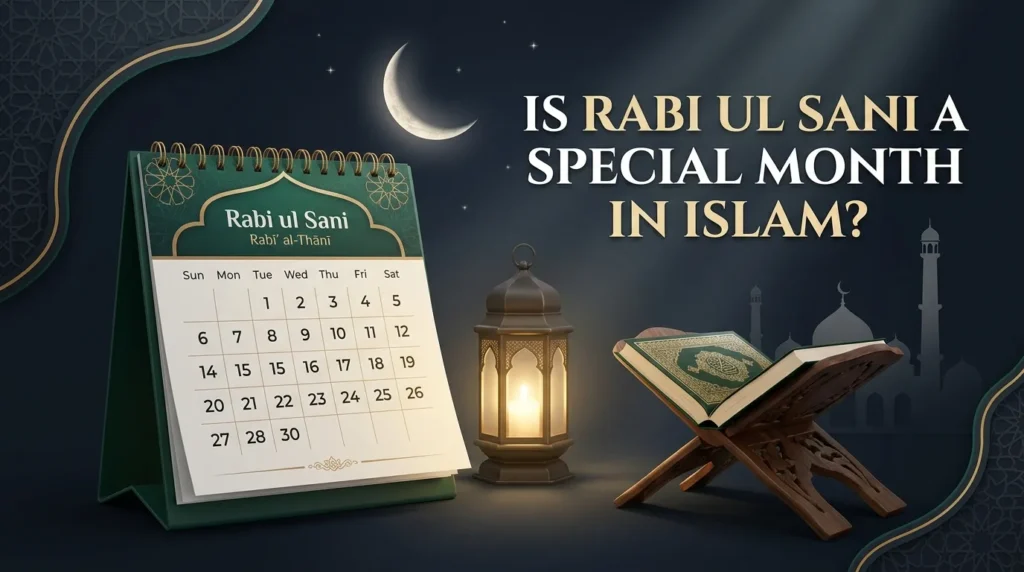
No. Rabi ul Sani is not one of the four sacred months in Islam, and it has no proven special status. It is simply one of the twelve months of the year.
The four sacred months in Islam are Dhul Qa’dah, Dhul Hijjah, Muharram, and Rajab. Rabi ul Sani is not one of them.
Claims of special rewards tied specifically to Rabi ul Sani should not be accepted without reliable evidence. What is true is simpler and better: Allah wants us to worship Him all through the year, not just in certain months.
This does not make Rabi ul Sani unimportant. Every month is a chance to grow closer to Allah. Good deeds done in Rabi ul Sani are rewarded just like good deeds done in any other month — through sincere effort and intention, not because of the month’s name.
Is There a Special Prayer for Rabi ul Sani?

No authentic evidence establishes a specific Salah exclusively for Rabi ul Sani. Muslims should not treat a particular number of rak’ahs, date, or promised reward as a Sunnah without reliable evidence.
Is There a 4-Rak’ah Rabi ul Sani Prayer?
Some pages online describe a special 4-rak’ah prayer tied to this month, with claims of huge rewards. This is not supported by strong, checkable proof. Before you follow any prayer tied to a date or a set number of rewards, look for real evidence. If a claim cannot be traced to a reliable source, it is safer to leave it and stick to prayers we know are real.
Which Prayers Can I Perform in Rabi ul Sani?
You can keep doing the prayers that are already proven and good for every day of the year:
- The five daily Salah — the base of a Muslim’s worship
- Sunnah prayers — extra prayers the Prophet ﷺ regularly performed
- Witr — prayed after Isha
- Tahajjud — a night prayer, prayed after waking up
- Duha (forenoon prayer) — a short prayer in the late morning
- Other Nawafil (voluntary prayers) — extra prayers for extra reward
If you want to make your daily Salah stronger this month, our guide on the importance of Salah in Islam explains why it matters so much. If you’re teaching a child to pray, see how to teach your child Salah.
Rabi ul Sani Duas
Is There a Special Rabi ul Sani Dua?
No single dua is proven to be made only for Rabi ul Sani. You can make authentic duas throughout Rabi ul Sani, just as you can throughout the year.
Authentic Duas You Can Recite in Rabi ul Sani
These duas are not tied to any one month. You can say them every day, including in Rabi ul Sani.
1. Dua for goodness in this life and the next
Arabic: رَبَّنَا آتِنَا فِي الدُّنْيَا حَسَنَةً وَفِي الْآخِرَةِ حَسَنَةً وَقِنَا عَذَابَ النَّارِ Transliteration: Rabbana atina fid-dunya hasanatan wa fil-akhirati hasanatan waqina ‘adhaban-nar Meaning: “Our Lord, give us good in this world and good in the next world, and save us from the fire.” Source: Quran 2:201
2. Dua for forgiveness
Arabic: رَبِّ اغْفِرْ لِي Transliteration: Rabbighfir li Meaning: “My Lord, forgive me.” When to say it: Any time, especially after Salah or before sleeping.
3. Dua for righteous children
Arabic: رَبِّ هَبْ لِي مِنَ الصَّالِحِينَ Transliteration: Rabbi hab li minas-saliheen Meaning: “My Lord, grant me [offspring] from among the righteous.” Source: Quran 37:100
Our detailed post on Rabbi habli minas-saliheen covers this dua in full, with Arabic, meaning, and when to say it.
4. Dua for parents
Arabic: رَبِّ ارْحَمْهُمَا كَمَا رَبَّيَانِي صَغِيرًا Transliteration: Rabbi irhamhuma kama rabbayani saghira Meaning: “My Lord, have mercy upon them as they raised me when I was small.” Source: Quran 17:24
5. Dua for guidance
Arabic: اللَّهُمَّ اهْدِنِي وَسَدِّدْنِي Transliteration: Allahummahdini wa saddidni Meaning: “O Allah, guide me and keep me firm.” Source: Sahih Muslim, Hadith 2725
6. Dua for rizq (provision)
If you want more duas for rizq with full detail, we have a complete guide: powerful dua for rizq.
7. Dua for protection
Arabic: حَسْبُنَا اللَّهُ وَنِعْمَ الْوَكِيلُ Transliteration: Hasbunallahu wa ni’mal wakeel Meaning: “Allah is enough for us, and He is the best one to trust.” Source: Quran 3:173
We explain this dua fully, with its Hadith background, in Hasbunallahu wa ni’mal wakeel: meaning, Hadith, benefits.
8. Dhikr for Strength and Reliance on Allah
Arabic: لَا حَوْلَ وَلَا قُوَّةَ إِلَّا بِاللَّهِ Transliteration: La hawla wa la quwwata illa billah Meaning: “There is no power and no strength except with Allah.” Source: Sahih al-Bukhari, Hadith 6384
This phrase is described in Hadith as a treasure from the treasures of Paradise. It is a short but powerful reminder of reliance on Allah, said any time strength or help is needed. See our full explanation here: La hawla wala quwwata illa billah.
What Should Muslims Do in Rabi ul Sani?
These are general acts of worship you can do any month — not special Rabi ul Sani rituals. Use this list as your simple monthly checklist.
1. Perform Salah Keep your five daily prayers on time. This is the base of everything else.
2. Read the Quran Even a small daily amount adds up. Try to understand the meaning, not just read the words.
3. Make Dua Talk to Allah in your own words too, not just memorized duas.
4. Increase Dhikr Say short phrases like SubhanAllah, Alhamdulillah, and Allahu Akbar during the day. Our post on so remember Me, I will remember you explains why this matters.
5. Make Istighfar Ask Allah for forgiveness often, for small and big mistakes.
6. Give Sadaqah Even a small gift to someone in need counts as charity.
7. Perform Voluntary Prayers Add a few extra rak’ahs beyond your five daily prayers when you can.
8. Fast Voluntarily Fasting is not required this month, but you can still fast if you wish (see below).
Can You Fast in Rabi ul Sani?
Yes, you can fast in Rabi ul Sani. But there is no fast that is only for this month. You can keep the same voluntary fasts you would keep any other time of year.
- Monday and Thursday fasting — an established voluntary practice
- White Days (Ayyam al-Beedh) — the 13th, 14th, and 15th of each Islamic month, also an established voluntary practice
- Other established voluntary fasts — as your local scholar guides you
If someone tells you there is a required or extra-rewarded “Rabi ul Sani fast,” ask for the source. If none exists, it is safer to stick with the fasts we already know are proven.
Rabi ul Sani Islamic Events and Historical Events
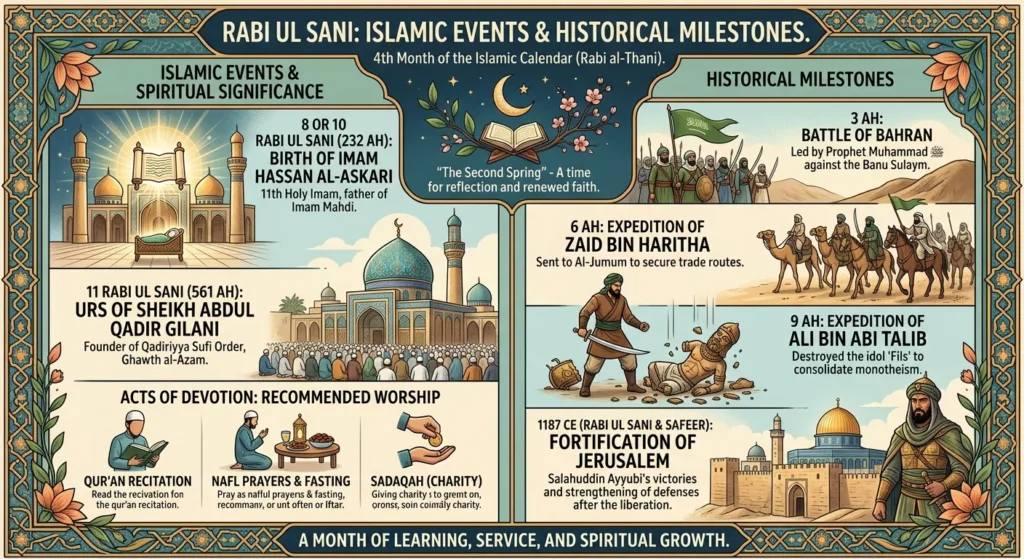
Historical reports vary regarding the exact dates of some events associated with Rabi al-Thani. The events below are included as historical associations rather than month-specific Islamic observances.
Battle of Furu’ at Buhran
Historical accounts place a battle known as Furu’ at Buhran in 3 AH, during this month.
Expedition Linked to Ali ibn Abi Talib (رضي الله عنه)
Some records report a military expedition in 9 AH during which the Prophet ﷺ appointed a companion to lead on his behalf, while he stayed in Madinah.
Note: Historical event dates in old sources can vary between scholars. Treat these as traditional reports, not fixed religious facts.
Famous Islamic Personalities Associated With Rabi ul Sani
One respected scholar is widely and consistently remembered on a specific date in this month.
| Date | Personality | Historical Note |
|---|---|---|
| 11th Rabi al-Thani | Sheikh Abdul Qadir Jilani | Death traditionally dated to 561 AH (1166 CE); a small number of sources give 17th instead. |
This is a traditional and historical association, not a religious observance required in Islam.
Abdul Qadir Jilani and Rabi ul Sani
Sheikh Abdul Qadir Jilani is the scholar most closely linked to this month. His passing is widely remembered on 11 Rabi al-Thani.
Abdul Qadir Jilani (1077–1166 CE) was a Hanbali scholar, preacher, and Sufi teacher based in Baghdad. According to historical and biographical sources, he founded the Qadiriyya, one of the oldest Sufi orders in Islamic history, and he spent much of his life teaching Quran, Hadith, and Islamic law in Baghdad. His biographical record states his death occurred on 11 Rabi al-Thani, 561 AH.
In South Asia, some followers observe 11 Rabi al-Thani as Giyarwi Sharif (“the honoured 11th”), with gatherings, Quran recitation, and charity. This is a community and traditional observance, particularly common among certain Sufi traditions — not an obligatory Islamic practice.
What matters most from his life is not the date of his death, but the values he taught:
- Tazkiyah — purifying the heart from bad habits
- Taqwa — staying aware of Allah in daily choices
- Servitude to Allah — putting Allah’s pleasure above personal desire
You don’t need a special date to practice these values. They are worth reflecting on any day of the year.
Rabi ul Sani and Self-Reflection
As the fourth month of the Islamic year, Rabi ul Sani can be a natural point for spiritual self-reflection. Since it comes soon after Muharram (the new Hijri year) and Rabi ul Awwal, it’s a good time to pause and ask honest questions:
- How is my Salah? Am I praying on time?
- Am I reading Quran regularly, or has it been sitting closed?
- Am I making enough dhikr during my normal day?
- Do I need to work on my character — patience, honesty, kindness?
- Am I helping others, or only thinking of myself?
- What spiritual goal can I set for the next three months?
This kind of quiet self-check is one of the most useful things you can do in any month, including Rabi ul Sani.
Common Misconceptions About Rabi ul Sani
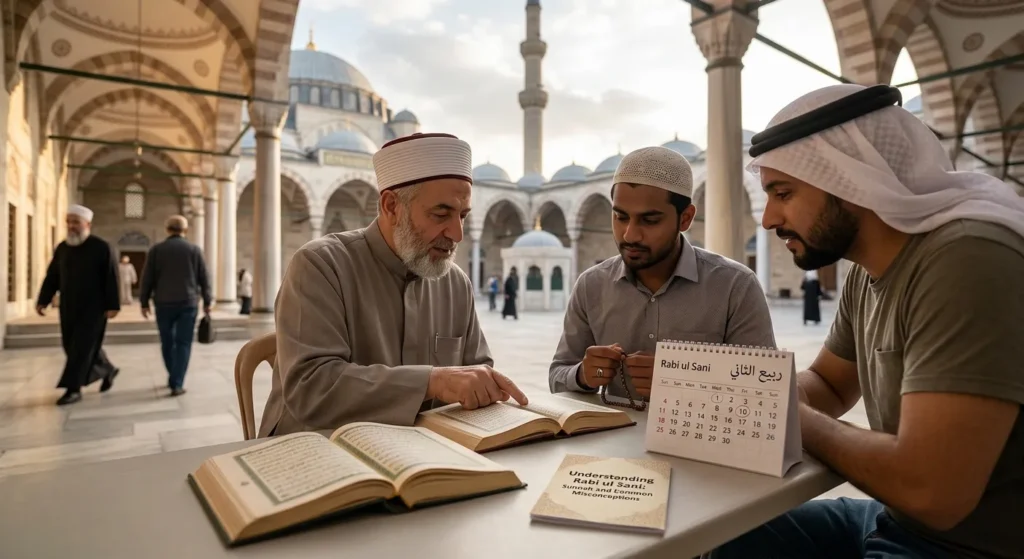
A few claims about this month spread online without real proof. Here’s the truth about each one.
“There is a special Rabi ul Sani prayer”
Not proven. No specific prayer is established as required or specially rewarded just for this month.
“Rabi ul Sani has special fasting”
Not accurate. General voluntary fasting (like Monday/Thursday) is an established practice, but there is no fast unique to this month.
“A special wazifa must be read”
Be careful here. Any claim that ties a fixed number of repetitions or a specific reward to a date needs real evidence. Without it, treat such wazifas as unproven, not obligatory.
“Rabi ul Sani is one of the sacred months”
No. The sacred months are Dhul Qa’dah, Dhul Hijjah, Muharram, and Rajab. Rabi ul Sani is not on this list.
Rabi ul Sani vs Rabi ul Awwal
| Rabi ul Awwal | Rabi ul Sani |
|---|---|
| 3rd Hijri month | 4th Hijri month |
| Widely linked to the life of Prophet Muhammad ﷺ | No single event this widely linked to it |
| Birth of the Prophet ﷺ is associated with it | Various scholars’ deaths are traditionally linked to it |
| Mawlid is marked by many communities | No universal month-specific event |
Want to know more about the third month and its prayers? Read our full guide: Rabi ul Awwal month prayers.
Frequently Asked Questions
What is Rabi ul Sani?
Rabi ul Sani is the fourth month of the Islamic calendar. It comes after Rabi ul Awwal and before Jumada al-Ula. It is also called Rabi al-Thani or Rabi ul Akhir.
What does Rabi al-Thani mean?
“Rabi” means spring, and “Thani” means second. Together, it means “the second spring,” a name traditionally connected to the season the month once fell in.
Why is Rabi ul Sani called Rabi al-Thani?
“Thani” is the Arabic word for “second.” The month is called Rabi al-Thani (the second Rabi) because it directly follows Rabi al-Awwal (the first Rabi) in the Hijri calendar.
Is Rabi ul Sani one of the four sacred months?
No. The four sacred months in Islam are Muharram, Rajab, Dhul Qa’dah, and Dhul Hijjah. Rabi ul Sani is not one of them.
Why is Rabi ul Sani also called Rabi al-Akhir?
“Akhir” means “last” in Arabic. Since Rabi ul Sani is the second and final month of the traditional “spring” pair, some communities call it Rabi al-Akhir instead of Rabi al-Thani.
Is there a special prayer for Rabi ul Sani?
No. No authentic evidence establishes a specific Salah exclusively for this month. Muslims can continue their five daily prayers, Sunnah prayers, and other established voluntary prayers as usual.
Is there a special dua for Rabi ul Sani?
No specific dua is proven to be made only for this month. You can use general, proven duas from the Quran and Hadith at any time, including this month.
Can I fast in Rabi ul Sani?
Yes, voluntary fasting such as Monday/Thursday fasts or the White Days are established practices. There is no fast that belongs only to this month.
Which Islamic personalities are traditionally associated with Rabi ul Sani?
Sheikh Abdul Qadir Jilani, a 12th-century scholar and founder of the Qadiriyya Sufi order, is the personality most consistently linked to this month. His death is traditionally remembered on 11 Rabi al-Thani, though a small number of sources give a different date.
In Closing
Rabi ul Sani may not carry the fame of Ramadan or Rabi ul Awwal, but it still holds real value. It gives every Muslim a quiet chance to check their Salah, open the Quran a little more, and turn back to Allah in small daily ways. No special ritual is needed — just steady, honest effort, in this month and every month after it.