Rabbighfirli Waliwalidayya: Meaning, Arabic Text, and Dua for Parents

You want to make dua for your parents, but you need the exact Arabic words and the real meaning. Rabbighfirli Waliwalidayya is a short, powerful line from the Quran that does just that. This guide gives you the Arabic, the English meaning, the Quran source, and how to use it for living or deceased parents.
What Does Rabbighfirli Waliwalidayya Mean?
Rabbighfirli Waliwalidayya means “My Lord, forgive me and my parents.” It is a short Arabic dua, or prayer, that a child says on behalf of themselves and their mother and father.
The phrase breaks into small parts. “Rabbi” means “My Lord.” “Ighfir li” means “forgive me.” “Wa” means “and.” “Li-walidayya” means “for my two parents.” Put together, this line asks Allah for forgiveness for the person praying and for both parents at the same time.
Rabbighfirli Waliwalidayya in Arabic
Here is the exact Arabic text of this dua.
رَبِّ اغْفِرْ لِي وَلِوَالِدَيَّ
This short line appears in the Quran, spoken by Prophet Ibrahim (as) himself. You will find the full verse and its source below.
Rabbighfirli Waliwalidayya Transliteration
If you cannot read Arabic script, use this transliteration to say the dua correctly.
Rabbighfir li waliwalidayya
You may also see it written as “Rabbi ghfir li wa liwalidayya” or “Rabbighfir lee waliwalidayya.” All these spellings point to the same Arabic words, just written differently in English letters.
Rabbighfirli Waliwalidayya English Meaning
Here is the full English translation of this dua.
“My Lord, forgive me and my parents.”
This simple line carries a deep meaning. A child asks Allah for personal forgiveness, and then asks the same mercy for their mother and father. It shows humility and love in one short prayer.
Rabbighfirli Waliwalidayya Ka Matlab (Urdu Meaning)
Many readers search for rabbighfirli waliwalidayya ka matlab or its Urdu tarjuma. Here it is in plain Urdu.
اے میرے رب! مجھے اور میرے والدین کو بخش دے۔
In simple words, this means: O my Lord, forgive me and forgive my parents too. This carries the same request found in the Arabic and English lines above.
Word-by-Word Breakdown
Seeing each Arabic word on its own helps you learn and understand the dua faster. This breakdown covers a part most guides skip.
| Arabic Word | Transliteration | Meaning |
|---|---|---|
| رَبِّ | Rabbi | My Lord |
| اغْفِرْ | Ighfir | Forgive |
| لِي | Li | For me / Me |
| وَ | Wa | And |
| لِوَالِدَيَّ | Li-walidayya | For my two parents |
Read the first three words together. They mean “My Lord, forgive me.” Read the last two words together. They mean “and my parents.”
Rabbighfirli Waliwalidayya in the Quran
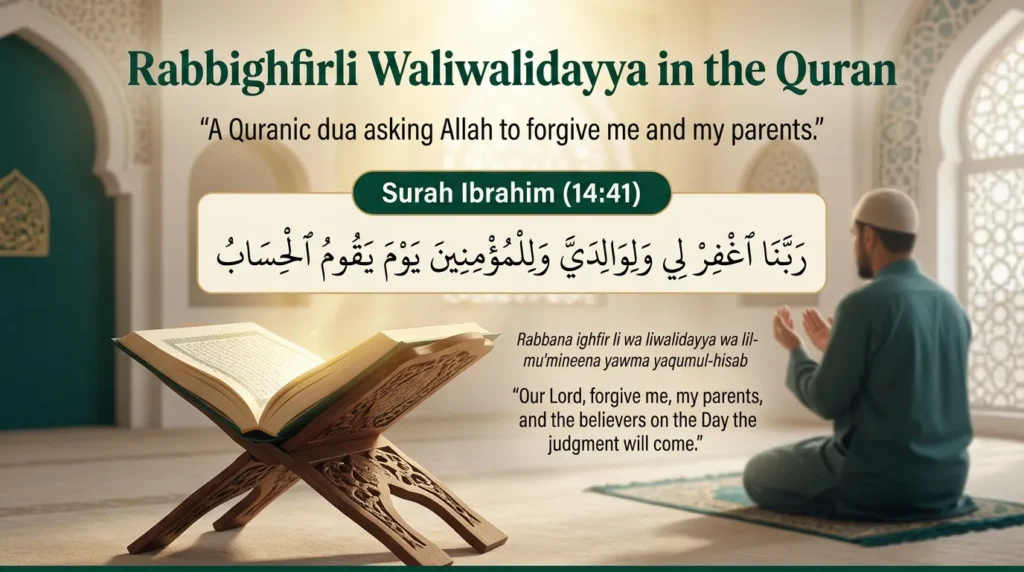
This dua comes straight from the Quran, not from a later book of supplications. That makes it especially valuable for daily prayer.
“My Lord, forgive me and my parents and the believers on the Day the account is established.” (Quran, Surah Ibrahim 14:41)
This verse belongs to a longer passage where Prophet Ibrahim (as) speaks directly to Allah. In the verses just before this one, he thanks Allah for his children and asks Allah to help him and his family keep up regular prayer. This dua for parents comes right after that, as part of the same heartfelt supplication.
Because this dua appears word-for-word in the Quran, saying it carries a special weight. You are not just saying a nice phrase. You are repeating the exact words of a Prophet, spoken with sincere love for his own parents.
Who First Said This Dua?
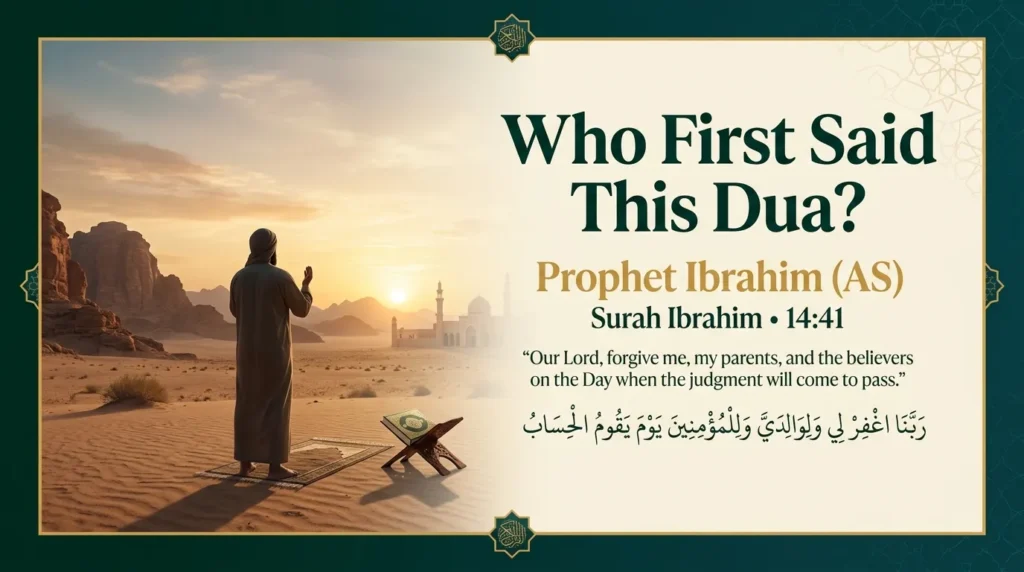
Prophet Ibrahim (as), also called Abraham, said this dua as part of his prayers recorded in Surah Ibrahim. He is known across the Quran for his strong faith and constant supplication to Allah.
This detail matters for two reasons.
- It shows the dua is proven and authentic. These are not invented words. They come directly from revealed scripture.
- It shows love for parents runs deep in Islamic history. A Prophet as great as Ibrahim (as) still made this simple request for his own parents.
How and When to Use This Dua
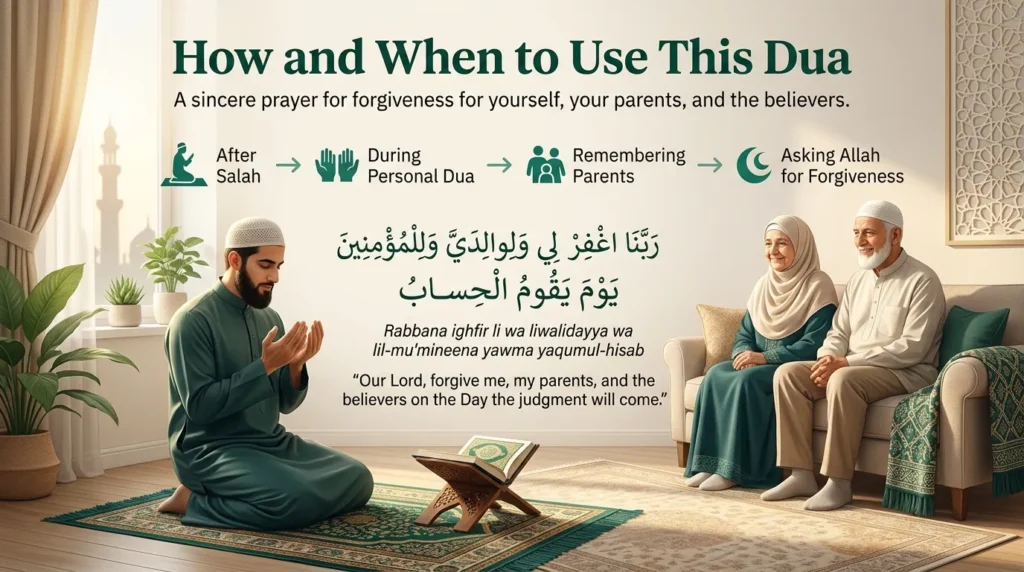
This dua fits naturally into daily life. Here are the best times and ways to use it.
- After each Salah. Many Muslims add short dua like this right after finishing their five daily prayers.
- During personal dua time. You do not need a special reason. Say it any time you think of your parents.
- Before or after visiting parents. Saying this dua before you see them, or right after, keeps their wellbeing on your heart.
- As part of daily dhikr. Add it to your regular remembrance of Allah, alongside other short duas.
- In your own language too. If your Arabic is still developing, you can also say the meaning in English or Urdu while you learn the Arabic form.
Can I Recite Rabbighfirli Waliwalidayya for Deceased Parents?
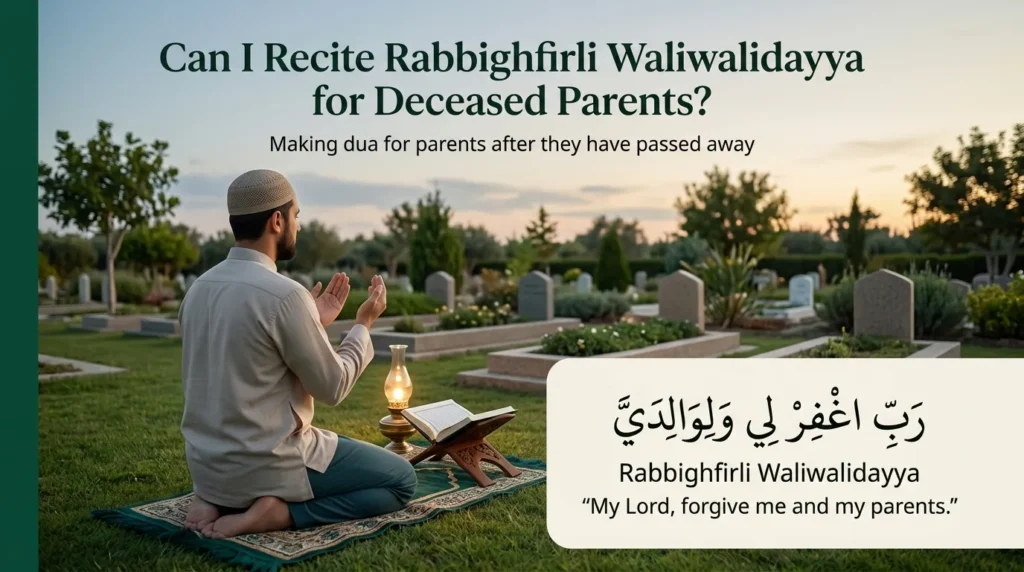
Yes, you can and should recite this dua for parents who have passed away. This is one of the most searched questions about this dua, and the answer brings real comfort.
The Prophet ﷺ said that a person’s good deeds stop after death, except for three things, including “a righteous child who prays for him” (Sahih Muslim 1631). This hadith confirms that dua from a child keeps helping a parent even after they have passed away.
So if your parents are no longer living, keep saying “Rabbighfirli waliwalidayya” for them. Your prayer still reaches them and still counts as an act of good on your part, too.
Rabbighfirli Waliwalidayya: Living Parents vs. Deceased Parents
Many readers ask if the wording changes based on whether parents are alive or have passed away. This table clears up the confusion, something most competitor pages skip entirely.
| Situation | Can You Use This Dua? | Extra Notes |
|---|---|---|
| Both parents living | Yes | Say it regularly as a dua for your parents, including after Salah if you wish. |
| One parent living, one deceased | Yes | The same wording asks Allah to forgive both parents. |
| Both parents deceased | Yes | You can continue making dua for your deceased parents. The Sunnah encourages praying for those who have passed away. |
| Parent was not Muslim | Case may differ | This situation has specific Islamic rulings, so seek guidance from a qualified and trusted scholar. |
For most readers, the Arabic wording itself does not change. The dua works the same way whether your parents are alive or have passed on.
Building a Daily Habit of Dua for Parents
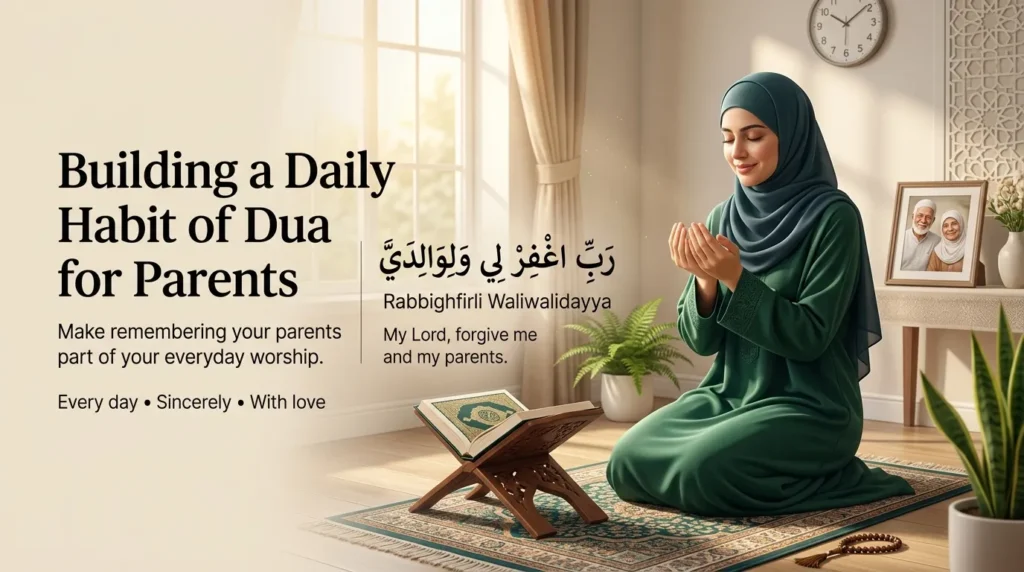
A short dua like this becomes powerful when said with real intention, not rushed out of habit. Try these simple steps.
- Attach it to Salah. Say it right after your Tasleem, while still seated.
- Picture your parents’ faces. This keeps your heart present, not just your tongue.
- Teach it to your children early. Short, meaningful dua like this is a great first step for young learners, much like early Quran memorization discussed in what age to teach your child the Quran.
- Pair it with good actions. Following dua with kindness toward your parents brings the words to life, a theme also covered in duties of parents and rights of children in Islam.
- Say it beyond Ramadan. Many people only think of parents’ forgiveness during Ramadan, but this dua fits every single day of the year, much like the reflection encouraged around Taqabbalallahu Minna wa Minkum after fasting.
This dua also connects naturally to the wider Islamic teaching on parents’ rights, a topic explored further in Islamic guidelines for parenting and child upbringing, which covers both sides of the parent-child relationship.
FAQs About Rabbighfirli Waliwalidayya
What does Rabbighfirli Waliwalidayya mean?
It means “My Lord, forgive me and my parents.” It is a short Quranic dua asking Allah’s forgiveness for the person praying and both parents.
Where is Rabbighfirli Waliwalidayya in the Quran?
It appears in Surah Ibrahim, chapter 14, verse 41 (Quran 14:41), spoken by Prophet Ibrahim (as).
Which surah contains Rabbighfirli Waliwalidayya?
Surah Ibrahim contains this dua. It sits near the end of a longer supplication by Prophet Ibrahim (as) about his family and prayer.
How do you pronounce Rabbighfirli Waliwalidayya?
Say it as “Rab-bigh-fir lee wa-li-wa-li-day-ya,” stressing the “gh” sound softly, like a breath from the throat.
Can I recite this dua for my deceased parents?
Yes. A child’s prayer for a parent still benefits them after death, based on an authentic hadith about deeds that continue after a person dies (Sahih Muslim 1631).
When should I read Rabbighfirli Waliwalidayya?
You can read it any time, but many Muslims say it after Salah, during daily dhikr, or whenever they think of their parents.
Is this dua only for living parents?
No. The same wording works for living and deceased parents. The intention behind the dua matters more than the wording changing.
Final Word
Rabbighfirli Waliwalidayya is short, but it carries a Prophet’s own love for his parents. Say it often, say it with meaning, and let it remind you to treat your parents with the same care behind these words. May Allah forgive us and forgive our parents, just as this dua asks.