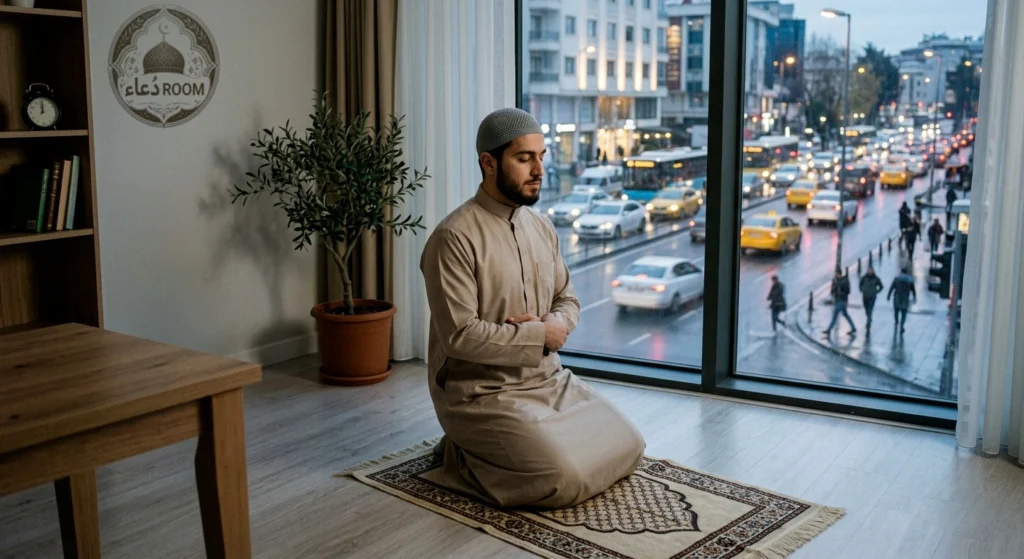
Tawakkaltu Alallah Meaning: The Full Dua, Arabic Text, and Hadith Proof

Tawakkaltu ‘ala Allah means “I have placed my trust in Allah,” or “I rely upon Allah.” It is part of a dua the Prophet Muhammad ﷺ taught Muslims to say when leaving the house. The full dua begins with “Bismillah” and ends with “La hawla wa la quwwata illa billah.”
Do you want to feel safe every time you step out of your door? This guide gives you the exact Arabic words, the real hadith behind them, and simple answers to every question people ask about this dua.
What Does Tawakkaltu Alallah Mean?
Tawakkaltu alallah means “I have placed my trust in Allah.” It comes from the Arabic word tawakkul, which means trust or reliance.
You may also see it spelled tawakkal allah, tawakkal to allah, or thawakkalthu alallah. These are all different ways people write the same Arabic phrase in English letters.
Word-by-Word Meaning
Here is a simple table that breaks down each word:
| Arabic | Transliteration | Meaning |
|---|---|---|
| تَوَكَّلْتُ | Tawakkaltu | I have placed my trust |
| عَلَى | ‘Ala | Upon / on |
| اللَّهِ | Allah | Allah |
Put together, tawakkaltu ‘ala Allah means “I have placed my trust upon Allah.” It shows that a person is handing a matter over to Allah, while still doing their own part.
Tawakkaltu alallah is only part of a longer dua. On its own, it is a short phrase of trust. But the well-known hadith about leaving the house gives the full wording, which starts with Bismillah and ends with la hawla wa la quwwata illa billah. The next section gives you that complete dua.
Bismillahi Tawakkaltu Alallahi: The Full Dua in Arabic

The full dua people search for is bismillahi tawakkaltu ala allah. This is the dua the Prophet ﷺ taught Muslims to say when leaving the house.
Here is the dua in Arabic:
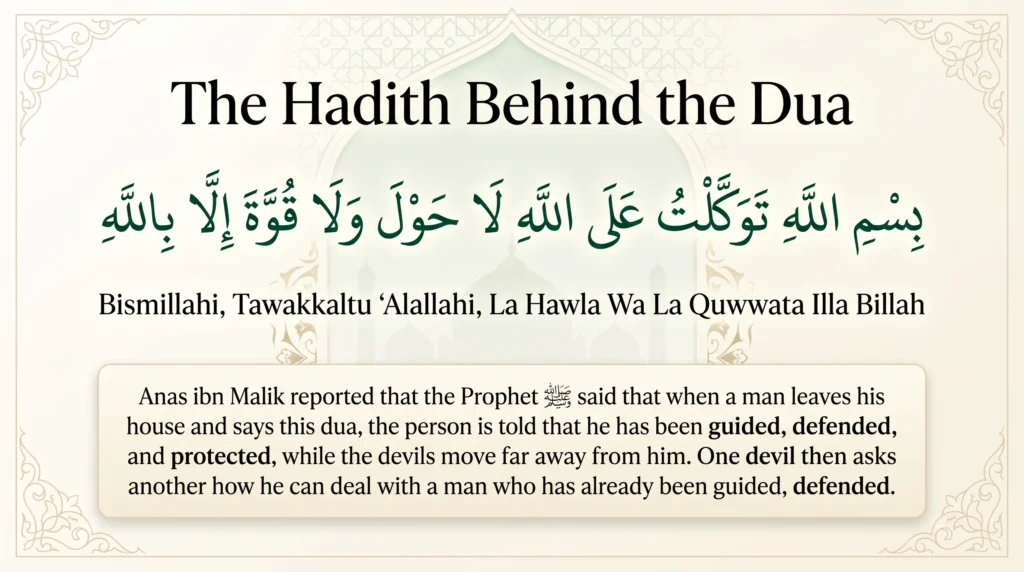
بِسْمِ اللَّهِ تَوَكَّلْتُ عَلَى اللَّهِ لاَ حَوْلَ وَلاَ قُوَّةَ إِلاَّ بِاللَّهِ
Here is how to say it in English letters:
Bismillahi, tawakkaltu ‘alallahi, la hawla wa la quwwata illa billah
Here is what it means:
“In the name of Allah, I trust in Allah. There is no power and no strength except with Allah.”
This whole dua has three parts. Here is the literal meaning of each one:
- Bismillah — “In the name of Allah.”
- Tawakkaltu ‘ala Allah — “I have placed my trust in Allah.”
- La hawla wa la quwwata illa billah — “There is no power or strength except through Allah.”
Together, these three lines move from starting an action in Allah’s name, to trusting Him with it, to admitting that all power belongs to Him alone.
The Hadith Behind This Dua
This dua is not just a nice phrase people made up. It comes from a real, verified hadith.
Anas ibn Malik reported that the Prophet ﷺ said that when a man leaves his house and says this dua, the person is told that he has been guided, defended, and protected, while the devils move far away from him. One devil then asks another how he can deal with a man who has already been guided, defended, and protected. This hadith is graded Sahih (authentic) by Shaykh al-Albani, and you can read it in full on Sunan Abi Dawud 5095.
This hadith provides direct evidence for saying this dua when leaving the house. Every part of the Arabic wording above comes straight from it.
Why “La Hawla Wala Quwwata Illa Billah” Matters So Much
The last part of this dua is its own famous phrase. The Prophet ﷺ once asked his companion Abu Musa if he should tell him about a treasure from the treasures of Paradise. Abu Musa said yes. The Prophet ﷺ then taught him this very phrase, as recorded in Sahih al-Bukhari and Sahih Muslim.
If you want to go deeper into this specific phrase, read our full guide on la hawla wala quwwata illa billah, including where it comes from and when to say it.
Where Trusting Allah Comes From in the Quran
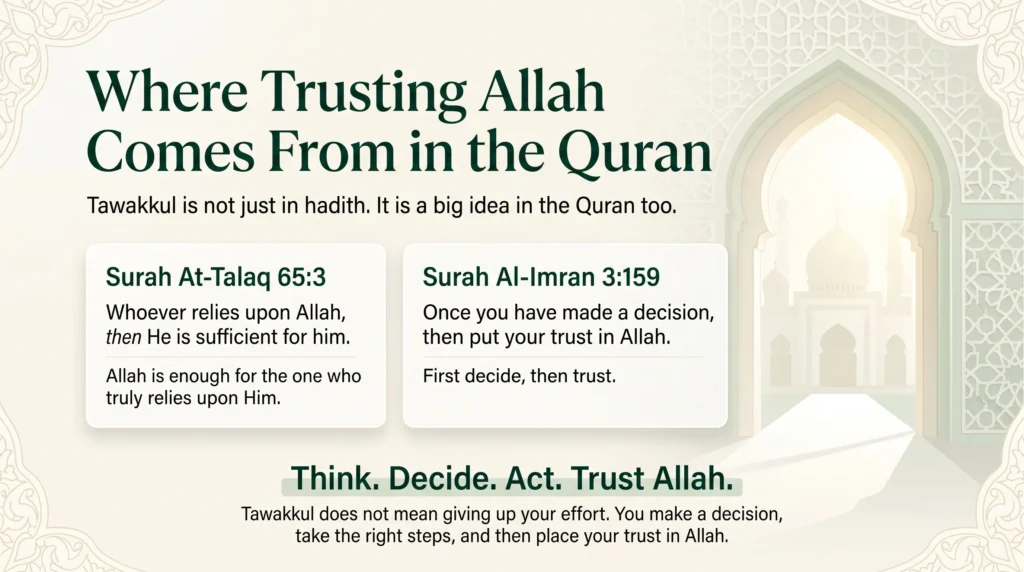
Tawakkul is not just in hadith. It is a big idea in the Quran too.
The verse teaches that whoever relies upon Allah, Allah is sufficient for them (see Surah At-Talaq, 65:3). This does not mean every worry disappears exactly as we wish. It means Allah is enough for the one who truly relies on Him, and He knows what is best.
Allah also says that once you have made a decision, you should then put your trust in Him, because Allah loves those who rely on Him (see Surah Al-Imran, 3:159). This verse teaches something important: first decide, then trust. You do not skip the thinking part.
Tawakkul in Islam: Relying on Allah While Taking the Proper Means
Some people think tawakkul means doing nothing and just waiting. This is wrong.
A man once asked the Prophet ﷺ, “Shall I tie it and rely upon Allah, or leave it loose and rely upon Allah?” The Prophet ﷺ replied, “Tie it and rely upon Allah” (see Jami’ at-Tirmidhi 2517, graded Hasan by Darussalam). This short story gives a clear example of how tawakkul works. You do your part. Then you trust Allah with the rest.
The Prophet ﷺ also said that if people truly relied on Allah, He would provide for them the way He provides for birds. Birds leave their nests hungry in the morning, and come back full in the evening (see Jami’ at-Tirmidhi 2344). The birds still fly out and search. They do not just sit in the nest.
In short, tawakkul means relying on Allah while taking the proper means. If you want to study this whole concept in more depth, our guide on tawakkul in Islam covers more verses and daily examples.
When Should You Say Tawakkaltu Alallah?
The specific Sunnah occasion established by the hadith is leaving the house. That is the one clear, established time for this exact dua.
Outside that occasion, a person may use these words as a general expression of trust in Allah. Some Muslims say them in moments like:
- Starting a journey
- Before something hard, like a job interview or a test
- When feeling worried
- After finishing their best effort on a task
These additional situations are personal uses of the meaning. They should not be presented as specific Sunnah occasions for this dua, the way leaving the house is.
Tawakkaltu Alallah vs. Similar Duas
Many similar phrases exist, and people often mix them up. Here is a simple table to compare them:
| Dua | Meaning | Best Time to Say It |
|---|---|---|
| Tawakkaltu Alallah | “I trust in Allah” | Leaving the house; also usable as a personal dua before starting something. |
| Hasbunallahu wa ni’mal wakeel | “Allah is enough for us, and He is the best guardian” | During hardship, fear, or when feeling wronged. |
| La hawla wala quwwata illa billah | “There is no power except with Allah” | When facing weakness, hard news, or shock. |
Want to explore the second one? Read our guide on hasbunallahu wa ni’mal wakeel to see its meaning, hadith, and benefits.
Common Mistakes About Tawakkul
Mistake 1: “Tawakkul means I don’t need to try.” This is false. Real tawakkul means relying on Allah while still taking the proper means. The story of the man and his camel shows this clearly.
Mistake 2: “Tawakkul means I should feel nothing.” Trusting Allah does not remove normal feelings like worry. It means you do not let worry control your choices. You act, then let go.
Mistake 3: “This dua is only for men.” The Arabic word tawakkaltu simply means “I have placed my trust.” It fits anyone, male or female, who says it with sincerity.
How to Make This Dua a Daily Habit
- Say it every time you walk out your front door, out loud or quietly.
- If you are leaving home to seek work or income, our page on a powerful dua for rizq pairs well with this habit.
- If you are heading into a place with conflict or unkind people, see our guide on a dua for protection from enemies.
- You may also choose to recite Ayat al-Kursi as a separate act of worship during your day.
- Teach it to your children so it becomes part of their morning routine too.
Frequently Asked Questions
What does Tawakkaltu Alallah mean?
It means “I have placed my trust in Allah.” It shows that a person is handing a matter over to Allah, while still doing their own part.
What is the full Bismillahi Tawakkaltu Ala Allah dua?
The full dua is: Bismillahi, tawakkaltu ‘alallahi, la hawla wa la quwwata illa billah. It means, “In the name of Allah, I trust in Allah. There is no power and no strength except with Allah.” It comes from Sunan Abi Dawud 5095.
Is Tawakkaltu Alallah found in the Quran or only in hadith?
The exact wording of the full dua comes from hadith, specifically Sunan Abi Dawud 5095. But the idea of trusting Allah, tawakkul, appears many times in the Quran, including Surah At-Talaq 65:3 and Surah Al-Imran 3:159.
When should I say Tawakkaltu Alallah?
The hadith connects it directly with leaving the house. Outside that occasion, some Muslims also say it as a personal dua before a journey, a hard task, or after finishing their best effort on something.
Does trusting Allah mean I should stop working hard?
No. Islam teaches that you must still act and try. The Prophet ﷺ told a man to tie his camel first, then trust Allah. Reliance and effort go together.
What is the difference between Tawakkaltu Alallah and Hasbunallahu wa ni’mal wakeel?
Tawakkaltu Alallah is tied to leaving home and is also said before or during an action. Hasbunallahu wa ni’mal wakeel is usually said during hardship or when someone feels wronged.
Can I say this dua in English instead of Arabic?
Yes, you can say the meaning in your own language. But saying it in Arabic connects you to the exact words in the hadith, so many Muslims try to learn the Arabic too.
A Short and Sincere Reminder
Every time you leave your house, you face the unknown. You do not know what the day holds. But you are not walking out alone.
Say Bismillahi tawakkaltu ‘ala Allah, and step outside while placing your trust in Allah. Try your best in everything you do. Then trust Him with the rest.