What is Impact of Quranic Storytelling on Children ?
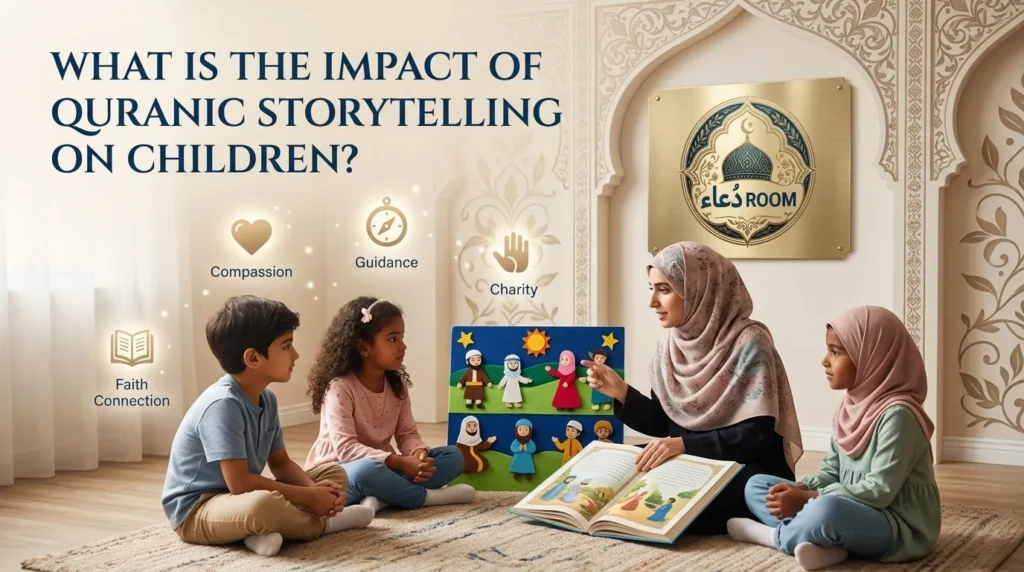
The impact of Quranic storytelling on children is powerful because stories reach places that ordinary instructions often can’t. A parent may say, “Be patient,” and a child may nod without fully understanding. But when we tell the story of Prophet Yusuf عليه السلام being separated from his family, facing hardship, staying faithful, and eventually forgiving those who hurt him, patience becomes visible. It becomes something the child can imagine, feel, and remember. That’s the beauty of Quranic storytelling: it turns values into living examples.
The Quran itself presents stories as a source of lessons. In Surah Yusuf 12:111, the Quran states that in their stories there is truly a lesson for people of reason, and describes revelation as guidance and mercy for people of faith. This gives Quranic stories a unique status. They aren’t random tales, bedtime fillers, or cultural folklore. They are divinely selected accounts that teach belief, character, worship, patience, justice, repentance, and hope. (Quran.com)
Quranic Stories Are More Than Entertainment
Children enjoy stories because stories feel like journeys. They have people, choices, emotions, tests, danger, relief, and endings that make sense. But Quranic stories for children go beyond entertainment because they carry guidance from Allah. They teach children that life has purpose, Allah sees everything, truth matters, good character wins in the end, and hardship can become a path to growth. When a child hears the story of Prophet Yunus عليه السلام making dua in darkness, they learn that Allah listens even when life feels scary. When they hear the story of Maryam عليها السلام, they learn modesty, trust, and strength.
Modern child development resources also support the value of storytelling. UNICEF describes storytelling as a powerful tool for teaching language, reading, listening, imagination, and early learning. UNICEF also notes that early childhood is a critical window for holistic development and that children need responsive caregiving, including talking, singing, and playing with loving caregivers. (UNICEF) This supports what many Muslim parents already notice at home: children absorb lessons better when they hear them through warm, repeated, meaningful interaction.
Why Children Remember Stories Better Than Lectures
Children don’t usually remember long lectures. They remember moments. They remember how a story made them feel. They remember the brave child, the patient prophet, the jealous brothers, the powerful ruler, the sincere dua, and the surprising ending. That’s why storytelling is like planting a seed in soft soil. The lesson may not appear immediately, but it grows quietly in the child’s heart.
When we use Islamic storytelling for kids , we give children mental pictures they can return to later. A child who feels jealous of a sibling can remember the story of Prophet Yusuf عليه السلام and his brothers. A child who feels afraid can remember Prophet Musa عليه السلام facing Fir‘awn with trust in Allah. A child who makes a mistake can remember that repentance is always possible. In this way, Quranic storytelling becomes a moral compass. It doesn’t only tell children what to do; it gives them examples to follow when real life becomes confusing.
Spiritual Impact of Quranic Storytelling on Children

The spiritual impact of Quranic storytelling on children begins with connection. Children may not understand abstract theology at a young age, but they understand stories. They may not fully grasp long explanations about tawheed, qadar, sabr, or tawakkul, but they can understand that Prophet Ibrahim عليه السلام trusted Allah, Prophet Musa عليه السلام asked Allah for help, and Prophet Yusuf عليه السلام stayed patient even when life was unfair. Through stories, children begin to see Allah’s names and attributes in action.
Building Love for Allah Through Stories
One of the biggest goals of Islamic parenting is to help children love Allah, not only fear punishment. Quranic stories help us do this naturally. When we tell children how Allah saved Prophet Musa عليه السلام, provided for Maryam عليها السلام, accepted the dua of Prophet Yunus عليه السلام, and raised the rank of Prophet Yusuf عليه السلام after years of hardship, children begin to see Allah as Merciful, Powerful, Wise, Near, and Caring. Their young hearts learn that Allah is not distant. Allah listens, guides, protects, and rewards patience.
This matters because children form emotional impressions before they form detailed beliefs. If Islam is introduced only through commands, warnings, and correction, a child may see religion as pressure. But when Islam is introduced through Quranic stories full of mercy, hope, courage, and beautiful outcomes, the child begins to feel that faith is a safe home. They learn that Allah’s guidance is not a burden; it is a light.
Teaching Tawheed, Trust, and Dua
Quranic storytelling for children is one of the easiest ways to teach tawheed. Instead of giving a formal definition only, we show children tawheed through the lives of the prophets. Prophet Ibrahim عليه السلام teaches that worship belongs only to Allah. Prophet Nuh عليه السلام teaches that a believer keeps calling to Allah even when people reject the truth. Prophet Musa عليه السلام teaches that power belongs to Allah, even when tyrants appear strong. Prophet Yunus عليه السلام teaches that no darkness is too deep for Allah’s mercy.
Dua also becomes easier to understand through stories. Children hear that prophets made dua in moments of fear, sadness, danger, and need. This teaches them that dua isn’t only for adults or only after salah. A child can make dua before an exam, when afraid at night, when missing someone, when feeling guilty, or when hoping for something good. The story gives the child permission to turn to Allah with a real heart.
Helping Children Love the Quran
Many children first meet the Quran through recitation lessons, Qaida pages, memorization targets, or tajweed correction. These are important, but if they are the only Quranic experience a child has, the Quran may feel like a school subject. Storytelling adds warmth. It tells the child, “The Quran speaks to your life. It has people, feelings, tests, choices, and lessons for you.”
The Quran describes Surah Yusuf as among the best of stories, and the full chapter shows how one story can teach patience, jealousy, family conflict, temptation, prison, leadership, forgiveness, and trust in Allah. (Quran.com) When children hear these stories in age-appropriate language, they begin to feel curiosity. They ask, “What happened next?” That question is gold. It means the child is leaning toward the Quran, not away from it.
Moral and Emotional Benefits of Quranic Stories

The moral impact of Quranic storytelling on children is visible in their daily choices. Stories help children understand right and wrong without feeling attacked. If a parent says, “Don’t lie ,” the child may feel blamed. But if the parent tells a story about truthfulness, trust, and consequences, the child receives the lesson with less resistance. Stories create a gentle distance between the child and the correction. The child can think, “What would I do?” without feeling shamed.
Teaching Honesty, Patience, Courage, and Gratitude
Quranic stories teach moral values in a complete way. Honesty is not only a rule; it is part of being trustworthy before Allah. Patience is not simply waiting; it is staying faithful when things are hard. Courage is not being loud; it is doing what is right even when afraid. Gratitude is not just saying Alhamdulillah; it is recognizing that every blessing comes from Allah and using it well.
For example, the story of Prophet Yusuf عليه السلام teaches children that jealousy can harm families, but forgiveness can heal them. Many Islamic learning resources for children highlight Prophet Yusuf’s story as a model of patience, forgiveness, and trust in Allah’s plan. (sahlah.net) This is a lesson children can use when they fight with siblings, feel left out, or struggle to forgive someone who hurt them.
Developing Emotional Intelligence and Empathy
Children need emotional vocabulary. They need to understand sadness, fear, jealousy, regret, hope, and relief. Quranic stories help them name these feelings safely. When we say, “Prophet Yaqub عليه السلام felt deep sadness when he missed Yusuf,” children learn that sadness is real and not shameful. When we say, “Yusuf’s brothers felt jealousy, but jealousy led them to do something wrong,” children learn that feelings must be managed with taqwa.
Storytelling also builds empathy. A child begins to ask, “How did Yusuf feel in the well?” “How did Musa’s mother feel when she placed him in the river?” “How did Yunus feel in the darkness?” These questions stretch the child’s heart. They help the child imagine another person’s pain, fear, and hope. Emotional intelligence grows when children are guided to feel with others, not only think about themselves.
Strengthening Resilience During Hard Times
Life will not always be easy for children. They may face failure, bullying, loneliness, sibling conflict, school pressure, illness, or disappointment. Quranic storytelling gives them inner tools before those tests arrive. It teaches them that hardship doesn’t mean Allah has abandoned them. Many prophets faced difficulty, yet Allah’s help came in the best time and the best way.
This is one reason Quranic storytelling is so valuable in modern parenting . Children today often face fast emotions and quick distractions. Stories slow them down. They teach them to wait, reflect, and trust. A child who knows the story of Yusuf عليه السلام may understand that one bad day isn’t the whole story. A child who knows the story of Musa عليه السلام may understand that courage can begin with fear and still move forward.
Educational and Language Benefits of Quranic Storytelling
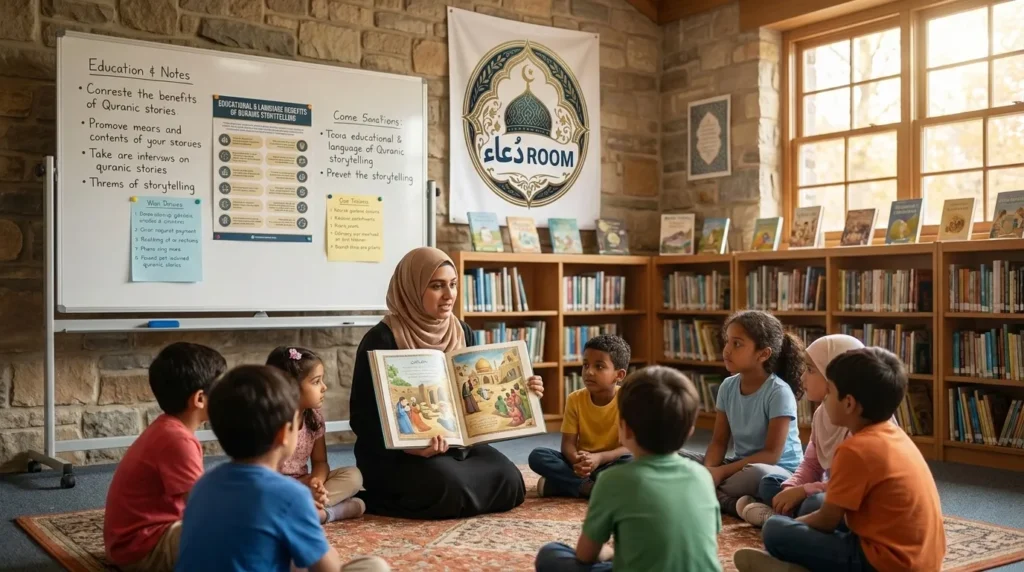
The educational impact of Quranic storytelling on children is also important. Storytelling improves listening, attention, vocabulary, memory, sequencing, and comprehension. Children learn how events connect: first this happened, then this happened, because of that, this result followed. That’s not only Islamic learning; that’s thinking skill. When children retell Quranic stories, they practice language, logic, memory, and moral reasoning at the same time.
Improving Listening, Vocabulary, and Focus
Storytelling trains children to listen. In a world of short videos and fast scrolling, listening has become harder for many children. A well-told Quranic story helps them sit, imagine, and follow a sequence. Even if they interrupt with questions, that’s not a failure. That’s engagement. UNICEF’s parenting guidance notes that reading picture books and talking with children helps them understand language and everyday meaning, and that this kind of interaction doesn’t require expensive tools.(UNICEF)
Quranic storytelling also introduces children to rich vocabulary: patience, mercy, forgiveness, trust, repentance, justice, gratitude, guidance, and courage. These words may sound big at first, but stories make them understandable. A child may not define “forgiveness” like a dictionary, but after hearing Prophet Yusuf عليه السلام forgive his brothers, the child understands what forgiveness looks like.
Making Islamic Learning Easier for Young Minds
Young children learn through concrete examples. Abstract Islamic concepts can be hard unless we connect them to something visible. Tawakkul becomes clearer when we tell the story of Musa عليه السلام at the sea. Sabr becomes clearer through Yusuf عليه السلام. Tawbah becomes clearer through Yunus عليه السلام. Tawheed becomes clearer through Ibrahim عليه السلام. In this way, Quranic storytelling becomes a bridge between belief and understanding.
Parents and teachers can use a simple method: story, feeling, lesson, action. First, tell the story. Then ask what the character may have felt. Then explain the Islamic lesson. Finally, connect it to one action the child can do today. For example, after the story of Prophet Yunus عليه السلام, the action may be, “When we make a mistake, we say sorry and ask Allah to forgive us.” That’s clear, simple, and memorable.
Connecting Quranic Lessons With Daily Life
The real value of storytelling appears when children use the lessons in daily life. If siblings fight, we can gently remind them of Yusuf عليه السلام and forgiveness. If a child is afraid, we can remind them of Musa عليه السلام and trust in Allah. If a child wastes food, we can tell stories that teach gratitude and responsibility. If a child feels lonely, we can remind them that Allah is always near.
This connection must be gentle. We shouldn’t turn every story into a heavy lecture. Children can smell a lecture from far away, and they often run from it. A better method is to ask, “What can we learn from this?” or “How can we use this tomorrow?” Let the child answer. When children discover the lesson themselves, it sticks.
Best Quranic Stories to Teach Children
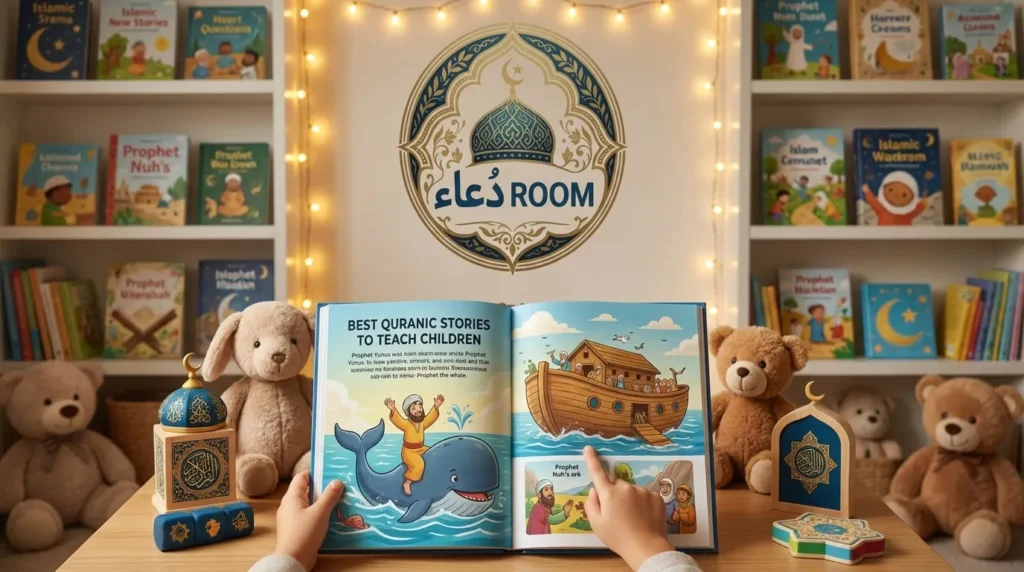
Choosing the right story matters. Some Quranic stories contain complex adult themes, so parents should adapt them according to age. We don’t need to include every detail for young children. We should focus on the lesson, keep the language clean and simple, and avoid frightening descriptions that a child isn’t ready for. The best Quranic stories for kids are the ones that match their emotional age and daily life.
Prophet Yusuf: Patience and Forgiveness
The story of Prophet Yusuf عليه السلام is one of the most complete stories to teach children . It includes family jealousy, separation, hardship, temptation, prison, leadership, reunion, and forgiveness. For young children, we can focus on simple lessons: jealousy hurts, Allah protects, patience is beautiful, and forgiveness is noble. For older children, we can discuss deeper lessons such as self-control, trust in Allah’s timing, and staying righteous when nobody is watching.
This story is especially useful for sibling issues. Children often struggle with jealousy, fairness, attention, and competition. The story of Yusuf عليه السلام gives parents a powerful way to discuss these emotions without directly blaming the child. We can ask, “What happened when jealousy grew in the hearts of Yusuf’s brothers?” Then we can ask, “What could they have done instead?” This helps children think morally.
Prophet Musa: Courage and Trust in Allah
The story of Prophet Musa عليه السلام teaches courage in many forms. His mother showed courage when she trusted Allah. Musa عليه السلام showed courage when he stood before Fir‘awn. The believers showed courage when they followed him. Children can learn that courage doesn’t mean never feeling afraid. Courage means trusting Allah and doing the right thing despite fear.
This story is helpful for children who feel nervous, shy, or weak. A child afraid of school, exams, darkness, or standing up for truth can benefit from hearing how Allah helped Musa عليه السلام in impossible situations. It teaches that Allah’s help can come in ways we don’t expect.
Prophet Ibrahim: Tawheed and Sacrifice
The story of Prophet Ibrahim عليه السلام is a strong foundation for teaching tawheed . Children learn that worship belongs only to Allah, that truth matters even when others disagree, and that obedience to Allah is the highest path. For young children, the message can be simple: Prophet Ibrahim عليه السلام loved Allah and worshipped only Him. For older children, parents can discuss courage, sacrifice, and rejecting false beliefs.
This story also helps build Islamic identity. Children learn that Muslims follow the path of prophets who stood for truth with dignity. They begin to see faith as something strong, beautiful, and honorable.
Practical Ways Parents Can Use Quranic Storytelling at Home

Parents don’t need to be scholars to use Quranic storytelling well. They need sincerity, reliable sources, age-appropriate language, and consistency. The impact of Quranic storytelling on children becomes stronger when stories are repeated, discussed, acted upon, and connected with family life. A single story told once may entertain, but a story returned to many times can shape character.
Bedtime Quran Stories
Bedtime is one of the best times for Quranic storytelling . Children are calmer, the home is quieter, and the heart is softer. A short five-minute story can become a memory that lasts for years. We can tell one part of a story each night rather than rushing through everything. This keeps children curious and gives them time to absorb the lesson.
A good bedtime pattern is simple: tell the story, ask one gentle question, mention one lesson, and end with dua. For example, after telling part of the story of Prophet Yunus عليه السلام, we can say, “What did he do when he was in difficulty?” Then we explain that he called upon Allah. Then we make dua together: “O Allah, help us remember You when we feel scared.”
Family Quran Story Circles
A weekly family story circle can make Islamic learning feel special. It doesn’t need to be formal. The family can sit after Maghrib, choose one Quranic story, read a short passage from a reliable source, and discuss one lesson. Children can draw a scene, retell the story, or share what they learned. Playful family interaction supports learning and parent-child connection, and UNICEF also highlights play as important for learning, resilience, inclusion, and family relationships.(UNICEF)
Family story circles also help older and younger children learn together. Younger children enjoy the story, while older children can discuss deeper meanings. Parents can ask age-based questions so every child participates.
Age-Based Storytelling Methods
| Age Group | Best Method | Example |
|---|---|---|
| 3–5 Years | Short, simple stories with repetition to build familiarity and love for Allah. | “Allah helped Prophet Musa.” |
| 6–8 Years | Tell the story and highlight one clear moral lesson they can practice daily. | “Tell the truth even when it’s hard.” |
| 9–12 Years | Encourage discussion, reflection, and connect the story with real-life situations. | “How do we handle jealousy?” |
| 13+ Years | Explore deeper meanings through reflection, tafsir, identity, and personal decision-making. | “What does this story teach about peer pressure?” |
The key is not to overload children. A four-year-old doesn’t need a long analysis. A teenager doesn’t need a baby version. When we match the method to the child’s age, Quranic storytelling becomes enjoyable and effective.
FAQs About Effect Of Quranic Storytelling for Children
1. What is the main impact of Quranic storytelling on children?
The main impact of Quranic storytelling on children is that it helps them understand Islam through examples they can remember. Stories teach faith, patience, honesty, courage, gratitude, forgiveness, and trust in Allah in a natural way. Instead of feeling like a lecture, the lesson feels like a journey. Children can imagine the people in the story, feel their struggles, and connect the lesson to their own lives. This makes Quranic storytelling one of the most effective tools for Islamic parenting and character building.
2. At what age should parents start Quranic storytelling?
Parents can begin Quranic storytelling from a very young age, even around three or four years old, as long as the stories are simple and gentle. At this age, children don’t need complex details. They need warmth, repetition, and clear lessons such as “Allah helps us,” “We should tell the truth,” and “We should be kind.” As children grow older, parents can add more detail, reflection, and discussion. The same story can be taught at different levels as the child matures.
3. Which Quranic story is best for young children?
For young children, the stories of Prophet Yusuf عليه السلام, Prophet Musa عليه السلام, Prophet Yunus عليه السلام, and Prophet Ibrahim عليه السلام are very beneficial when told in simple language. Prophet Yusuf’s story teaches patience and forgiveness. Prophet Musa’s story teaches courage and trust in Allah. Prophet Yunus’s story teaches repentance and dua. Prophet Ibrahim’s story teaches tawheed and love for Allah. Parents should choose the story based on the child’s age, personality, and current needs.
4. How can parents make Quranic stories fun without disrespect?
Parents can make Quranic stories engaging through voice, questions, drawings, story cards, family discussions, and bedtime routines while keeping respect for the Quran. The goal is not to turn sacred stories into silly entertainment. The goal is to make the child listen with interest and love. Parents can ask questions like, “What do you think happened next?” or “How do you think he felt?” This keeps children involved while preserving the seriousness and beauty of the lesson.
5. Should Quranic stories include Arabic verses?
Yes, Arabic verses can be included, especially for older children, but parents should also explain the meaning in simple English. For younger children, it may be enough to mention that “Allah tells us this story in the Quran.” As they grow, parents can show them the verse, read the translation, and explain the lesson. This helps children connect storytelling directly with the Quran, not just with general Islamic culture.
6. Can Quranic storytelling improve children’s behavior?
Yes, Quranic storytelling can improve behavior when parents connect stories with daily actions. A story about honesty can help when a child lies. A story about patience can help when a child is frustrated. A story about forgiveness can help during sibling conflict. The change may not happen overnight, but repeated stories create moral memory. Over time, children begin to use those examples when making choices.
Conclusion
The impact of Quranic storytelling on children reaches the heart, mind, language, emotions, and behavior. It helps children love Allah, understand the Quran, build Islamic identity, develop moral values, and face life with patience and trust. Quranic stories don’t only teach children what happened in the past; they teach them how to live today.
When parents use Quranic storytelling with warmth, accuracy, and consistency, children begin to see Islam as meaningful and beautiful. They learn that the Quran is not distant from their lives. It speaks to jealousy, fear, sadness, courage, mistakes, forgiveness, family, and hope. That connection is priceless.
A home that tells Quranic stories becomes a home of reflection. Children grow up with examples in their hearts: Yusuf عليه السلام forgiving, Musa عليه السلام trusting, Ibrahim عليه السلام standing for tawheed, Yunus عليه السلام making dua, and Maryam عليها السلام relying on Allah. These stories become lights along the road of childhood, guiding children toward faith, character, and confidence.
May Allah make the Quran beloved to our children, fill their hearts with guidance, and help us teach them His stories with wisdom, mercy, and sincerity.