
Fi Amanillah Meaning: What It Means and When Muslims Say It

You just heard someone say “fi amanillah” and you want to know what it means. Maybe a friend texted it before a trip. Maybe you want to say it correctly yourself. This guide gives you the plain meaning, the Arabic spelling, and the right way to reply — in simple words.
Fi Amanillah Meaning In English

Fi Amanillah means “in the protection of Allah.” It is a short prayer said when leaving someone, like saying goodbye.
The person says it to wish safety on the other person. It is close to saying “go safely” or “God keep you safe.” Allah is the Arabic word for God. So the full feeling behind the phrase is: “I leave you in God’s care.”
Some people say it a bit differently. You may see:
- Fi Amanillah
- Fee Amanillah
- Fi Aman Allah
- Fi Aman illah
All of these point to the same phrase. They are just different ways people spell the sound in English letters.
Fi Amanillah In Arabic

The Arabic spelling is في أمان الله.
Arabic: في أمان الله Transliteration: Fee A-maan-il-lah Meaning: In the protection of Allah
Say it slowly at first: Fee (like “fee” you pay) — A-man (like “a mon”) — il-lah (like “ill-lah”). Put together, it flows as “Fee-a-man-il-lah.”
What Do the Three Words Mean?
The phrase has three simple Arabic words joined together. Breaking it down helps you understand why it carries real spiritual weight, not just polite habit.
| Arabic Word | Simple Meaning | Role in the Phrase |
|---|---|---|
| Fi في | “in” or “within” | Sets the location — you are placing someone in something. |
| Aman أمان | “safety” or “protection” | The thing you are placing them in. |
| Allah الله | God | Who is doing the protecting. |
Put them together and you get “in the safety/protection of Allah.” It is not a wish thrown into the air. It names Allah directly as the protector. That is what makes it a dua — an Islamic word for a prayer or request made to God.
Fi Aman Allah vs. Similar Farewell Phrases
Muslims use a few different farewell phrases, and they are not all exactly the same. Knowing the differences helps you pick the right one.
| Phrase | Arabic | Literal Meaning | Common Feel |
|---|---|---|---|
| Fi Amanillah | في أمان الله | In the protection of Allah | Formal, common in Arab countries |
| Allah Hafiz | اللہ حافظ | May Allah be [your] Guardian | Casual, common among South Asian Muslims |
| Ma’a as-Salama | مع السلامة | Go with safety/peace | General “goodbye,” used by Arabic speakers of all faiths too |
| Fi Hifzillah | في حفظ الله | In the safekeeping of Allah | Close synonym of Fi Amanillah |
None of these phrases replace the five daily prayers or any obligation in Islam. They are simply good manners — a small habit that turns an everyday goodbye into a short prayer for someone’s safety.
When To Say Fi Amanillah

Say it any time you are parting from someone, especially before a trip or at the end of the day. It works the same way “take care” or “safe travels” works in English, but with a spiritual meaning behind it.
Common moments people use it:
- Saying goodbye at the end of a phone call or visit
- Before someone leaves for a flight, drive, or long trip
- At the end of the night, instead of just “good night”
- When someone you love is going through a hard or uncertain time
Example sentences:
- “Fi amanillah, have a safe flight!”
- “Good night. Fi aman Allah.”
- “See you next week, inshaAllah. Fi amanillah.”
How To Reply to Fi Amanillah
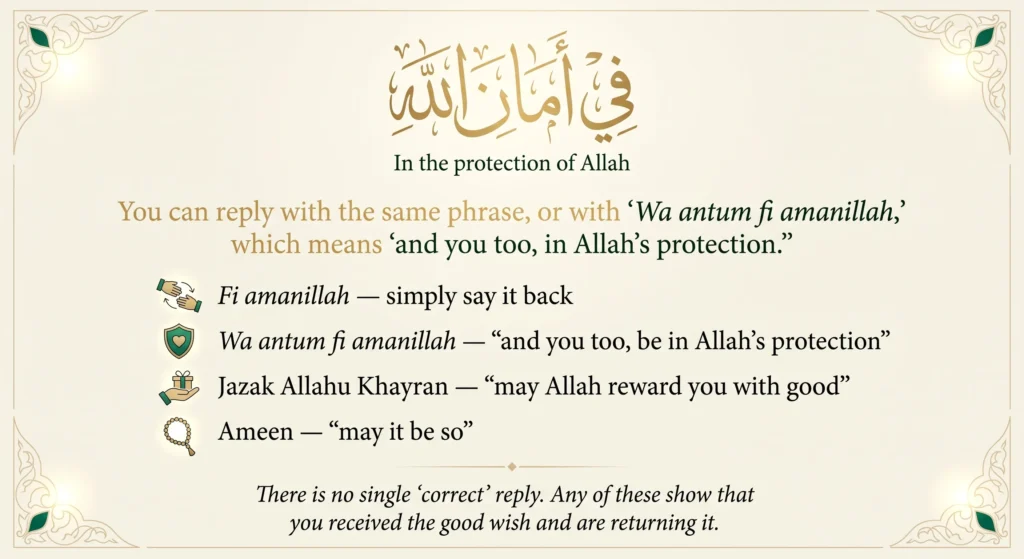
You can reply with the same phrase, or with “Wa antum fi amanillah,” which means “and you too, in Allah’s protection.”
Other common replies include:
- Fi amanillah — simply say it back
- Wa antum fi amanillah — “and you too, be in Allah’s protection”
- Jazak Allahu Khayran — “may Allah reward you with good,” a thank-you for the kind dua
- Ameen — “may it be so,” accepting the prayer made for you
There is no single “correct” reply. Any of these show that you received the good wish and are returning it.
Does Fi Amanillah Come From the Quran or Hadith?
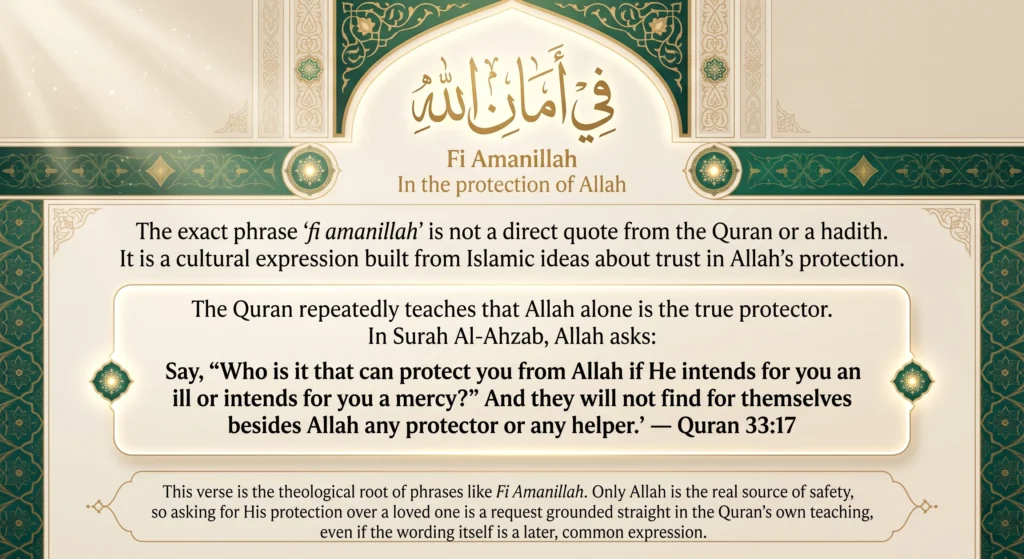
The exact phrase “fi amanillah” is not a direct quote from the Quran or a hadith. It is a cultural expression built from Islamic ideas about trust in Allah’s protection. This is a point most guides skip, but it matters if you want to use language with full confidence.
The Quran repeatedly teaches that Allah alone is the true protector. In Surah Al-Ahzab, Allah asks the disbelievers who could shield them from His will:
“Say, ‘Who is it that can protect you from Allah if He intends for you an ill or intends for you a mercy?’ And they will not find for themselves besides Allah any protector or any helper.” — Quran 33:17
This verse is the theological root of phrases like Fi Amanillah. Only Allah is the real source of safety, so asking for His protection over a loved one is a request grounded straight in the Quran’s own teaching, even if the wording “fi amanillah” itself is a later, common expression.
The Real Sunnah Dua For Saying Goodbye
If you want to say goodbye the way the Prophet Muhammad (peace be upon him) actually taught, there is an authentic hadith for that. Ibn Umar, a companion of the Prophet, used to say this exact dua when parting from someone:
Arabic: أَسْتَوْدِعُ اللَّهَ دِينَكَ وَأَمَانَتَكَ وَخَوَاتِيمَ عَمَلِكَ Transliteration: Astawdi’ullaha dinaka, wa amanataka, wa khawatima ‘amalik Translation: I entrust to Allah your faith, your trusts, and the last of your deeds.
Ibn Umar said he learned this exact wording from the Prophet himself, who used to bid his companions farewell with it. This hadith is recorded in Jami’ at-Tirmidhi, Hadith 3443, and scholars have graded it authentic (hasan sahih).
If you want to say goodbye in a way that follows the Sunnah word for word, this dua is the strongest option. Fi Amanillah is a shorter, simpler, culturally common phrase that carries the same spirit.
Why Muslims Say This Instead of Just “Goodbye”

Saying “fi amanillah” turns an ordinary goodbye into a small act of trust in Allah. This trust has a name in Islam: tawakkul, meaning reliance on Allah while still doing your part. You can read more about this idea in our guide on tawakkul in Islam.
There are a few real reasons this small phrase carries weight:
- It reminds both people that safety comes from Allah, not luck. No person can fully protect another; only Allah controls what happens.
- It is a form of dua for someone else. Praying for another person in their absence is known to be a beautiful act of worship, not just kind words.
- It builds connection. Saying a real prayer over someone, even a short one, feels different from a routine “bye.”
If you want other short phrases that carry the same spirit of trusting Allah for protection, phrases like Hasbunallahu wa ni’mal wakeel and La hawla wala quwwata illa billah work well in daily life too.
A Few Related Phrases Worth Knowing
Since Fi Amanillah is about safety and protection, you may also want simple duas to say for someone directly, not just at goodbye. A well-known one for daily protection is Ayatul Kursi, often recited for safety and peace of mind. If someone is facing hardship or fear, there is also a short dua for protection from enemies and oppression that fits well. And if you’re building a small collection of short, meaningful Islamic phrases to use daily, our post on the meaning of Mashallah is a natural next read.
Fi Amanillah Meaning — Quick Summary
| Question | Short Answer |
|---|---|
| What does it mean? | “In the protection of Allah” |
| How is it spelled in Arabic? | في أمان الله |
| When do you say it? | When saying goodbye, especially before travel. |
| Is it from the Quran/Hadith? | The exact phrase is cultural; the idea is rooted in Quran 33:17 and the Sunnah dua in Tirmidhi 3443. |
| How do you reply? | “Fi amanillah” back, or “Jazak Allahu Khayran.” |
FAQ: Fi Amanillah Meaning
What does Fi Amanillah mean in English?
It means “in the protection of Allah.” Muslims say it when saying goodbye to wish safety on the other person, much like saying “take care” but as a short prayer.
How do you spell Fi Amanillah in Arabic?
It is written as في أمان الله. The three parts are fi (في), aman (أمان), and Allah (الله).
What is the difference between Fi Amanillah and Allah Hafiz?
Both mean roughly the same thing — a wish for Allah’s protection. Fi Amanillah is more common and formal in Arab-speaking countries. Allah Hafiz is more casual and common among South Asian Muslims.
How do you reply to Fi Amanillah?
You can say it back, reply with “Wa antum fi amanillah” (“and you too”), or say “Jazak Allahu Khayran” to thank the person for the dua.
Is Fi Amanillah a hadith or Sunnah phrase?
No, the exact wording is not from a hadith. It’s a common cultural expression. The Sunnah dua the Prophet actually taught for farewells is different: “Astawdi’ullaha dinaka, wa amanataka, wa khawatima ‘amalik,” found in Jami’ at-Tirmidhi 3443.
Can non-Arabic speakers say Fi Amanillah?
Yes. Many Muslims who don’t speak Arabic as a first language still use this phrase. It’s common in everyday speech across many Muslim communities, not limited to Arabic speakers.
Is it okay to use Fi Amanillah in a text message?
Yes, it’s commonly used in texts, calls, and in person. It works well at the end of a conversation, before a trip, or at bedtime.
Final Thought
Fi Amanillah is a small phrase, but it holds a full idea: real safety belongs to Allah alone, and asking for it on someone’s behalf is an act of care and faith at the same time. Next time you say goodbye to someone you love, try saying it with these words in mind — not just as a habit, but as a real prayer for their safety.