Rabbi Habli Minas Saliheen: Full Meaning, Arabic Text, and How to Use This Dua
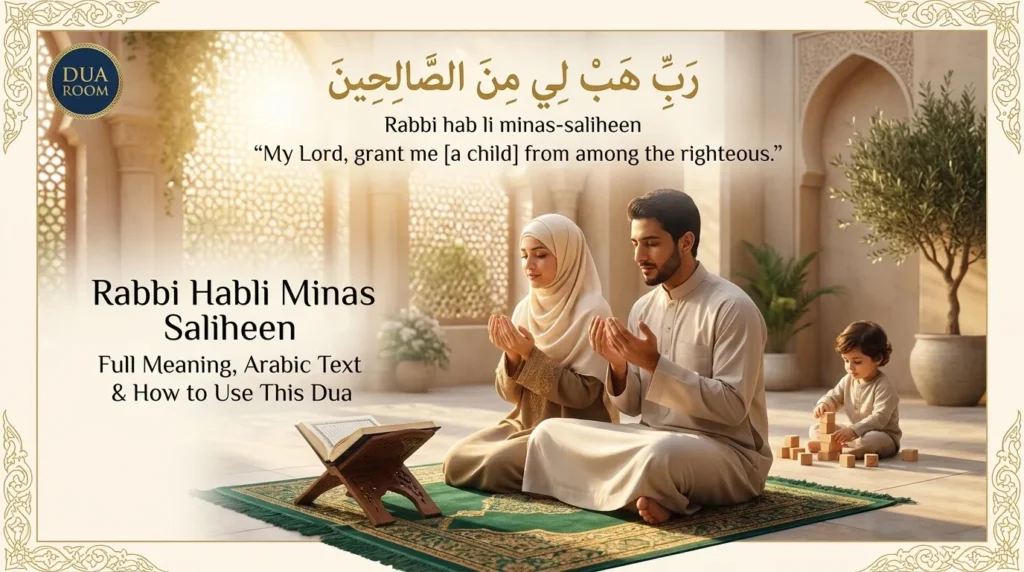
You found this dua and you want to know what it really means. You may be hoping for a child. You may want your kids to grow up righteous. Rabbi Habli Minas Saliheen is a short prayer from the Quran that asks Allah for exactly that. Below, you will get the exact Arabic text, the correct translation, the full story behind it, and clear steps for how to use it.
What Does Rabbi Habli Minas Saliheen Mean?
Rabbi Habli Minas Saliheen means “My Lord, grant me [a child] from among the righteous.” It is a short dua (a personal prayer or request to Allah) asking for a child who will grow up to be good and God-fearing.
The word Rabbi means “my Lord.” Habli means “grant me” or “give me.” Minas Saliheen means “from among the righteous,” or people who live good, honest lives. Put together, the person praying is asking Allah for a child who will belong to that group of righteous people.
Rabbi Habli Minas Saliheen: Arabic, Transliteration, and Translation
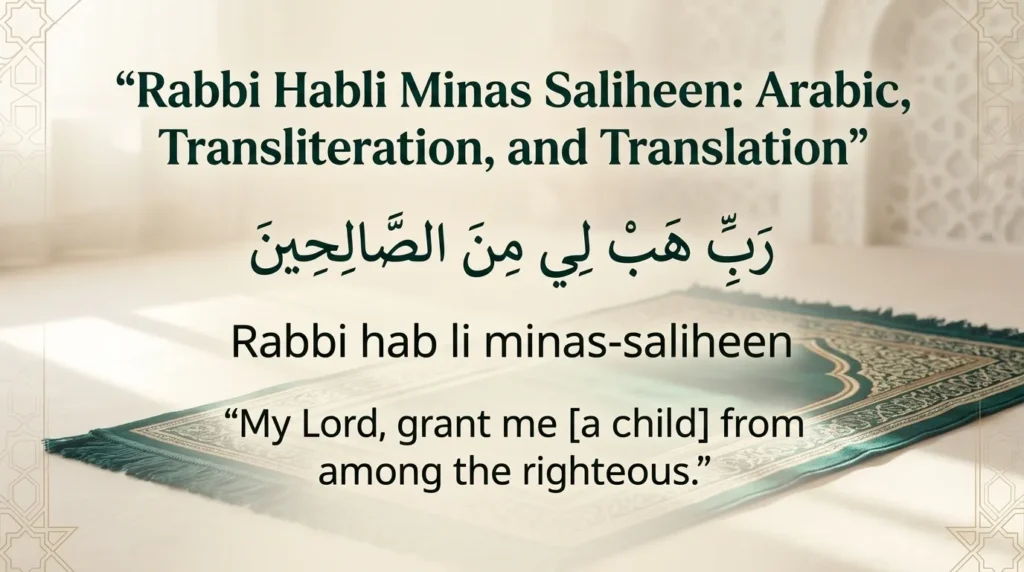
Here is the full dua in Arabic script, how to say it in English letters, and what it means. Reading it in this order helps you say it correctly even if you cannot read Arabic script.
Rabbi hab li minas-saliheen
“My Lord, grant me [a child] from among the righteous.”
Rabbi Habli Minas Saliheen — Quran Reference
| Element | Details |
|---|---|
| Surah | As-Saffat (Chapter 37) |
| Verse (Ayah) | 100 |
| Arabic | رَبِّ هَبْ لِي مِنَ الصَّالِحِينَ |
| Transliteration | Rabbi hab li minas-saliheen |
| Sahih International translation | “My Lord, grant me [a child] from among the righteous.” |
| Quran.com (Dr. Mustafa Khattab) translation | “My Lord! Bless me with righteous offspring.” |
| Who said it | Prophet Ibrahim (AS), also spelled Abraham |
| Surah type | Meccan |
Where Is Rabbi Habli Minas Saliheen in the Quran?
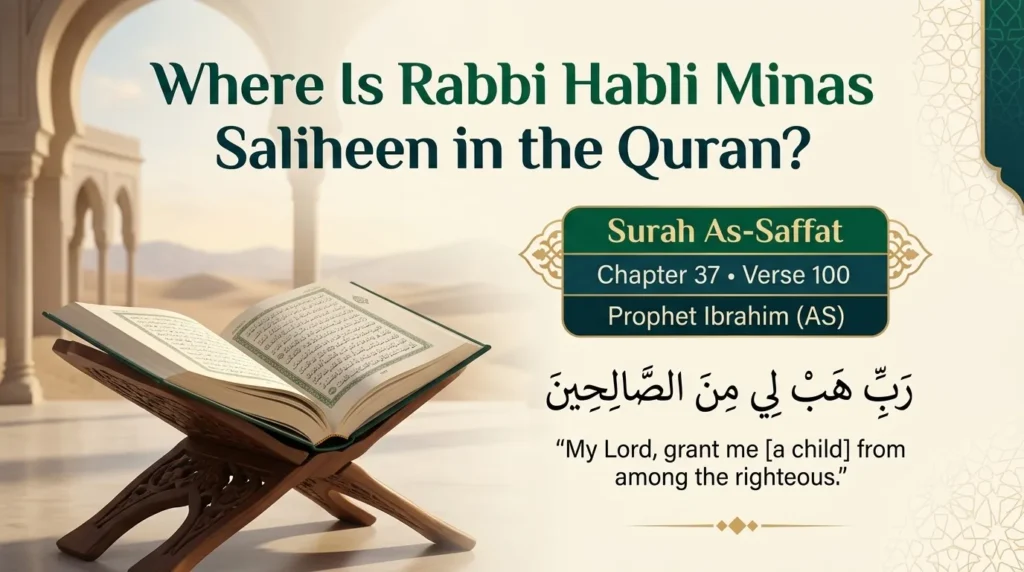
This dua is verse 100 of Surah As-Saffat, the 37th chapter of the Quran. You will sometimes see it written as Quran 37:100. Some people misspell it as “rabbi habli minassaliheen” or “rabbi habli minas saleheen,” but the correct Arabic verse and meaning stay the same no matter how it is spelled in English letters.
Surah As-Saffat has 182 verses. It was revealed in Makkah, before the Prophet Muhammad ﷺ moved to Madinah. You can read the full verse with its Arabic text and several English translations directly on Quran.com’s page for As-Saffat, verse 100.
The Story Behind the Dua: Why Ibrahim (AS) Said This
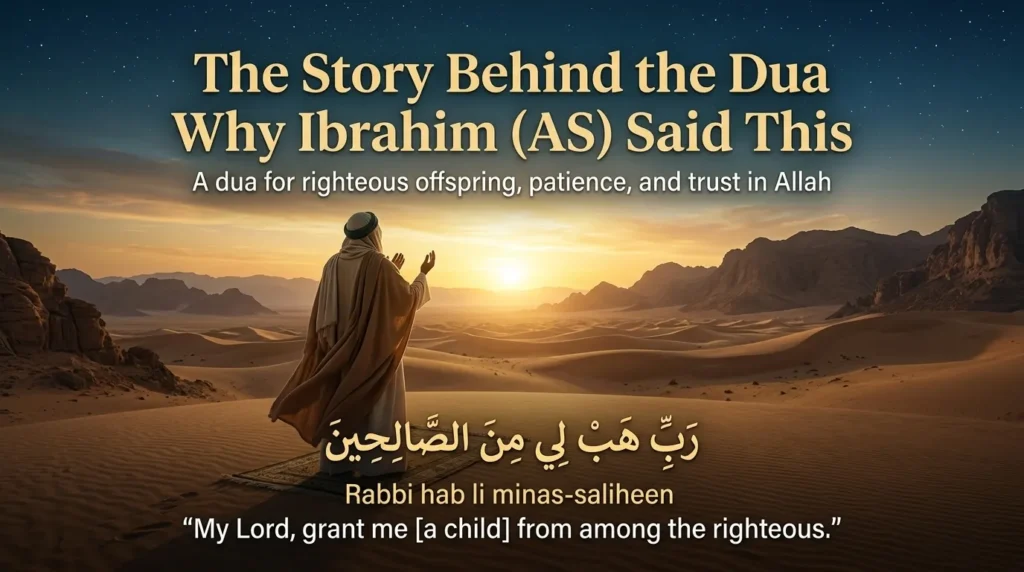
Prophet Ibrahim (AS) said this dua because he had no children and was growing old. He had left his homeland with only his wife and his nephew, Prophet Lut (Lot). Wanting a child to carry on his family and his mission, he turned to Allah with this simple, honest request.
The very next verse answers the dua. Allah says, “So We gave him good tidings of a forbearing boy” (Quran 37:101). This son was Ismail (Ishmael). Later, in the same surah, Ibrahim is tested when he sees a vision that he must sacrifice his son. Both father and son submit to Allah, and Allah replaces the sacrifice with a ram. This story is why Muslims around the world remember Ibrahim and Ismail every year during Eid al-Adha.
Ibrahim later thanks Allah for this gift in a different surah. In Surah Ibrahim, he says: “Praise to Allah, who has granted to me in old age Ismail and Isaac. Indeed, my Lord is the Hearer of supplication” (Quran 14:39). This shows the dua was not a one-time wish. It was part of a long, patient relationship of asking and thanking Allah.
Rabbi Habli Minas Saliheen vs. Rabbi Habli Min Ladunka: What Is the Difference?
These are two different duas from two different prophets, both asking for children. People often mix them up because both start with the word “Rabbi habli,” which means “My Lord, grant me.”
Rabbi Habli Minas Saliheen vs. Rabbi Habli Min Ladunka Zurriyyatan Tayyibah
| Detail | Rabbi Habli Minas Saliheen | Rabbi Habli Min Ladunka Zurriyyatan Tayyibah |
|---|---|---|
| Who said it | Prophet Ibrahim (AS) | Prophet Zakariya (AS) |
| Quran location | Surah As-Saffat, 37:100 | Surah Aal-Imran, 3:38 |
| Arabic | رَبِّ هَبْ لِي مِنَ الصَّالِحِينَ | رَبِّ هَبْ لِي مِن لَّدُنكَ ذُرِّيَّةً طَيِّبَةً إِنَّكَ سَمِيعُ الدُّعَاءِ |
| Meaning | “My Lord, grant me [a child] from among the righteous.” | “My Lord, grant me from Yourself a good offspring. Indeed, You are the Hearer of supplication.” |
| His situation | Old and childless, wanted a child to continue his mission | Old, with a barren wife, prayed after seeing Allah provide for Maryam |
| Answered with | His son Ismail (AS) | His son Yahya (AS), known as John the Baptist |
Both duas show the same lesson. No matter how old you are or how impossible your situation looks, Allah hears sincere dua. You can read Zakariya’s full dua and its context on Quran.com’s page for Aal-Imran, verse 38.
How and When to Recite Rabbi Habli Minas Saliheen
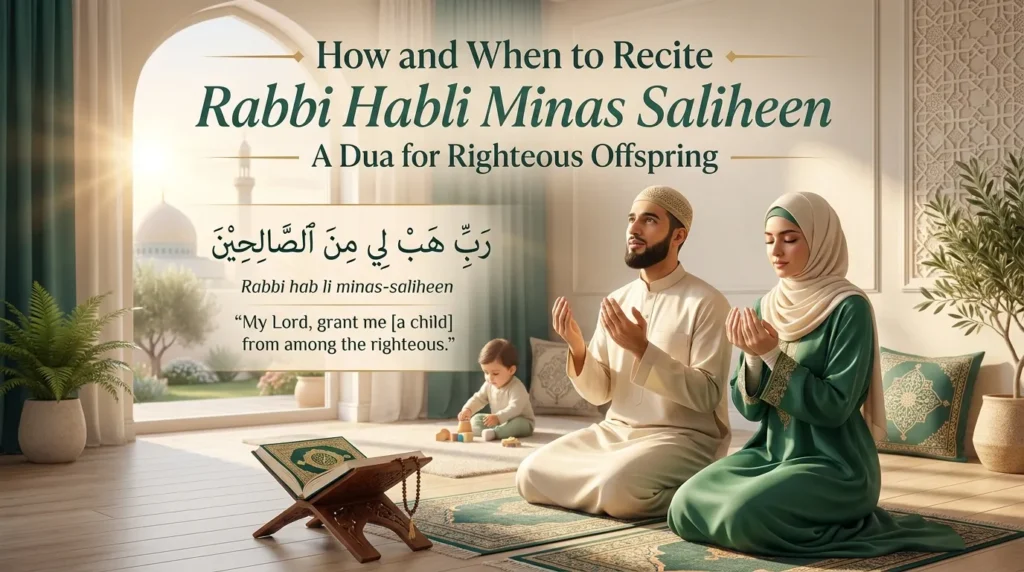
You can say this dua any time you sincerely ask Allah for a righteous child, whether you are trying to conceive, currently pregnant, or already raising kids. There is no single “correct” moment fixed in the Quran or Hadith. What matters most is sincerity, not timing.
Here are common times people choose to recite it:
- While trying to conceive: After the five daily prayers, especially during the last third of the night, a time when duas are more likely to be accepted.
- During pregnancy: Many parents recite it regularly while carrying their child, asking Allah to shape the child’s heart toward righteousness.
- After childbirth: As a continued prayer for the child’s upbringing and character.
- For children already born: Parents keep making this dua throughout a child’s life, not just before birth.
How Many Times Should You Recite It?
There is no fixed number for this dua stated in the Quran or in an authentic hadith. Some people repeat it a set number of times as a personal habit, but this is not a religious requirement. What matters is that you say it with sincerity (ikhlas, meaning doing something purely for Allah) and real hope that Allah will answer. You can say it once, or repeat it often in your own daily duas — both are acceptable.
Word-by-Word Meaning
Breaking down each Arabic word helps you understand exactly what you are saying, not just repeat sounds.
Rabbi Habli Minas Saliheen: Word-by-Word Meaning
| Arabic Word | Transliteration | Meaning |
|---|---|---|
| رَبِّ | Rabbi | My Lord |
| هَبْ | Hab | Grant / Give |
| لِي | Li | To me |
| مِنَ | Mina | From |
| الصَّالِحِينَ | as-Saliheen | The righteous ones |
Why This Dua Still Matters for Parents Today
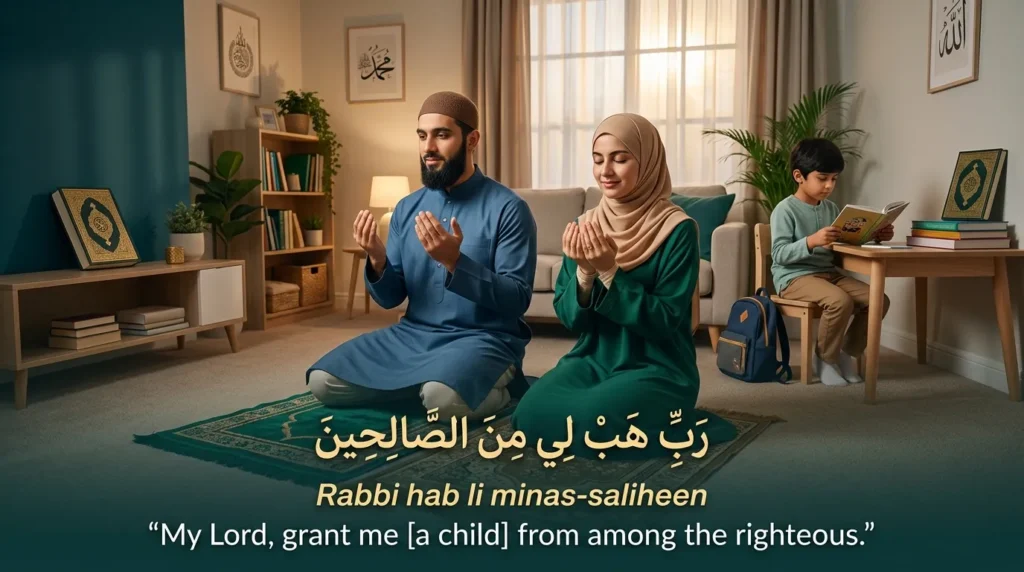
This dua is not only about having a child. It is about wanting a righteous child, one who prays, tells the truth, and stays close to Allah. Many parents today face the same worry Ibrahim (AS) had: not just wanting children, but wanting good children in a world full of distractions.
This is also why raising the child after birth matters just as much as the dua itself. A sincere prayer works alongside real effort. You may find it helpful to also read about how parents can encourage children to love the Quran, Islamic guidelines for parenting and child upbringing, and the duties of parents and rights of children in Islam.
Once your child is a little older, deciding what age to start teaching your child the Quran and learning how to teach your child salah are natural next steps that build on this early dua.
There is also a strong reason in the Hadith to keep asking for righteous children. The Prophet ﷺ said: “When a man dies, his acts come to an end, but three: recurring charity, or knowledge by which people benefit, or a pious child who prays for him” (Sahih Muslim 1631). A righteous child keeps praying for their parents even after the parents pass away. This is one more reason this dua carries so much weight.
Frequently Asked Questions
What does Rabbi Habli Minas Saliheen mean in simple words?
It means “My Lord, grant me a child from among the righteous.” It is a prayer asking Allah for a child who will grow up good and faithful.
Where in the Quran is Rabbi Habli Minas Saliheen found?
It is verse 100 of Surah As-Saffat, the 37th chapter of the Quran. It is often written as Quran 37:100.
Who first said this dua?
Prophet Ibrahim (AS) said it. He was old and had no children at the time. Allah answered his prayer with his son, Ismail (AS).
Can I recite this dua during pregnancy?
Yes. Many parents recite it while pregnant, asking Allah to make the child righteous. There is no rule against reciting it at any stage of pregnancy.
Is there a fixed number of times to recite it?
No. There is no set number in the Quran or an authentic hadith. Say it with sincerity, whether once or many times.
Can women recite this dua too, or only men?
Anyone can recite it. The words themselves ask Allah on behalf of “me,” so both mothers and fathers, or anyone hoping for a righteous child in their family, can say it.
What is the difference between this dua and “Rabbi habli min ladunka zurriyyatan tayyibah”?
Both ask for righteous children, but Rabbi Habli Minas Saliheen was said by Prophet Ibrahim (AS) in Surah As-Saffat 37:100. The second dua was said by Prophet Zakariya (AS) in Surah Aal-Imran 3:38.
A Final Word
Ibrahim (AS) asked Allah for one thing above all else: a child who would be righteous, not just a child. That is worth remembering every time you make this dua. Whether you are asking for a child, expecting one, or raising one right now, you are echoing the same honest words a prophet once said. Keep saying them, keep raising your children with care, and trust that Allah hears every sincere dua.