4th Kalima Tauheed: Meaning, Arabic Text, and English Translation
Maybe your child came home from madrassa and asked you to check their Kalima. Or maybe you just want to know what these words really mean before you say them. Either way, you are in the right place.
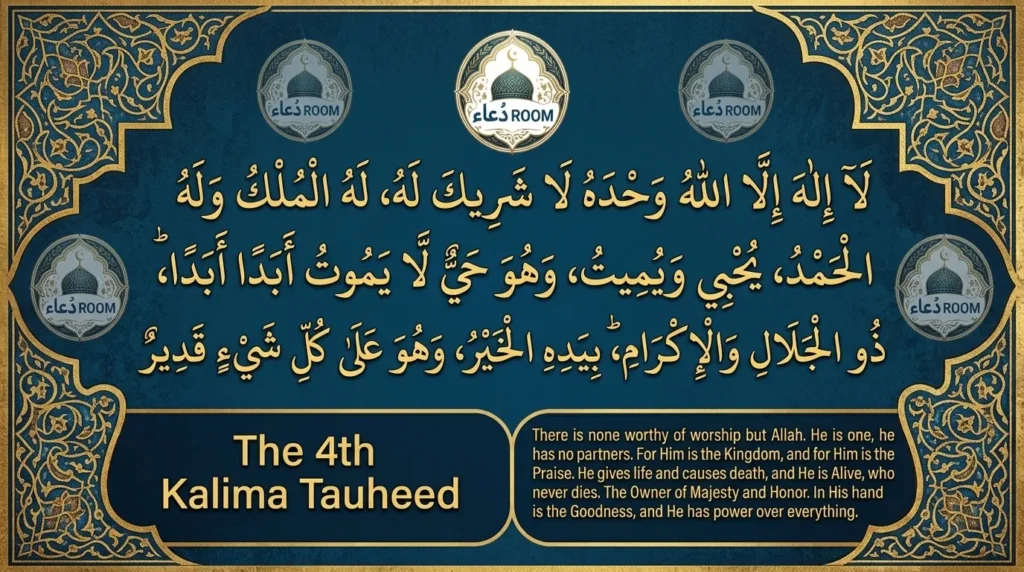
This guide gives you the 4th Kalima Tauheed in Arabic, with an easy transliteration, plus the English and Urdu meaning. You will also learn where the words come from, why they matter, and how to say them the right way.
What Is the 4th Kalima Tauheed?
The 4th Kalima is called Tauheed. It means “Oneness.” It is a short prayer that says Allah is One, with no partner, and He has full power over everything.
The word Tauheed (also spelled Tawheed) comes from Arabic. It means believing that Allah is One. There is no other god. No angel, no prophet, no idol, and no person shares His power.
Tauheed is the biggest idea in Islam. It is the base that everything else stands on. Salah (prayer), fasting, and every other act of worship only count if your Tauheed is correct first.
The opposite of Tauheed is shirk. Shirk means giving Allah’s power or worship to someone or something else. The Quran calls shirk the one sin Allah will not forgive unless a person turns back to Him before death (see Surah An-Nisa 4:48).
The 4th Kalima puts this huge idea into a few short lines you can say every day.
4th Kalima Tauheed in Arabic
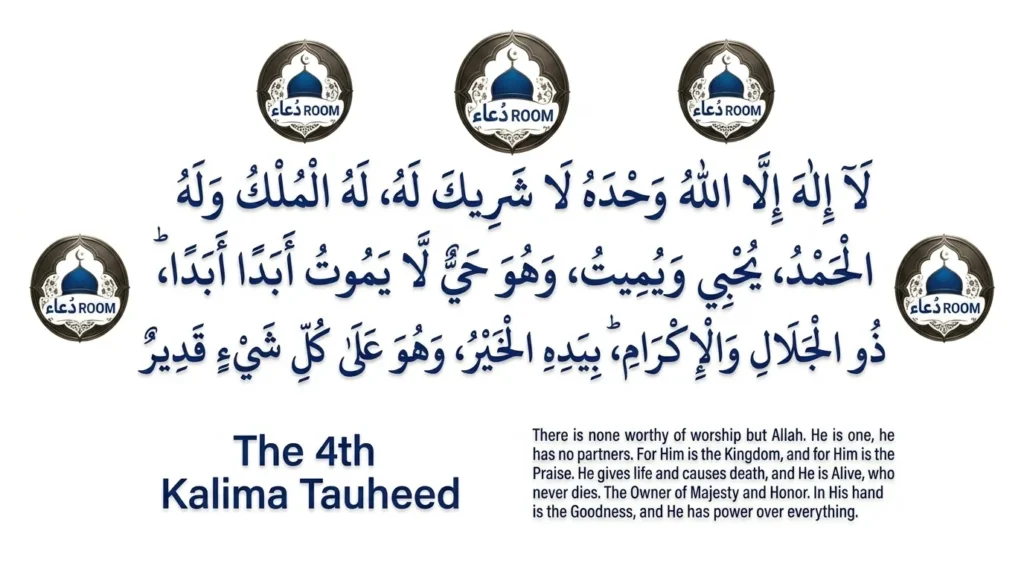
Here is the 4th Kalima written in Arabic, with an easy English transliteration under it.
Arabic: لَا إِلٰهَ إِلَّا اللهُ وَحْدَهُ لَا شَرِيْكَ لَهُ لَهُ الْمُلْكُ وَلَهُ الْحَمْدُ يُحْيِي وَيُمِيْتُ وَهُوَ حَيٌّ لَا يَمُوْتُ أَبَدًا أَبَدًا ذُوالْجَلَالِ وَالْإِكْرَامِ بِيَدِهِ الْخَيْرُ وَهُوَ عَلٰى كُلِّ شَيْءٍ قَدِيْرٌ
Transliteration: La ilaha illallah, wahdahu la sharika lah. Lahul mulku wa lahul hamdu, yuhyi wa yumitu, wa Huwa hayyun la yamutu abadan abada. Dhul jalali wal ikram. Biyadihil khair. Wa Huwa ala kulli shai-in qadir.
Say each word slowly at first. It helps to break it into small parts and repeat each part three times before you join them.
4th Kalima Tauheed Meaning in English
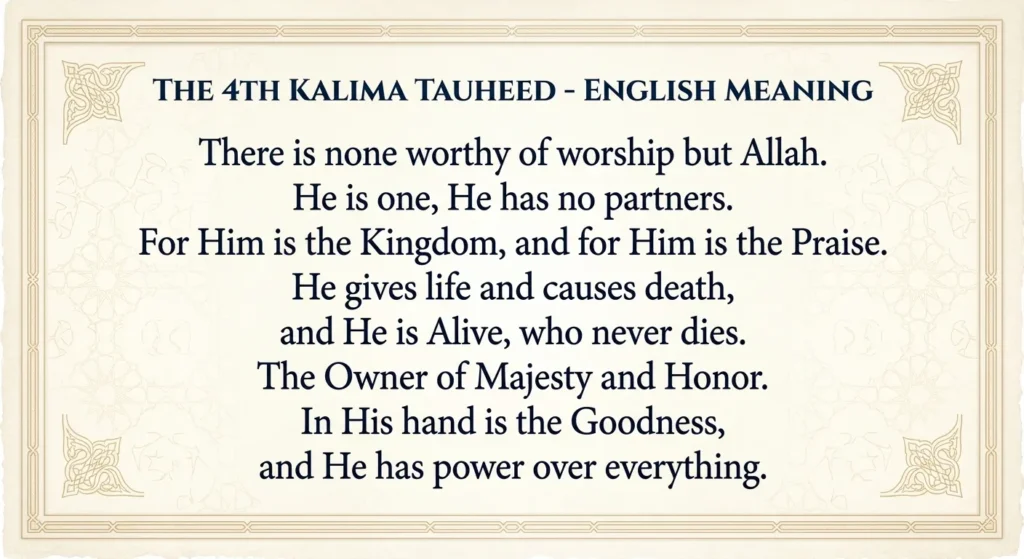
In simple English, the 4th Kalima says Allah is One, He has no partner, He owns everything, He gives life and death, and He can do anything.
Here is the full English meaning, line by line:
There is no god except Allah. He is One. He has no partner. The Kingdom belongs to Him, and all praise belongs to Him. He gives life and He gives death. He is alive. He will never die, not ever. He owns all glory and honor. All good is in His hand. He has power over everything.
Every line answers a question about who Allah is. He is alone in His power. He owns everything that exists. He controls life and death. He never dies, unlike every living thing He created. He deserves honor. He holds all good. And nothing is too hard for Him.
Word-by-Word Breakdown
This table breaks the Kalima into small pieces. It helps you understand each word, not just recite it.
| Arabic Phrase | Transliteration | Simple English Meaning |
|---|---|---|
| لَا إِلٰهَ إِلَّا اللهُ | La ilaha illallah | There is no god except Allah |
| وَحْدَهُ لَا شَرِيْكَ لَهُ | Wahdahu la sharika lah | He is One. He has no partner |
| لَهُ الْمُلْكُ وَلَهُ الْحَمْدُ | Lahul mulku wa lahul hamdu | The Kingdom is His. All praise is His |
| يُحْيِي وَيُمِيْتُ | Yuhyi wa yumitu | He gives life and He gives death |
| وَهُوَ حَيٌّ لَا يَمُوْتُ أَبَدًا أَبَدًا | Wa Huwa hayyun la yamutu abadan abada | He is alive. He never dies, not ever |
| ذُوالْجَلَالِ وَالْإِكْرَامِ | Dhul jalali wal ikram | He owns all glory and honor |
| بِيَدِهِ الْخَيْرُ | Biyadihil khair | All good is in His hand |
| وَهُوَ عَلٰى كُلِّ شَيْءٍ قَدِيْرٌ | Wa Huwa ala kulli shai-in qadir | He has power over everything |
4th Kalima Tauheed Meaning in Urdu
In Urdu, the 4th Kalima says Allah ke siwa koi ibadat ke laiq nahi. Wo akela hai. Uska koi shareek nahi.
Below is the Urdu translation for readers who understand Urdu better than English.
اللہ کے سوا کوئی معبود نہیں، وہ اکیلا ہے، اس کا کوئی شریک نہیں، بادشاہی اسی کی ہے اور سب تعریفیں اسی کے لیے ہیں۔ وہی زندہ کرتا ہے اور مارتا ہے۔ وہ ہمیشہ زندہ ہے، کبھی نہیں مرے گا۔ عظمت اور بزرگی والا ہے۔ اسی کے ہاتھ میں بھلائی ہے۔ اور وہ ہر چیز پر قدرت رکھنے والا ہے۔
If you are teaching this to family members who read Urdu, it helps to read the Urdu meaning first. Then move to the Arabic words. This way, the person understands the meaning before they memorize the sound.
Why the 4th Kalima Is Called “Tauheed”
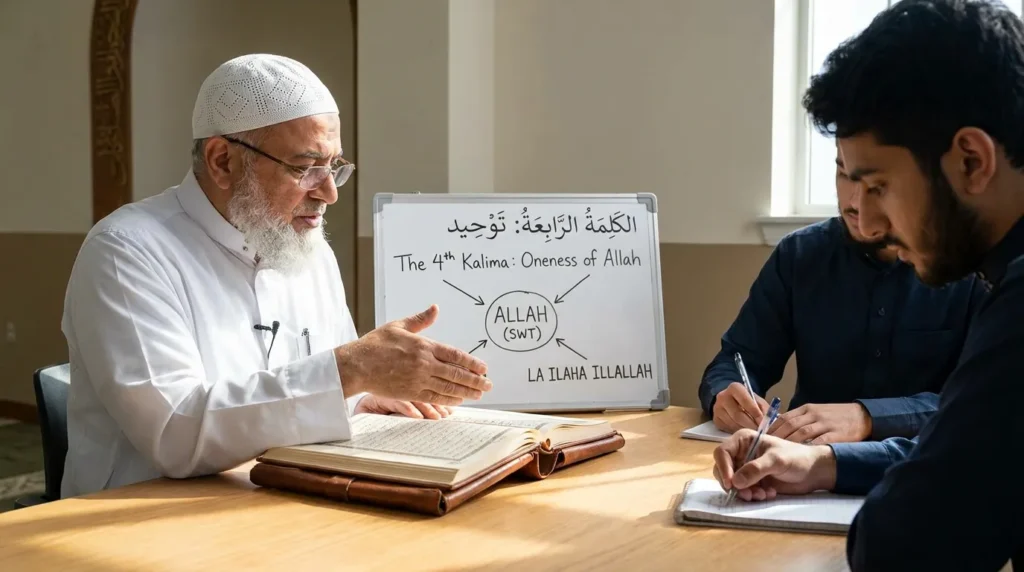
The name Tauheed fits because every single line of this Kalima proves that Allah is One and no one shares His power.
Some scholars connect the spirit of this Kalima to Surah Al-Ikhlas, a short surah in the Quran that also explains Tauheed in just four verses. It says Allah is One, He needs nothing, He was not born, and nothing is equal to Him. Many teachers use Surah Al-Ikhlas to introduce children to the same idea the 4th Kalima teaches.
Understanding Tauheed changes how you see your whole day. Once you truly believe only Allah controls your rizq (provision), your health, and your outcome, you stop putting your trust in people, luck, or objects. This trust in Allah alone is called tawakkul, and it grows directly out of a strong belief in Tauheed.
Hadith Proof for the 4th Kalima Tauheed
The six Kalimas are not found together in one place in the Quran or Hadith. But many hadiths mention the same words and praise their reward.
It’s important to know this up front: the six Kalimas, as a set, are a teaching tool. Scholars grouped them over time to help children and new Muslims learn Islam step by step. But the words inside the 4th Kalima do come from real, verified hadiths.
Sahih Muslim 2691 records that the Prophet Muhammad ﷺ said whoever says these words 100 times in a day gets a reward like freeing ten slaves, gets 100 good deeds written for him, has 100 sins wiped away, and is protected from Satan until evening (see the full hadith on Sunnah.com).
It’s worth being precise here. The exact wording in this hadith is the shorter core phrase: “La ilaha illallahu wahdahu la sharika lahu, lahul-mulku wa lahul-hamdu, wa Huwa ‘ala kulli sha’in Qadir” (“There is no god but Allah, the One, having no partner with Him. Sovereignty belongs to Him and all praise is due to Him, and He is Able to do all things”). This shorter formula is what carries the 100-times reward described above.
The longer 4th Kalima used in South Asian tradition adds extra lines, such as “yuhyi wa yumitu… abadan abada” (He gives life and death… never, ever) and “Dhul jalali wal ikram” (Owner of Majesty and Honor). These extra phrases are not part of the Sahih Muslim 2691 wording itself. They come from other authentic supplications and dhikr, including the tahlil recited by the companion Abdullah bin Az-Zubair after every prayer.
Sunan an-Nasa’i 1340, graded Sahih, records that Abdullah bin Az-Zubair used to say a similar, longer dhikr after every prayer, and that the Prophet ﷺ used to do the same (see it on Sunnah.com). Its wording overlaps closely with the extended 4th Kalima, though it is not word-for-word identical either.
So while the exact 4th Kalima, as a single fixed text, is a later teaching arrangement, its core sentence carries a specific, verified 100-times reward from Sahih Muslim 2691, and its remaining phrases are rooted in related, authentic dhikr like Sunan an-Nasa’i 1340. Treat the added lines as beautiful, well-grounded additions rather than as part of the exact hadith reward formula.
How and When to Recite the 4th Kalima Tauheed
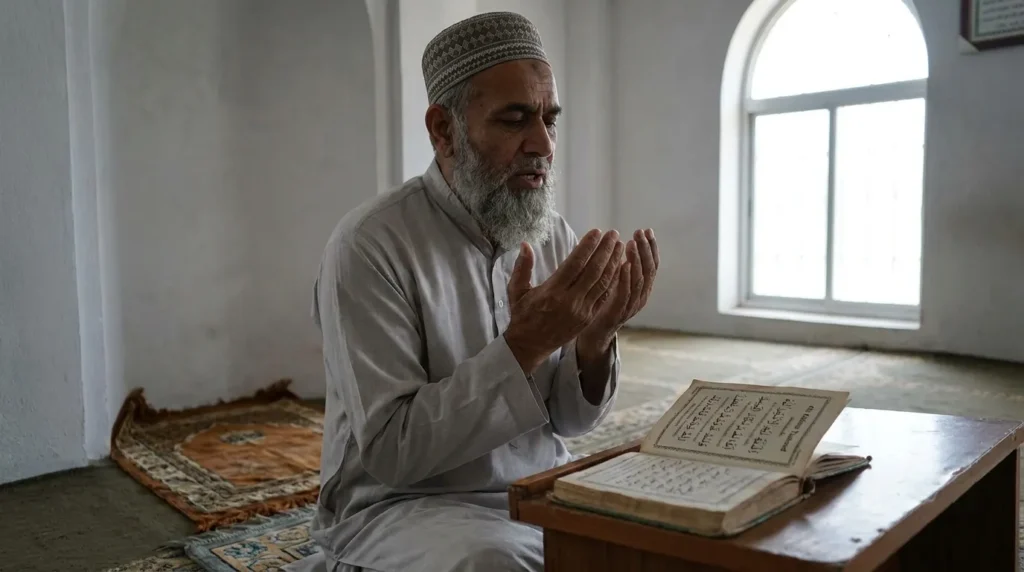
You can say the 4th Kalima at any time, but it carries the most reward when said after Salah or as part of your daily dhikr.
Here are simple ways to fit it into your day:
- After Fajr and Maghrib prayers. Many scholars recommend saying dhikr like this right after these two prayers.
- 100 times a day. Based on the hadith above, saying it 100 times daily brings a large reward.
- In the morning or evening routine. Pair it with other short dhikr, like you might already do with durood shareef after prayer.
- While doing daily tasks. You can say it quietly while walking, cooking, or waiting somewhere.
- With a tasbih (prayer beads). Counting on your fingers or beads helps you track how many times you’ve said it.
If you already have a habit of saying dhikr after salah, adding the 4th Kalima is an easy next step. Say it slowly and think about the meaning. This matters more than rushing through the words fast.
4th Kalima Tauheed vs. the Other Five Kalimas
The 4th Kalima focuses only on Tauheed, Allah’s Oneness, while the other Kalimas cover faith, testimony, praise, forgiveness, and rejecting false belief.
This table shows how the 4th Kalima fits with the other five.
| Kalima | Arabic Name | What It Focuses On |
|---|---|---|
| 1st Kalima | Tayyibah | Declares faith: Allah is One, Muhammad ﷺ is His Messenger |
| 2nd Kalima | Shahadat | A personal testimony of that same faith |
| 3rd Kalima | Tamjeed | Praises and glorifies Allah |
| 4th Kalima | Tauheed | Affirms Allah’s Oneness and total power |
| 5th Kalima | Astaghfar | Asks Allah for forgiveness |
| 6th Kalima | Radde Kufr | Rejects disbelief and false gods |
Each Kalima teaches something different, but they all build on the same base: belief in One Allah alone.
How to Teach the 4th Kalima Tauheed to Kids
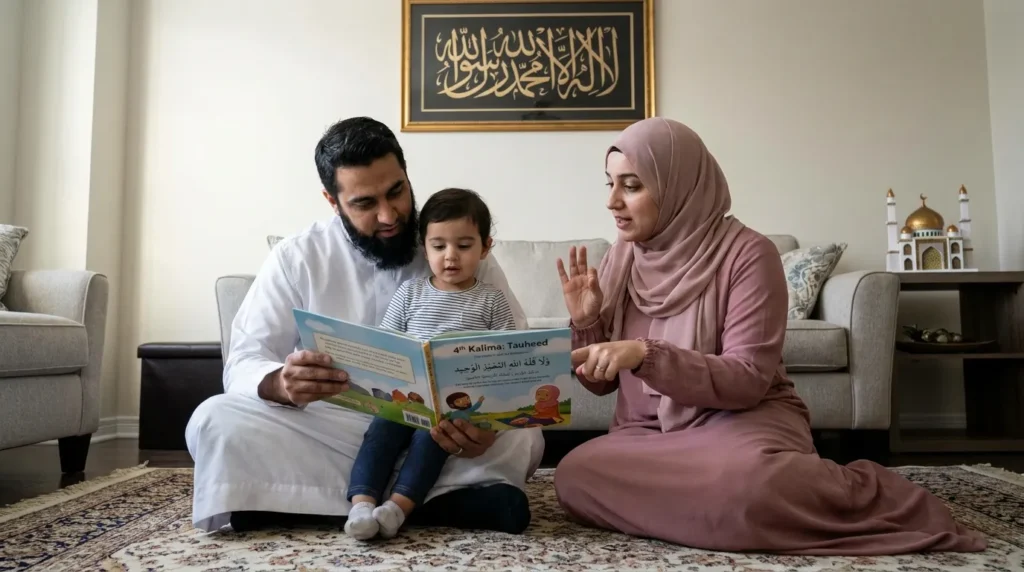
Break the Kalima into small chunks, explain each part with an easy example, and repeat it often instead of rushing to full memorization.
Kids often learn this Kalima at madrassa, but they may not understand the words. Try these steps:
- Say one phrase at a time. Start with “La ilaha illallah” only. Once your child says it correctly, add the next phrase.
- Use a simple example. Explain “He gives life and death” by pointing to a plant that grows and later dries up. Say, “Only Allah made that happen.”
- Repeat daily, not just once a week. Short, daily repetition works better than one long session.
- Connect it to real life. When something good happens, say, “That was from Allah’s hand,” linking it to the line about Allah holding all good.
- Pair it with other memorization. If you’re already working on teaching your child Salah, add the Kalima as a short extra step, not a separate big task.
If you’re not sure what age to start, many parents begin gentle Islamic memorization once a child can speak in full sentences, often around age three to five. Go at your child’s pace, and keep the mood light and encouraging.
Common Mistakes When Reciting the 4th Kalima
The most common mistakes are rushing the words, mixing up the order of phrases, and reciting without understanding the meaning.
Watch out for these:
- Skipping “wahdahu la sharika lah.” This phrase means “He is One, He has no partner.” Some people rush past it, but it is the heart of the whole Kalima.
- Saying “abadan abada” only once. The word for “never, ever” is meant to be said twice for emphasis.
- Reciting without meaning. Saying the Arabic without knowing what it means turns a powerful prayer into empty sound. Always learn the translation alongside the Arabic.
- Confusing it with the 1st Kalima. The 1st Kalima (Tayyibah) also starts with “La ilaha illallah” but continues differently. Learn both separately so you don’t blend them.
FAQ: 4th Kalima Tauheed
What does “Tauheed” mean?
Tauheed means believing that Allah is One, with no partner, no equal, and no one who shares His power. It is the central belief in Islam.
Is the 4th Kalima found in the Quran?
Not as one single verse. Its meaning matches ideas from Surah Al-Ikhlas, and its exact words are close to phrases found in verified hadiths like Sahih Muslim 2691.
How many times should I recite the 4th Kalima Tauheed?
A hadith mentions a great reward for saying similar words 100 times in a day. You can also say it fewer times and still gain reward, since every bit of dhikr counts.
What is the difference between the 4th Kalima and the 1st Kalima?
The 1st Kalima (Tayyibah) declares faith in Allah and in Muhammad ﷺ as His Messenger. The 4th Kalima (Tauheed) focuses only on proving Allah’s Oneness and power, without mentioning the Prophet ﷺ by name.
Can I recite the 4th Kalima in English instead of Arabic?
It is best to learn the Arabic words, since that is the original form used in worship. But understanding the English meaning while you recite the Arabic helps you connect with the words, not just repeat sounds.
What is shirk, and how does the 4th Kalima protect against it?
Shirk means giving Allah’s power or worship to someone or something else. The 4th Kalima directly rejects shirk by repeating that Allah alone owns power, life, death, and all good.
At what age should children start learning the 4th Kalima?
There is no fixed age in Islamic law. Many parents start short phrases around age three to five, once a child can speak clearly, and build up from there.
Final Thoughts
The 4th Kalima Tauheed is short, but it carries one of the biggest truths in Islam: Allah is One, and everything good comes from His hand. Learn it slowly, understand each line, and say it with your heart present, not just your tongue. That is when these few words start to change how you see your whole day.