Allahumma Anta Rabbi La Ilaha Illa Anta: Full Dua, Meaning & Benefits of Sayyidul Istighfar
If you die today, are you sure your sins are forgiven?
This is a hard question. But the Prophet Muhammad ﷺ gave us one dua that can answer it. It is called Sayyidul Istighfar, which means “the leader of all prayers for forgiveness.” Among all the words a Muslim can say to ask Allah for forgiveness, this one is the best. The Prophet ﷺ himself said so.
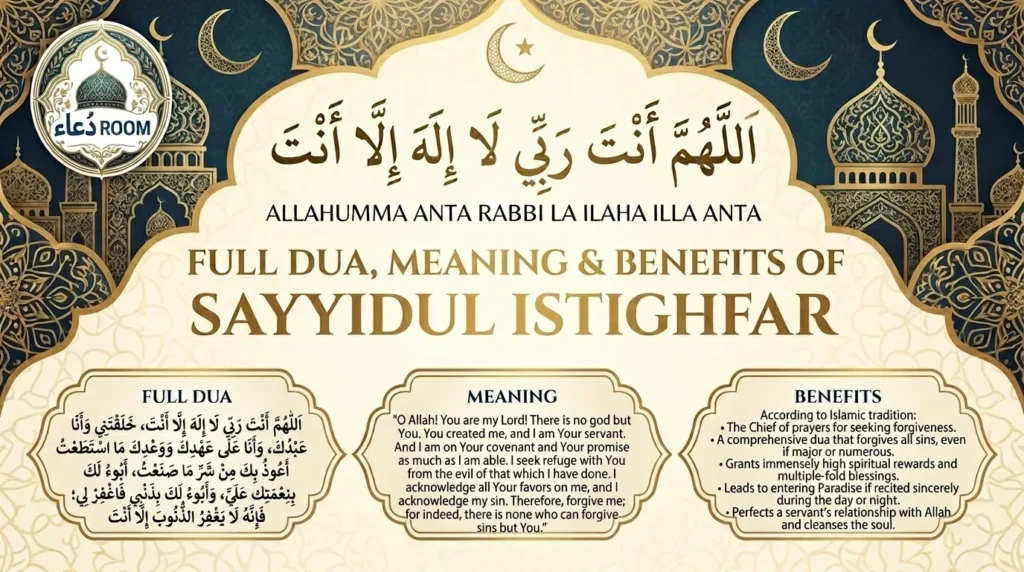
This dua begins with the words “Allahumma anta rabbi la ilaha illa anta” (O Allah, You are my Lord, there is no god but You). In this article, you will learn the full Arabic text, the easy transliteration, the word-by-word English meaning, the authentic hadith behind it, and why reciting it every morning and evening can change your life. We will also cover the biggest questions people ask about this dua, in simple words that anyone can understand.
What Is Sayyidul Istighfar?
“Sayyidul Istighfar” is an Arabic phrase. “Sayyid” means leader or chief, and “Istighfar” means asking Allah for forgiveness. So Sayyidul Istighfar means “the chief of all ways of asking forgiveness.”
This name was not given by scholars later on. It comes straight from the Prophet Muhammad ﷺ. He described this exact dua with these words, telling us that no other istighfar (dua for forgiveness) is greater than it. That is why Muslims around the world memorize it and recite it daily, especially after Fajr and before sleeping.
Allahumma Anta Rabbi Full Dua in Arabic
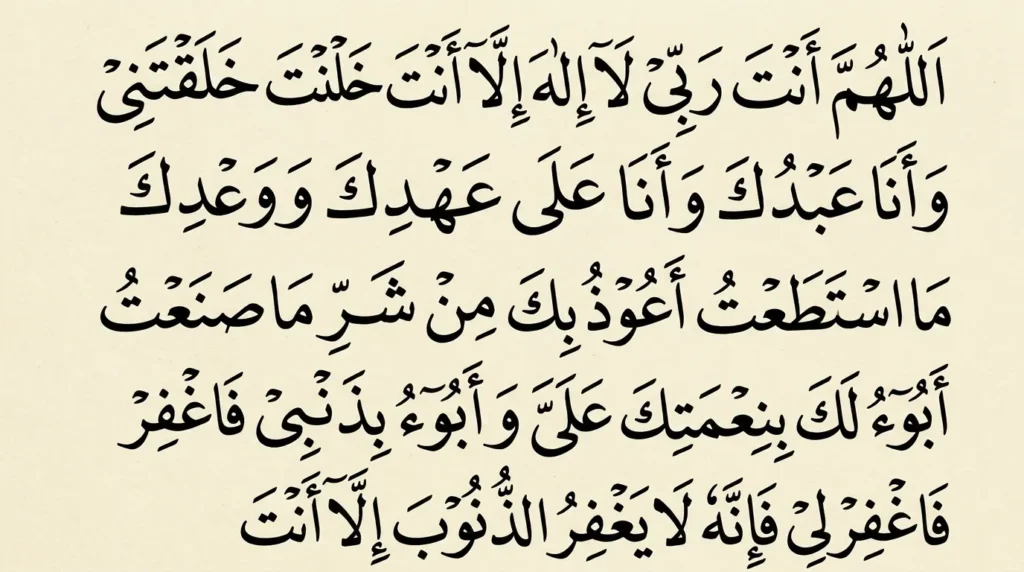
Here is the complete dua in Arabic:
اللَّهُمَّ أَنْتَ رَبِّي لَا إِلَهَ إِلَّا أَنْتَ خَلَقْتَنِي وَأَنَا عَبْدُكَ وَأَنَا عَلَى عَهْدِكَ وَوَعْدِكَ مَا اسْتَطَعْتُ أَعُوذُ بِكَ مِنْ شَرِّ مَا صَنَعْتُ أَبُوءُ لَكَ بِنِعْمَتِكَ عَلَيَّ وَأَبُوءُ لَكَ بِذَنْبِي فَاغْفِرْ لِي فَإِنَّهُ لَا يَغْفِرُ الذُّنُوبَ إِلَّا أَنْتَ
Transliteration (Easy English Reading)
If you cannot read Arabic yet, you can still recite the dua using this simple pronunciation guide:
Allahumma anta Rabbi la ilaha illa anta, khalaqtani wa ana ‘abduka, wa ana ‘ala ‘ahdika wa wa’dika mastata’tu, a’udhu bika min sharri ma sana’tu, abu’u laka bini’matika ‘alayya, wa abu’u laka bidhanbi, faghfir li fa innahu la yaghfirudh dhunuba illa anta.
Try to say it slowly at first. Break it into small parts, repeat each part a few times, and soon you will remember the whole dua by heart, in sha Allah.
English Meaning of the Dua
The translation of this beautiful dua is:
“O Allah, You are my Lord. There is none worthy of worship but You. You created me, and I am Your servant. I hold to Your covenant and Your promise as much as I am able. I seek refuge in You from the evil of what I have done. I acknowledge Your favor upon me, and I acknowledge my sin. So forgive me, for none forgives sins except You.”
Every single line of this dua carries deep meaning. It is not just a set of words — it is a full conversation between a servant and his Lord, where the servant admits three things at once: that Allah is his only God, that Allah created and owns him, and that he himself is guilty of sin and needs mercy.
The Hadith Behind Sayyidul Istighfar
This dua is not something a scholar made up. It comes directly from an authentic hadith recorded by Imam Bukhari. Shaddad ibn Aws (radiyallahu ‘anhu) reported that the Prophet Muhammad ﷺ said:
“The most superior way of asking forgiveness from Allah is to say: Allahumma anta Rabbi la ilaha illa anta… [full dua]. Whoever recites it during the day with firm faith in it and dies on the same day before the evening will be among the people of Paradise. And whoever recites it at night with firm faith in it and dies before the morning will be among the people of Paradise.”
This hadith is recorded in Sahih al-Bukhari, Hadith 6306, one of the most trusted books of hadith in Islam. Because of this promise, scholars have always encouraged Muslims to memorize this dua and recite it with real understanding and sincerity, not just as fast words on the tongue.
Why Asking for Forgiveness (Istighfar) Matters So Much

Some people think istighfar is only for “big sinners.” That is not true. Even the Prophet ﷺ, who was free from major sin, used to ask Allah for forgiveness more than seventy times a day. Every human being makes mistakes, and Allah loves those who turn back to Him.
The Quran tells us clearly that seeking forgiveness brings real, practical rewards in this life, not only in the next one. Allah says in the Quran:
“And O my people, ask forgiveness of your Lord and then repent to Him. He will send [rain from] the sky upon you in showers and increase you in strength [added] to your strength.” — Surah Hud, 11:52
Allah also promises never to turn away a sincere sinner who asks for mercy:
“Say, O My servants who have transgressed against themselves [by sinning], do not despair of the mercy of Allah. Indeed, Allah forgives all sins.” — Surah Az-Zumar, 39:53
And Allah promises great reward to those, men and women alike, who remember Him often and stay humble:
“…and the men who remember Allah often and the women who do so — for them Allah has prepared forgiveness and a great reward.” — Surah Al-Ahzab, 33:35
So when you say “Allahumma anta rabbi la ilaha illa anta,” you are not just repeating memorized words — you are living out these Quranic promises with your own tongue and heart.
When and How to Recite This Dua
You can recite Sayyidul Istighfar at any time, but there are a few moments when it carries extra importance based on the hadith and Sunnah:
- In the morning, right after Fajr salah, before you start your day.
- In the evening, close to Maghrib or before you go to sleep at night.
- After each of the five daily prayers, alongside your usual dhikr. If you want to strengthen this habit, it helps to first get your daily prayers in order — you can read more about the importance of salah in Islam to build a stronger connection between your prayers and your duas.
- In moments of guilt or sadness, whenever you feel far from Allah after making a mistake.
- During hardship or confusion, since asking forgiveness often opens the door to Allah’s help and relief.
There is no fixed number of times you must repeat it. Some people say it once a day with full concentration, others repeat it several times. What matters most is that your heart is present and sincere while your tongue moves — not just fast recitation without thought.
Word-by-Word Breakdown (Understand What You’re Saying)
Many people recite this dua for years without knowing what each part actually means. Here is a simple breakdown so you can feel every word instead of just saying it:
- Allahumma anta Rabbi – O Allah, You are my Lord (the One who owns and takes care of me)
- La ilaha illa anta – There is no god worthy of worship except You
- Khalaqtani wa ana ‘abduka – You created me, and I am Your servant
- Wa ana ‘ala ‘ahdika wa wa’dika mastata’tu – I try my best to stay true to my promise to You
- A’udhu bika min sharri ma sana’tu – I seek Your protection from the evil of what I have done
- Abu’u laka bini’matika ‘alayya – I admit and thank You for the blessings You gave me
- Wa abu’u laka bidhanbi – And I admit my sin in front of You
- Faghfir li – So please forgive me
- Fa innahu la yaghfirudh dhunuba illa anta – Because no one can forgive sins except You
When you understand each line like this, the dua stops being just “Arabic words” and becomes a real, honest conversation with Allah — exactly what dua is supposed to be.
The Deeper Lesson in This Dua
Notice something powerful about the structure of Sayyidul Istighfar. It does not start by asking for forgiveness right away. It starts by praising Allah, confirming His oneness, and remembering that He is the Creator. Only after that does the servant confess his sin and ask for pardon.
This teaches us an important lesson: true repentance is not just saying “sorry.” It is remembering who Allah is first, being grateful for His blessings, admitting our own weakness honestly, and then asking with humility. This is also why many scholars encourage pairing this dua with other forms of trust in Allah, like reflecting on tawakkul in Islam — because true forgiveness-seeking and true reliance on Allah go hand in hand.
Other Duas Worth Learning Alongside Sayyidul Istighfar
Once you have memorized this dua, you may want to build a small daily collection of powerful duas and dhikr. A few that pair beautifully with Sayyidul Istighfar include:
- Ayatul Kursi — for protection, recited after each prayer and before sleep.
- Hasbunallahu wa Ni’mal Wakeel — a dua of trust for times of worry or fear.
- A powerful dua for rizq (sustenance) — for those asking Allah to open doors of provision.
Reciting a small, consistent set of duas every day — even if it is just a few minutes — builds a habit that Allah loves. As the Quran reminds us, Allah tells His servants: “So remember Me; I will remember you.” You can read more on this beautiful promise in our article on Surah Al-Baqarah 2:152.
Tips to Memorize Sayyidul Istighfar Quickly
- Break the dua into three parts: (1) praising Allah, (2) admitting sin, (3) asking forgiveness.
- Write the transliteration on a small card or save it as your phone wallpaper for one week.
- Repeat it after every prayer for seven days straight — repetition is the fastest way to memorize.
- Listen to a slow, clear recitation a few times before trying to say it on your own.
- Say the English meaning out loud once a day, so the Arabic words connect with real feeling, not just memorized sound.
Frequently Asked Questions
1. What does “Allahumma anta rabbi la ilaha illa anta” mean?
It means “O Allah, You are my Lord, there is no god but You.” It is the opening line of Sayyidul Istighfar, the greatest dua for seeking Allah’s forgiveness, taught by Prophet Muhammad ﷺ.
2. What is Sayyidul Istighfar and why is it called the “master” of all forgiveness duas?
Sayyidul Istighfar is a specific dua the Prophet ﷺ described as the best and most complete way to ask Allah for forgiveness. It is called the “master” or “leader” (sayyid) of all istighfar because it combines praise of Allah, acceptance of sin, and a sincere request for pardon in one dua.
3. Which hadith mentions Sayyidul Istighfar?
It is recorded in Sahih al-Bukhari, Hadith 6306, narrated by Shaddad ibn Aws. The Prophet ﷺ said that whoever recites it with firm faith in the day or night and passes away before the next prayer time will be among the people of Paradise.
4. When is the best time to recite this dua?
The best times are in the morning after Fajr and in the evening before sleeping, since the hadith specifically mentions day and night recitation. Many people also say it after each of the five daily prayers.
5. Can I recite Sayyidul Istighfar without knowing Arabic?
Yes. You can start with the transliteration to learn correct pronunciation. Reciting it in Arabic is best because that is the original wording taught by the Prophet ﷺ, but understanding the English meaning while you say it helps you feel the dua with real sincerity.
6. How many times should I recite this dua daily?
There is no fixed number required. Many scholars recommend saying it at least once in the morning and once in the evening, but you may repeat it as many times as you like throughout the day.
7. Is there an audio version to help me learn the correct pronunciation?
Yes, many reciters have recorded Sayyidul Istighfar with clear, slow pronunciation. Listening to a few recitations before you try memorizing it will help you say every word correctly, especially the harder Arabic letters.
Final Words
Allahumma anta rabbi la ilaha illa anta is more than a line to memorize — it is a complete act of worship in itself. It teaches humility, honesty about our mistakes, and full trust that only Allah can forgive what we have done wrong. Make it part of your morning and evening routine, understand its meaning as you say it, and let it become one of the sentences your tongue never forgets, in sha Allah.
May Allah accept our istighfar and forgive us all.