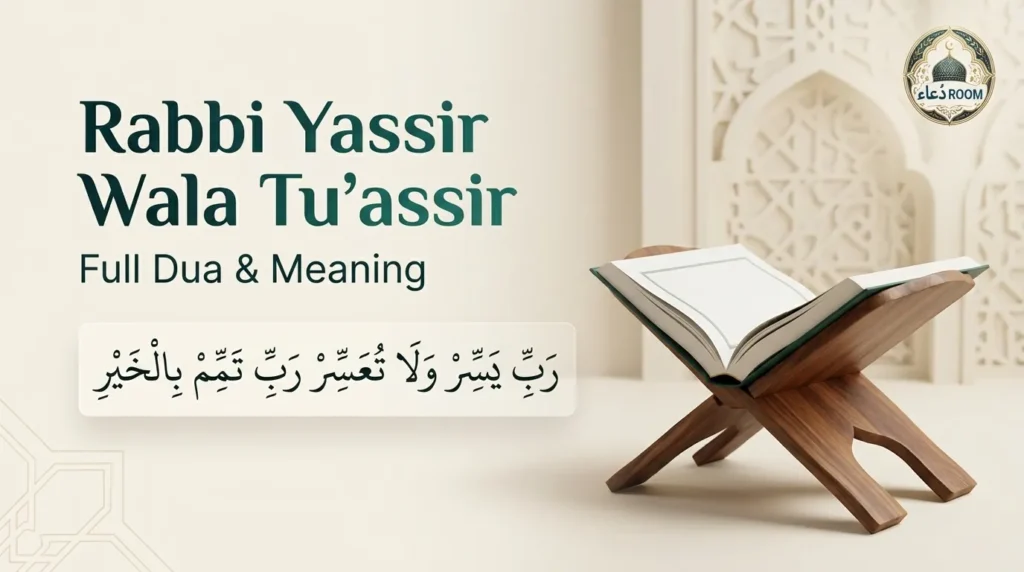
Rabbi Yassir Wala Tu’assir Full Dua & Meaning
Life feels hard sometimes. An exam, a job interview, a new task — all of it can feel too heavy. That’s why so many Muslims say the words “Rabbi Yassir Wala Tu’assir” before they start something hard. But what does this dua really mean? And is it from the Quran, a hadith, or somewhere else? This guide gives you clear, checked answers — no guessing, no made-up sources.
What Does “Rabbi Yassir Wala Tu’assir” Mean?
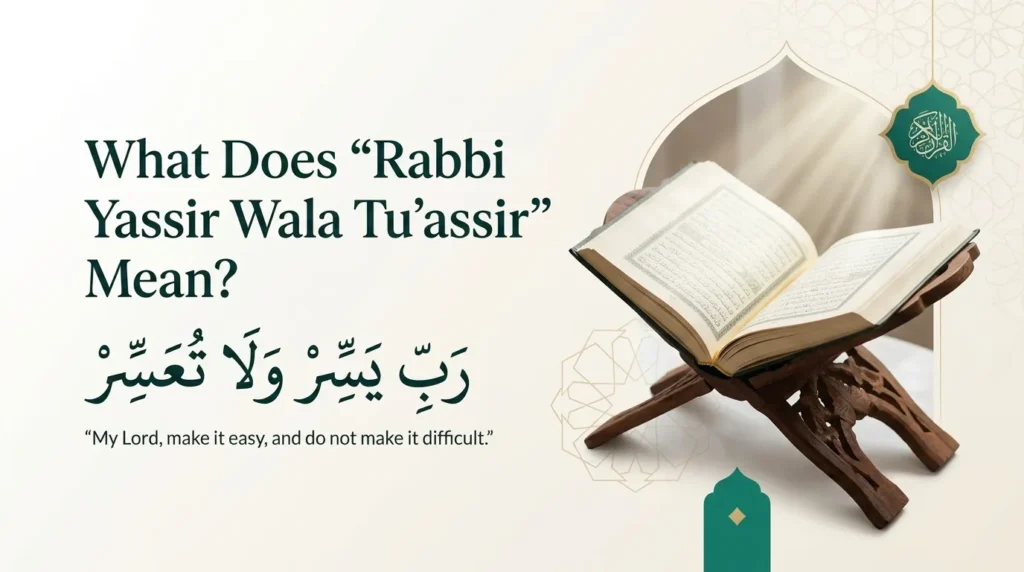
“Rabbi Yassir Wala Tu’assir” means “My Lord, make it easy, and do not make it hard.” It is a short dua (a personal prayer to Allah). People say it before a task that feels big or scary.
Arabic: رَبِّ يَسِّرْ وَلَا تُعَسِّرْ Transliteration: Rabbi yassir wa la tu’assir Meaning: “My Lord, make it easy, and do not make it difficult.”
Each word is simple once you break it down:
- Rabbi = “My Lord”
- Yassir = “make easy” (from the Arabic root yusr, meaning ease)
- Wa la = “and not”
- Tu’assir = “make hard” (from the root usr, meaning hardship)
You’ll also see a version that starts with “Allahumma” instead of “Rabbi.” Both mean the same thing. “Allahumma” means “O Allah,” and “Rabbi” means “My Lord.” People use either one.
Is “Rabbi Yassir Wala Tu’assir” From the Quran or a Hadith?

No. “Rabbi Yassir Wala Tu’assir” is not a verse from the Quran, and it does not appear in any hadith. This is an important fact many websites get wrong.
The scholars at Hadith Answers, a platform managed by trained Hadith teachers, were asked this exact question directly. Their answer was clear: these words do not appear in any Hadith.
They also provided important context: many scholars and authors historically open their books with this supplication, and teachers frequently recite it when beginning a lesson. Since its meaning is sound and beneficial, there is no harm in reciting it whenever you face difficulty—even though it was not transmitted directly from the Prophet ﷺ.
So here is the honest picture:
| Question | Answer |
|---|---|
| Is it in the Quran? | No. |
| Is it in a hadith? | No — confirmed by hadith scholars. |
| Is it okay to say? | Yes — the meaning is good and it does not go against Islam. |
| Where does it come from? | A tradition passed down by scholars and teachers over the years. |
| Is its meaning found elsewhere in Islam? | Yes — the same idea appears in authentic Quran verses (see below). |
This does not make the dua bad. Many good habits in Islam are not word-for-word in the Quran or hadith. What matters is that the meaning is true and does not go against Islamic teaching. Asking Allah for ease is always a good thing to do.
The Real Hadith About Making Things Easy

There is a real hadith that carries a similar idea, but it is not the same dua. It is a command from the Prophet ﷺ to his companions, not a personal prayer.
The Prophet ﷺ said: “Make things easy for people and do not make them difficult; give them glad tidings and do not drive them away.” — Sahih al-Bukhari (69), Sahih Muslim (1734) This hadith is recorded in Sahih al-Bukhari (Hadith 69). The Prophet ﷺ said this about teaching people their religion. He wanted teachers to be gentle, not harsh.
This hadith uses the same root words — yassiru (make easy) and tu’assiru (make hard) — as the popular dua. That’s likely why the two get mixed up online. But one is a command about how to teach others. The other is a personal prayer you say for yourself.
Quran Verses With the Same Meaning
While the exact words “Rabbi Yassir Wala Tu’assir” are not in the Quran, the idea of asking Allah for ease is found in real verses. Here are two you can trust:
| Verse | Arabic | Meaning |
|---|---|---|
| Surah Ta-Ha, 20:25-26 | رَبِّ اشْرَحْ لِي صَدْرِي وَيَسِّرْ لِي أَمْرِي |
“My Lord, expand my chest for me, and ease my task for me.”
(Prophet Musa’s prayer before facing Pharaoh) |
| Surah Ash-Sharh, 94:5-6 | فَإِنَّ مَعَ الْعُسْرِ يُسْرًا |
“So indeed, with hardship comes ease.”
(Repeated twice, offering comfort and hope) |
Prophet Musa (AS) said his dua right before he had to speak to a cruel king. He was scared. He asked Allah to open his chest and make his task easy. This is very close to what Muslims mean today when they say “Rabbi Yassir Wala Tu’assir” — asking Allah for strength and ease before something hard.
Rabbi Yassir Wala Tu’assir Rabbi Tammim Bil Khair (Full Dua)
Rabbi Yassir Wala Tu’assir: Longer Version
رَبِّ يَسِّرْ وَلَا تُعَسِّرْ رَبِّ تَمِّمْ بِالْخَيْرِ
Rabbi yassir wa la tu’assir, Rabbi tammim bil khair
“My Lord, make it easy, do not make it hard. My Lord, let it end in good.”
“Complete” or “finish”
“With good”
So the second half asks Allah to let the task end well, not just start well. Some people also add “wa bika nasta’een” at the end, which means “and in You we seek help.” This last part is close to real Quranic language — Surah Al-Fatiha (1:5) says “Iyyaka nasta’een,” meaning “You alone we ask for help.” Adding it is fine, but it is your own addition, not a fixed part of the original phrase.
Rabbi Yassir Wala Tu’assir in Urdu
اے میرے رب! آسان کر دے اور مشکل نہ بنا۔
اے میرے رب! آسان کر دے، مشکل نہ بنا۔ اے میرے رب! اسے اچھے انجام تک پہنچا دے۔
“O my Lord, make it easy, don’t make it hard. O my Lord, let it reach a good end.”
Rabbi Yassir Wala Tu’assir in Jawi Script

Jawi is the old Arabic-based writing style used for Malay and Indonesian. Since the dua is already in Arabic, its Jawi form looks the same as the Arabic text:
رَبِّ يَسِّرْ وَلَا تُعَسِّرْ
There is no separate “Jawi version” with different letters — Jawi script borrows the Arabic alphabet directly. If your teacher or book asks you to write it in Jawi, you can copy the Arabic text above exactly as it is.
When and How to Say This Dua

You can say this dua any time you feel worried about a task ahead. Common moments include:
- Before an exam or test
- Before a job interview
- Before starting a new project at work
- Before a hard conversation
- Before travel
- When you feel stuck or stressed
There is no fixed number of times to say it. Say it with a sincere heart, whenever you need Allah’s help. You do not need to be in wudu (a state of ritual purity) to say it, since it is a personal dua, not part of salah (formal prayer). Still, saying it with focus and humility helps you feel its meaning more.
If you want more dua ideas for daily struggles, you may also like this dua for good results in exams or this dua asking Allah to grant righteous companions, which follows the same “Rabbi” style of prayer.
Building Trust in Allah Alongside This Dua

This dua works best when it comes from real tawakkul — trust in Allah. Tawakkul means doing your best and then leaving the result to Allah. You can read more about tawakkul in Islam to build this mindset alongside your daily duas.
It also helps to remember that ease and hardship are part of every believer’s path. As one popular reminder puts it, Allah never said the journey would be easy — but He does promise that ease comes with every hardship, just as Surah Ash-Sharh says.
Parents often teach this dua to children before school tests. If you’re building a habit of teaching short duas at home, this guide on how to teach your child salah has more simple steps for young learners. And if you want a dua for your own parents while you ask Allah for ease, try Rabbighfirli Waliwalidayya.
In Short
“Rabbi Yassir Wala Tu’assir” is a short, honest prayer: “My Lord, make it easy, don’t make it hard.” It is not a verse from the Quran, and it is not found in any hadith — trusted scholars have confirmed this directly. But its heart matches real Quran verses, like Musa’s prayer before Pharaoh and the promise that ease comes with hardship. You don’t need a hadith number to make a prayer real. You just need a sincere heart and trust that Allah hears you.
FAQs
What is the meaning of the dua “Rabbi Yassir Wala Tu’assir”?
It means “My Lord, make it easy, and do not make it difficult.” Muslims say it before a hard task, asking Allah for help and ease.
Is “Rabbi Yassir Wala Tu’assir” from the Quran or a hadith?
No. Hadith scholars have confirmed it is not found in any hadith collection, and it is not a Quran verse. It is a traditional dua passed down by scholars, and it is fine to say since its meaning is good.
What is the full dua “Rabbi Yassir Wala Tu’assir Rabbi Tammim Bil Khair”?
It means “My Lord, make it easy, do not make it hard. My Lord, let it end in good.” The second part asks Allah for a good ending, not just an easy start.
What is the Arabic text of “Allahumma Yassir Wala Tu’assir”?
It is written اللَّهُمَّ يَسِّرْ وَلَا تُعَسِّرْ. It means “O Allah, make it easy and do not make it difficult.” It has the same meaning as “Rabbi Yassir Wala Tu’assir.”
What is the full dua in Urdu?
“اے میرے رب! آسان کر دے اور مشکل نہ بنا” — “O my Lord, make it easy, and don’t make it hard.”
When should I recite this dua?
Say it before anything that feels hard — an exam, an interview, a hard talk, or travel. There is no fixed number of times. Say it with sincerity whenever you need Allah’s help.
Is Rabbi Yassir Wala Tu’assir known for being a Sunnah dua?
No, it is not labeled a Sunnah dua since it is not from a hadith. It is known as a helpful, traditional supplication that scholars have long approved of, because its meaning matches true Islamic teaching about trusting Allah for ease.