Hasbunallahu Wa Ni’mal Wakeel: Meaning, Story, Hadith Evidence, and When to Say It

Life sometimes puts us in situations we cannot control. A scary diagnosis. Money problems. Someone plotting against us. In these moments, many Muslims say five simple words: Hasbunallahu wa ni’mal wakeel. These words carry the weight of two Prophets’ trust in Allah, and they can carry your weight too. In this guide, you will learn exactly what the phrase means, where it comes from in the Quran, the hadith that support it, and how to use it in your own life — explained in the simplest way possible.
Quick Summary
| Phrase Component | Arabic | Literal English Meaning |
|---|---|---|
| Hasbuna | حَسْبُنَا | Sufficient for us |
| Allahu | اللَّهُ | Allah |
| wa | وَ | And |
| Ni’mal | نِعْمَ | How Excellent Is |
| Al-Wakeel | الْوَكِيلُ | The Ultimate Trustee / Guardian |
What Does Hasbunallahu Wa Ni’mal Wakeel Mean?
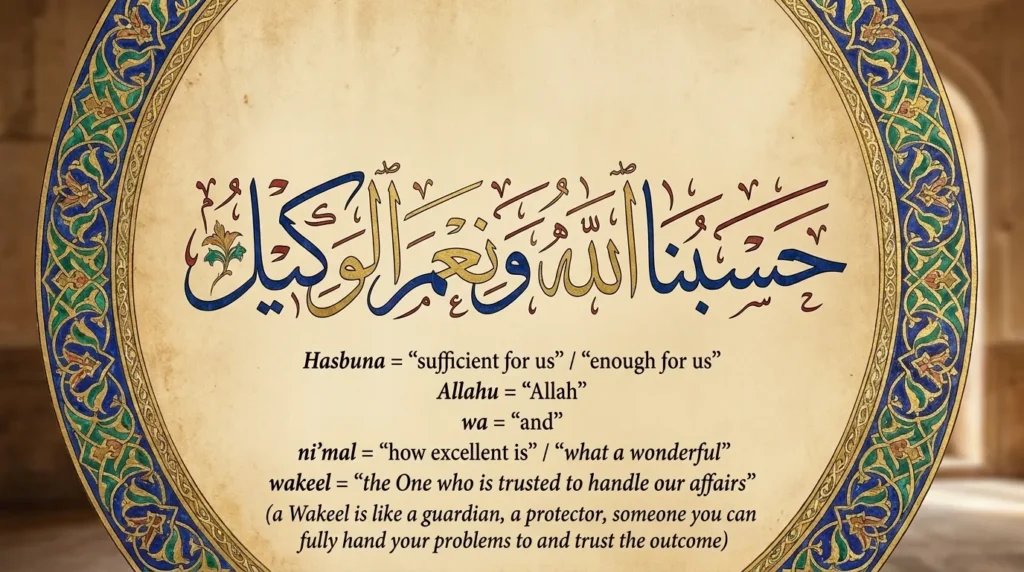
Hasbunallahu wa ni’mal wakeel (حَسْبُنَا اللَّهُ وَنِعْمَ الْوَكِيلُ) means “Allah is enough for us, and He is the best One to take care of our affairs.”
Break it into simple pieces and it becomes even easier to understand:
- Hasbuna = “sufficient for us” / “enough for us”
- Allahu = “Allah”
- wa = “and”
- ni’mal = “how excellent is” / “what a wonderful”
- wakeel = “the One who is trusted to handle our affairs” (a Wakeel is like a guardian, a protector, someone you can fully hand your problems to and trust the outcome)
So in plain English, a person saying this is saying: “I don’t have to carry this alone. Allah is enough, and He handles things better than I ever could.” If you want to go deeper into this idea of full reliance on Allah, we’ve written a complete guide on tawakkul in Islam — its meaning, Quranic verses, and benefits, which is really the heart of what this dua is teaching us.
Why Al-Wakeel Specifically?
Allah has many beautiful names, so why does this dua reach for Al-Wakeel rather than, say, Al-Mujeeb (The Answerer) or Al-Qadeer (The All-Powerful)? In human terms, a wakeel is the attorney or agent you formally hand power of attorney to — someone who now legally represents your case. When you call on Allah as your Wakeel, you’re not just asking Him to act; you’re handing over the entire outcome and the worry that comes with it, so your own job shrinks down to simply doing your part with sincerity.
Where Does This Dua Come From in the Quran?
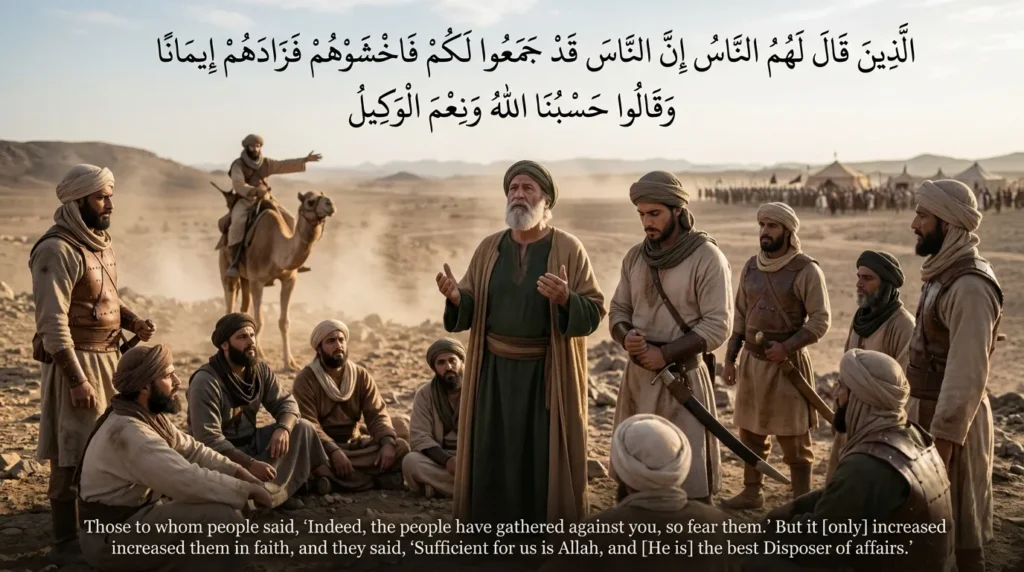
This phrase is not something scholars invented later — it comes directly from the Quran, in Surah Al-Imran, ayah 173:
Those who were warned that enemies had gathered a large force against them, only grew stronger in faith because of the warning, and they responded by saying that Allah alone was enough for them, and He is the best Protector. (Surah Al-Imran, 3:173)
You can read the full verse with its scholarly commentary directly on Quran.com’s tafsir of 3:173.
The real story behind this verse
This is where most articles online stop — but the context is what makes this verse powerful. This ayah was revealed after the Battle of Uhud, when the Muslims were already tired and wounded. News reached them that the enemy army was regrouping to finish them off. Instead of panicking, the Prophet ﷺ and a small group of companions marched out anyway, toward a place called Hamra al-Asad, trusting Allah completely. Their enemy, upon hearing how firm their faith was, lost their nerve and turned back without a fight. Their trust was rewarded — not because they were certain of winning, but because they handed the outcome to Allah.
The Hadith Evidence Behind This Dua
A lot of articles on this topic quote a single hadith and stop there. To actually understand why this phrase carries so much weight, it helps to see all the authentic hadith that connect to it — one on where the words come from, and two more on why trusting Allah this way matters.
1. The origin hadith — Ibn Abbas, Sahih al-Bukhari 4563
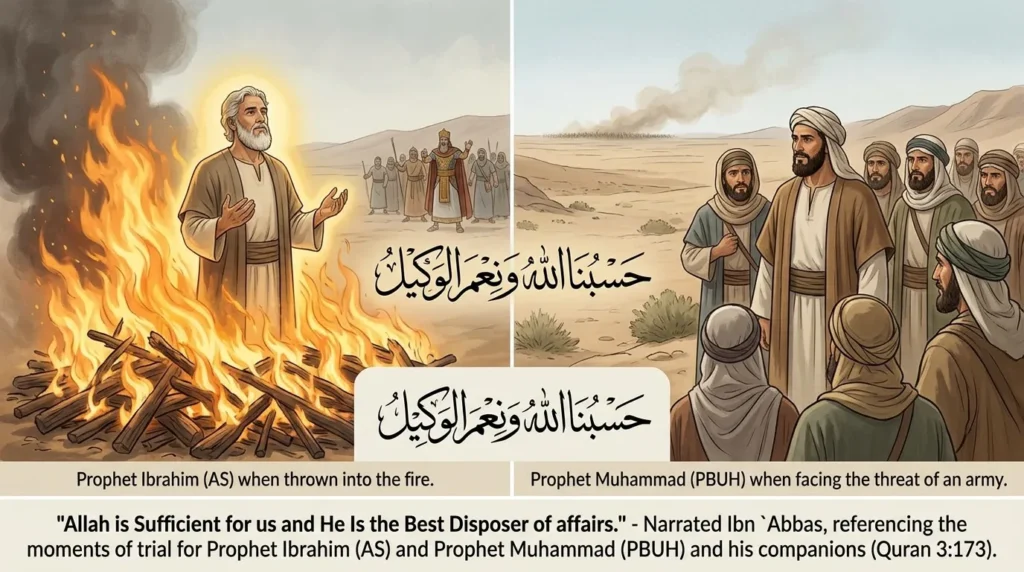
This is the core hadith behind the whole topic. Ibn Abbas (may Allah be pleased with him) reported that when Prophet Ibrahim (AS) was thrown into the fire, he said “Hasbunallahu wa ni’mal wakeel.” Prophet Muhammad ﷺ and the companions said the exact same words centuries later, when they were warned that a massive army had gathered against them after the Battle of Uhud. This hadith is what ties the dua to two separate Prophets and two separate crises. You can read it directly on Sunnah.com’s entry for Bukhari 4563.
2. The hadith on what tawakkul actually earns you — Jami’ at-Tirmidhi 2344
Umar ibn al-Khattab (may Allah be pleased with him) narrated that the Prophet ﷺ said: “If you were to rely upon Allah with the reliance He is due, He would provide for you just as He provides for the birds — they go out in the morning with empty stomachs and return in the evening full.” Imam Tirmidhi graded this hadith hasan sahih (authentic). It matters here because it explains the mechanism behind Hasbunallahu wa ni’mal wakeel: this isn’t a phrase about giving up effort, it’s a phrase about handing the outcome to Allah after you’ve done your part — the same way a bird still has to leave the nest.
3. The hadith on the reward of true reliance — Sahih al-Bukhari 5705 / Sahih Muslim 220
The Prophet ﷺ described seventy thousand people from his ummah who would enter Paradise without any reckoning. When asked who they were, he said they were people who did not seek ruqyah from others, did not believe in omens, did not use cauterization, “but rather they place their trust in their Lord.” Scholars cite this hadith as one of the clearest statements in the Sunnah on the virtue of tawakkul — the same quality that Hasbunallahu wa ni’mal wakeel expresses in a single sentence.
Together, these three hadith show that this dua isn’t an isolated phrase — it sits at the center of one of the most repeated themes in the Sunnah: doing your part, then trusting Allah completely with what you cannot control.
Why the story of Ibrahim (AS) matters so much
Picture the scene: Ibrahim (AS) is tied up. A massive fire has been built specifically to kill him. There is no army to save him, no escape route, nothing he can physically do. In that exact moment — the most helpless a person can be — he says: “Allah is enough for us, and He is the best Protector.” Allah then commanded the fire to become cool and safe for him (this part is described in Surah Al-Anbiya, 21:69). The lesson is simple: this dua is not just words for comfortable days. It’s for the moment when everything else has failed and only Allah remains.
Why Do We Say Hasbunallahu Wa Ni’mal Wakeel?

We say it because it retrains the heart in one sentence. When fear or worry takes over, this phrase reminds a person of three things at once:
- Allah already knows what you’re going through.
- Allah is capable of handling it, no matter how big the problem looks to you.
- Your job is trust and effort — the outcome belongs to Allah.
This is the essence of tawakkul — not doing nothing and waiting, but doing your part (as the bird hadith above describes) and then genuinely letting go of the outcome. If your heart is heavy right now, it may also help to read these Quran verses and quotes for when life feels unbearably hard — many people say they found comfort in them during their darkest weeks.
When Should You Recite Hasbunallahu Wa Ni’mal Wakeel?
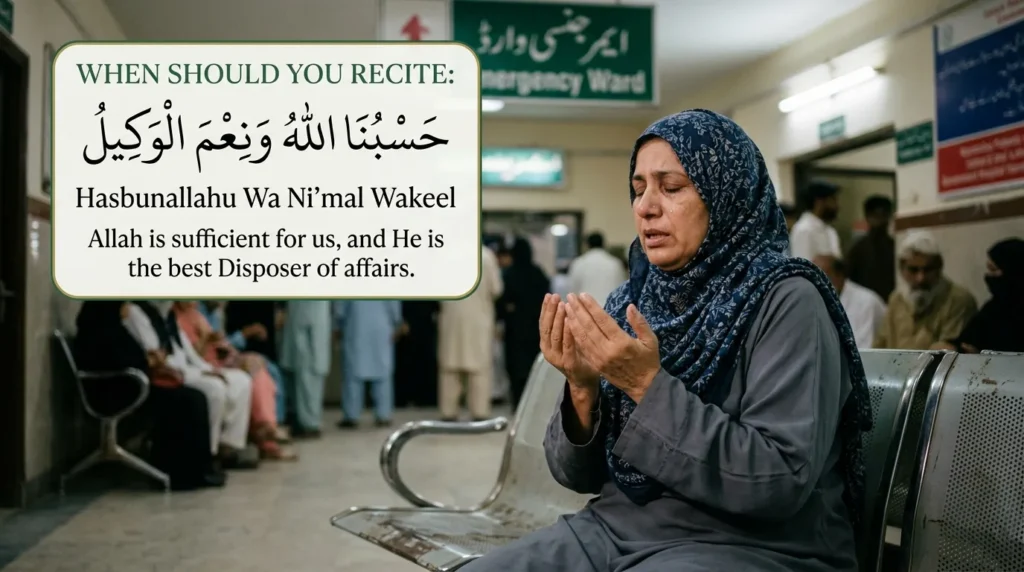
Based on the Quran and hadith above, scholars mention this dua fits situations like:
- When you’re afraid of a person or group who wants to harm you
- Before a difficult meeting, exam, surgery, or court case
- When you feel financially stuck or overwhelmed by debt
- During illness, grief, or loss
- When people are lying about you or plotting against you
- Simply as a daily reminder to hand your worries to Allah, even on ordinary days
If you’re currently dealing with someone actively working against you, this dua pairs naturally with a longer prayer — see our full collection of duas for protection from enemies and oppression for more options rooted in the Quran and Sunnah.
Hasbunallahu Wa Ni’mal Wakeel vs. Hasbiyallahu La Ilaha Illa Huwa

People often confuse these two, so here’s the simple difference:
Quick Comparison
Both phrases express complete trust in Allah, but they are used in slightly different contexts. Here’s an easy comparison to understand their meaning and Quranic origin.
| Phrase | Where It’s From | Meaning |
|---|---|---|
| Hasbunallahu wa ni’mal wakeel | Surah Aal-e-Imran (3:173) | “Allah is enough for us” — a collective declaration of trust in Allah. Prophet Ibrahim (AS) also used the singular form Hasbiya Allah. |
| Hasbiyallahu la ilaha illa huwa | Surah At-Tawbah (9:129) | “Allah is enough for me; there is no deity except Him.” It is a personal declaration of tawheed, reliance, and complete trust in Allah. |
Both express the same trust in Allah — one is said as a community, one as an individual. You can use either depending on whether you’re speaking for yourself or standing with others in a shared difficulty.
How to Pronounce Hasbunallahu Wa Ni’mal Wakeel
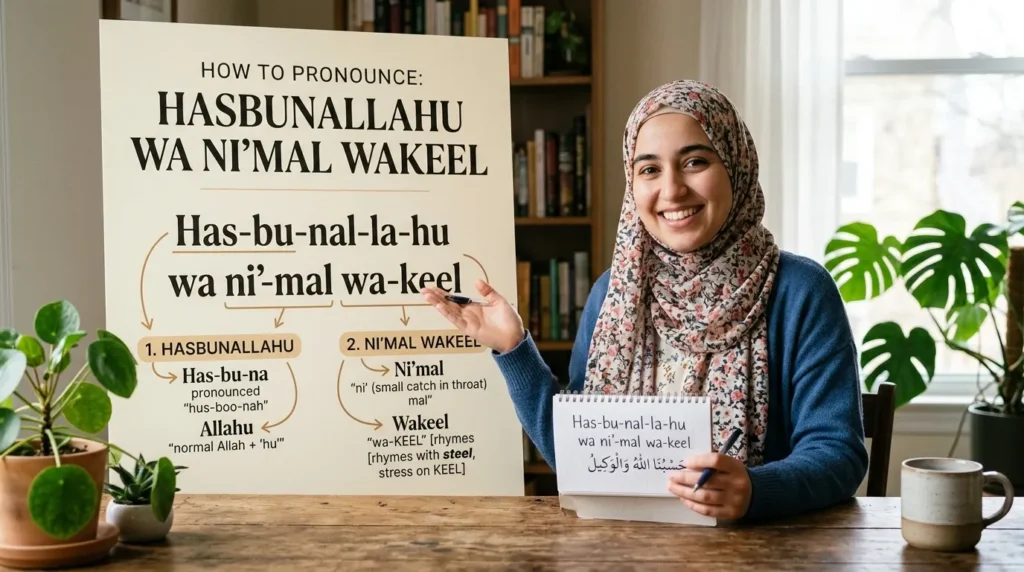
Here is a simple, syllable-by-syllable guide so you can say it correctly:
Has-bu-nal-la-hu wa ni’-mal wa-keel
- Say “Has-bu-na” like “hus-boo-nah”
- “Allahu” is pronounced the normal way you say Allah’s name, with a “hu” at the end
- “Ni’mal” has a small pause (the apostrophe) — say “ni” then a short catch in your throat, then “mal”
- “Wakeel” rhymes with “steel” — wa-KEEL, stress on the second part
Alternative spellings & transliterations: because Arabic-to-English transliteration isn’t standardized, you’ll see this phrase written a few different ways online — they’re all referring to the same dua:
- Hasbunallah wanikmal wakil (a spelling especially common in Southeast Asia, including Malaysia and Indonesia)
- Hasbi allahu wa ni’mal wakeel
- Hasbunallah wa ni’mal wakil
[EMBED: short audio player or 15–20 second video clip of a qari reciting Surah Al-Imran, ayah 173, so readers can hear the correct pronunciation without leaving the page]
Hearing a qari (reciter) say it a few times will fix the pronunciation in your memory faster than reading alone.
Common Variations You’ll See Online
You may notice the dua written slightly longer in some places, as:
“Hasbunallahu wa ni’mal wakeel, ni’mal mawla wa ni’man naseer”
This adds “He is the best Protector and the best Helper.” The second half of this longer version echoes language found in Surah Al-Anfal 8:40, where Allah describes Himself as the believers’ protector and helper. It is not from the same hadith (4563) discussed above — it is a combination that became popular in general supplication and dhikr circles, joining two divinely-given expressions of reliance rather than quoting a single verse. It’s not wrong to say, but it’s good to know the shorter phrase is the one directly recorded in the Quran and the authentic hadith, while the longer version is an added supplication some people like to include.
Benefits of Reciting This Dua (Rooted in What the Texts Actually Say)

Based only on what the Quran and hadith describe — not exaggerated claims — reciting this dua with sincerity and understanding can help you:
- Calm the heart during fear, the same way it strengthened the faith of the companions at Uhud instead of weakening it (Quran 3:173)
- Shift your focus from the problem to the Problem-Solver, which naturally reduces anxious thinking
- Practice real tawakkul, meaning you still act and try your best — like the bird that leaves the nest each morning — but you stop torturing yourself over things outside your control (Tirmidhi 2344)
- Follow the example of two Prophets, Ibrahim (AS) and Muhammad ﷺ, in the exact moments they needed strength the most (Bukhari 4563)
- Align yourself with a quality the Prophet ﷺ singled out for the highest reward — the seventy thousand who enter Paradise without reckoning are described as people who place their trust fully in their Lord (Bukhari 5705, Muslim 220)
Be cautious of websites promising a fixed “magic number” of repetitions (like reciting it exactly 450 or 1,000 times) as a guaranteed formula for a specific outcome — this is not something found in the Quran or the authentic hadith on this dua. What is authentically recommended is sincerity, understanding the meaning, and consistency, not a specific count. For a wider collection of verses and reminders about patience during hard seasons of life, see these Islamic quotes on life, sabr, and Alhamdulillah.
A Note on Using This Dua Today
Millions of Muslims around the world, including families going through war, displacement, and loss, continue to repeat these words as their last source of strength when everything else has been taken from them. This is exactly the spirit the dua was revealed for — not decoration, but real reliance on Allah when a person has nothing else left to hold onto. If you’re looking for more short, powerful reminders like this one to hold onto during hard days, browse our list of heart-touching Islamic quotes in English.
Other Verses That Pair Well With This Dua
Two other Quranic reminders go hand-in-hand with the trust expressed in this dua:
- Ayatul Kursi — the verse of Allah’s throne, often recited for protection; read our full breakdown of Ayatul Kursi’s meaning, Arabic text, and benefits
- Surah Al-Baqarah 2:152, where Allah promises to remember those who remember Him — see our explanation of what “so remember Me, I will remember you” means
Reciting these together with Hasbunallahu wa ni’mal wakeel builds a fuller sense of protection and closeness to Allah, especially before sleep, after Salah, or during a hard week. If you’re rebuilding a habit of daily dua and remembrance, it also helps to strengthen the five daily prayers first — our guide on the importance of Salah in Islam is a good place to start.
Publishing note: output the section below through your SEO plugin’s structured FAQ block (e.g. RankMath’s or Yoast’s FAQ block, or a custom FAQPage JSON-LD snippet) rather than plain headings/paragraphs. That’s what makes these questions eligible for the FAQ dropdown rich result in Google search.
Frequently Asked Questions
1. What does Hasbunallahu wa ni’mal wakeel mean? It means “Allah is sufficient for us, and He is the best One to trust with our affairs.” It comes from Surah Al-Imran 3:173 and is a declaration of full reliance on Allah during hardship.
2. Where does Hasbunallahu wa ni’mal wakeel appear in the Quran and hadith? The phrase is recorded in the Quran in Surah Al-Imran 3:173. Its background is explained in Sahih al-Bukhari 4563, narrated by Ibn Abbas, which reports that both Prophet Ibrahim (AS) and Prophet Muhammad ﷺ said these exact words in moments of extreme danger.
3. Who said Hasbunallahu wa ni’mal wakeel first — Ibrahim (AS) or the companions? According to Sahih al-Bukhari 4563, Prophet Ibrahim (AS) said it first, when he was thrown into the fire. Centuries later, Prophet Muhammad ﷺ and the companions said the same words when warned that a large army had gathered against them after the Battle of Uhud.
4. When should I recite Hasbunallahu wa ni’mal wakeel? Any time you feel fear, injustice, financial stress, illness, or overwhelming difficulty — before a hard meeting, exam, or medical procedure — and also as a regular daily reminder of trust in Allah, even on ordinary days.
5. Is there a specific number of times I must recite Hasbunallahu wa ni’mal wakeel? No authentic hadith fixes an exact number for this dua. Claims of a specific count (such as 450 times) for a guaranteed outcome are not found in the Quran or in Sahih al-Bukhari 4563. Sincerity, understanding the meaning, and consistency matter more than counting a specific number.
6. What is the difference between Hasbunallahu wa ni’mal wakeel and Hasbiyallahu la ilaha illa huwa? Hasbunallahu wa ni’mal wakeel is a group/community declaration from Surah Al-Imran 3:173. Hasbiyallahu la ilaha illa huwa is an individual declaration of tawheed from Surah At-Tawbah 9:129. Both express trust in Allah — one on behalf of a group, one on behalf of a single person.
7. Can I recite Hasbunallahu wa ni’mal wakeel for marriage problems, financial stress, or fear of enemies? Yes. Since the dua is a general declaration of trust in Allah during any hardship — not limited to one type of problem — it applies to marriage difficulties, financial stress, illness, and fear of people working against you, alongside taking the practical steps available to resolve the issue.
Final Reminder
Two Prophets, centuries apart, faced two completely different kinds of fear—one stood before a blazing fire, while the other faced a powerful army. Yet both responded with the exact same five words: Hasbunallahu wa ni’mal wakeel.