Jazakallah Khair Meaning: What It Means and How to Reply
Someone said “Jazakallah Khair” to you and you want to know what it means. This guide gives you the meaning, the Arabic spelling, and common ways to reply, in plain words.
Jazakallah Khair Meaning In English
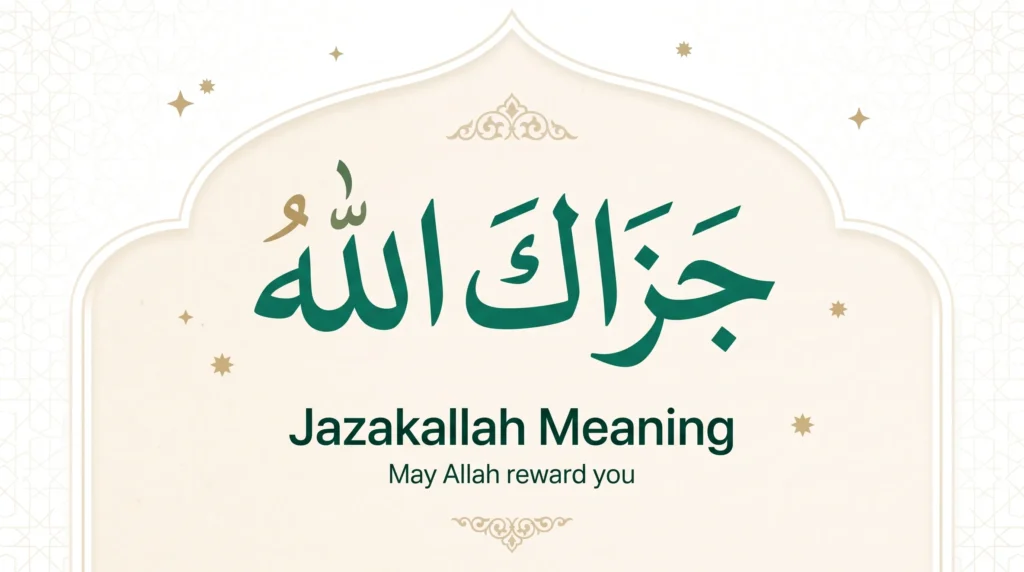
Jazakallah means “May Allah reward you.” It is a short prayer Muslims say to thank someone.
The word comes from Arabic. Jazak means “reward you,” and Allah is the Arabic word for God. So Jazakallah is asking Allah, not the person, to give the reward. This is different from a plain “thank you,” which only comes from you.
On its own, Jazakallah means “may Allah reward you,” without specifying what kind of reward. That is why most Muslims add one more word: khair, meaning “good.” Together, Jazakallah Khair means “May Allah reward you with good.”
Jazakallah Khair Meaning: Why the Extra Word Matters
Jazakallahu Khairan means “May Allah reward you with good.” The word khairan specifies the good being asked for.
The shorter form, Jazakallah, is commonly understood and widely used in daily speech. Jazakallahu Khairan is the fuller wording, and it is also the exact phrase reported in the hadith of the Prophet ﷺ, which is covered in detail further down this page.
Jazakallah Khair In Arabic
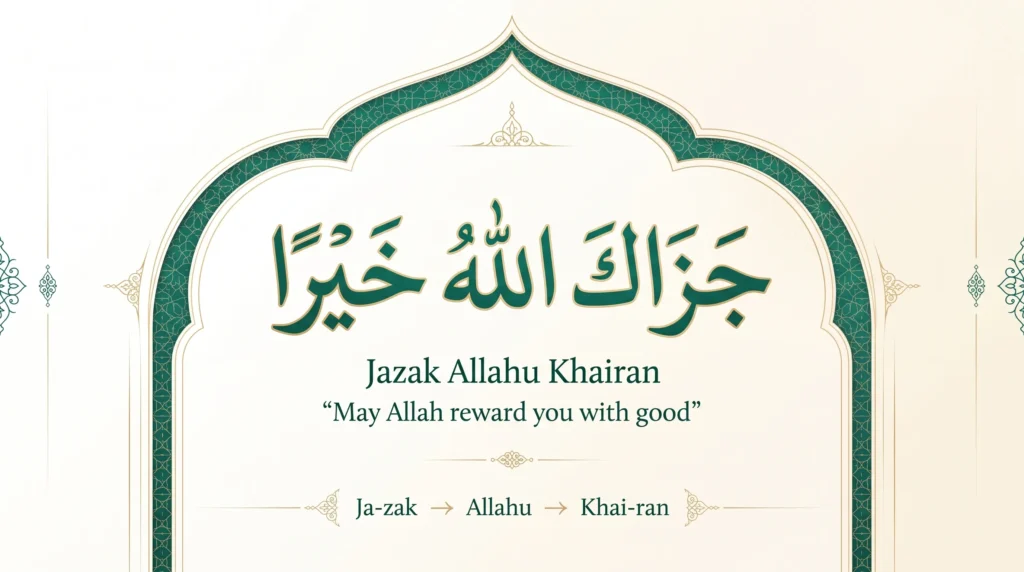
The Arabic spelling is جزاك الله خيرًا.
Arabic: جزاك الله خيرًا Transliteration: Jazak Allahu Khairan Meaning: May Allah reward you with good
Say it in parts: Ja-zak (like “ja-zak”) — Allahu (Allah, with “hu” at the end) — Khai-ran (like “khy-ran”). Together it flows as “Ja-za-kal-la-hu khai-ran.”
What Do the Words Mean?
The phrase has three simple parts, and each one adds meaning.
| Arabic Word | Simple Meaning | Role in the Phrase |
|---|---|---|
| Jazaka (جزاك) | “reward you” | The action, directed at “you” |
| Allahu (الله) | Allah (God) | Who is giving the reward |
| Khairan (خيرًا) | “with good” | What kind of reward is being asked for |
Together, Jazakallahu Khairan means “May Allah reward you with good.” It is a prayer, not a compliment. Instead of praising the person directly, you are asking Allah to repay them.
Jazakallah vs. Jazakillah vs. Jazakumullah
Arabic changes the word “jazak” based on who you are speaking to. This is one detail many guides skip, but it matters for using the phrase correctly.
| Phrase | Arabic | Who You Say It To |
|---|---|---|
| Jazak Allahu Khairan | جزاك الله خيرًا | One man |
| Jazaki Allahu Khairan | جزاكِ الله خيرًا | One woman |
| Jazakumu Allahu Khairan | جزاكم الله خيرًا | A group (mixed or men) |
| Jazakunna Allahu Khairan | جزاكن الله خيرًا | A group of women only |
If you are unsure which form to use, “Jazakumu Allahu Khairan” is a safe, common choice when speaking to more than one person, and it is sometimes also used to address a single person more formally.
When To Say Jazakallah Khair
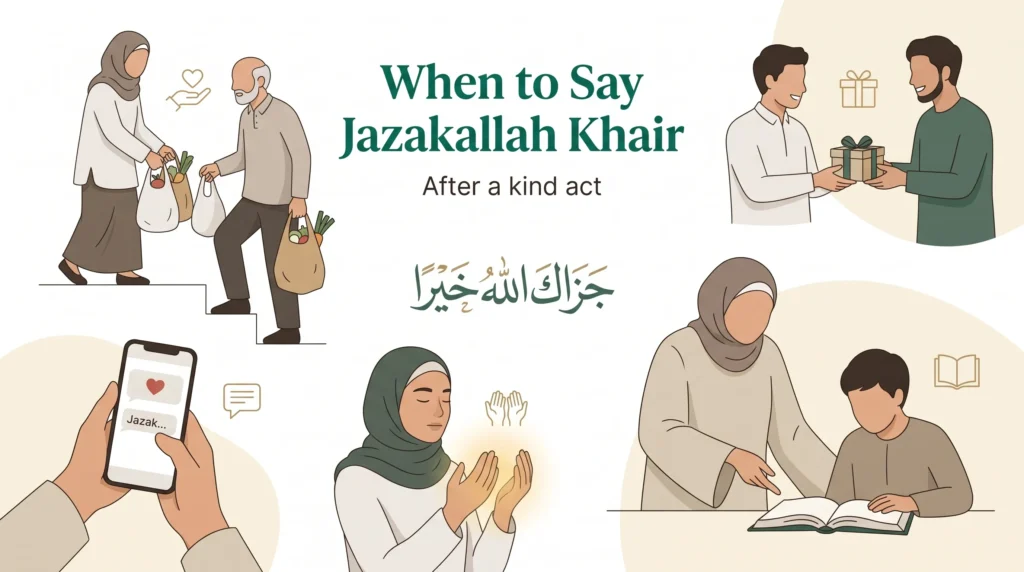
Say it any time someone does something kind for you, big or small. It works well in place of “thank you.”
Common moments people use it:
- After someone helps you with a task
- After receiving advice, a gift, or a favor
- After a teacher or speaker shares helpful knowledge
- In a text or message, to close out a thank-you note
- After someone makes dua (a prayer request) for you
Example sentences:
- “Thanks for the ride today. Jazak Allahu Khairan!”
- “That lecture was so helpful. Jazakallah Khair for sharing it.”
- “Jazakillah Khair for checking in on me, sis.”
Jazakallah Khair Reply (Jazakallah Khair Ka Jawab)
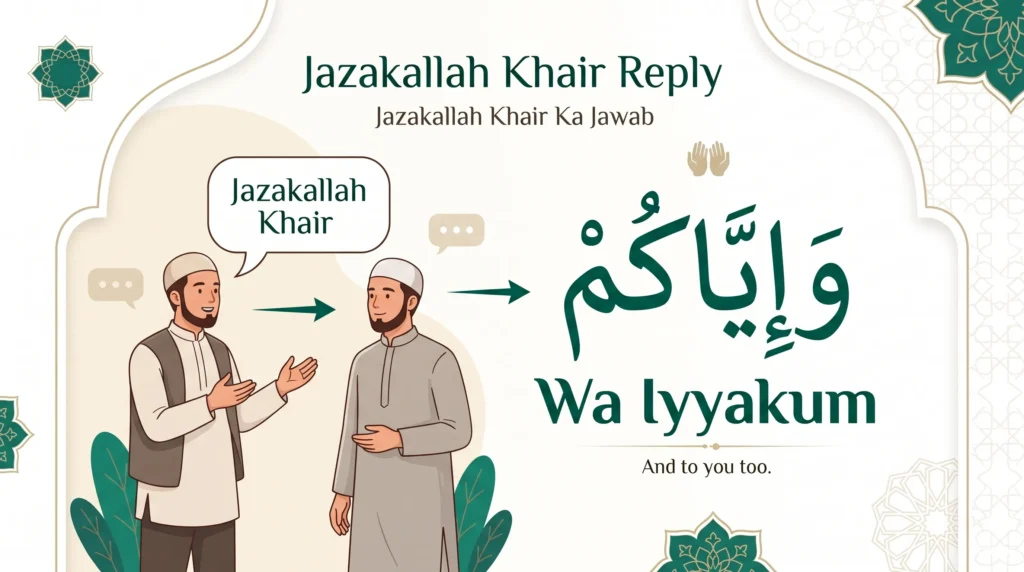
A common reply is “Wa Iyyakum,” which means “and to you too.”
If you are searching for jazakallah khair ka jawab — the Urdu and Hindi phrase for “the reply to Jazakallah Khair” — here are the main options:
- Wa Iyyaka (to a man) / Wa Iyyaki (to a woman) / Wa Iyyakum (to a group) — “and to you too”
- Wa Antum Fa Jazakumullahu Khairan — a more formal reply meaning “and you too, may Allah reward you with good”
- Ameen — simply accepting the prayer, meaning “may it be so”
Some people reply with the same phrase again, saying “Jazakallah Khair” back. This is also acceptable. There is no single required response — “Wa Iyyakum,” “Ameen,” and returning the same dua are all common and widely used.
Is Jazakallah Khair From a Hadith?
Yes. Saying Jazakallah Khair to thank someone is directly supported by an authentic hadith.
Usamah bin Zaid, a companion of the Prophet Muhammad (peace be upon him), reported that the Prophet said:
“Whoever has a favor done for him and says to the one who did it, ‘Jazak Allahu Khairan (may Allah reward you well),’ has done enough to thank him.”
This hadith is recorded in Jami’ at-Tirmidhi, Hadith 2035, and it is graded Hasan (sound) by scholars. It shows that saying this phrase is not just a nice habit. The Prophet ﷺ described it as a complete way to thank someone, even without adding anything else.
A Real Example From the Prophet’s Companions
There is also a recorded moment in early Islamic history where a companion used this exact phrase. Aisha (may Allah be pleased with her) once lost a necklace during a journey with the Prophet ﷺ. The search for it led to the revelation of the Quranic ruling on tayammum (a way to purify oneself for prayer using clean earth when water is not available). Afterward, the companion Usaid bin Hudair told her:
“Jazaki Allahu Khairan (May Allah reward you well). By Allah, whenever anything happened which you did not like, Allah brought good for you and for the Muslims in that.”
This account is recorded in Sahih al-Bukhari, Hadith 336, one of the major authentic hadith collections. It shows the phrase in real use among the Prophet’s own companions, not only as a general teaching.
The Quranic Principle Behind It
The idea of returning good for good also appears directly in the Quran:
“Is the reward for good [anything] but good?” — Quran 55:60
This verse does not use the exact phrase Jazakallah. It expresses the broader idea of responding to good with good.
Jazakallah Khair vs. Jazakallah Khairan Kaseeran
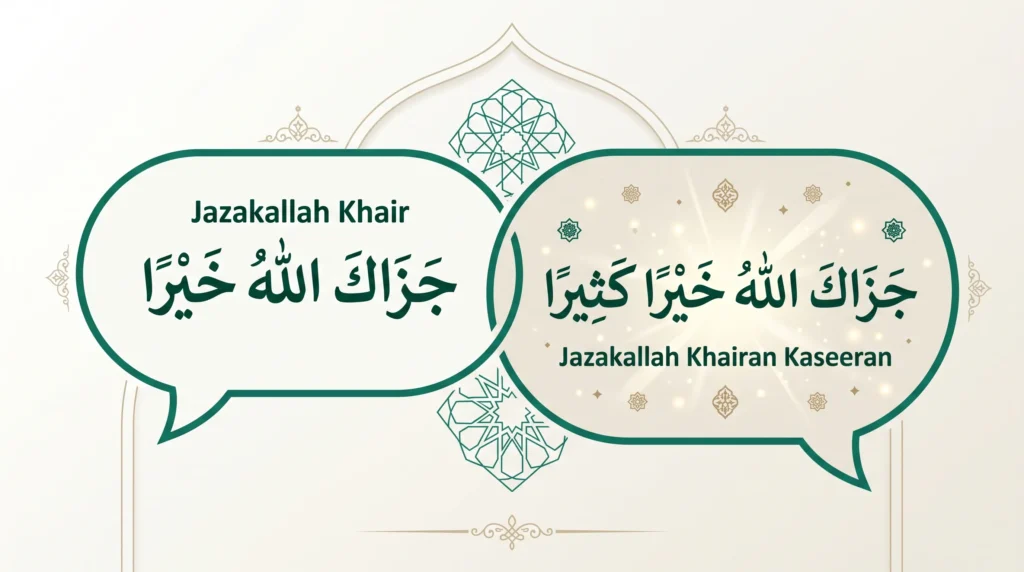
Jazakallah Khairan Kaseeran adds emphasis, meaning “May Allah reward you with abundant good.” This longer form is used when someone wants to express deeper or stronger gratitude than the standard phrase carries.
The word kaseeran (كثيرًا) means “abundantly” or “a lot.” Adding it does not change the core meaning of the phrase, but it intensifies it. You might hear this version after someone does something especially significant, like helping during a hard time, offering financial support, or spending a lot of effort on your behalf. In everyday, smaller moments, the standard “Jazakallah Khair” remains the more common and natural choice.
Jazakallah Khair vs. Shukran: What’s the Difference?
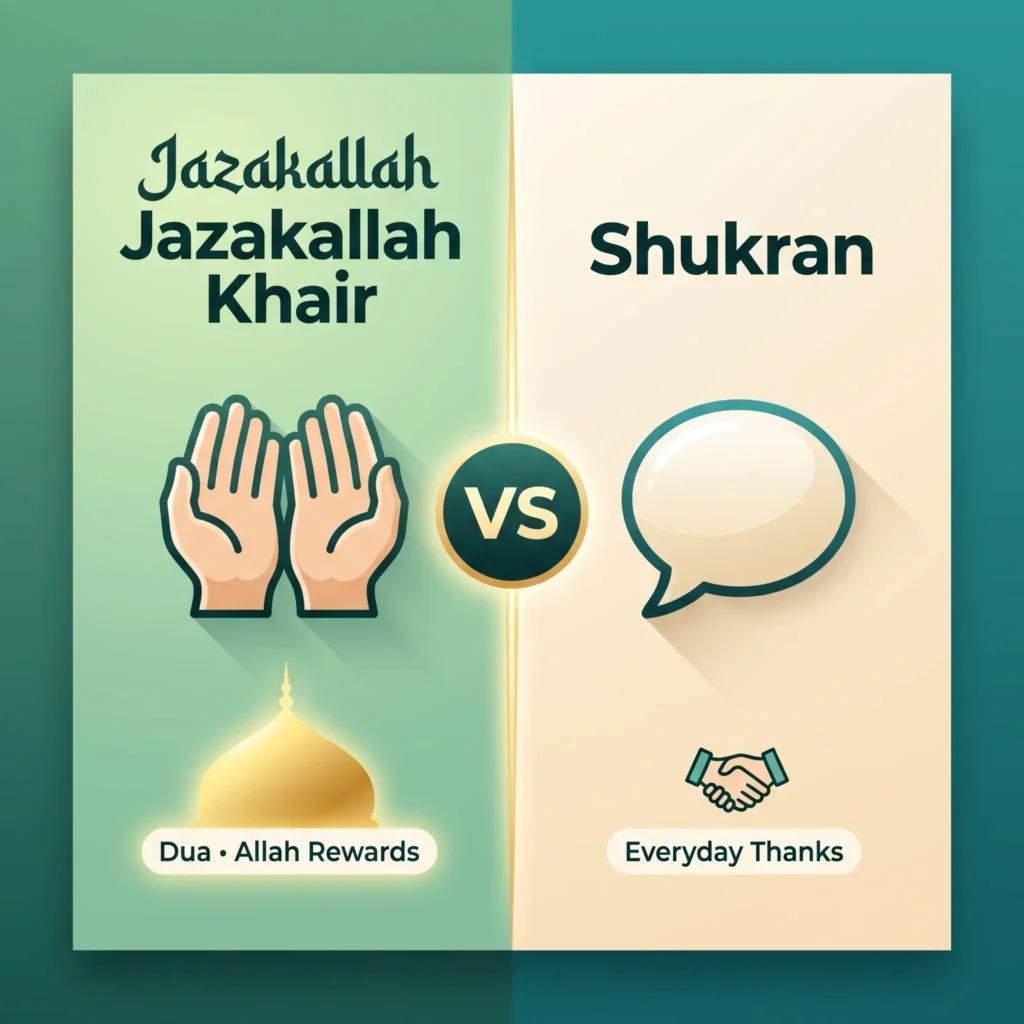
Shukran simply means “thanks.” Jazakallah Khair asks Allah to reward the person, rather than just acknowledging the favor yourself.
Jazakallah Khair is a dua asking Allah to reward the person, while Shukran is simply a word meaning “thanks.” Both can be used to express gratitude, although Jazakallah Khair has an explicitly religious meaning. Shukran remains a perfectly fine, common word, especially in casual Arabic-speaking settings, while Jazakallah Khair is often preferred in more specifically Islamic contexts.
Related Phrases Worth Knowing
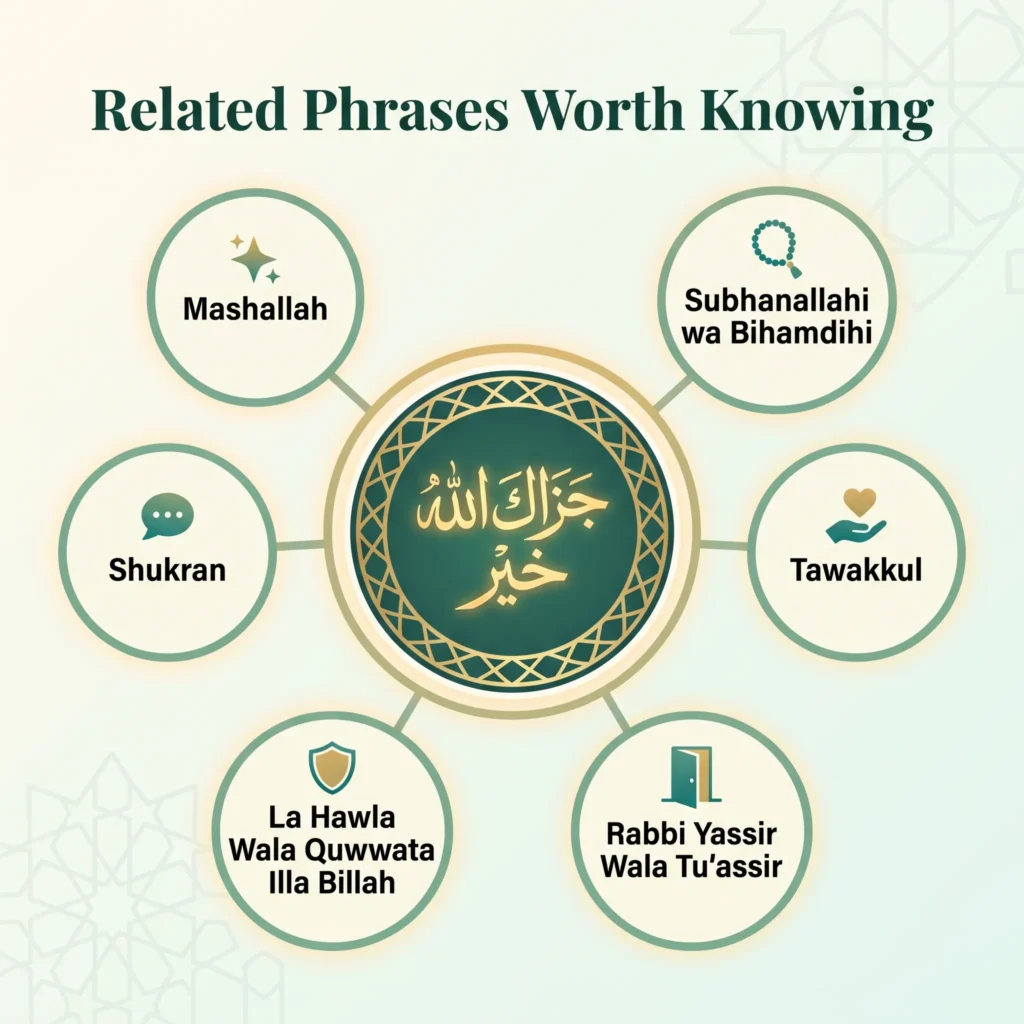
Jazakallah Khair fits into a wider set of everyday Islamic phrases used to thank, bless, and encourage one another. If you want to explore related expressions, our guide on the meaning of Mashallah covers a phrase often used alongside Jazakallah Khair when praising something good. For a short dhikr many Muslims recite daily, see Subhanallahi wa Bihamdihi.
If you want to understand how trust in Allah connects to phrases like this one, our post on tawakkul in Islam is a helpful next read. For a short dua often said when facing something difficult, see Rabbi Yassir Wala Tu’assir. And if you’re building a small collection of protective daily phrases, our guide on La Hawla Wala Quwwata Illa Billah is worth reading too.
Jazakallah Khair — Quick Summary
| Question | Short Answer |
|---|---|
| What does it mean? | “May Allah reward you with good” |
| How is it spelled in Arabic? | جزاك الله خيرًا |
| When do you say it? | Thanking someone for a favor, help, or advice |
| Is it from a hadith? | Yes, Jami’ at-Tirmidhi 2035 (Hasan) |
| How do you reply? | “Wa Iyyakum” or “Ameen” |
FAQ: Jazakallah Khair Meaning
What is the meaning of Jazakallah Khair?
Jazakallah Khair means “May Allah reward you with good.” It’s a short Islamic prayer said to thank someone, asking Allah to reward them rather than simply saying thanks yourself.
What is the reply to Jazakallah Khair (Jazakallah Khair ka Jawab)?
A common reply is “Wa Iyyakum,” meaning “and to you too.” You can also say “Wa Iyyaka” to a man, “Wa Iyyaki” to a woman, or simply “Ameen.”
What is the difference between Jazakallah and Jazakallah Khair?
Jazakallah means “May Allah reward you.” Jazakallahu Khairan means “May Allah reward you with good.” The fuller phrase, Jazakallahu Khairan, is the wording reported in the hadith.
Is Jazakallah Khair only for Muslims to say?
The phrase carries a specific Islamic religious meaning, since it is a prayer directed to Allah. It is most commonly used by and among Muslims, though many people outside the faith may hear and recognize it in daily conversation.
Can Jazakallah Khair be said to a woman?
Yes. The correct form for addressing a woman is “Jazaki Allahu Khairan,” using “Jazaki” instead of “Jazak.”
Is it wrong to shorten Jazakallahu Khairan to just Jazakallah?
Jazakallah means “May Allah reward you.” Jazakallahu Khairan means “May Allah reward you with good.” The fuller phrase, Jazakallahu Khairan, is the wording reported in the hadith, and many teachers encourage using it when possible.
What does Jazakumullahu Khairan mean?
It means “May Allah reward you all with good.” It’s the plural form, used when thanking more than one person at once, or as a more formal way to address a single person.
Final Thought
Jazakallah Khair is a small phrase that carries a real prayer inside it: that the good someone did for you comes back to them, multiplied. Next time someone helps you, try saying it with that meaning in mind, not just as a habit, but as a genuine request on their behalf.