
Salatul Hajat Ki Dua: How to Pray and What It Means

Do you have a need right now and want to ask Allah for help? Many Muslims turn to a prayer called Salatul Hajat for this. On this page, you will find the full salatul hajat ki dua, clear steps, and honest hadith sources, not guesses.
What Is Salatul Hajat?
Salatul Hajat means the prayer of need. Hajat is an Arabic word for a need or a wish. Muslims pray it, then ask Allah for help with something in life.
Salatul Hajat is not one of the five daily prayers. It is a nafl prayer. Nafl means an extra prayer you choose to pray. You can pray Salatul Hajat any time you have a real need. This includes needs like a job, a health problem, a family issue, or any personal worry.
Some people also call it salat ul haja or namaz e hajat. These names all point to the same prayer.
Salatul Hajat Ki Dua: Arabic, Transliteration, and Meaning
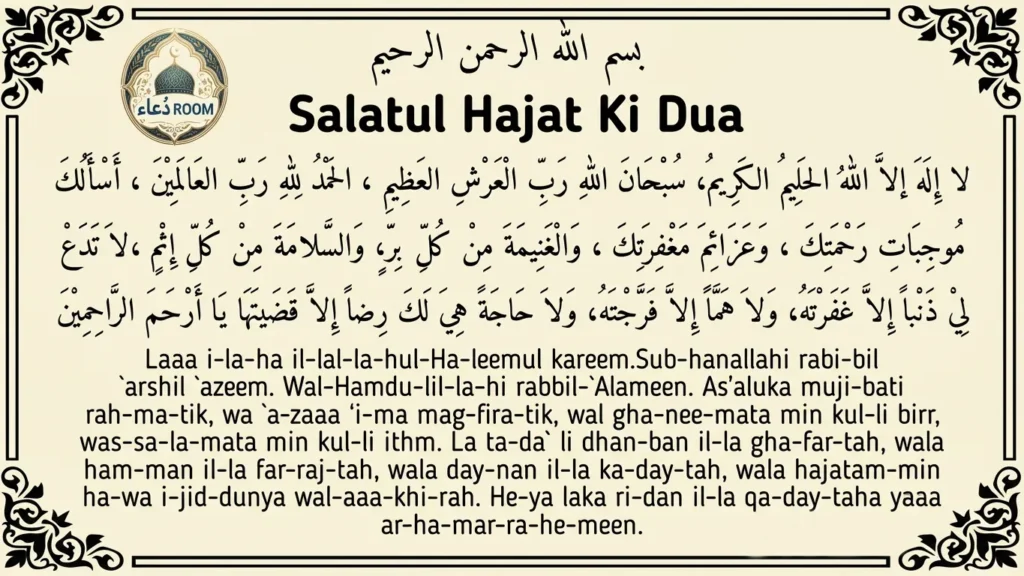
The short answer: this dua comes from a hadith about a companion named Abdullah bin Abi Awfa. Below is the full Arabic text, how to say it, and its meaning in plain English.
Arabic
لَا إِلَهَ إِلَّا اللَّهُ الْحَلِيمُ الْكَرِيمُ، سُبْحَانَ اللَّهِ رَبِّ الْعَرْشِ الْعَظِيمِ، الْحَمْدُ لِلَّهِ رَبِّ الْعَالَمِينَ، أَسْأَلُكَ مُوجِبَاتِ رَحْمَتِكَ، وَعَزَائِمَ مَغْفِرَتِكَ، وَالْغَنِيمَةَ مِنْ كُلِّ بِرٍّ، وَالسَّلَامَةَ مِنْ كُلِّ إِثْمٍ، لَا تَدَعْ لِي ذَنْبًا إِلَّا غَفَرْتَهُ، وَلَا هَمًّا إِلَّا فَرَّجْتَهُ، وَلَا حَاجَةً هِيَ لَكَ رِضًا إِلَّا قَضَيْتَهَا يَا أَرْحَمَ الرَّاحِمِينَ
Transliteration
La ilaha illallahul Halimul Karim. Subhan Allahi Rabbil ‘Arshil ‘Azim. Al-hamdu lillahi Rabbil ‘Alamin. As’aluka mujibati rahmatika, wa ‘aza’ima maghfiratika, wal ghanimata min kulli birrin, was salamata min kulli ithmin. La tada’ li dhanban illa ghafartahu, wa la hamman illa farrajtahu, wa la hajatan hiya laka ridan illa qadaitaha, ya arhamar rahimin.
English Meaning
“There is no god but Allah, the Forbearing, the Generous. Glory be to Allah, Lord of the Mighty Throne. Praise be to Allah, Lord of the worlds. I ask You for what brings Your mercy, and for Your full forgiveness. I ask for a share of every good deed, and safety from every sin. Do not leave any sin of mine unforgiven, or any worry unrelieved, or any need that pleases You unfulfilled, O Most Merciful of the merciful.”
This dua is found in Jami’ at-Tirmidhi 479 and Sunan Ibn Majah 1384. We explain what scholars say about this hadith in a later section, so read on before you form your final view.
How to Pray Salatul Hajat: Step by Step
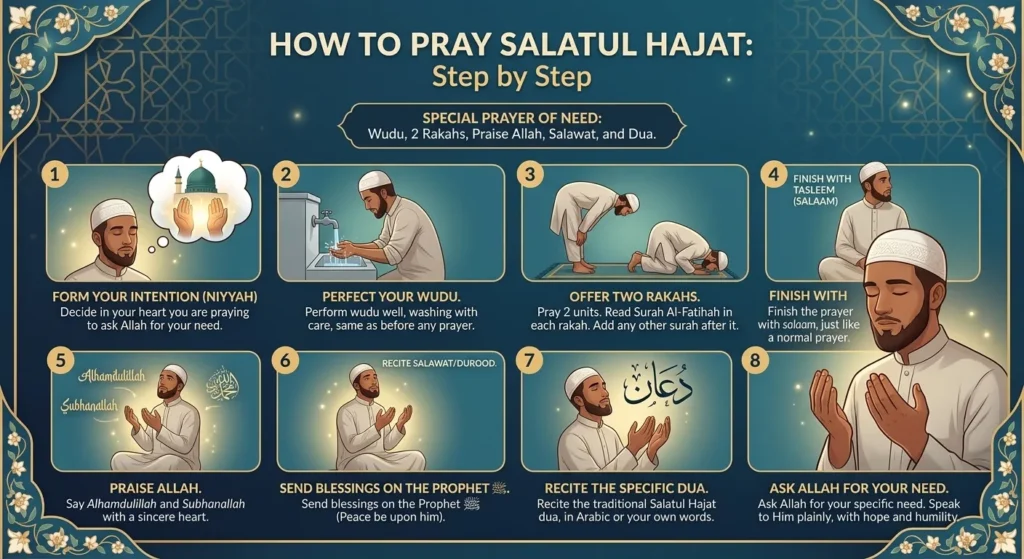
In short, you make wudu, pray two rakahs, praise Allah, send blessings on the Prophet ﷺ, then say your dua. Here is the full method.
- Make your intention. Decide in your heart that you are praying to ask Allah for your need.
- Perform wudu well. Wash with care, the same as before any prayer.
- Pray two rakahs. Read Surah Al-Fatihah in each rakah. Add any other surah you know after it.
- Finish the prayer with salaam, just like a normal prayer.
- Praise Allah. Say Alhamdulillah and Subhanallah with a sincere heart.
- Send blessings on the Prophet ﷺ. This is called durood or salawat.
- Recite the Salatul Hajat ki dua, in Arabic or your own words.
- Ask Allah for your need. Speak to Him plainly, with hope and humility.
Some Muslims also like to recite Surah Al-Ikhlas or Surah Al-Kafirun after Al-Fatihah in each rakah. This is a common practice, but it is not required. Any surah you know well is fine.
How Many Rakahs Are in Salatul Hajat Ki Namaz?
Most scholars mention two rakahs for Salatul Hajat, based on the hadith text itself. Some general books on voluntary prayer mention up to four rakahs as an option for extra reward. Two rakahs is the number stated in the actual hadith, and it is what most trusted guides recommend for the standard prayer.
Salatul Hajat Namaz Time: When Can You Pray It?
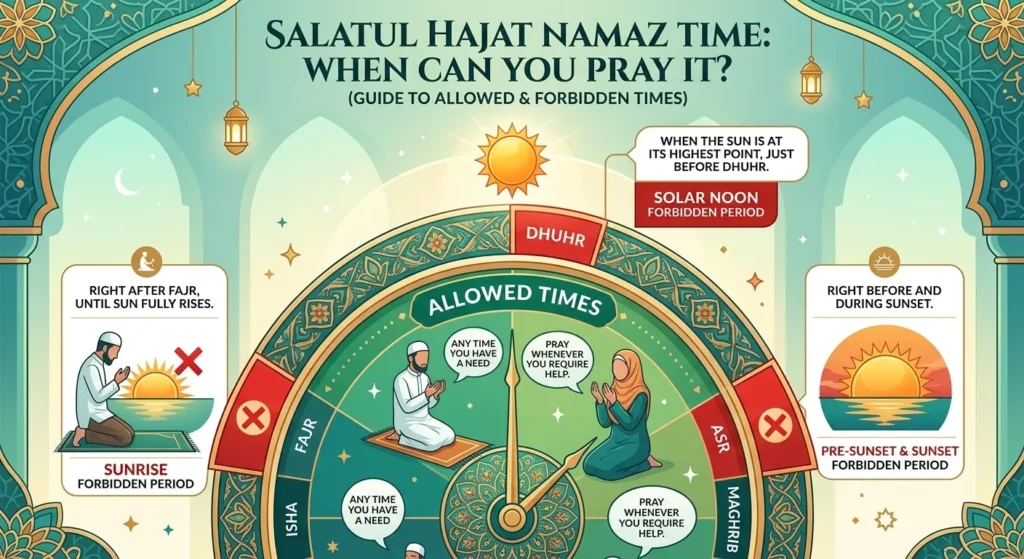
You can pray Salatul Hajat almost any time you have a need. The only limit is the times when prayer is not allowed. These forbidden times are:
- Right after Fajr, until the sun fully rises
- When the sun is at its highest point, just before Dhuhr
- Right before and during sunset
Outside of these three windows, you are free to pray. This means you can pray Salatul Hajat after Isha without any problem, since Isha time is not one of the restricted periods.
Many Muslims choose the last third of the night for this prayer. This choice is based on a strong and authentic hadith, not a guess. The Prophet ﷺ said that Allah comes down to the lowest heaven in the last third of every night and says, “Who calls upon Me, that I may answer him? Who asks Me, that I may give him?” This hadith is found in Sahih al-Bukhari 1145, and its authenticity is agreed upon by both Bukhari and Muslim. This is why the last third of the night is seen as a special time for any dua, including the dua of Salatul Hajat.
Is the Hadith About Salatul Hajat Ki Dua Authentic?
This is the most important question on this page, and the honest answer is that scholars disagree. The hadith text is real. It appears in Tirmidhi and Ibn Majah. But its chain of narrators has been questioned by hadith experts.
Imam Tirmidhi himself called this hadith gharib, which means strange or rare, and he noted a problem in its chain. A narrator in the chain, named Fa’id ibn Abdur Rahman, was graded weak by several scholars. Imam Ahmad ibn Hanbal called him matruk, which means his narrations are usually not accepted. Sheikh Al-Albani graded this specific hadith as da’if jiddan, meaning very weak.
At the same time, some scholars accept weak hadith like this one when they describe a virtuous act, as long as the act does not go against anything proven in the Quran or authentic Sunnah. This is a known idea in Islamic scholarship, though scholars also disagree on how far to apply it.
Because of this split, some Islamic teachers treat Salatul Hajat as a recommended practice. Others, including the Permanent Committee for Islamic Research and Ifta in Saudi Arabia, say it should not be treated as a fully proven act of worship based on this one hadith.
Here is the part that is not in dispute at all: praying two rakahs of voluntary prayer, then making sincere dua to Allah, is always allowed and always good. Dua itself is commanded many times in the Quran. Allah says, “Call upon Me, and I will answer you” (Surah Ghafir 40:60). So even a reader who prefers caution about this specific hadith can still pray nafl and turn to Allah with full confidence.
Can You Make Your Own Dua Too?
Yes. After the set dua, you are free to ask Allah for your need in your own words and your own language. Speak to Him honestly about what is on your heart. You do not need fancy words. Allah understands every language and every heart.
If you want more words to lean on, you may also find comfort in a dua for rizq if your need is about provision, or a dua for pain in the body if your need is about health.
Salatul Hajat vs Istikhara: What Is the Difference?
Salatul Hajat is for asking Allah for help with a need you already know. Istikhara is for asking Allah to guide you when you are stuck between choices. If you already know your need and want Allah’s help to reach it, pray Salatul Hajat. If you are unsure which option is right, Istikhara fits better.
What to Do If Your Need Is Not Fulfilled Right Away
This is a common worry, and it deserves a clear, honest answer. No prayer or dua forces a fixed result. Allah answers dua in three ways: He may grant it now, He may grant something better later, or He may turn away some harm equal to it, as explained by scholars based on general hadith about dua. Keep praying and stay patient. This mindset is closely tied to tawakkul, or full trust in Allah, a topic explained further in this guide on tawakkul in Islam.
Common Mistakes to Avoid
- Do not treat this dua as a fixed formula that forces a result.
- Do not skip wudu or rush through the two rakahs.
- Do not pray it during the three forbidden prayer times.
- Do not stop your normal five daily prayers while focusing on this one. Daily salah stays the foundation, as explained in this guide on the importance of salah in Islam.
- Do not lose hope if the answer is delayed. Trust Allah’s timing and His wisdom.
Salatul Hajat Ki Dua: Quick Reference Table
| Question | Simple Answer |
|---|---|
| What is it? | A voluntary prayer for a personal need. |
| How many rakahs? | Two rakahs, based on the hadith text. |
| When can I pray it? | Any time, except the three forbidden prayer times. |
| Best time | Last third of the night, per Sahih al-Bukhari 1145. |
| What is the dua? | A specific dua from Tirmidhi 479 and Ibn Majah 1384. |
| Is the hadith authentic? | Its chain is graded weak by several scholars; views differ. |
| Can I make personal dua? | Yes, in your own words after the set dua. |
| Can women pray it? | Yes, the same way as any other nafl prayer. |
Frequently Asked Questions
Is Salatul Hajat mentioned in Sahih Bukhari or Sahih Muslim?
No. The specific dua and hadith come from Jami’ at-Tirmidhi (479) and Sunan Ibn Majah (1384), not from Sahih al-Bukhari or Sahih Muslim. Its chain has been graded weak by scholars such as Al-Albani.
How do I pray Salatul Hajat step by step?
Make wudu, pray two rakahs of nafl prayer, praise Allah, send durood on the Prophet ﷺ, then recite the dua. After that, ask Allah for your need in your own words as well.
What is the best salatul hajat namaz time?
Any time is fine, except the three forbidden prayer times. Many Muslims prefer the last third of the night, based on the authentic hadith in Sahih al-Bukhari 1145 about Allah’s mercy in that hour.
Can I pray Salatul Hajat after Isha?
Yes. Isha is a normal prayer time, not a forbidden one. You can pray Salatul Hajat any time after Isha and before the restricted window near Fajr.
Can women pray Salatul Hajat ki namaz?
Yes. Salatul Hajat is open to both men and women. The steps are the same as for any other nafl prayer.
What if I cannot read Arabic?
You can read the dua from the transliteration, or simply make your own honest dua in English or your own language. Perfect Arabic is not required for Allah to hear your dua.
Does Salatul Hajat guarantee that my need will be fulfilled?
No dua or prayer guarantees one exact outcome. Muslims ask Allah for help and trust His wisdom, knowing He answers in the way and time that is truly best for them.
Final Thoughts
Salatul Hajat gives you a simple, honest way to bring your need straight to Allah. Pray with sincerity, ask for what is truly good for you, and trust His plan. Whether you use the dua from the hadith or your own words, what matters most is a heart that turns to Allah with hope.