Subhanallahi Wa Bihamdihi: Meaning, Arabic Text, and Benefits

You keep hearing Subhanallahi wa bihamdihi, but you want the real meaning, not a guess. You also want to know why the Prophet ﷺ told us to say it 100 times a day. This guide gives you the Arabic, the English meaning, the exact hadith, and simple steps to make it a daily habit.
What Does Subhanallahi Wa Bihamdihi Mean?
Subhanallahi wa bihamdihi means “Glory be to Allah, and praise be to Him.” It is a short phrase of tasbih, which means glorifying Allah, paired with tahmid, which means praising Him.
The phrase has two small parts joined together. “Subhanallahi” means Allah is far above any flaw or weakness. “Wa bihamdihi” means “and with His praise,” showing that all good comes only from Him. Muslims say this phrase to remember Allah and to thank Him at the same time.
Subhanallahi Wa Bihamdihi in Arabic
Here is the exact Arabic text of this dhikr (remembrance).
سُبْحَانَ اللَّهِ وَبِحَمْدِهِ
This short line is easy to read once you know each Arabic word. You will see the word-by-word meaning further down this page.
Subhanallahi Wa Bihamdihi Transliteration and Pronunciation
If you cannot read Arabic script yet, this transliteration helps you say the words correctly.
Subhan-Allahi wa bihamdihi
Follow these steps to say it clearly.
- Subhan — say “sub-haan,” stress the second part.
- Allahi — say “al-laa-hi,” a soft, even sound.
- wa — say “wa,” short and quick, meaning “and.”
- bihamdihi — say “bi-ham-di-hi,” four clear beats.
Say it slowly for the first few days. Speed will come naturally once the sounds feel easy.
Subhanallahi Wa Bihamdihi English Meaning
Here is the full Subhanallahi wa bihamdihi meaning in English.
“Glory be to Allah, and praise be to Him.”
Some translations say, “How perfect Allah is, and I praise Him.” Both mean the same thing. You are saying that Allah has no flaw, and every form of praise belongs to Him alone.
Subhanallahi Wa Bihamdihi Ka Matlab (Urdu Meaning)
Many readers search for subhanallahi wa bihamdihi ka matlab or its Urdu tarjuma. Here it is in simple Urdu.
اللہ پاک ہے، اور تمام تعریفیں اسی کے لیے ہیں۔
In plain words, this means: Allah is pure and free from all faults. All praise belongs to Him alone. This is the same belief carried in the Arabic and English lines above.
Word-by-Word Breakdown
Most guides give you only the full phrase. But breaking it into single words helps you learn it faster and understand every part.
| Arabic Word | Transliteration | Meaning |
|---|---|---|
| سُبْحَانَ | Subhana | Glory / Free from flaw |
| اللَّهِ | Allahi | Of Allah |
| وَ | Wa | And |
| بِ | Bi | With |
| حَمْدِ | Hamdi | Praise |
| هِ | Hi | His (belonging to Him) |
Read the first two words together. They mean “Glory be to Allah.” Read the last four words together. They mean “and with His praise.”
The Hadith Behind Subhanallahi Wa Bihamdihi
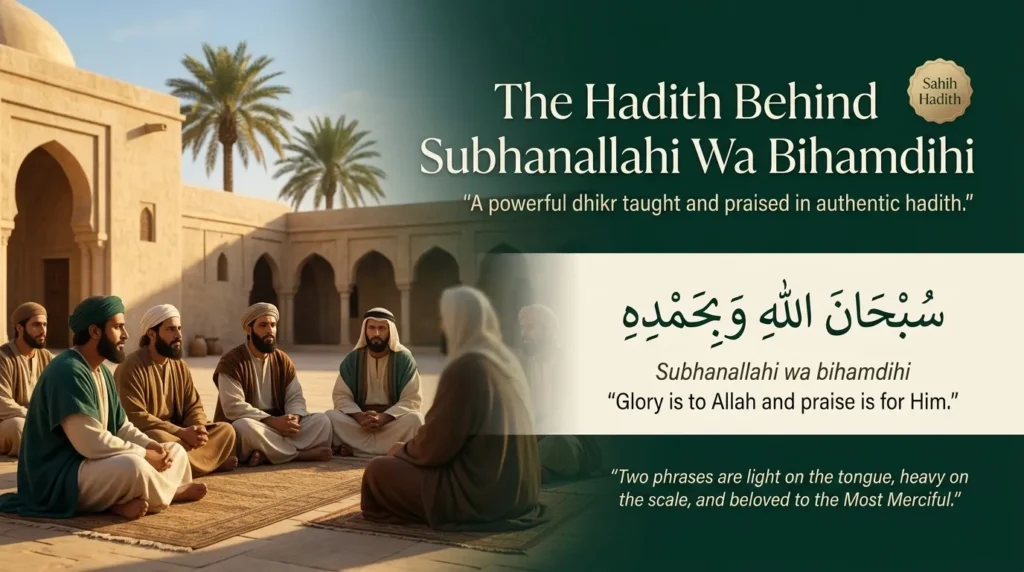
This phrase is not just a nice saying. It comes straight from the Prophet’s ﷺ own words, recorded in Sahih al-Bukhari.
“There are two expressions which are very easy for the tongue to say, but they are very heavy in the balance and are very dear to The Beneficent (Allah): ‘Subhan Allah Al-Azim’ and ‘Subhan Allah wa bihamdihi.'” (Sahih al-Bukhari 6406)
This hadith tells you three things about this short phrase:
- It is easy to say. No long words, no hard grammar.
- It is heavy on the scale. On the Day of Judgment, good deeds are weighed. This phrase adds real weight.
- It is loved by Allah. Few acts of worship are described this way in the Hadith.
Subhanallahi Wa Bihamdihi 100 Times: What Happens?

Saying this phrase 100 times a day carries a special promise from the Prophet ﷺ. This is likely the single biggest reason people search for this dhikr today.
“Whoever says, ‘Subhan Allah wa bihamdihi,’ one hundred times a day, will be forgiven all his sins even if they were as much as the foam of the sea.” (Sahih al-Bukhari 6405)
Read that promise again. Sea foam covers a huge amount of space. The hadith uses that image to show just how much sin this simple dhikr can wipe away. A few points to keep in mind:
- This covers minor sins. Scholars explain that major sins still need direct repentance (tawbah) to Allah.
- Consistency matters more than speed. Saying it 100 times slowly, with focus, is better than rushing through it.
- You can spread it across the day. You do not need to say all 100 in one sitting.
Subhanallahi Wa Bihamdihi, Subhanallahil Azeem

You will often see this phrase paired with a second line: Subhanallahil Azeem, meaning “Glory be to Allah, the Almighty.” The hadith above names both phrases together as the two words “light on the tongue, heavy in the balance.”
Together, the full dhikr reads:
سُبْحَانَ اللَّهِ وَبِحَمْدِهِ، سُبْحَانَ اللَّهِ الْعَظِيمِ Subhan-Allahi wa bihamdihi, Subhan-Allahi-l-Azim “Glory be to Allah, and praise be to Him. Glory be to Allah, the Almighty.”
You can say either phrase alone, or say them together as one longer dhikr. Both forms come from the same authentic hadith.
When to Recite: Morning, Evening, and After Salah

There is no single fixed time set only for this dhikr, but three moments work especially well for building a strong habit.
- Morning and evening. These two windows are common times for daily adhkar (plural of dhikr) in Islamic tradition.
- After each Salah. Many Muslims add short dhikr like this right after finishing their prayer, while still seated.
- Any spare moment. While walking, waiting, or doing simple tasks, your tongue can stay busy with this phrase.
If you already have a habit of daily dhikr after prayer, this phrase pairs well with other short remembrances like Hasbunallahu wa ni’mal wakeel, which many Muslims recite in the same routine.
How to Make It a Daily Habit

A promise this large deserves a real plan, not just good intentions. Try these simple steps.
- Use your fingers or a tasbih counter. Count on your right hand, or use prayer beads, to reach 100 without losing track.
- Attach it to something you already do. Say it while waiting for the kettle, walking to your car, or right after Salah.
- Split it into small sets. Try 25 in the morning, 25 midday, 25 in the evening, and 25 before bed.
- Say it with meaning, not just sound. Remind yourself what the words mean each time you say them.
- Teach it to your children early. Short dhikr like this is a gentle first step before harder memorization, much like early Quran learning covered in how parents can encourage children to love the Quran.
This dhikr also fits well into the wider habit of daily remembrance encouraged across Islamic teaching. For readers building a full daily worship routine, understanding the importance of Salah in Islam gives helpful context for where short dhikr like this one fits in.
Subhanallahi Wa Bihamdihi vs. Other Short Dhikr
Many similar-sounding phrases exist. This table shows how this dhikr compares to two other well-known ones.
| Phrase | Arabic Meaning | Main Focus |
|---|---|---|
|
Subhanallahi wa bihamdihi
Glorification + Praise
|
Glory and praise be to Allah | Combines glorifying and praising Allah in one phrase. |
|
Subhanallahi
Glorification
|
Glory be to Allah | Focuses on glorifying and declaring Allah free from all imperfections, without the added phrase of praise. |
|
La ilaha illallah wahdahu la sharika lahu
Tawheed
|
None has the right to be worshipped but Allah alone | Declares Allah’s complete oneness and rejects any partner with Him. |
Each phrase carries its own reward. Learning several short forms of dhikr gives you more ways to remember Allah through the day.
Why This Dhikr Combines Two Meanings
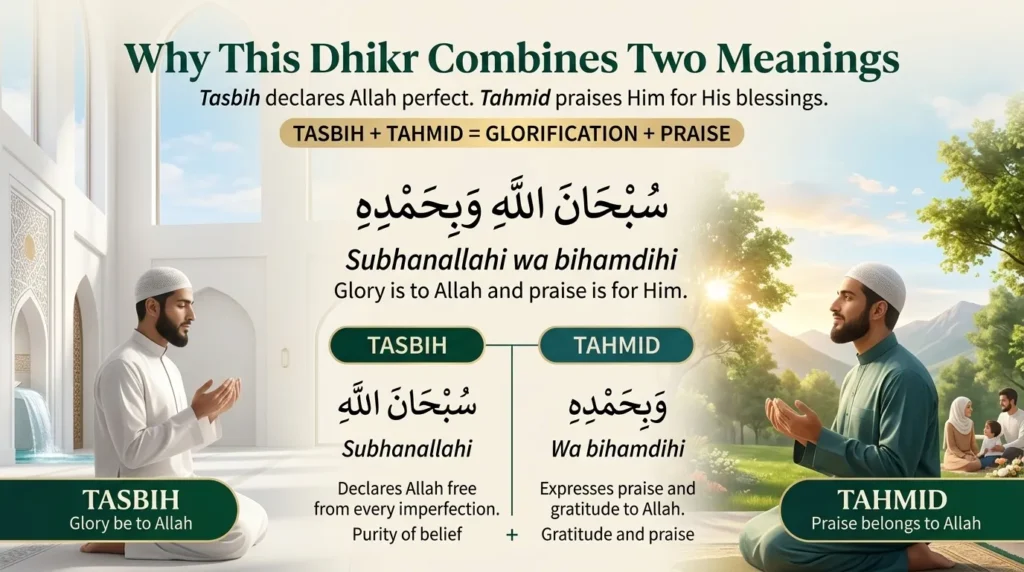
Most short dhikr focus on only one idea. Subhanallahi wa bihamdihi stands out because it joins two ideas in one breath.
- Tasbih (Subhanallahi) clears away any wrong idea about Allah. It states that He has no partner, no flaw, and no equal.
- Tahmid (wa bihamdihi) adds gratitude on top of that belief. It says every good thing traces back to Him, and He alone deserves thanks.
Saying only “Subhanallah” glorifies Allah. Saying only “Alhamdulillah” thanks Him. This combined phrase does both jobs in four short words. That may be part of why the Prophet ﷺ called it “heavy in the balance” despite being so easy to say. Few phrases pack that much meaning into so little effort.
This balance of glorifying Allah while thanking Him also mirrors a wider habit in Islam of remembering Allah often. Scholars often place phrases like this alongside the general command in Islamic teaching to remember Allah frequently throughout the day, not just during formal prayer. That habit of ongoing remembrance connects naturally to daily dua and gratitude, a theme also explored in powerful dua for rizq, where thanking Allah plays a central role in seeking His blessings.
FAQs About Subhanallahi Wa Bihamdihi
What is Subhanallahi wa bihamdihi?
It is a short Islamic phrase of dhikr. It means “Glory be to Allah, and praise be to Him,” combining glorification and praise in one line.
Is Subhanallahi wa bihamdihi a hadith or a Quran verse?
It comes from hadith, not the Quran. The Prophet ﷺ taught and praised this phrase, recorded in Sahih al-Bukhari.
What is the reward for saying it 100 times a day?
The Prophet ﷺ said all a person’s sins are forgiven, even if they equal the foam of the sea, though this applies to minor sins (Sahih al-Bukhari 6405).
Can I say Subhanallahi wa bihamdihi after Salah?
Yes. Many Muslims add it right after finishing their prayer, along with other short forms of dhikr.
Can women recite Subhanallahi wa bihamdihi?
Yes. This dhikr has no restriction by gender. All Muslims, men and women, can say it at any time.
When should I recite Subhanallahi wa bihamdihi?
You can say it any time, but morning, evening, and right after Salah are common and easy times to build the habit.
Is 100 times a strict requirement?
No. The number 100 carries a special promise in the hadith, but saying this phrase any number of times still counts as good dhikr.
Final Word
Subhanallahi wa bihamdihi is short, but its reward is enormous. Say it with a calm heart and real meaning, not just fast repetition. A phrase this light on the tongue should never feel heavy on your daily routine.