First Kalma Tayyab: Meaning, Arabic Text, and English Translation
You want to learn the First Kalma Tayyab the right way. Maybe your child needs it for school. Maybe you just want to understand what you are saying. Either way, you need the true Arabic words, a clear English meaning, and an easy way to say it. This guide gives you all three, plus the real Quran and Hadith behind it.
What Is the First Kalma?
The First Kalma is the short Arabic sentence that states the basic belief of every Muslim. It says there is only one God, and Muhammad ﷺ is His messenger.
Muslims call it Kalima Tayyab, or the “Word of Purity.” The word Kalima (كلمة) means “word” or “statement.” The word Tayyab (طيب) means “pure” or “good.” Together, they mean a pure statement of faith.
It is the first of the Six Kalimas, a set of short Islamic statements taught to children across South Asia. Each Kalima builds on the one before it. But the First Kalma stands alone as the root of Islamic belief. Without it, a person is not yet a Muslim.
First Kalma Tayyab in Arabic
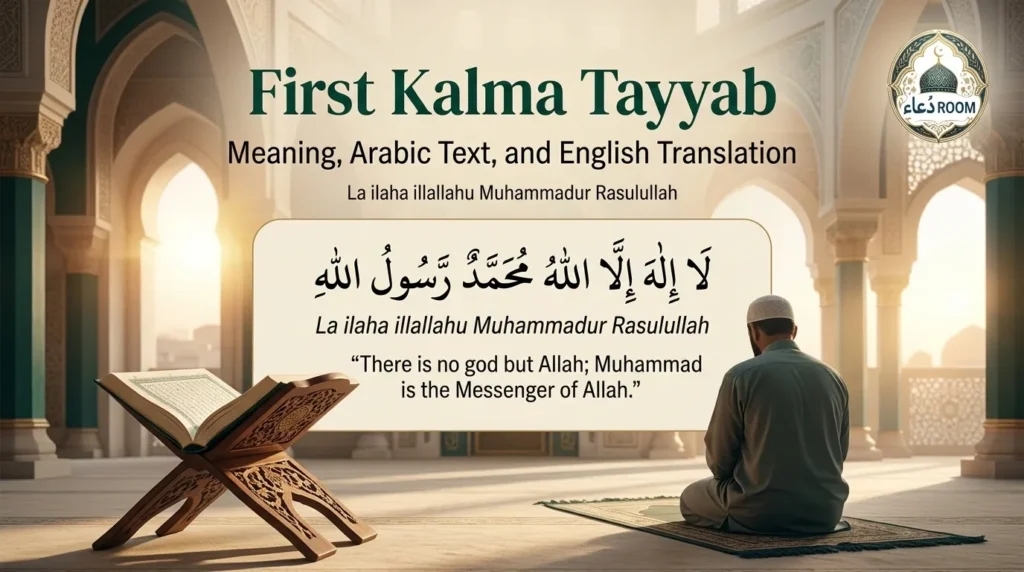
Here is the exact Arabic text of the First Kalma Tayyab.
لَا إِلَٰهَ إِلَّا ٱللَّٰهُ مُحَمَّدٌ رَّسُولُ ٱللَّٰهِ
This line has two parts. The first part talks about Allah. The second part talks about Prophet Muhammad ﷺ. You will learn both parts below.
First Kalma Tayyab Transliteration
If you cannot read Arabic yet, use this transliteration. It shows how to say the words using English letters.
La ilaha illallahu Muhammadur Rasulullah
Say it slowly at first. Break it into small pieces. Then join the pieces together.
First Kalma Meaning in English
Here is the First Kalma tayyab with English translation.
“There is no god but Allah, and Muhammad is the Messenger of Allah.”
This one line carries two beliefs. First, only Allah deserves worship. Second, Muhammad ﷺ is His true and final messenger. A person becomes Muslim by believing and saying this line with a sincere heart.
First Kalma Tayyab Ka Matlab (Urdu Meaning)
Many readers search for pehla kalma tayyab ka tarjuma. Here is the Urdu meaning in simple words.
اللہ کے سوا کوئی معبود نہیں، محمد (ﷺ) اللہ کے رسول ہیں۔
In short, this means: Allah is the only one worthy of worship. Muhammad ﷺ is His messenger. This is the same belief in Urdu words.
Word-by-Word Breakdown of the First Kalma
Most guides give you the full line only. But it helps to see each word on its own. This table breaks the First Kalma Tayyab into small parts so you can learn it word by word.
| Arabic Word | Transliteration | Meaning |
|---|---|---|
| لَا | La | No / None |
| إِلَٰهَ | Ilaha | God / Deity |
| إِلَّا | Illa | Except |
| ٱللَّٰهُ | Allahu | Allah |
| مُحَمَّدٌ | Muhammadur | Muhammad |
| رَّسُولُ | Rasulu | Messenger |
| ٱللَّٰهِ | Allahi | Of Allah |
Read the first four words together. They mean “There is no god except Allah.” Read the last three words together. They mean “Muhammad is the messenger of Allah.”
How to Pronounce First Kalma Tayyab
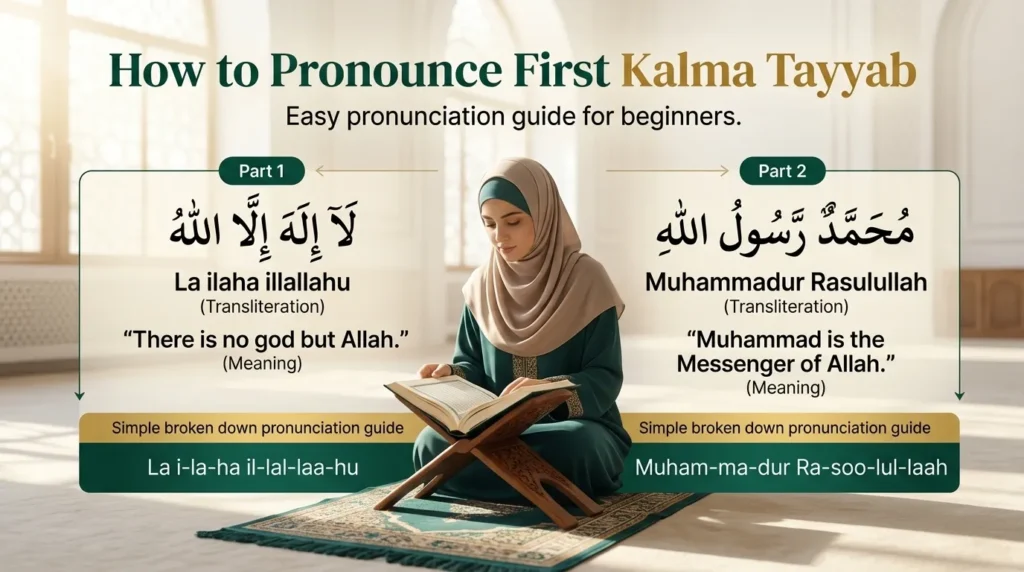
Getting the sounds right matters. Here is a simple, step-by-step way to say it.
- La — say it like “laa,” a long “a” sound.
- ilaha — say “ee-laa-ha,” soft and even.
- illallahu — say “il-lal-laa-hu,” keep the “l” sound strong.
- Muhammadur — say “mu-ham-ma-dur,” stress the middle part.
- Rasulullah — say “ra-soo-lul-laah,” end with a long “aah” sound.
Say each part slowly for a week. Then speak the full line at normal speed. Listening to a Qari (Quran reciter) say it out loud also helps a lot.
The Two Parts of the First Kalma Tayyab
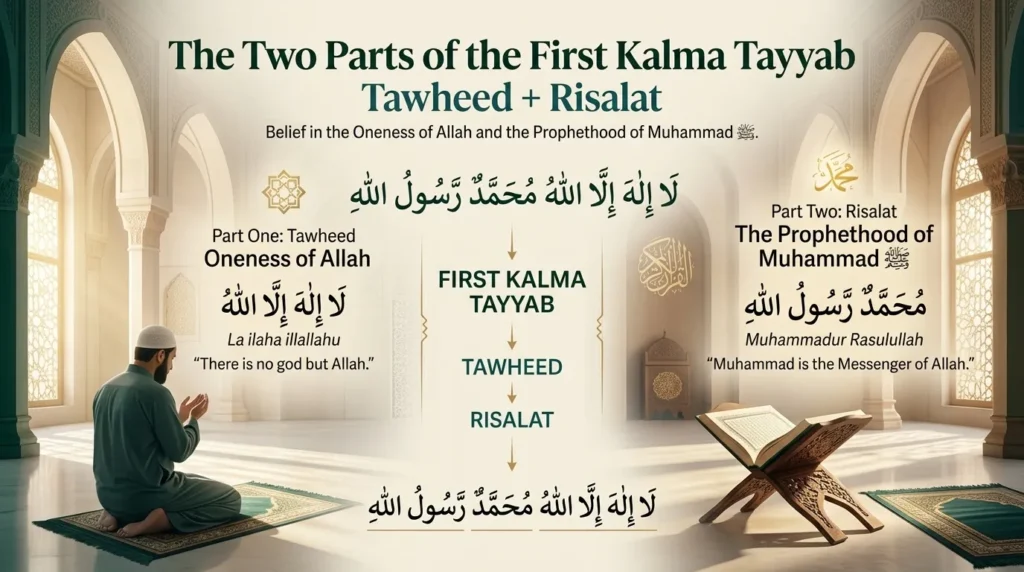
The First Kalma splits into two clear beliefs. Each part teaches something different.
Part One: Tawheed (Oneness of Allah)
The first half, “La ilaha illallah,” teaches Tawheed. Tawheed means believing that Allah alone is God. Nothing and no one shares His power. This belief sits at the center of Islam.
Part Two: Risalat (The Prophethood of Muhammad ﷺ)
The second half, “Muhammadur Rasulullah,” teaches Risalat. Risalat means believing that Muhammad ﷺ is Allah’s true and final messenger. No new prophet will come after him. This belief connects directly to the Quran, where Allah says:
“Muhammad is the Messenger of Allah.” (Quran, Surah Al-Fath 48:29)
Another verse tells believers to hold firm to Tawheed. Allah says in the Quran:
“So know that there is no god but Allah.” (Quran, Surah Muhammad 47:19)
These two verses are not the exact Kalima line. But they carry the same core belief that the Kalima states in one short sentence.
Why the First Kalma Tayyab Matters (Fazilat)
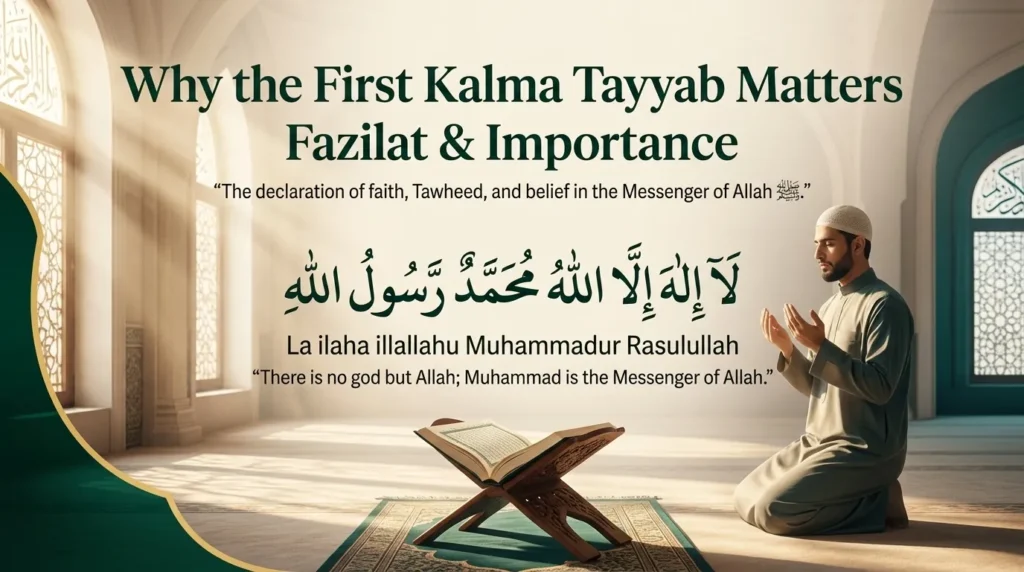
Readers often search for first kalma tayyab fazilat, which means its virtue or reward. The Prophet ﷺ spoke about the deep value of this belief many times.
- It opens the door to Paradise. The Prophet ﷺ said that Allah keeps Hell-fire away from anyone who says “La ilaha illallah” with a sincere heart, seeking only Allah’s pleasure (Sahih al-Bukhari 6423).
- It brings forgiveness at death. The Prophet ﷺ said that no soul dies bearing witness to this belief, with full certainty in the heart, without Allah forgiving it (Sunan Ibn Majah 3796).
- It is the last advice for the dying. The Prophet ﷺ told his companions to remind their dying loved ones to say “La ilaha illallah” (Sunan Ibn Majah 1444).
- It is the gateway into Islam. Saying this line with belief is the first formal step to becoming Muslim.
These are strong reasons to learn this Kalima well and to say it often, not just to memorize it once for a test.
First Kalma Tayyab for Kids
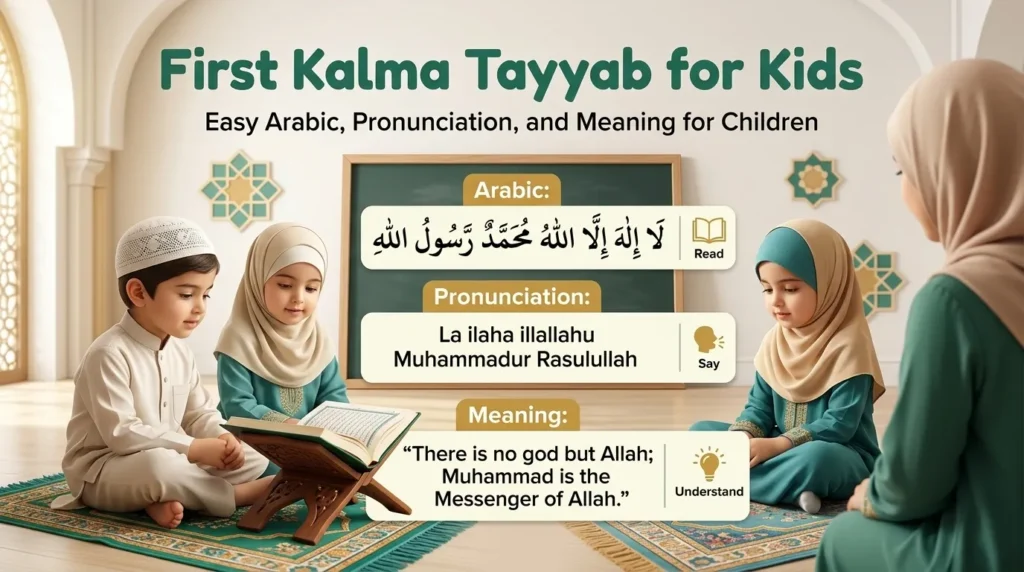
Children can learn this Kalima at a young age with the right method. Here are simple steps that work well at home.
- Split it into two lines. Teach “La ilaha illallah” first. Add “Muhammadur Rasulullah” once that part feels easy.
- Use repetition, not pressure. Say it together five times a day for a week.
- Add hand actions or rhythm. Clapping or tapping helps young children remember words.
- Explain the meaning in plain words. Tell your child, “This means only Allah is God, and Muhammad ﷺ brought His message.”
- Praise small wins. Celebrate every correct word, not just full sentences.
If you are building a wider learning plan at home, it also helps to know what age to start teaching your child the Quran and how to encourage your child to love the Quran as they grow.
First Kalma vs. the Other Five Kalimas
The First Kalma is one part of a bigger set. This table shows how it compares to the rest.
| Kalima | Name | Core Meaning |
|---|---|---|
| 1st | Tayyab | Word of purity — Tawheed and Risalat |
| 2nd | Shahadat | Formal witness of faith |
| 3rd | Tamjeed | Glorifying and praising Allah |
| 4th | Tauheed | Deep declaration of Allah’s oneness |
| 5th | Astaghfar | Asking Allah for forgiveness |
| 6th | Radde Kufr | Rejecting disbelief and shirk |
Once you know the First Kalma well, the next natural step is the Fourth Kalima Tauheed, which expands on the same belief in Allah’s oneness.
FAQs About the First Kalma Tayyab
What is the First Kalma in Arabic?
The First Kalma in Arabic is “لَا إِلَٰهَ إِلَّا ٱللَّٰهُ مُحَمَّدٌ رَّسُولُ ٱللَّٰهِ.” It means there is no god but Allah, and Muhammad ﷺ is His messenger.
What is the First Kalma called?
It is called Kalima Tayyab, or the Word of Purity. Some people also call it Kalima Tayyibah.
How many words are in the First Kalma?
The First Kalma has seven Arabic words. Four words form the first part about Allah. Three words form the second part about Muhammad ﷺ.
Is the First Kalma the same as the Shahada?
Yes, the meaning is the same. The First Kalma states belief in short form. The Shahada, or Second Kalma, adds “I bear witness” before the same belief.
Why do Muslims teach the First Kalma to children first?
It carries the root belief of Islam in one short line. Children learn it first because every other belief and act of worship builds on it.
Can saying the First Kalma alone make someone Muslim?
Yes, saying it with true belief and sincere intent is the entry point into Islam. It must come from real conviction, not just repeated words.
What is the reward of reciting the First Kalma often?
The Prophet ﷺ said sincere belief in this line keeps a person away from Hell-fire and brings Allah’s forgiveness (Sahih al-Bukhari 6423).
Final Word
The First Kalma Tayyab is short, but it holds the whole weight of Islamic belief. Learn the Arabic, understand the meaning, and say it with a sincere heart. That is worth far more than perfect memorization alone. May Allah make this small word of purity heavy in our scale of good deeds.