
Very Powerful Dua for Rizq Quranic & Masnoon Duas for Wealth and Barakah
If you are worried about money, waiting for a job, struggling with debt, or just feeling like your rizq (provision) is tight right now, you are not alone. Many Muslims search for a “powerful dua for rizq” during exactly this kind of moment.

Quick Answers
Simple answers to common questions about dua and rizq.
Is there one dua guaranteed to make you rich?
No. Islam does not teach that any single dua is a magic formula for instant wealth. But there are authentic Quranic and Prophetic duas Muslims can sincerely ask Allah with, trusting in His wisdom.
Can dua increase rizq?
Yes. Allah is Ar-Razzaq, the Provider, and He tells us to ask Him. Dua is one of the means Allah has given us to seek provision.
Which duas can I read?
Seven duas from the Quran and the Sunnah of the Prophet ﷺ speak directly about rizq, sufficiency, and barakah. You’ll find them below, with the Arabic, transliteration, English and Urdu meaning, and source for each.
One more thing before we start: rizq is bigger than money. It includes wealth, but also food, health, family, knowledge, opportunities, good relationships, peace of mind, and the everyday blessings we often forget to count. Keeping this in mind will change how you make dua for rizq.
What Is Rizq in Islam?
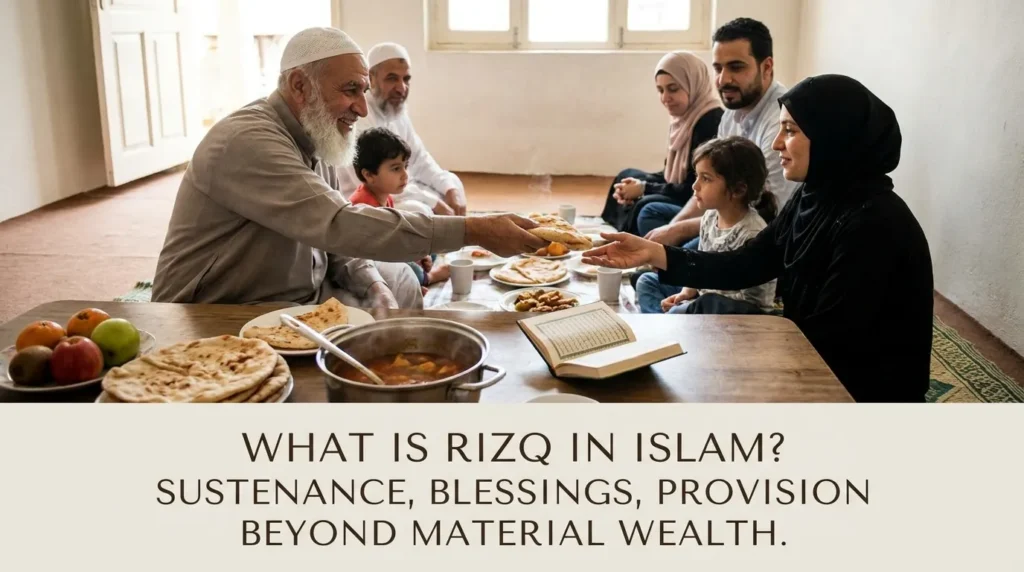
Rizq means everything Allah provides for His creation. In everyday Arabic and in the Quran, it is not limited to money.
Rizq includes:
- Money and material wealth
- Food and drink
- Health and strength
- Family, children, and good relationships
- Knowledge and understanding
- Work and opportunities
- Safety, peace, and contentment
- Time, and the ability to use it well
Rizq vs. wealth: Wealth (money) is only one part of rizq. A person can be wealthy but have very little barakah (blessing) in their life, health, or relationships. Another person may have modest income but real contentment and blessing in what they have. That is why the Quran and Sunnah always connect rizq with barakah, not just quantity.
Halal rizq: Islam teaches Muslims to seek rizq only through lawful (halal) means, and to stay away from haram earnings such as riba (interest), fraud, theft, and dishonest trade — even if the haram path looks faster or easier.
Why do Muslims ask Allah for rizq? Because Allah alone is the true source of provision. Human effort matters and is required, but the outcome — how much comes, when it comes, and what form it takes — is in Allah’s hands. This is why dua for rizq is not separate from working for a living; it goes alongside it.
Allah as Ar-Razzaq: One of Allah’s names is Ar-Razzaq, the Ever-Providing. Allah says in the Quran:
إِنَّ اللَّهَ هُوَ الرَّزَّاقُ ذُو الْقُوَّةِ الْمَتِينُ “Indeed, it is Allah who is the [continual] Provider, the firm possessor of strength.” — Quran, Surah Adh-Dhariyat 51:58
Knowing this name of Allah is itself a comfort: the One you are asking is the same One who already provides for every living creature on earth.
What Is the Most Powerful Dua for Rizq?
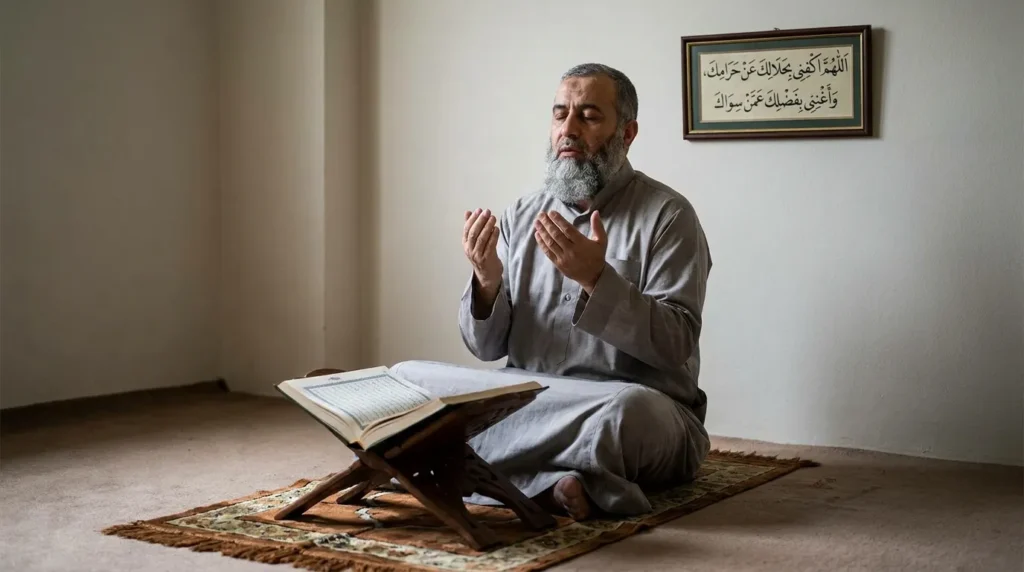
People often want one single dua that will “unlock” their rizq. It’s important to be honest here: no scholar can point to one specific dua and say it is guaranteed to make a person wealthy. That claim is not something Islam establishes.
What Islam does establish is this — the strongest approach to dua for rizq is to use the authentic supplications that the Quran and the Prophet ﷺ actually taught, said with a sincere heart, full trust in Allah (tawakkul), and combined with honest effort. Reciting words without meaning them, or without taking any lawful means, is not what these duas were meant for.
With that understood, here is one of the most beautiful and widely recited duas for rizq, spoken by a Prophet of Allah himself at a moment of real hardship.
Dua for Rizq in Arabic
Dua of Musa (AS)
رَبِّ إِنِّي لِمَا أَنزَلْتَ إِلَيَّ مِنْ خَيْرٍ فَقِيرٌ
Rabbi inni lima anzalta ilayya min khayrin faqeer
“My Lord, indeed I am, for whatever good You would send down to me, in need.”
What This Dua Teaches Us
This is the dua of Prophet Musa (Moses), peace be upon him. He said it after fleeing his city, alone, tired, with no money, no shelter, and no clear plan — yet he did not lose hope in Allah. He simply admitted his need to Allah in a few honest words. He didn’t list demands; he expressed complete dependence. After making this dua, Allah opened a path for him — Musa was soon given help, safety, and eventually an opportunity to work and build a new life.
When to Read This Dua
You can say this dua any time you feel needy, uncertain, or stretched — while looking for work, waiting for money that is owed to you, or simply making your daily dua after salah. It is short, sincere, and easy to remember, which is part of why it is loved by so many Muslims.
7 Powerful Duas for Rizq From the Quran and Sunnah
1. Dua of Prophet Musa for Rizq
رَبِّ إِنِّي لِمَا أَنزَلْتَ إِلَيَّ مِنْ خَيْرٍ فَقِيرٌ
Rabbi inni lima anzalta ilayya min khayrin faqeer
“My Lord, indeed I am, for whatever good You would send down to me, in need.”
Explanation: As explained above, this dua is a simple, humble admission of need before Allah. It teaches us that asking Allah for help is not weakness — even a Prophet did it.
When to read it: During hardship, job searching, financial pressure, or simply as part of your daily dua.
2. Rabbana Atina Fid-Dunya Hasana
رَبَّنَا آتِنَا فِي الدُّنْيَا حَسَنَةً وَفِي الْآخِرَةِ حَسَنَةً وَقِنَا عَذَابَ النَّارِ
Rabbana atina fid-dunya hasanatan wa fil-akhirati hasanatan wa qina ‘adhaban-nar
“Our Lord, give us good in this world and good in the Hereafter, and protect us from the punishment of the Fire.”
Explanation: This dua is important because it doesn’t ask for rizq or money by name. It asks for “hasanah” — good — in this world and the next. Halal wealth, good health, a peaceful home, and righteous children can all be part of “good in this world,” but so can honesty, patience, and closeness to Allah. This dua keeps rizq in its proper place: important, but never more important than your Hereafter.
When to read it: Any time, and it is especially recited during Hajj at Arafat and Sa’i, though it can be said in any dua.
3. Dua for Halal Rizq and Independence From Haram
اللَّهُمَّ اكْفِنِي بِحَلَالِكَ عَنْ حَرَامِكَ وَأَغْنِنِي بِفَضْلِكَ عَمَّنْ سِوَاكَ
Allahumma-kfini bi-halalika ‘an haramika wa aghnini bi-fadlika ‘amman siwak
“O Allah, suffice me with what You have made lawful instead of what You have made unlawful, and make me independent of all others besides You by Your grace.”
Explanation: This dua comes from a specific, moving narration. A mukatab — a slave working under a contract to buy his own freedom — came to Ali ibn Abi Talib (may Allah be pleased with him) and said he could not raise the payment he owed. Ali asked if he should teach him words the Prophet ﷺ had taught him, then said: “If you had a debt upon you like the mountain of Sir, Allah would settle it for you,” before giving him these words. It asks for two things at once: that your halal income becomes enough for you, so you’re never pushed toward haram shortcuts, and that you rely on Allah’s generosity rather than depending on people.
When to read it: When you’re struggling financially, in debt, or ever feel tempted toward a dishonest or haram source of income.
4. Dua for Barakah in Rizq
اللَّهُمَّ اغْفِرْ لِي ذَنْبِي وَوَسِّعْ لِي فِي دَارِي وَبَارِكْ لِي فِي رِزْقِي
Allahumma-ghfir li dhanbi, wa wassi’ li fi dari, wa barik li fi rizqi
“O Allah, forgive my sin, expand my home for me, and bless me in my provision.”
Source: Reported in Jami’ at-Tirmidhi 3500, associated with Abu Musa al-Ash’ari (may Allah be pleased with him). Worth knowing before you rely on it: scholars have differed on the strength of this exact wording — some, including Shaykh al-Albani, graded this particular narration weak. A closely related report, with the isnad graded sound by al-Albani, has Abu Musa saying similar words after his own prayers (“…and ease my affairs…and bless me in my provision”). Given this, treat the dua below as a beautiful, widely recited supplication rather than one resting on the strongest possible chain — and feel free to pair it with the more firmly established duas in this list.
Explanation: Notice the order of this dua — it starts with asking for forgiveness before asking for provision. Many scholars point out that sin can block barakah, so seeking forgiveness first prepares the heart for the provision that follows. The dua then asks not just for “more” but for blessing (barakah) in what is given.
When to read it: After salah, in the morning, or whenever you remember it — it’s short and easy to memorise.
5. Dua for Relief From the Burden of Debt
اللَّهُمَّ إِنِّي أَعُوذُ بِكَ مِنَ الْهَمِّ وَالْحَزَنِ، وَالْعَجْزِ وَالْكَسَلِ، وَالْبُخْلِ وَالْجُبْنِ، وَضَلَعِ الدَّيْنِ وَغَلَبَةِ الرِّجَالِ
Allahumma inni a’udhu bika minal-hammi wal-hazani, wal-‘ajzi wal-kasali, wal-bukhli wal-jubni, wa dala’id-dayni wa ghalabatir-rijal
“O Allah, I seek refuge in You from worry and grief, from incapacity and laziness, from miserliness and cowardice, from the burden of debt, and from being overpowered by men.”
Explanation: This is a distinct dua from the halal-sufficiency dua above, and it’s especially relevant when debt is weighing on your mind and your emotions at the same time. It names eight things together — including dala’ id-dayn, literally “the burden that bends a person down under debt” — and asks Allah’s protection from all of them in one breath. It treats financial pressure and the anxiety that comes with it as connected, which is often exactly how debt actually feels.
When to read it: When debt or financial pressure is affecting your peace of mind, alongside a genuine plan to repay what is owed.
6. Dua for Sufficient Sustenance
حَسْبُنَا اللَّهُ وَنِعْمَ الْوَكِيلُ
Hasbunallahu wa ni’mal wakeel
“Allah is sufficient for us, and He is the best Disposer of affairs.”
Explanation: This is different from asking to become rich — it is asking Allah to be enough for you. It was said by the believers when they faced a huge army and felt afraid, and Allah turned that fear into safety and blessing. Applied to rizq, it’s a dua of trust: you have done what you can, and now you leave the outcome to Allah, who is the best One to trust your affairs with. You can read more in our guide to Hasbunallahu wa Ni’mal Wakeel.
When to read it: In moments of financial fear or uncertainty, when you’ve done everything within your power and now need to hand the rest over to Allah.
7. Dua for Beneficial Knowledge and Pure Provision
اللَّهُمَّ إِنِّي أَسْأَلُكَ عِلْمًا نَافِعًا وَرِزْقًا طَيِّبًا وَعَمَلًا مُتَقَبَّلًا
Allahumma inni as’aluka ‘ilman nafi’an, wa rizqan tayyiban, wa ‘amalan mutaqabbala
“O Allah, I ask You for beneficial knowledge, good and pure provision, and deeds that are accepted.”
Explanation: This is the dua the Prophet ﷺ used to say right after finishing the Fajr prayer. It’s beautiful because it asks for three things together: knowledge that actually benefits you, provision that is tayyib (pure and wholesome, not just large in amount), and actions that Allah accepts from you. It reminds us that “good rizq” is about quality and purity, not only quantity.
When to read it: Right after the Fajr prayer, which is when the Prophet ﷺ used to recite it.
Very Powerful Dua for Rizq and Money
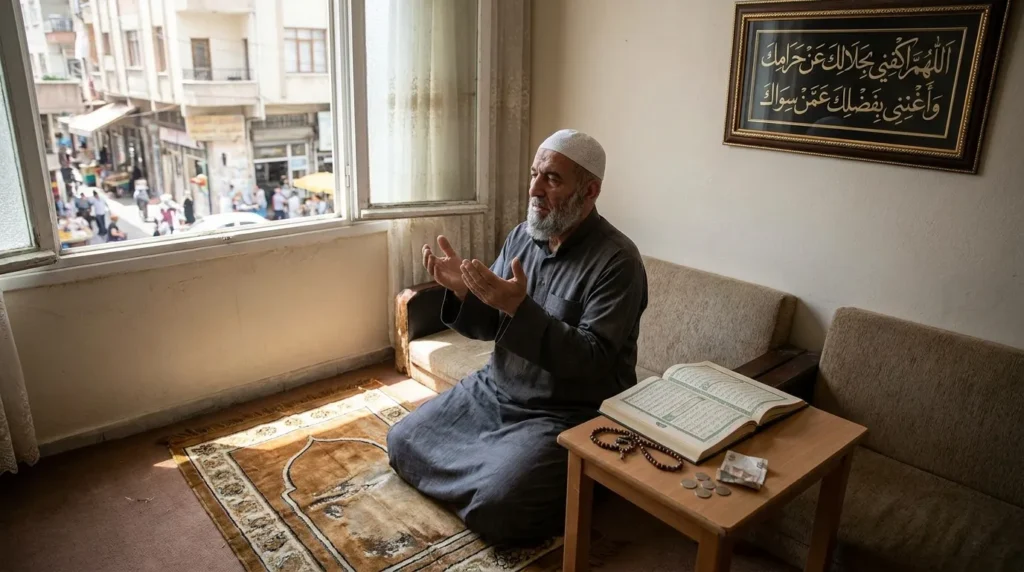
Can I make dua specifically for money? Yes. It is permissible in Islam to ask Allah directly for halal wealth. Money itself is neither good nor bad — it is a trust (amanah) and a means. What matters is how it’s earned and how it’s used.
When you ask Allah for money, try to ask for it alongside three things:
- Halal rizq — provision earned and used the lawful way
- Barakah — blessing in what you already have, not just a bigger number
- Contentment (qana’ah) — a heart that isn’t restless even while working hard for more
Avoid framing your dua as “give me wealth no matter what” — instead, ask Allah for wealth that is good for you in this life and the next, as the dua “Rabbana atina fid-dunya hasanatan” teaches.
Dua for Rizq to Come Quickly
Many people search for a dua that will bring money “fast.” It’s important to be honest with you here: Islam does not teach that reciting a particular dua guarantees money will arrive within a set number of days or hours. No authentic hadith promises a timeline like that.
What Islam does teach is that Allah answers dua in the way and the timing that is best for the person asking — sometimes quickly, sometimes later, and sometimes in a different form than expected (for example, relief from an expense instead of new income). Keep making the duas above sincerely, take real steps toward halal income, and trust Allah with the timing.
Quranic Wazifa for Rizq, Money and Wealth

The word “wazifa” is often used online for a set of duas or Quranic verses repeated a certain number of times for a certain goal. It’s worth understanding the difference between similar terms:
- Quranic dua — a supplication taken word-for-word from the Quran, such as “Rabbana atina fid-dunya hasanatan.”
- Dhikr — remembrance of Allah through His names, tasbih (SubhanAllah), tahmid (Alhamdulillah), and similar phrases.
- Wazifa — a term (mostly used in South Asian Islamic culture) for a regular, often repeated, practice of dua or dhikr, sometimes tied to a specific number of repetitions.
- Personal supplication — asking Allah in your own words, in any language, about your own situation.
All of these can be part of a Muslim’s daily life. But we won’t give you a fixed repetition count (such as “read this 100 times after Fajr”) for rizq unless that specific number is actually established in an authentic hadith. Where no such number exists, you are free to recite a dua as often as you sincerely wish — there’s no need to invent a rule that Allah and His Messenger ﷺ did not set.
Dua for Rizq After Every Prayer
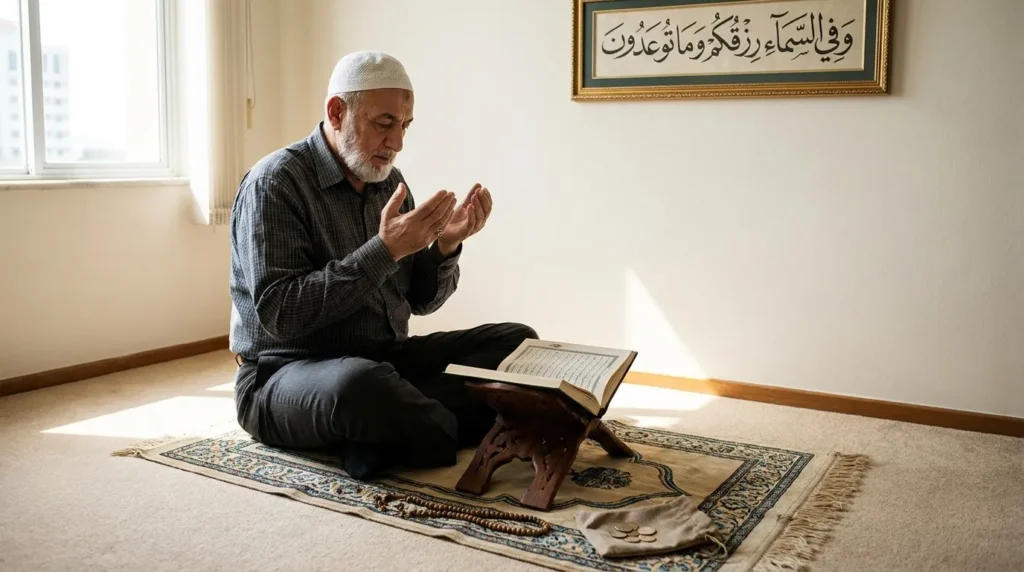
It’s common to search for a dua “after Fajr,” “after Isha,” and so on. Here’s the honest picture:
There isn’t authentic evidence that a completely different, specific dua for rizq is prescribed after each of the five daily prayers. What we do know is this:
- A Muslim can make dua for rizq after any salah, once the obligatory dhikr after prayer is completed.
- The dua “Allahumma inni as’aluka ‘ilman nafi’an, wa rizqan tayyiban, wa ‘amalan mutaqabbala” (Ibn Majah 925) is specifically reported to have been said by the Prophet ﷺ right after Fajr.
- For Zuhr, Asr, Maghrib, and Isha, there’s no single dua tied specifically to that prayer for rizq — but the time right after finishing any salah, while you are still in a state of worship, is a good time to ask Allah sincerely for your needs, including rizq.
- Tahajjud deserves special mention (see the next section), because the last third of the night carries its own strong, authentic virtue for dua of any kind, including rizq.
You can read more on the value of consistent salah itself in our article on the importance of salah in Islam.
When Is the Best Time to Make Dua for Rizq?

Islam teaches us that there are certain times when dua has special virtue and is especially encouraged. These apply to dua for rizq as much as any other dua.
During Tahajjud (the Last Third of the Night)
Abu Hurairah (may Allah be pleased with him) reported that the Prophet ﷺ said that in the last third of every night, Allah descends to the lowest heaven and says: “Who is calling upon Me, that I may answer him? Who is asking Me, that I may give him? Who is seeking My forgiveness, that I may forgive him?” (Sahih al-Bukhari and Sahih Muslim)
Between Adhan and Iqamah
Anas ibn Malik (may Allah be pleased with him) reported that the Prophet ﷺ said: “Dua made between the adhan and the iqamah is not rejected.” (Jami’ at-Tirmidhi 212, Sunan Abi Dawud 521)
During Sujood (Prostration)
Abu Hurairah (may Allah be pleased with him) reported that the Prophet ﷺ said: “The nearest a servant comes to his Lord is when he is prostrating himself, so make abundant supplication [in that state].” (Sahih Muslim 482)
On Friday
The Prophet ﷺ mentioned that there is a special hour on Friday when a Muslim’s dua, if made at that moment, is answered. (Sahih al-Bukhari, Sahih Muslim)
While Fasting
Fasting is another state connected with accepted dua. Scholars mention the dua of a fasting person among those that are not turned away, based on hadith in Jami’ at-Tirmidhi. If you’d like to read more around fasting and its virtues, see our piece on Ramadan quotes, Quran verses, hadith, and fasting.
How to Ask Allah for Rizq the Right Way

Ask for Halal Rizq
Make it a habit to specifically ask for provision that is lawful, not just “more.” A large haram income is not a blessing in Islam, no matter how much it looks like one.
Ask for Barakah
Barakah means blessing — that what you have goes further, lasts longer, and does more good than the number on its own would suggest. Two people can earn the same amount, and one has barakah in it while the other doesn’t.
Make Dua With Tawakkul
Tawakkul means placing your trust in Allah after you’ve taken the steps available to you — applying for the job, doing honest work, managing your money wisely — and then trusting Allah with the result. Dua without any effort, or effort without any trust in Allah, both miss the balance Islam teaches. You can read more in our guide to tawakkul in Islam.
Avoid Haram Income
Riba (interest), fraud, bribery, theft, and dishonest dealings might look like they bring rizq faster, but they strip away the barakah Allah puts in lawful earnings. Guarding your income is part of seeking halal rizq and following the guidance of Islam; it should go hand in hand with making dua, not be treated as separate from it.
Combine Dua With Effort
The Prophet ﷺ himself worked as a trader before prophethood, and his companions worked in farming, trade, and crafts. Dua for rizq is not a replacement for effort — the two go together.
Don’t Become Impatient
The Prophet ﷺ warned against a person losing hope and saying “I made dua and dua was not answered.” Sometimes the answer to your dua is delayed, sometimes it comes in another form, and sometimes it is saved for the Hereafter. Patience is part of the dua itself.
Islamic Ways to Increase Rizq

Alongside dua, the Quran and Sunnah mention specific actions connected with an increase in rizq and barakah.
Istighfar
Istighfar means asking Allah for forgiveness, usually by saying “Astaghfirullah.” Allah says in the Quran, describing the words of Prophet Nuh (Noah) to his people:
فَقُلْتُ اسْتَغْفِرُوا رَبَّكُمْ إِنَّهُ كَانَ غَفَّارًا * يُرْسِلِ السَّمَاءَ عَلَيْكُم مِّدْرَارًا * وَيُمْدِدْكُمْ بِأَمْوَالٍ وَبَنِينَ وَيَجْعَل لَّكُمْ جَنَّاتٍ وَيَجْعَل لَّكُمْ أَنْهَارًا “I said: Seek forgiveness of your Lord — indeed, He is ever a Perpetual Forgiver. He will send [rain from] the sky upon you in [continuous] showers. And give you increase in wealth and children, and provide for you gardens and provide for you rivers.” — Quran, Surah Nuh 71:10-12
This passage is one of the clearest links in the Quran between seeking forgiveness and an increase in provision.
Maintaining Family Ties
The Prophet ﷺ said: “Whoever wishes for his provision to be increased and his lifespan to be extended, let him maintain the ties of kinship.” (Sahih al-Bukhari, Sahih Muslim)
In everyday life, this can be as simple as calling a parent regularly, visiting relatives, checking on an aunt or uncle you’ve lost touch with, or resolving a family rift instead of letting it continue.
Giving Sadaqah
Sadaqah means voluntary charity, even something small. The Prophet ﷺ said that charity does not decrease wealth. (Sahih Muslim) Giving sadaqah, even a small amount given sincerely, is one of the practical ways scholars connect with barakah in what remains. A kind word itself can also count as an act of charity — you can read more in our article on a kind word as a form of charity.
Gratitude to Allah
Allah says in the Quran:
لَئِن شَكَرْتُمْ لَأَزِيدَنَّكُمْ “If you are grateful, I will surely increase you [in favor].” — Quran, Surah Ibrahim 14:7
Gratitude here isn’t just saying “Alhamdulillah” — it means recognising Allah’s blessings and using them the way He intended, not wasting or misusing them.
Taqwa
Taqwa means God-consciousness — being mindful of Allah in your daily choices. Allah says:
وَمَن يَتَّقِ اللَّهَ يَجْعَل لَّهُ مَخْرَجًا * وَيَرْزُقْهُ مِنْ حَيْثُ لَا يَحْتَسِبُ “And whoever fears Allah — He will make for him a way out, and will provide for him from where he does not expect.” — Quran, Surah At-Talaq 65:2-3
Tawakkul
As mentioned earlier, tawakkul is trusting Allah after taking lawful means. It’s a foundation for both peace of heart and, as many scholars note from this same passage of Surah At-Talaq, an opening of unexpected rizq.
Earning Through Halal Means
Choose work, business, and investments that are clearly halal, and avoid grey areas where you can. If you’re unsure whether an income source is permissible, it’s worth asking a knowledgeable scholar rather than assuming.
Can Dua Make You Rich Quickly?
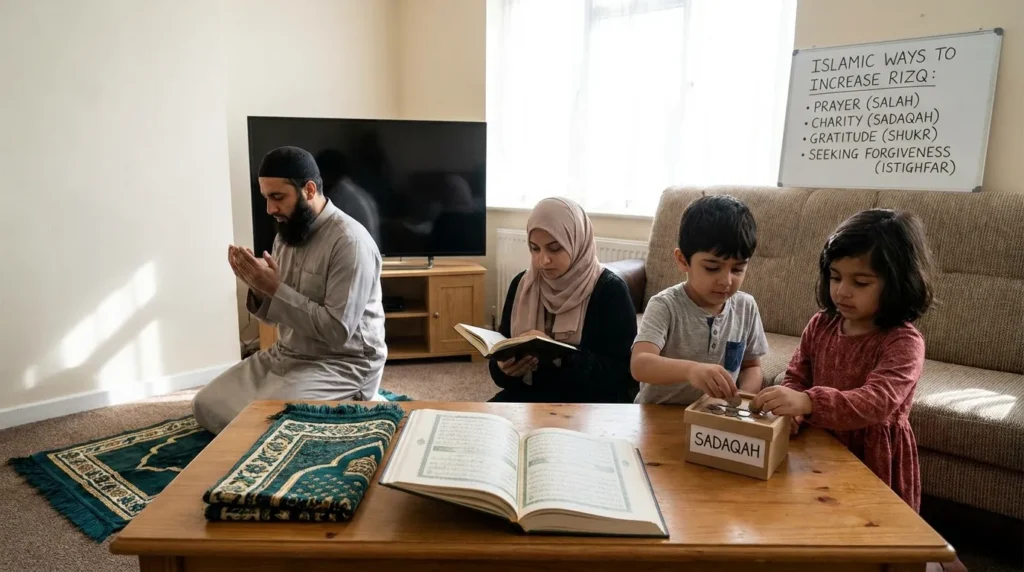
Let’s be direct: dua is not a magic formula for becoming rich overnight, and no honest scholar will tell you otherwise.
Here’s what is true instead:
- Allah answers dua according to His wisdom, not according to our timeline.
- Rizq can arrive in different forms — sometimes as money, sometimes as an opportunity, sometimes as a reduced expense, good health that lets you work, or a person who helps you unexpectedly.
- A delay in an answer doesn’t mean rejection. The Prophet ﷺ described Allah as either giving what was asked, warding off an equivalent harm, or saving the reward for the Hereafter — in response to sincere dua (Musnad Ahmad).
- Dua works alongside halal effort, not instead of it.
If an article or a person promises you guaranteed wealth from repeating a phrase a certain number of times, treat that claim with caution — it is not something authentic Islamic teaching establishes.
How Many Times Should I Read a Dua for Rizq?
If an authentic hadith specifies a number of repetitions for a particular dua, it is good to follow that number. For example, some adhkar (remembrances) after salah do have specific counts mentioned in hadith, such as saying SubhanAllah, Alhamdulillah, and Allahu Akbar a set number of times.
But for the duas for rizq covered in this article, no fixed repetition count is established in authentic hadith. That means:
- You should not treat an invented number (like “read this 313 times”) as if it were Sunnah.
- Outside of prescribed counts, you’re free to say these duas as often as you sincerely want — once, a few times, or as a regular daily habit — without needing to pretend a specific number is required or guaranteed to work.
Dua for Rizq in Arabic, Transliteration, English & Urdu
| Dua | Arabic | Transliteration | English Meaning | Urdu Meaning | Source |
|---|---|---|---|---|---|
| Dua of Musa (AS) | رَبِّ إِنِّي لِمَا أَنزَلْتَ إِلَيَّ مِنْ خَيْرٍ فَقِيرٌ | Rabbi inni lima anzalta ilayya min khayrin faqeer | My Lord, indeed I am, for whatever good You would send down to me, in need. | اے میرے رب! تو نے میری طرف جو بھلائی نازل کی میں اس کا محتاج ہوں۔ | Quran 28:24 |
| Good in This World and Hereafter | رَبَّنَا آتِنَا فِي الدُّنْيَا حَسَنَةً وَفِي الْآخِرَةِ حَسَنَةً وَقِنَا عَذَابَ النَّارِ | Rabbana atina fid-dunya hasanatan wa fil-akhirati hasanatan wa qina ‘adhaban-nar | Our Lord, give us good in this world and good in the Hereafter, and protect us from the Fire. | اے ہمارے رب! ہمیں دنیا میں بھی بھلائی عطا فرما اور آخرت میں بھی بھلائی، اور ہمیں آگ کے عذاب سے بچا۔ | Quran 2:201 |
| Halal Sufficiency | اللَّهُمَّ اكْفِنِي بِحَلَالِكَ عَنْ حَرَامِكَ وَأَغْنِنِي بِفَضْلِكَ عَمَّنْ سِوَاكَ | Allahumma-kfini bi-halalika ‘an haramika wa aghnini bi-fadlika ‘amman siwak | O Allah, suffice me with what is lawful instead of what is unlawful, and make me independent of others by Your grace. | اے اللہ! مجھے اپنے حلال کے ذریعے حرام سے بچا اور اپنے فضل سے مجھے اپنے سوا سب سے بے نیاز کر دے۔ | Tirmidhi 3563 |
| Barakah in Rizq | اللَّهُمَّ اغْفِرْ لِي ذَنْبِي وَوَسِّعْ لِي فِي دَارِي وَبَارِكْ لِي فِي رِزْقِي | Allahumma-ghfir li dhanbi, wa wassi’ li fi dari, wa barik li fi rizqi | O Allah, forgive my sin, expand my home, and bless me in my provision. | اے اللہ! میرے گناہ بخش دے، میرے گھر میں کشادگی عطا فرما، اور میرے رزق میں برکت دے۔ | Tirmidhi 3500 See note above |
| Relief from the Burden of Debt | اللَّهُمَّ إِنِّي أَعُوذُ بِكَ مِنَ الْهَمِّ وَالْحَزَنِ، وَالْعَجْزِ وَالْكَسَلِ، وَالْبُخْلِ وَالْجُبْنِ، وَضَلَعِ الدَّيْنِ وَغَلَبَةِ الرِّجَالِ | Allahumma inni a’udhu bika minal-hammi wal-hazani, wal-‘ajzi wal-kasali, wal-bukhli wal-jubni, wa dala’id-dayni wa ghalabatir-rijal | O Allah, I seek refuge in You from worry and grief, incapacity and laziness, miserliness and cowardice, the burden of debt, and being overpowered by men. | اے اللہ! میں تیری پناہ مانگتا ہوں غم اور رنج سے، عاجزی اور سستی سے، بخل اور بزدلی سے، قرض کے بوجھ اور لوگوں کے غلبہ سے۔ | Bukhari 6369 |
| Sufficiency and Trust | حَسْبُنَا اللَّهُ وَنِعْمَ الْوَكِيلُ | Hasbunallahu wa ni’mal wakeel | Allah is sufficient for us, and He is the best Disposer of affairs. | ہمارے لیے اللہ کافی ہے اور وہ بہترین کارساز ہے۔ | Quran 3:173 |
| After Fajr | اللَّهُمَّ إِنِّي أَسْأَلُكَ عِلْمًا نَافِعًا وَرِزْقًا طَيِّبًا وَعَمَلًا مُتَقَبَّلًا | Allahumma inni as’aluka ‘ilman nafi’an, wa rizqan tayyiban, wa ‘amalan mutaqabbala | O Allah, I ask You for beneficial knowledge, pure provision, and accepted deeds. | اے اللہ! میں تجھ سے نفع بخش علم، پاکیزہ رزق اور قبول ہونے والا عمل مانگتا ہوں۔ | Ibn Majah 925 |
Frequently Asked Questions About Dua for Rizq
What is the most powerful dua for rizq?
There isn’t one single dua that Islam labels “the most powerful” for guaranteed wealth. The strongest approach is to sincerely recite authentic Quranic and Prophetic duas — such as the dua of Musa (AS) in Surah Al-Qasas 28:24 — with real trust in Allah and honest effort.
Which surah is best for rizq?
No specific surah is labelled in authentic hadith as “the surah for rizq.” However, Surah Al-Qasas (containing the dua of Musa), Surah Al-Baqarah (containing “Rabbana atina”), and Surah Nuh (linking istighfar to provision) are commonly reflected on for this topic.
What is the best Quranic dua for wealth?
“Rabbana atina fid-dunya hasanatan wa fil-akhirati hasanatan” (Quran 2:201) is one of the most complete, because it asks for good in both this life and the next, rather than money alone.
Which dua can help increase rizq?
The duas listed in this article, along with practical steps like istighfar, sadaqah, and maintaining family ties, are all connected in the Quran and Sunnah with an increase in rizq and barakah.
Is there a dua to become rich in Islam?
Islam allows Muslims to ask Allah for halal wealth, but it does not teach that any dua guarantees riches. Ask for halal rizq, barakah, and sufficiency, and leave the outcome to Allah.
What dua should I read for money problems?
“Allahumma-kfini bi-halalika ‘an haramika wa aghnini bi-fadlika ‘amman siwak” (Tirmidhi 3563) directly addresses financial hardship and the temptation toward haram shortcuts.
What dua should I read for debt?
Both the Tirmidhi 3563 dua above (originally taught by the Prophet ﷺ to Ali, then passed on to a struggling mukatab) and the dua seeking refuge from “the burden of debt” (Sahih al-Bukhari 6369) are directly connected to debt, alongside genuine effort to repay what is owed.
Can I make dua for money?
Yes, it is permissible to ask Allah directly for halal money and provision.
What is the best time to make dua for rizq?
The last third of the night (Tahajjud), between the adhan and iqamah, during sujood, and on Friday are all times reported in authentic hadith as carrying special virtue for dua.
Can I read dua for rizq after Fajr?
Yes. The dua “Allahumma inni as’aluka ‘ilman nafi’an, wa rizqan tayyiban, wa ‘amalan mutaqabbala” (Ibn Majah 925) was specifically recited by the Prophet ﷺ after Fajr.
Can I read dua for rizq in Tahajjud?
Yes, and Tahajjud is one of the times when dua carries special virtue, based on authentic hadith about the last third of the night.
How many times should I read dua for rizq?
Follow any specific number given in an authentic hadith where one exists. Otherwise, there is no fixed count — you can recite these duas as often as you sincerely wish.
How can I increase my rizq according to Islam?
Through istighfar, maintaining family ties, giving sadaqah, gratitude, taqwa, tawakkul, and earning through halal means — alongside sincere dua.
Final Thoughts
Ask Allah for halal rizq, barakah, and sufficiency, while continuing to work through halal means. Dua is an act of worship — a conversation with your Creator — not a guaranteed shortcut to instant wealth. If you’re going through a difficult time financially, know that Allah sees your situation, and that patience combined with sincere dua and honest effort is exactly what He has asked of us. For more on trusting Allah through hard times, see our article on tawakkul in Islam.
Sources & References
Quran:
- Surah Adh-Dhariyat 51:58
- Surah Al-Qasas 28:24
- Surah Al-Baqarah 2:201
- Surah Aali ‘Imran 3:173
- Surah Nuh 71:10-12
- Surah Ibrahim 14:7
- Surah At-Talaq 65:2-3
Hadith:
- Jami’ at-Tirmidhi 3563 (dua for halal sufficiency, taught by the Prophet ﷺ to Ali, then by Ali to a mukatab in debt)
- Jami’ at-Tirmidhi 3500 (dua for barakah in rizq, associated with Abu Musa al-Ash’ari — grading disputed; see note in Section 4)
- Sahih al-Bukhari 6369 (dua for refuge from worry, grief, and the burden of debt)
- Sunan Ibn Majah 925 (dua after Fajr for beneficial knowledge, pure rizq, accepted deeds)
- Sahih Muslim 482 (nearness to Allah in sujood)
- Jami’ at-Tirmidhi 212 / Sunan Abi Dawud 521 (dua between adhan and iqamah)
- Sahih al-Bukhari & Sahih Muslim (Allah’s descent in the last third of the night; the Friday hour of acceptance)
- Sahih al-Bukhari & Sahih Muslim (maintaining family ties and increase in rizq)
- Sahih Muslim (sadaqah does not decrease wealth)