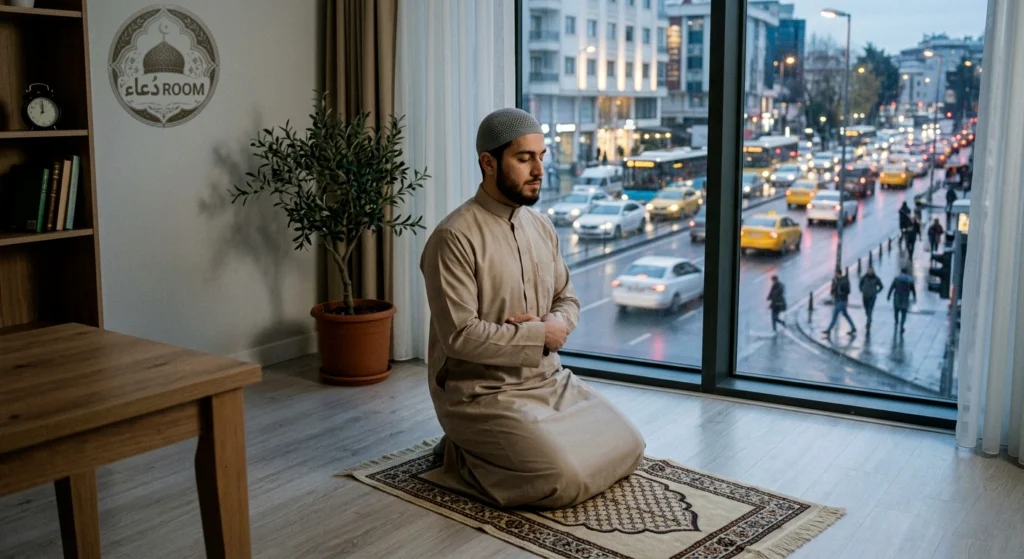
How to Teach Your Child Salah With Love and Consistency
Teaching children salah is one of the most important responsibilities we have as Muslim parents. Prayer is not only a daily obligation; it is a child’s lifelong connection with Allah. When we teach salah correctly, we are not simply teaching movements, words, and times. We are helping our children understand that they have a direct relationship with their Creator, a place to return when life feels confusing, and a daily source of peace, discipline, gratitude, and guidance.

The best way to teach children salah is through love, example, patience, gentle repetition, and meaningful explanation. Children should not grow up thinking prayer is only a command shouted across the house or a duty connected to fear. They should learn that salah is a gift from Allah, a protection for the heart, a spiritual break during the day, and a beautiful way to speak to Allah privately. Parenting guidance on teaching salah often emphasizes that parents should make salah a priority themselves, show a positive attitude toward it, and avoid introducing prayer with harshness or frightening stories at a young age. (Zakeeya Ali)
When we want our children to love prayer , we must build the habit slowly and wisely. A child may first watch us pray, then copy our movements, then learn wudu, then memorize short surahs, then understand prayer times, and later become responsible for praying consistently. This journey requires time. We should not expect instant perfection. Our role is to guide, remind, encourage, correct gently, and keep making dua.
Why Teaching Salah to Children Matters
Salah is the foundation of a Muslim’s daily life. It organizes the day around remembrance of Allah and teaches children that worship is not separate from ordinary life. A child who learns salah early begins to understand time, discipline, cleanliness, focus, gratitude, humility, and obedience to Allah. Prayer teaches children that life is not only about school, games, food, friends, and screens. It reminds them that they were created for a more noble purpose.
This video on What Makes Salah The Best Form Of Dua? is highly relevant because it explains how prayer establishes a deep, daily connection and acts as a direct line of communication with our Creator.
When children grow up seeing salah respected at home, they naturally absorb its importance. They notice whether parents delay prayer or stop everything for prayer. They notice whether prayer is performed calmly or rushed. They notice whether salah is treated as a burden or as a blessing. One parent-focused salah guide explains this beautifully: children absorb our actions more than our words, so parents must show that life should rotate around prayer, not prayer around life. (Zakeeya Ali)
Teaching salah also protects Islamic identity. In a world full of distractions, prayer becomes a child’s anchor. It reminds them five times a day that they belong to Allah. It gives them a spiritual rhythm that can carry them through childhood, teenage years, adulthood, stress, temptation, and hardship.
Start by Becoming a Salah Role Model
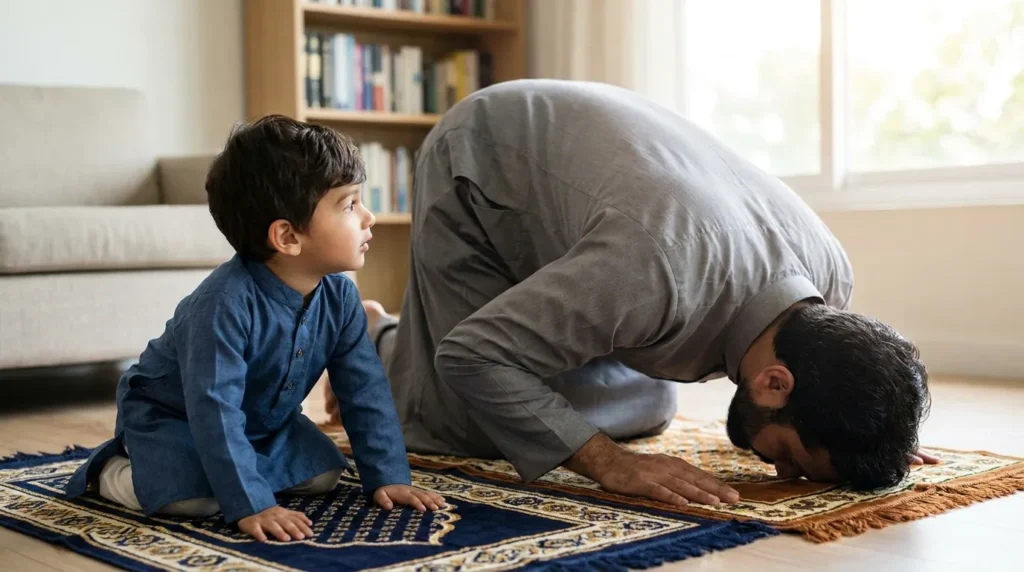
Before we teach children to pray, we must ask ourselves: What do they see from us? If we want our children to pray on time, they should see us praying on time. If we want them to love salah, they should see us treating salah with love. If we want them to take wudu seriously, they should see us preparing for prayer with care.
Children learn through observation. Long before they understand fiqh, they understand family habits. A toddler who sees a parent making sujood may copy the movement. A young child who hears the adhan may begin to recognize prayer time. An older child who sees parents pause shopping, travel, entertainment, or work for salah learns that prayer is not optional decoration; it is a priority.
We can make this practical by speaking about salah naturally during the day:
- “It is almost Asr; let us finish this before prayer.”
- “We will go out after Maghrib so we do not miss salah.”
- “Let us find a clean place to pray.”
- “Alhamdulillah, prayer gives us a peaceful break.”
These small statements shape a child’s mind. They teach that salah is part of life everywhere, not only at home or in the masjid.
Teach Children That Salah Is a Gift, Not a Burden
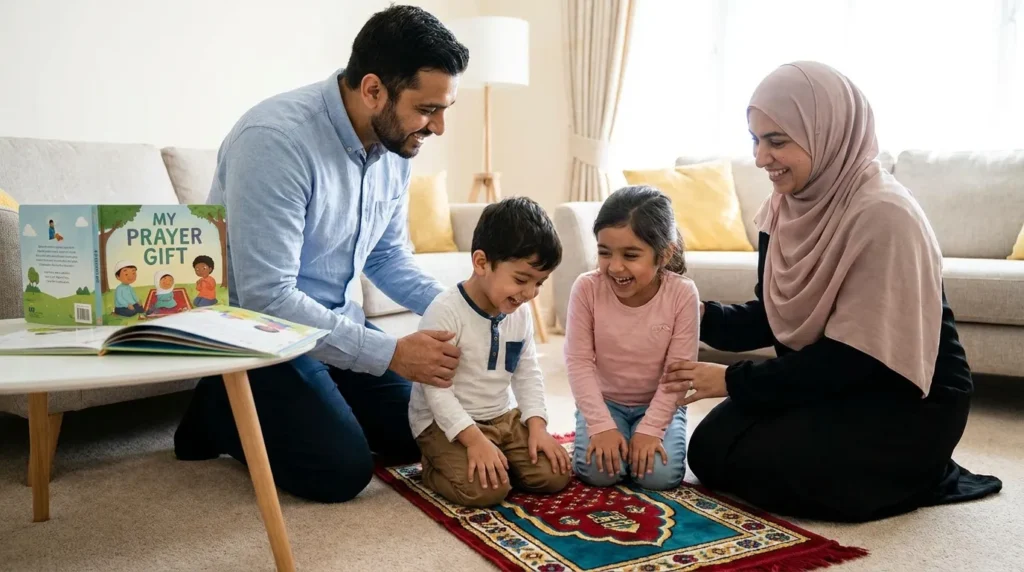
Children need to know why we pray. If they only hear “Pray because you have to,” salah may feel heavy. If they hear “Prayer is how we speak to Allah,” their hearts begin to soften. We should explain salah in warm and simple language:
“Salah is a special meeting with Allah. We stand before Him, thank Him, ask Him for help, and remember that He is always near.”
This explanation is powerful for children because it makes prayer personal. Children understand relationships. They know what it means to talk to someone they love. When we explain that salah is a private conversation with Allah, it becomes meaningful.
We can also explain that salah helps us pause during a busy day. Just like the body needs food, the heart needs prayer. Just like a phone needs charging, our iman needs salah. These simple analogies help children understand spiritual ideas in familiar language.
For younger children, we should focus on Allah’s love, mercy, blessings, and closeness. We should avoid making prayer sound frightening at the beginning. As children grow older and become more mature, we can gradually teach them the seriousness of missing salah with balance, wisdom, hope, and accountability.
This Urdu parenting tips guide offers additional practical advice on positive discipline and communicative strategies for raising righteous children.
When Should We Start Teaching Children Salah?
We can introduce salah from the earliest years by letting children watch and imitate. A two-year-old may stand beside us and copy movements. A four-year-old may learn that Muslims pray five times a day. A six-year-old may begin learning wudu, short surahs, and simple prayer words. Around age seven, children should be trained more seriously and consistently.
The goal is gradual development. We should not expect a young child to perform perfect salah immediately. First, they develop love and familiarity. Then, they learn actions. Then, they learn words. Then, they learn prayer times. Then, they learn responsibility.
| Age Group | Salah Learning Focus | Practical Method |
|---|---|---|
| 2–4 Years | Familiarity and Imitation | Let children watch family members pray and imitate the prayer movements in a fun, encouraging way. |
| 5–6 Years | Basic Meaning and Routine | Teach the names of the five daily prayers, basic Wudu steps, and help them memorize short Surahs. |
| 7–9 Years | Regular Training | Encourage daily Salah, gently correct mistakes, use reward charts, and pray together consistently. |
| 10–12 Years | Responsibility | Explain the importance of Salah, prayer times, discipline, and maintaining consistency. |
| Teen Years | Personal Connection | Discuss the purpose of Salah, accountability before Allah, concentration (Khushu’), and self-discipline. |
The earlier we create a positive relationship with prayer, the easier formal training becomes later. If we wait until the teenage years without any prayer culture at home, teaching salah may become harder. Still, it is never too late. We begin with intention, dua, patience, and a realistic plan.
Teach Wudu as Part of the Salah Journey
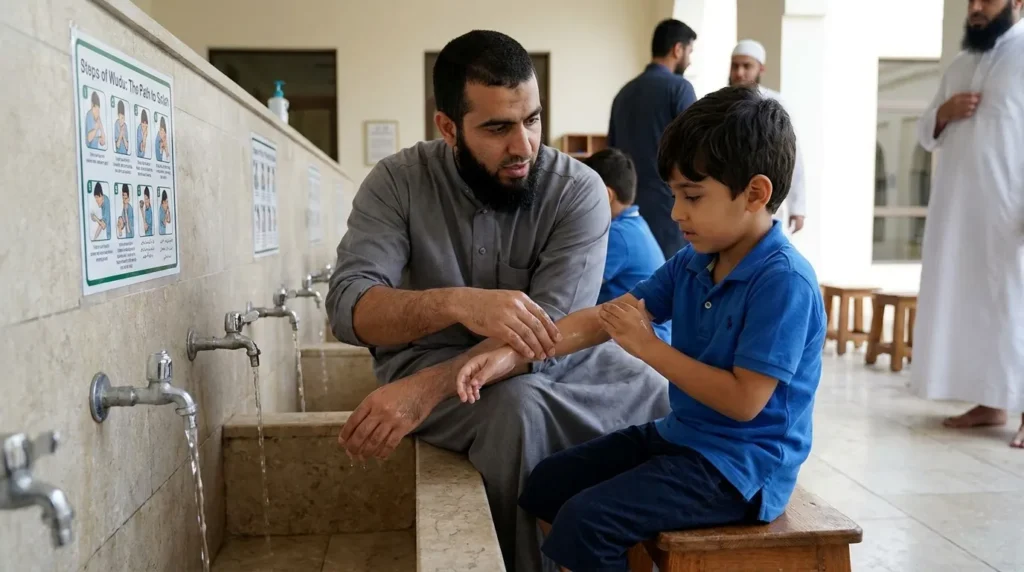
Children usually enjoy water, so wudu can become a beautiful introduction to salah. We should teach them that wudu is not only washing the body; it is preparation to stand before Allah. Wudu teaches cleanliness, order, calmness, and respect for prayer.
We can begin by letting young children watch us make wudu. Then we can guide them step by step. Instead of overwhelming them with every detail at once, we can teach gradually:
- Say Bismillah.
- Wash hands.
- Rinse mouth.
- Clean nose.
- Wash face.
- Wash arms.
- Wipe head.
- Wipe ears.
- Wash feet.
For small children, we can use a simple wudu poster near the sink. For older children, we can explain the correct order and common mistakes. We should praise effort and correct gently. If a child splashes water or forgets a step, we should not turn wudu into stress. We can say, “Good effort. Let us try this step again.”
Teach Prayer Movements Step by Step
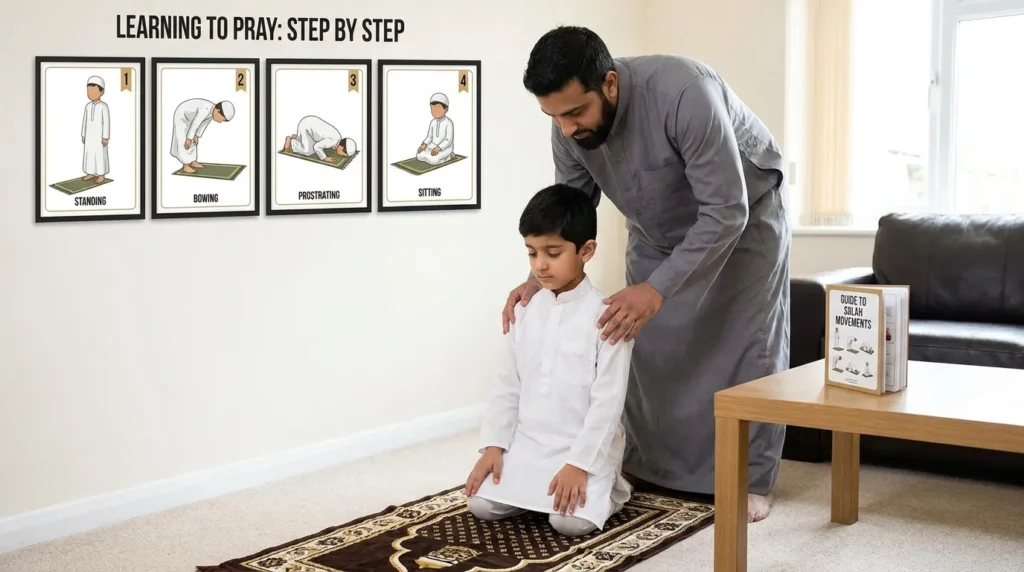
Children learn better when salah is broken into small parts. If we try to teach every movement, word, and rule in one sitting, they may feel overwhelmed. Instead, we should teach gradually.
First, we can teach the main positions:
- Standing
- Ruku
- Standing after ruku
- Sujood
- Sitting
- Final sitting
- Salam
Once the child knows the movements, we can add the words slowly. We may begin with Allahu Akbar, Subhana Rabbiyal Azeem, Subhana Rabbiyal A‘la, and Assalamu alaikum wa rahmatullah. Then we can gradually teach Surah Al-Fatihah, short surahs, tashahhud, durood, and dua.
The key is repetition without pressure. We should allow children to practice beside us. A child who prays imperfectly with love is still learning. We should avoid constantly interrupting every small mistake during salah. After prayer, we can gently explain one correction at a time.
Use Islamic Stories to Build Love for Prayer
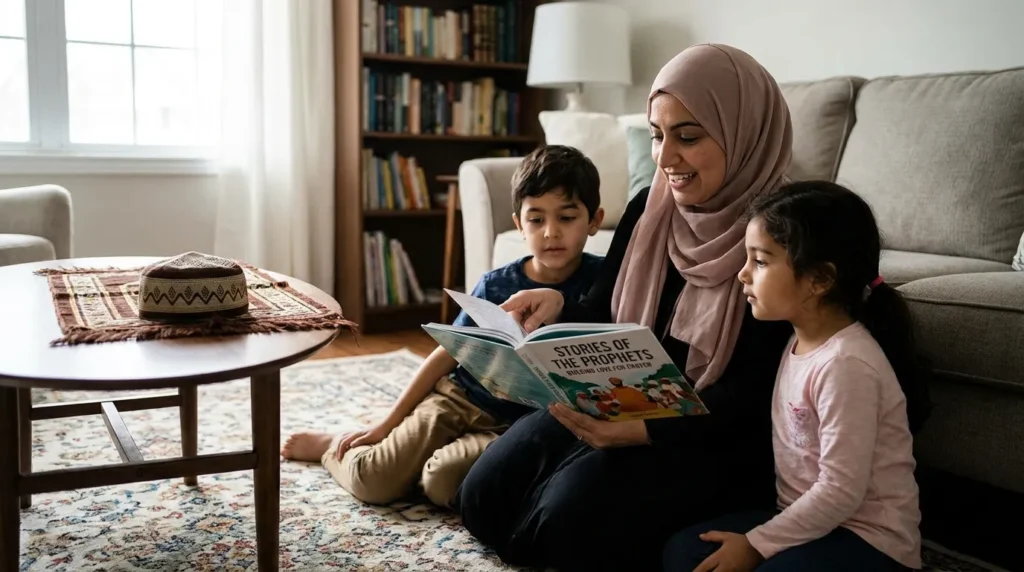
Stories are one of the most effective ways to teach children salah. Children remember stories better than lectures. A story gives them emotions, pictures, and meaning. Instead of saying only, “Prayer is important,” we can tell stories that show how prayer brings peace, strength, and closeness to Allah.
One parenting guide recommends using stories when teaching salah, especially for young children, because stories can help children understand prayer as a gift rather than connecting it only with punishment. (Zakeeya Ali)
We can tell children:
“When we pray, we are speaking to Allah. We thank Him for our food, our family, our health, our home, and everything He gives us. Salah helps our hearts become clean and strong.”
We can also connect prayer with the stories of the prophets . We can explain how prophets turned to Allah in difficulty, made dua, and trusted Him. This helps children see salah as part of a believer’s life, not just a repeated routine.
Create a Positive Salah Environment at Home
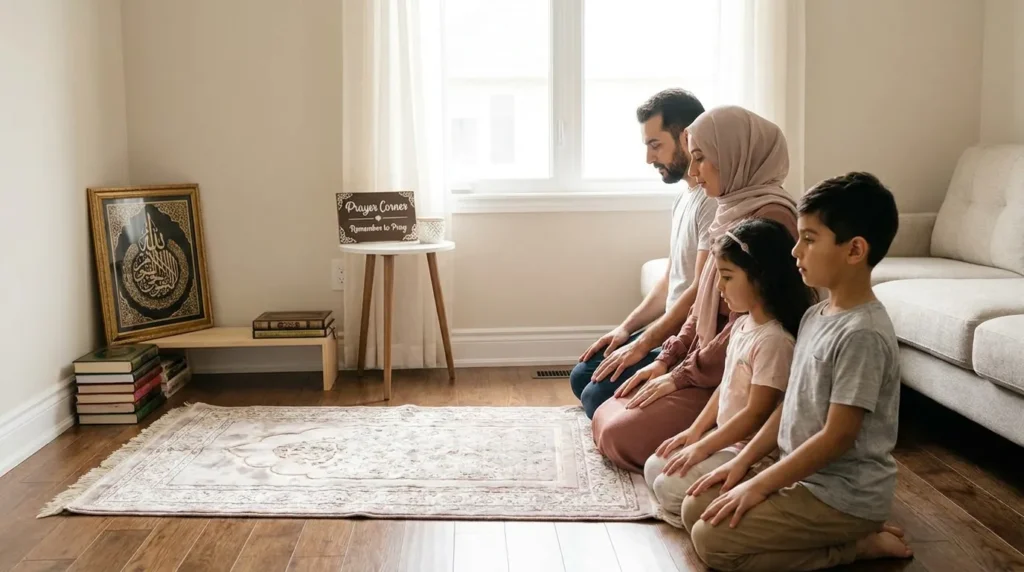
A child’s relationship with prayer is shaped by the atmosphere around prayer. If salah time is always filled with shouting, threats, anger, and panic, the child may begin to dislike prayer. If salah time is calm, warm, consistent, and meaningful, the child is more likely to accept it.
We can create a positive salah environment by setting up a clean prayer space, giving children their own prayer mat, using gentle reminders, playing the adhan, and praying together as a family. Desi Doll Company’s prayer encouragement article recommends practical ideas such as prayer-related toys, prayer mats, reminders, and making prayer part of daily family life. (desidollcompany.com)
A special prayer space does not need to be expensive. It can be a clean corner with prayer mats, a small Quran shelf, duas, and a simple salah chart. When children see that prayer has a respected place in the home, they understand that it matters.
We can also make jama‘ah at home when possible. Praying together teaches unity. Children love belonging. When the family stands together for salah, the child feels included in something important.
Use Salah Charts and Gentle Tracking
A salah chart can help children build consistency. Children often enjoy visual progress. A chart gives them a clear reminder and a sense of achievement. But we must use charts wisely. The goal is not to turn salah into a sticker competition. The goal is to help children develop awareness and routine.
This Salah Tracker Drawing tutorial is highly relevant because it provides a creative and visual step-by-step guide on how to make an engaging daily prayer chart at home to help children track their progress.
A simple salah chart may include:
| Prayer | Completed |
|---|---|
| 🌅 Fajr | |
| ☀️ Dhuhr | |
| 🌤️ Asr | |
| 🌇 Maghrib | |
| 🌙 Isha |
For younger children, we can celebrate effort. For older children, the chart can help them track consistency honestly. We should not shame children publicly if they miss a prayer. Instead, we can say, “Let us see what made it difficult today and how we can improve tomorrow.”
Noor Academy’s guide to prayers for children emphasizes teaching children important duas and prayers gradually, including short daily supplications that build Islamic routine. (Noor Academy) Salah charts can work well alongside dua learning, because both build daily remembrance of Allah.
Teach Children the Five Daily Prayers Clearly
Children should know the names of the five prayers and when they happen. We can teach this naturally throughout the day.
| 🕌 Prayer | 🌟 Simple Child-Friendly Explanation |
|---|---|
| 🌅 Fajr | The morning prayer offered before the sun rises to begin the day with Allah. |
| ☀️ Dhuhr | The midday prayer offered when the sun has passed its highest point. |
| 🌤️ Asr | The afternoon prayer that reminds us to remember Allah during the day. |
| 🌇 Maghrib | The prayer offered just after the sun sets. |
| 🌙 Isha | The night prayer offered before going to sleep. |
We can connect each prayer with daily life. Fajr is before the day begins. Dhuhr is when we pause in the middle of the day. Asr reminds us before evening. Maghrib comes when the sun sets. Isha closes the day before sleep.
Children understand time through routines. Instead of only teaching clock times, we can say:
- “After we wake up, we pray Fajr.”
- “After school, we prepare for Asr.”
- “When the sun sets, it is Maghrib.”
- “Before bed, we pray Isha.”
This makes salah feel natural and connected to daily rhythm.
Make Fajr Easier for Children
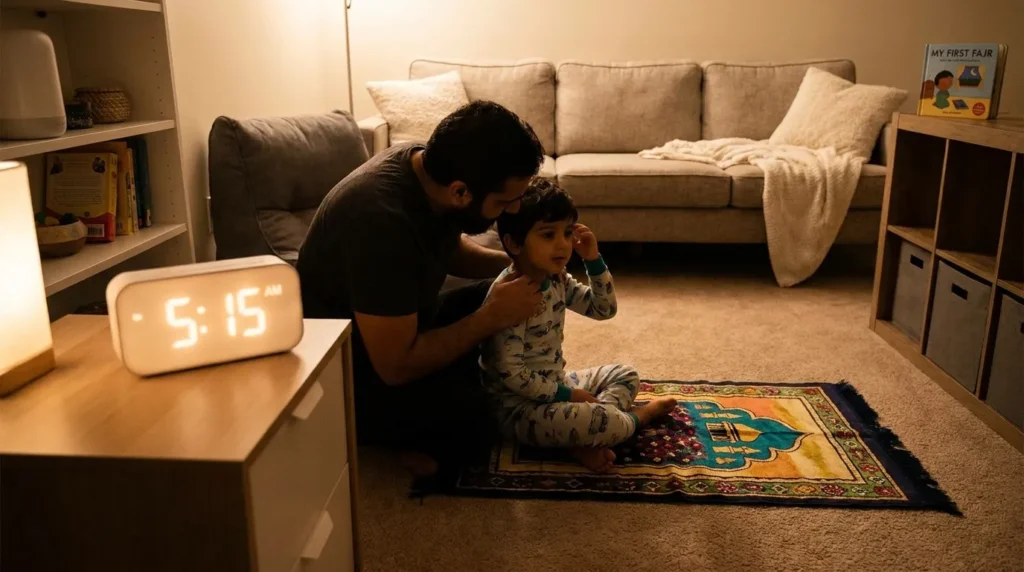
Fajr can be challenging for children, especially as they grow older and sleep later. We should help them succeed instead of only blaming them. Fajr begins the night before. If children sleep too late, waking up becomes difficult. A strong Fajr routine requires a strong bedtime routine.
We can help children by:
- Setting an earlier bedtime
- Reducing screens before sleep
- Preparing clothes and prayer mats at night
- Using a gentle wake-up method
- Opening curtains softly
- Speaking with kindness
- Praising effort after prayer
- Letting them rest afterward if possible
We should avoid harsh wake-up methods that make Fajr feel traumatic. One parenting article advises parents not to yell, bang on doors, or wake children with anger for Fajr; instead, it recommends gentle reminders that frame Fajr as full of barakah and reward. (Zakeeya Ali)
For older children and teens, we should also teach responsibility. They can set alarms, sleep earlier, and understand that Fajr is a serious obligation. But even then, our tone should remain respectful and wise.
Teach Salah With Love, Not Fear Alone
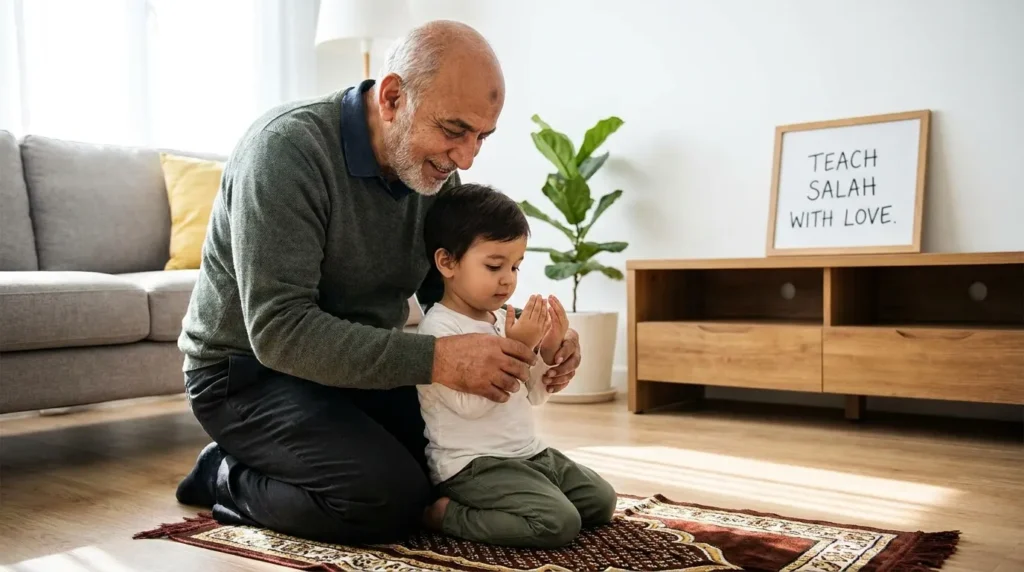
Fear has a place in Islamic education, especially as children mature and learn accountability. But young children should first know Allah through love, mercy, gratitude, and closeness. If the first emotional connection with salah is fear of punishment, they may pray outwardly but feel distant inwardly.
About Islam’s article on helping kids love prayer focuses on building positive associations with salah, including making prayer feel meaningful, encouraging, and connected to love of Allah rather than constant pressure. (About Islam)
We should say things like:
“Allah loves when we pray.”
“Salah helps our hearts.”
“We thank Allah because He gives us everything.”
“Prayer is our special time with Allah.”
“When we feel sad, we can talk to Allah in salah.”
As children become older, we can teach them that salah is an obligation and that missing it is serious. But this should be balanced with hope, mercy, and encouragement.
Avoid Overcorrecting During Prayer
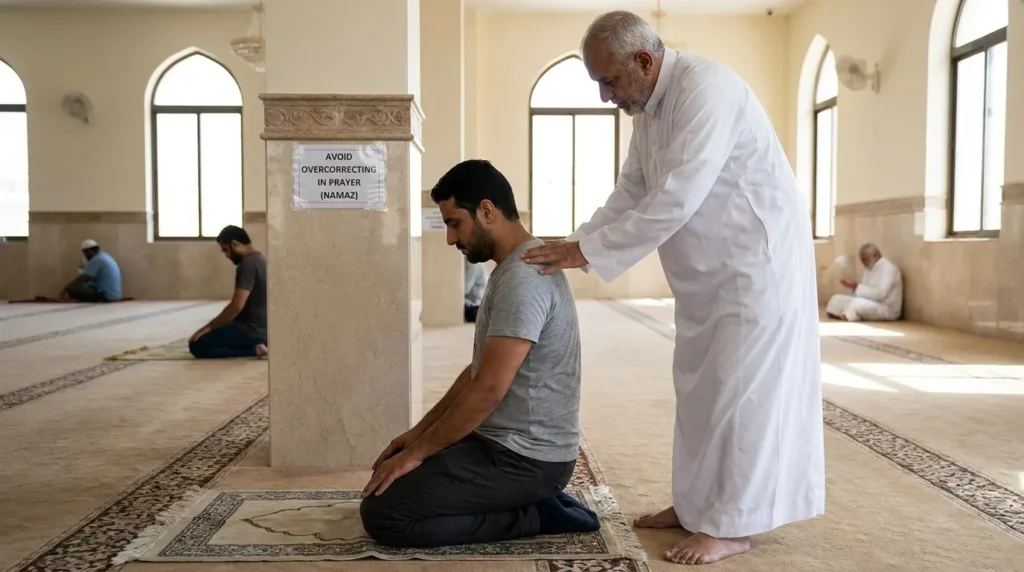
When children begin praying, they will make mistakes. They may move too much, laugh, forget words, look around, mix up positions, or rush. This is normal. If we correct every mistake harshly, they may feel that salah is too difficult.
We should focus on one improvement at a time. For example, one week we focus on standing properly. Another week we focus on ruku. Another week we focus on Surah Al-Fatihah. Another week we focus on calmness.
Instead of saying, “You are doing it wrong,” we can say:
“You are learning well. Today let us improve your sujood.”
Instead of interrupting constantly, we can observe and teach afterward. Prayer should not become a performance under pressure. It should become worship.
Use Rewards Carefully and Wisely

Rewards can motivate children, especially at younger ages. A sticker, praise, special family recognition, or small treat can help build positive feelings around salah. But rewards should support the habit, not replace sincerity.
We can say:
“We are proud that you prayed today. May Allah bless you.”
This connects the reward to Allah, not only to the parent’s approval. We should gradually move from external rewards to internal motivation. As children grow, they should understand that the real reward of salah is Allah’s pleasure, peace of heart, and success in the Hereafter.
Good rewards include:
- Verbal praise
- A star on a chart
- Extra bedtime story
- Choosing a family activity
- A special dua for the child
- Small Islamic gift
- Parent-child quality time
The best reward is often attention. Children love when parents notice their effort.
Teach Children the Meaning of What They Recite
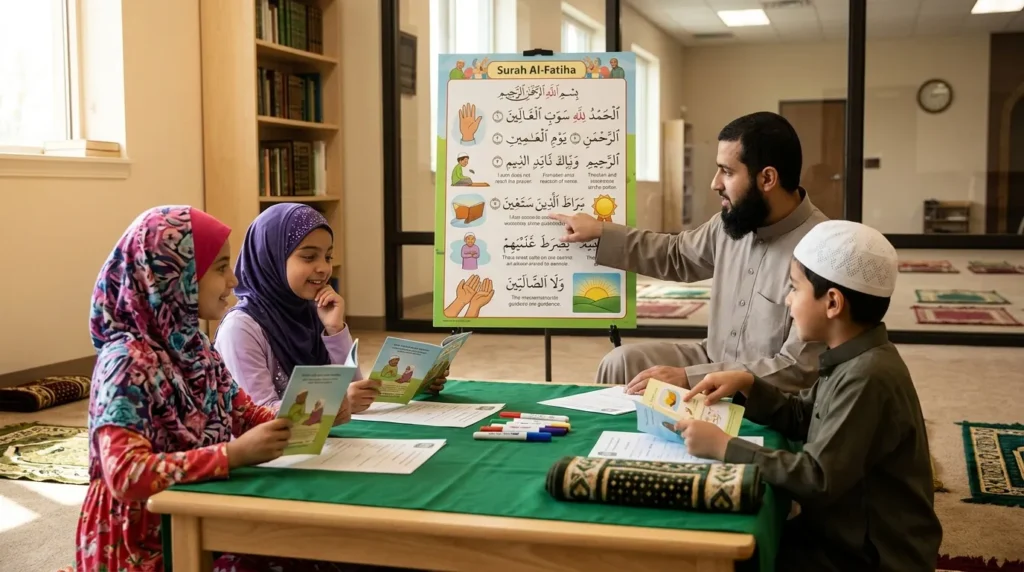
Children may memorize prayer words before understanding them. That is normal. But over time, we should teach meanings. When children know what they are saying, prayer becomes more powerful.
For example, we can explain Surah Al-Fatihah simply:
- We praise Allah.
- We remember that Allah is Merciful.
- We worship only Him.
- We ask Him for help.
- We ask Him to guide us.
We can explain Allahu Akbar as: Allah is greater than everything.
We can explain Subhana Rabbiyal Azeem as: My Lord is perfect and great.
We can explain Subhana Rabbiyal A‘la as: My Lord is perfect and Most High.
Understanding does not need to be complicated. Simple meanings build connection. A child who understands even a little will pray with more awareness.
Encourage Prayer Through Family Participation
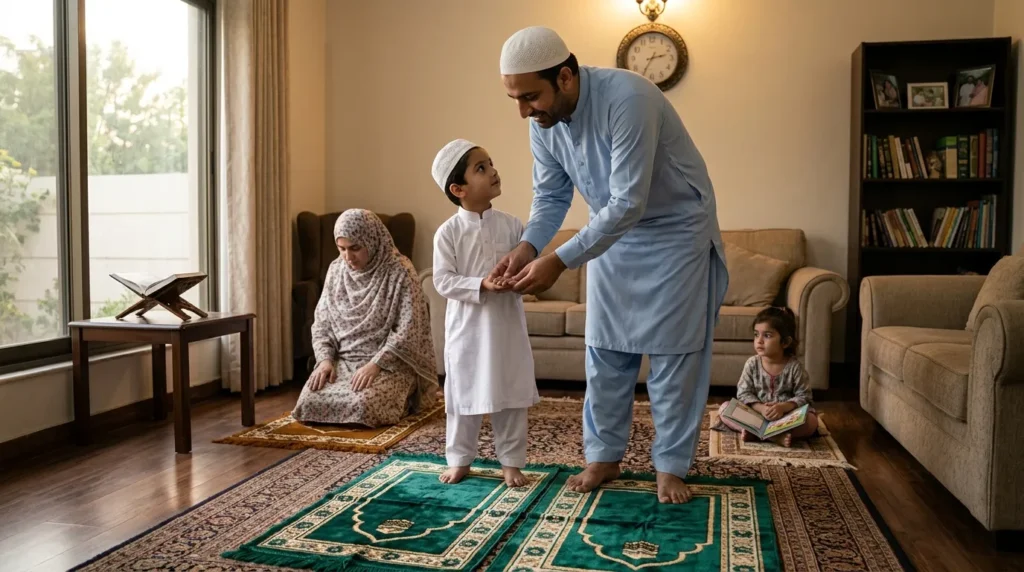
Children love doing things with family. Salah becomes easier when it is not isolated. We can pray together, remind each other, prepare together, and celebrate consistency together.
A family prayer routine may include:
- Someone calls everyone gently.
- Children make wudu.
- Prayer mats are arranged.
- A parent leads prayer.
- After salah, the family makes short dua.
- Parents praise effort and calmness.
This routine helps children see salah as part of family life. It also teaches unity. The child feels, “This is what our family does.”
We can also involve children in small responsibilities. One child can roll out prayer mats. Another can remind the family of Maghrib. Another can check the prayer chart. Involvement creates ownership.
How to Teach Salah to a Child Who Refuses to Pray
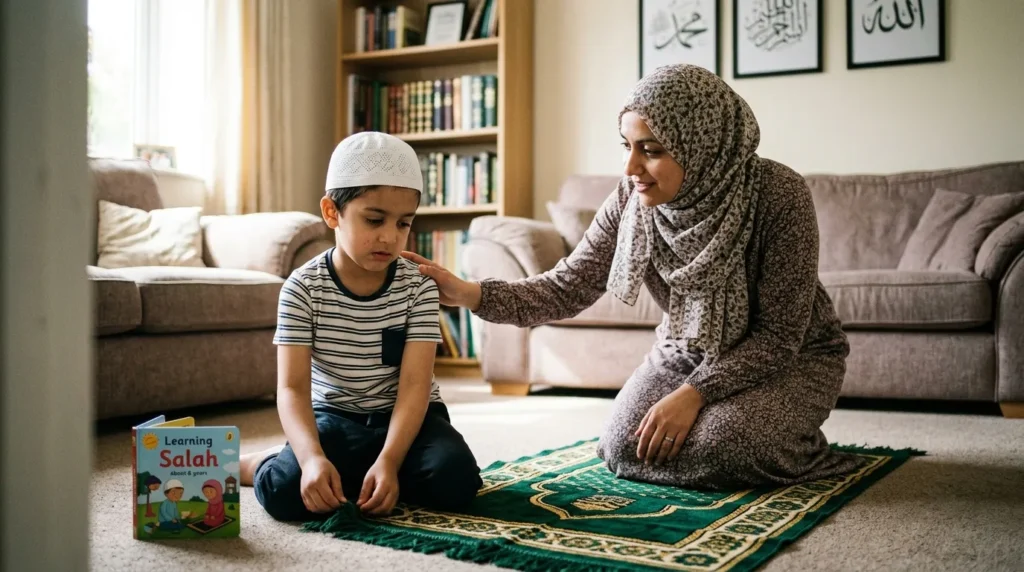
Some children resist prayer. They may say they are tired, bored, busy, or not interested. When this happens, we should avoid panic. Resistance does not always mean failure. It means we need wisdom.
First, we should identify the reason. Is the child tired? Is prayer time always stressful? Do they understand why salah matters? Are we too harsh? Are screens making transitions difficult? Is the child copying someone who does not pray? Does the child feel forced but not connected?
Then we respond accordingly. If the child is young, we keep reminders gentle and consistent. If the child is older, we explain responsibility clearly. We should remain firm but kind.
Useful phrases include:
“Prayer is not something we skip, but we can make it easier together.”
“Let us pray now, and then you can continue playing.”
“I know you feel tired, but salah gives barakah.”
“We all struggle sometimes. Let us stand together.”
We should avoid long arguments. A calm, consistent routine is stronger than emotional battles.
How to Teach Salah to Teenagers
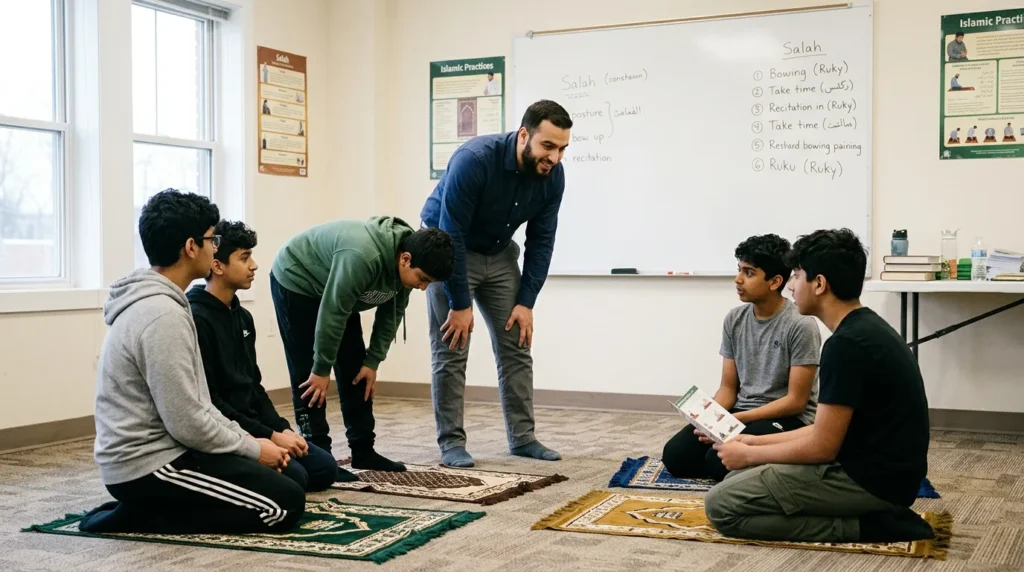
Teaching salah to teenagers requires respect, honesty, and deeper conversation. Teens do not respond well to baby methods. They need meaning, responsibility, and personal connection. They may also have doubts, distractions, sleep problems, peer pressure, or spiritual laziness. With teens, we should discuss:
- Why salah matters
- What happens to the heart when prayer is abandoned
- How salah protects identity
- How to manage school and prayer
- How to pray outside the home
- How to wake for Fajr
- How to rebuild missed habits
- How to handle spiritual weakness
We should speak with seriousness but not humiliation. Teens need to know that missing salah is not a small matter, but they also need hope that they can improve. If they are struggling, we can help them start again with one prayer at a time, then build consistency. We should also encourage good company. Friends who pray make prayer easier. A teen surrounded by people who ignore salah will need stronger inner discipline.
Common Mistakes Parents Make When Teaching Salah
Parents often have good intentions but use methods that weaken a child’s love for prayer. We should avoid these common mistakes:
| ❌ Common Mistake | ✅ Better Approach |
|---|---|
| Shouting at every prayer time | Use calm, gentle, and consistent reminders instead of anger. |
| Teaching punishment before love | Begin by teaching Allah’s mercy and that Salah is a beautiful gift from Him. |
| Expecting perfection too early | Teach Salah step by step and celebrate gradual progress. |
| Overcorrecting every movement | Focus on improving one mistake at a time to avoid overwhelming the child. |
| Not praying on time as parents | Lead by example and make Salah a visible family priority. |
| Comparing siblings | Encourage each child according to their own ability and pace. |
| Making Salah feel boring | Use stories, explain the meaning of Salah, and build a positive family routine. |
| Ignoring teens’ questions | Answer honestly, respectfully, and encourage open conversations about faith. |
The child’s memories of salah matter. We want them to remember prayer as peaceful, meaningful, and important—not as a daily emotional fight.
Daily Salah Teaching Routine for Children
A simple daily routine can help children learn naturally.
| 🕒 Time | 📌 Activity | 🎯 Purpose |
|---|---|---|
| 🌅 Morning | Wake children gently for Fajr or allow younger children to observe family members praying. | Builds awareness and familiarity with Salah. |
| 🏫 After School | Talk about which daily prayers have been offered and which are still remaining. | Teaches prayer timing and daily responsibility. |
| 🌇 Maghrib | Pray together as a family whenever possible. | Builds a lifelong habit and strengthens family bonds. |
| 🌙 Bedtime | Share one lesson about Salah or recite a short dua together before sleeping. | Builds understanding, love, and meaning. |
| 📅 Weekly | Review the child’s Salah chart and praise sincere effort and improvement. | Builds consistency, motivation, and confidence. |
This routine does not need to be perfect. Some days will be messy. Children may resist. Parents may feel tired. But consistency over months and years creates results.
Mermaid Diagram: Step-by-Step Salah Learning Journey
Best Tips to Help Children Love Salah
To help children love salah, we should make prayer visible, meaningful, and positive. We should connect salah with Allah’s love, daily gratitude, family bonding, and spiritual peace.
Helpful methods include:
- Pray on time as parents.
- Speak positively about prayer.
- Give children their own prayer mat.
- Teach meanings slowly.
- Use gentle reminders.
- Pray together as a family.
- Share Islamic stories about prayer.
- Use a salah chart wisely.
- Praise sincere effort.
- Avoid harshness and humiliation.
- Make dua for the child’s heart.
The most powerful method is our own example. A parent who loves salah silently teaches more than a hundred lectures.
FAQs For Teaching Your Child Salah
1. At what age should a child start learning and performing Salah?
Introduce prayer informally between ages 2 and 6 through imitation and basic routines. Begin regular, consistent training at age 7. By age 10, children should understand Salah as a formal, daily responsibility and practice it consistently.
- Ages 2–4: Let them watch family members and copy movements naturally.
- Ages 5–6: Teach the names of the five prayers, simple Wudu steps, and short Surahs.
- Ages 7–9: Start regular training, use positive reinforcement charts, and pray together.
- Age 10+: Establish accountability and emphasize the self-discipline required to pray on time.
2. What should I do if my child refuses to pray?
Avoid shouting, shaming, or engaging in long emotional arguments, which can make them associate prayer with stress. Instead, follow these steps:
- Find the root cause: Check if they are overtired, distracted by screens, or simply do not understand why they need to pray.
- Lower the friction: Offer to stand together and pray as a family (Jama‘ah) to make the transition easier.
- Stay firm but kind: Use reassuring phrases like, “I know you feel tired, but let’s stand together for a few minutes so we can get our barakah (blessing) before you finish playing.”
3. How can I help my child wake up for Fajr without getting angry?
A successful Fajr routine begins the night before. If children go to bed too late, waking up naturally becomes a battle.
- Adjust bedtimes: Reduce screen time before bed and ensure they sleep early enough to get adequate rest.
- Use gentle wake-up methods: Avoid banging on doors or yelling. Wake them with light touch, soft words, or by opening curtains gently.
- Frame it positively: Highlight the spiritual rewards and peace of Fajr, and always praise their effort immediately after they finish praying.
4. Should I correct my child every time they make a mistake during prayer?
No. Overcorrecting a child while they pray or pointing out every mistake at once can overwhelm them and make them feel like prayer is a performance under pressure.
- Observe now, teach later: Let them finish their prayer without interruption.
- One fix at a time: Focus on one small improvement per week. For example, spend one week focusing on a calm ruku (bowing), and the next week on memorizing a specific phrase.
- Praise effort: Frame corrections positively, such as, “Your prayer was beautifully calm today. Next time, let’s work on keeping your feet straight during sujood (prostration).”
5. How do I motivate teenagers to pray consistently when they lose interest?
Teenagers do not respond well to rigid commands or baby methods; they need deep, respectful conversations about identity and purpose.
- Focus on the “Why”: Discuss how Salah protects their heart from stress and acts as a direct anchor to Allah in a confusing world.
- Problem-solve together: Treat them as partners. Talk about how they can manage prayer times around their school schedules, sports, and social lives.
- Encourage good company: Peer pressure heavily influences teenagers. Help them find friends or community environments where praying on time is normal and respected.
6. What is the most effective way to make a child actually love Salah?
The most powerful tool is your own daily example. Children naturally absorb their parents’ unspoken attitudes toward worship.
- Be a role model: Let your children see you happily stopping work, chores, or entertainment as soon as the adhan (call to prayer) sounds.
- Change the narrative: Speak about Salah as a beautiful gift, a direct conversation with a loving Creator, and a peaceful break from a busy day—not as a heavy burden or chore.
- Create a welcoming environment: Set up a clean, dedicated prayer space at home, give them their own prayer mats, and emphasize Allah’s mercy and love from an early age.
Conclusion: Raising Children Who Love Salah
Teaching children salah is a long and beautiful journey. We begin with example, then love, then imitation, then understanding, then routine, then responsibility. We teach wudu, movements, words, prayer times, meanings, and consistency step by step. We avoid harshness, overcorrection, comparison, and fear-based teaching in the early years. We create a home where salah is respected, loved, and practiced.
Our goal is not only that children perform the movements of prayer. Our goal is that they love standing before Allah, turn to Him in difficulty, thank Him in ease, and carry salah as a source of strength throughout life.
When we teach salah with mercy and firmness, we give our children one of the greatest gifts a parent can offer: a daily connection with Allah. May Allah make our children among those who establish prayer, love prayer, protect prayer, and find peace through prayer.