The Importance of Salah in Islam: Beauty, Benefits & Life-Changing Power
Have you ever rushed through a prayer just to get it over with?
Maybe you felt guilty afterward. Maybe you did not feel anything at all.
You are not alone — and this article is for you.
The five daily prayers are not just a religious obligation. They are the most direct connection a human being can have with their Creator. They are the first thing you will be asked about on the Day of Judgment. And they carry a beauty that most of us have never fully experienced.
In this guide, we go beyond the rules. You will learn why Salah matters so deeply, why so many of us struggle with it, and how to transform it from a daily chore into something you genuinely love
Why Is Salah Important in Islam?
A Moment of Pure Accountability
Picture the Day of Judgment.
Every word you said. Every action you took. Every private moment. All of it laid bare.
The Prophet Muhammad (ﷺ) told us that the very first deed a servant will be questioned about is their obligatory prayer.
Not their charity. Not their fasting. Their Salah.
If it is sound, everything else succeeds. If it is corrupt, everything else is in danger (Jami at-Tirmidhi 413).
That is not a minor detail. That is the entire story.
It Came From the Heavens — Literally

Every other pillar of Islam was revealed on Earth through the angel Jibreel.
Salah was different.
The command for the five daily prayers was given directly to the Prophet (ﷺ) during his ascension to the heavens — the Isra and Mi’raj. No intermediary. No distance. A direct conversation with Allah.
Originally fifty prayers, reduced out of mercy to five — while keeping the reward of fifty.
This is not a routine ritual. Every time you pray, you are answering a personal invitation from the Lord of the Worlds.
Your Daily Shield
The world pulls at you constantly.
Temptation. Distraction. Moral grey areas. Slow spiritual decay.
Allah already knew this. His answer was direct:
“Indeed, prayer prohibits immorality and wrongdoing.” (Quran 29:45)
Every prayer washes away the minor sins that accumulate between prostrations.
Think of the five daily prayers as a recurring reset. A shield that protects you not just from the outside world, but from your own worst impulses.
A Light That Never Goes Out
The Prophet (ﷺ) called Salah the coolness of his eyes.
Not a duty. Not a task. The coolness of his eyes.
For the believer, the value of prayer is described as a light — a nur — that cuts through doubt, anxiety, and confusion.
In this life, it guides you. On the Day of Judgment, it illuminates your face. On the path to Paradise, it lights the way.
In a world where so many people feel lost, the believer has a compass that resets five times a day.
The Line Between Faith and Its Absence
The Prophet (ﷺ) was direct:
“Between a man and disbelief is the abandonment of prayer.” (Sahih Muslim 82)
This is not meant to frighten. It is meant to wake us up.
The role of Salah in a Muslim’s life is not decorative. It is structural. Remove it, and the entire foundation shifts.
Why We Struggle With Salah Today
Let us be honest about something.
Most articles on this topic skip this section entirely. They describe how beautiful prayer is — and then leave you feeling guilty that you do not feel that way.
So let us talk about the real struggle.
The Phone Is Winning
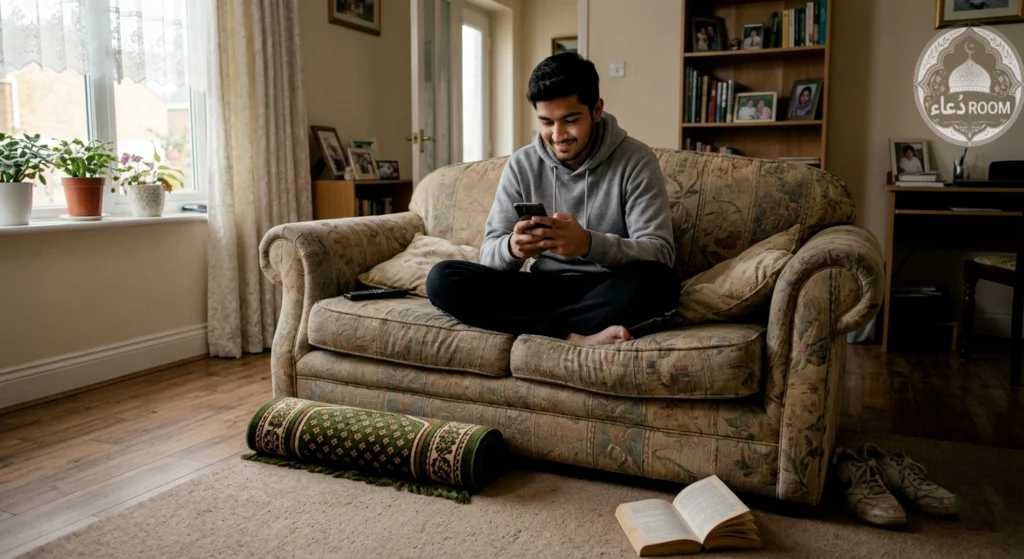
The average person checks their phone over 150 times a day.
That is once every six minutes.
The adhan goes off, and the phone is already in your hand. The notification feels more urgent than the call to prayer. The scroll feels easier than standing on the mat.
This is not a personal failure. It is a deliberate design. Phones are engineered to be more compelling than almost anything else in your life.
Prayer requires stillness. Technology punishes stillness.
That tension is real — and acknowledging it is the first step.
The Guilt Spiral

Many Muslims have a complicated relationship with Salah that looks like this:
Miss a prayer. Feel guilty. Feel too guilty to pray the next one properly. Miss that one too. Feel worse. Stop praying altogether. Feel like you are too far gone to come back.
This cycle destroys more prayer habits than anything else.
The truth is simple: Allah is not waiting to punish you for missed prayers. He is waiting for you to come back. The next prayer is always an open door, not a locked one.
Routine Without Meaning
Some people pray every single prayer — and feel nothing.
The movements are correct. The words are memorized. But the heart is somewhere else entirely.
This is perhaps the quietest struggle of all. Because it is easy to dismiss. “At least I am praying,” you tell yourself.
But deep down, you know something is missing. And that feeling is not guilt — it is hunger. A hunger for the real thing.
Life Is Just Busy
Work. Family. Commutes. Deadlines. School runs. Social obligations.
The significance of daily prayers does not disappear under pressure — but our access to stillness does.
When life accelerates, Salah is often the first thing compressed. Prayed quickly in the car. Combined at the last minute. Rushed through before bed.
This is not a character flaw. It is what happens when an eternal practice meets a modern schedule.
The answer is not guilt. It is strategy — and we will get to that.
The Overlooked Beauty of the Islamic Prayer
Now that we have been honest about the struggle, let us talk about what is waiting on the other side of it.
The Arabic root of the word Salah means to connect. To link. To be in close relation.
This is not a chore. It is a hand reaching toward the most powerful force in existence — and that force reaching back.
Allah Is Listening to You Right Now
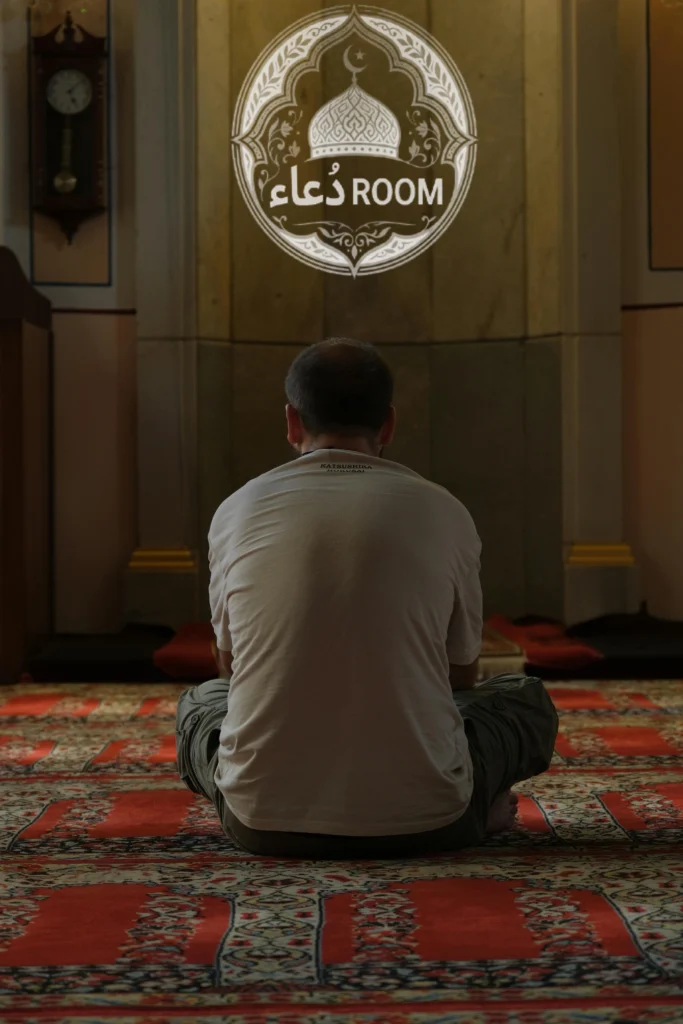
Here is something that will change how you pray forever.
Salah is not a monologue.
When the Prophet (ﷺ) taught us Surah Al-Fatiha, Allah revealed: “I have divided the prayer between Myself and My servant into two halves.”
When you say “All praise is due to Allah, Lord of the worlds” — Allah responds: “My servant has praised Me.”
When you say “The Most Merciful, the Especially Merciful” — He responds: “My servant has glorified Me.”
This exchange happens every single time. Every verse. Every prayer. Every day.
You are not reciting into silence. Allah is listening to you right now.
The Closest You Will Ever Be
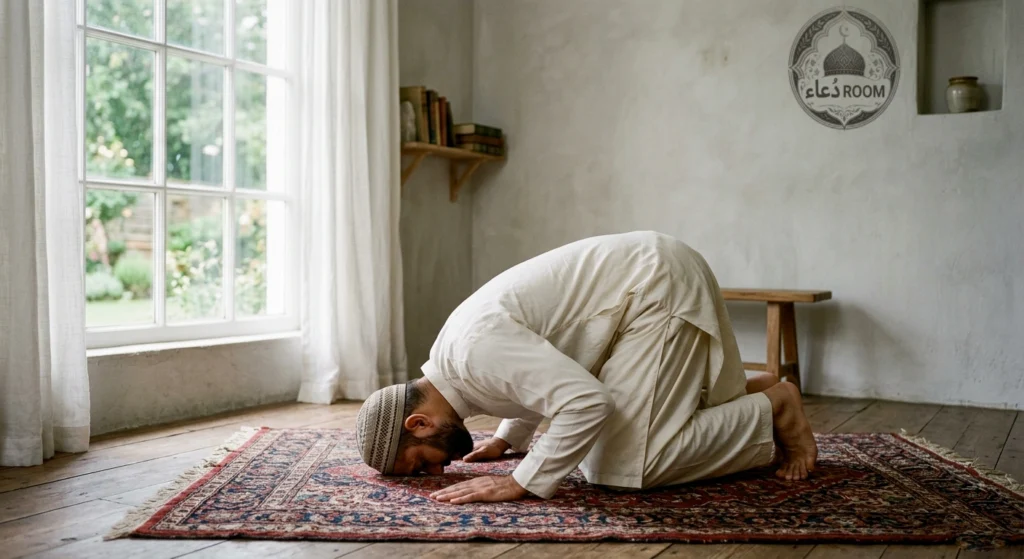
There is one moment in Salah unlike any other.
The sujood. The forehead on the ground.
The Prophet (ﷺ) told us that a servant is nearest to their Lord while in prostration (Sahih Muslim 482).
In that moment, the ego goes quiet. The to-do list disappears. The noise stops.
You are not alone in that moment. You are as close to Allah as a human being can get in this life.
That is not ritual. That is an encounter.
Five Appointments, Not Five Interruptions
Reframe the five daily prayers completely.
They are not interruptions to your day. They are the most important appointments in your day — set by the One who loves you more than anyone else ever could.
Fajr wakes you with intention before the world makes its demands. Zuhr pulls you out of the midday chaos for a moment of peace. Asr arrives in the afternoon rush as a reminder of what actually matters. Maghrib closes the working day with gratitude. Isha brings the night to rest with hope.
This is not a schedule imposed on you. It is a divine architecture — a structure that organizes your entire day around the only relationship that will never disappoint you.
What Science Is Finally Catching Up To
The Quran said it 1,400 years ago:
“Verily, in the remembrance of Allah do hearts find rest.” (Quran 13:28)
Modern research is now confirming what believers have always known. Rhythmic movement, focused attention, and regular moments of stillness reduce cortisol, lower anxiety, and build long-term emotional resilience.
The benefits of Salah for mental health are not metaphorical. They are measurable.
Every prayer is a daily detox. Not just for the soul — for the nervous system.
One Billion People, One Direction
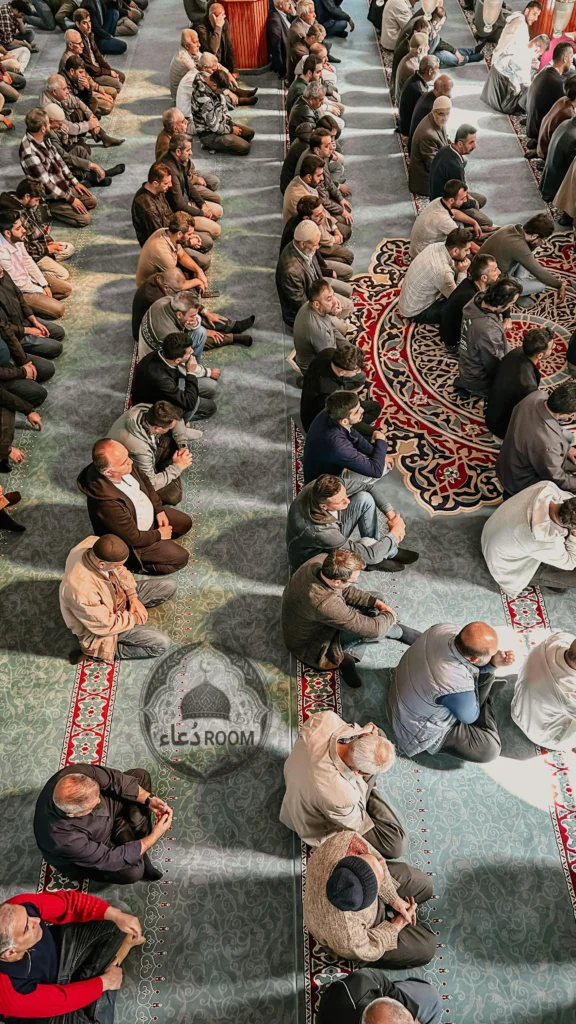
Right now, as you read this, somewhere in the world someone is prostrating.
Five times a day, nearly two billion Muslims face the same Qibla, recite the same words, and move in the same rhythm.
A child in Indonesia. An elderly woman in Morocco. A student in London. A farmer in Bangladesh.
You are never praying alone. You are part of the largest, most unified act of worship on Earth — repeated five times every single day.
You Are Building Something That Lasts Forever
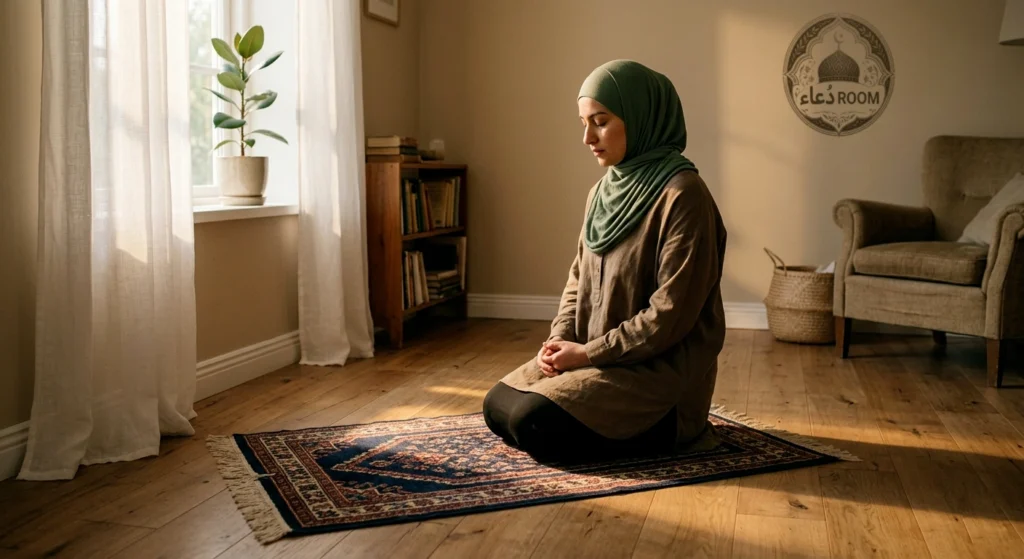
The Prophet (ﷺ) made a promise to anyone who prays the twelve daily sunnah rak’ahs consistently: a house will be built for them in Paradise (Sahih Muslim 728).
Two before Fajr. Four before Zuhr and two after. Two after Maghrib. Two after Isha.
Every time you pray them, a brick is laid. A room is added. A home is built.
You are not just praying. You are constructing an eternal future with your own hands — one rak’ah at a time.
Practical Steps to Unlock Khushu
Step 1: The 3-Minute Sit
Before you say “Allahu Akbar,” stop.
Sit on the prayer mat for three minutes. Recall one specific blessing from the last twenty-four hours. Then say to yourself quietly: “I am about to enter the presence of my Creator.”
That shift in awareness changes everything that follows.
Step 2: Learn What You Are Actually Saying
You have been reciting Surah Al-Fatiha your entire life.
Do you know what every word means?
Not just a rough translation — the weight of each word. Spend one week with just that surah. Read its tafsir. Sit with it.
The next time you recite it in prayer, it will not feel like a memorized script. It will feel like a conversation.
Step 3: Talk to Allah in Sujood
In the second prostration of each rak’ah, pause for ten extra seconds before rising.
In those seconds, speak to Allah in your own language.
Tell Him what is worrying you. Ask for what you genuinely need. Thank Him for something specific.
Do not perform. Just speak. The formality of prayer was never meant to prevent intimacy — it was meant to frame it.
Step 4: Start With Two Rak’ahs
If the sunnah prayers feel overwhelming, begin with just one pair.
The two rak’ahs before Fajr.
The Prophet (ﷺ) said they are better than the entire world and everything it contains. Two simple rak’ahs. Before the world wakes up. Just you and Allah.
That is the entry point to building a prayer life you actually love.
Step 5: The Forward Frame
Before each prayer, ask yourself one question:
“If these words were the last I ever sent forward — would I be content with them?”
Not to create fear. To create presence. To remind yourself that what you are doing right now is not temporary. It is being recorded, carried forward, and will meet you again.
Frequently Asked Questions
Q1: Why is Salah important in Islam according to the Quran?
The Quran commands Salah more than any other act of worship. Surah Al-Ankabut (29:45) states that prayer prohibits immorality and wrongdoing. Surah Ta-Ha (20:14) says: “Establish prayer for My remembrance.” The significance of daily prayers in the Quran is not just ritual — it is the foundation of a life connected to Allah, a protection against moral decay, and the most consistent form of His remembrance available to us.
Q2: What are the main benefits of Salah for mental health?
The benefits of Salah for mental health are both spiritual and physical. The rhythmic movement, required focus, and five daily pauses from worldly stress act as a powerful and consistent counter to anxiety. The Quran confirms that hearts find rest in the remembrance of Allah (13:28). Modern research supports this — regular mindfulness practices reduce cortisol, improve emotional regulation, and build long-term psychological stability. The five daily prayers are, among other things, a mental health practice fourteen centuries ahead of its time.
Q3: How can I find beauty in Salah when I feel distracted and disconnected?
Start with honesty. Acknowledge that the distraction is real — then make one small change. Learn the meaning of Surah Al-Fatiha this week. Then spend sixty seconds in sujood speaking to Allah in your own language about something real in your life. The beauty of Salah is not unlocked by praying perfectly. It is unlocked by praying honestly.
Q4: What does it mean that Salah is a “light”?
When the Prophet (ﷺ) described prayer as a light, he meant something layered. In this life, it provides clarity, purpose, and guidance. On the Day of Judgment, it manifests as radiance on the believer’s face. On the path across to Paradise, it literally lights the way. The role of Salah as light is not poetry — it is a description of what consistent prayer does to a person’s life, inside and out.
Q5: What if I have missed many years of prayer?
Come back. That is it.
Allah’s door is not closed because of missed years. Repent sincerely. Begin today — with today’s prayers, performed on time. Then gradually work on making up what was missed with a realistic, consistent schedule. Do not try to do everything at once. One prayer at a time is enough to begin. Allah loves the one who returns to Him, no matter how long they were away.
A Final Word
The next time you hear the adhan, pause for just a moment.
Do not see it as a pause in your life. Do not see it as a disruption to what you were doing.
See it as the moment your actual life begins — again. Five times a day, every day, for as long as you live.
You have been invited. Not summoned. Not commanded in the cold, bureaucratic sense.
Invited. By name. Into the presence of the One who created you, knows you completely, and is still calling you back.
That call will end one day. The adhan will go off and you will not be here to hear it.
Until then — answer it.
About the Author
Prof. Irfan has spent over twenty years teaching Islamic ethics and Quranic studies — but his relationship with Salah has not always been easy. Like many, he went through years of praying out of habit rather than conviction, rushing through rak’ahs, and wondering why prayer felt hollow. That personal struggle is what drove him to spend decades studying the inner dimensions of Islamic worship. He holds a doctorate in Islamic Ethics and speaks regularly at conferences across the Muslim world. His goal has always been the same: to help ordinary people find in their daily prayers what he eventually found in his — not just an obligation, but a lifeline.