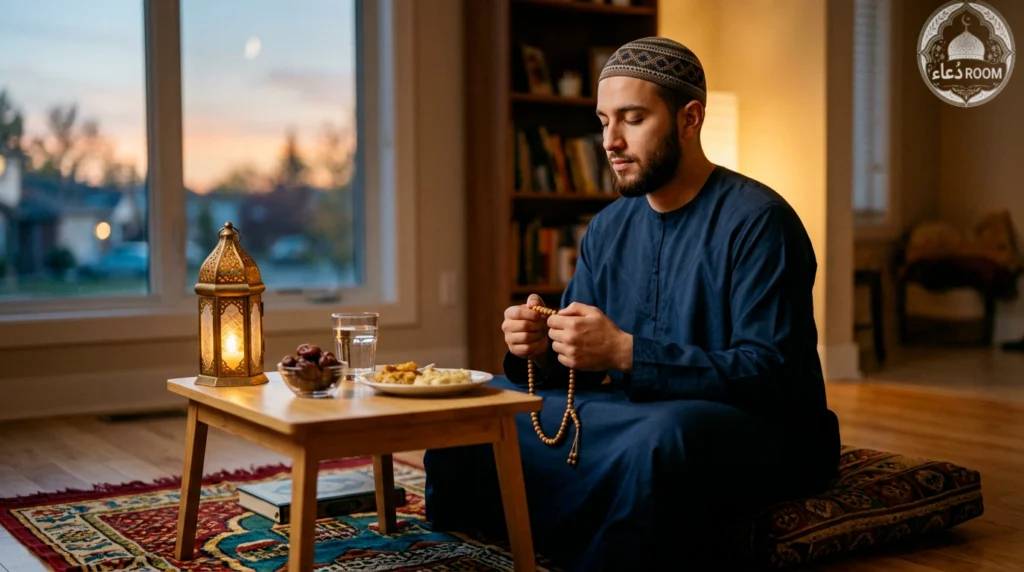
What the Qur’an Says About Love: Tawakkul, Peace, and Everyday Life

Love in Islam Is Not Just a Feeling
When people ask “What does the Quran say about love?” they often expect a handful of romantic verses — something soft and comforting. But the Qur’an’s vision of love is far more profound, more layered, and more practical than that.
Love in the Qur’an is a system. It starts with your relationship to Allah ﷻ, flows into your marriage, shapes how you treat your community, and — through tawakkul (trust in Allah) — transforms how you navigate the uncertainty and stress of everyday life. When all these layers align, the result is something the Qur’an explicitly promises: sakīnah — tranquility, peace, and stillness of the heart.
In this guide, we explore every dimension of love the Qur’an addresses — not as an academic exercise, but as a practical roadmap for the Muslim who wants their daily life to reflect what Allah ﷻ has described in His Book.
The Arabic Words for Love in the Qur’an
Before diving into the verses, it helps to understand what the Qur’an actually says linguistically. Two primary Arabic roots carry the meaning of love in the Qur’an:
1. Ḥubb (حُبّ) — derived from the root ḥā bā bā, this word appears approximately 95 times in various forms. It describes intense devotion, drive, and attachment — the kind of love that consumes and motivates a person. The Qur’an uses ḥubb to describe both noble loves (love of Allah, love of doing good) and misplaced loves (excessive attachment to wealth, to this fleeting world).
2. Mawadda (مَوَدَّة) — from the root wāw dāl dāl, this word conveys tender affection, warmth, and closeness. Allah ﷻ uses mawadda particularly when speaking of the deep bond in marriage and of His own constant, supportive love for the believers.
Understanding this distinction matters: ḥubb is the fire; mawadda is the warmth. A healthy spiritual and human life needs both — passion for Allah ﷻ and His commands, and gentle warmth in our relationships with one another.
1. Love of Allah: The Foundation That Changes Everything
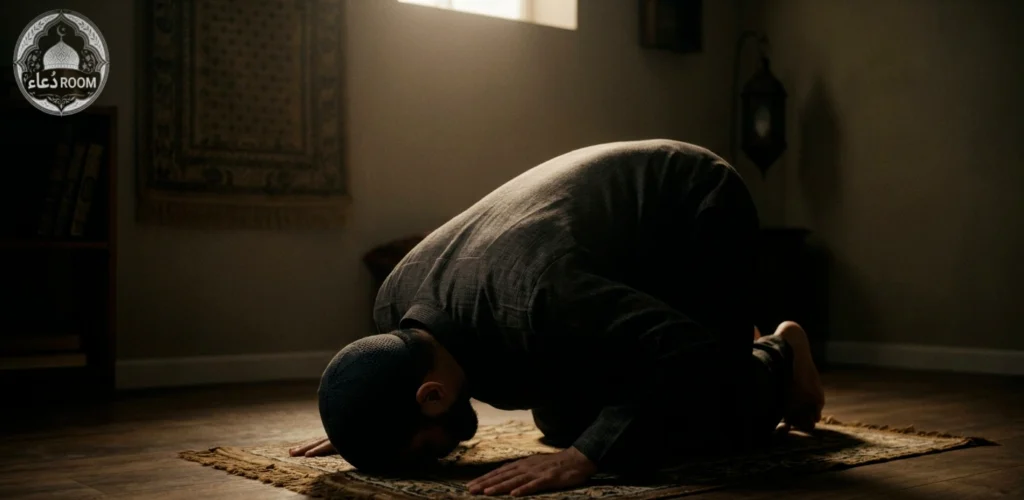
The Qur’an is clear: the most important love a person can cultivate is their love for Allah ﷻ. Not as an abstract theological concept — but as a living, active devotion that shapes choices, calms the heart, and provides moral clarity.
“Say, [O Prophet], ‘If you [sincerely] love Allah, then follow me; Allah will love you and forgive your sins.'” — Āl-‘Imrān 3:31
This verse is often called the āyat al-maḥabba — the verse of love. It frames love of Allah not as a passive emotion but as something that must be demonstrated. The proof is in following the Prophet ﷺ. And the reward? Allah’s love in return — along with forgiveness.
“As for those who believe and do good, the Most Compassionate will certainly bless them with genuine love.” — Maryam 19:96
“Surely, my Lord is Most Merciful, All-Loving.” — Hūd 11:90 | Al-Burūj 85:14
One of the 99 Names of Allah is Al-Wadūd (الوَدُود) — the Most Loving, the Affectionate. This Name tells us something profound: Allah’s love for His servants is not conditional on our perfection. It is consistent, generous, and waiting to be reciprocated. Reflecting on this Name — and making du’ā using it — can completely reshape a person’s relationship with their Creator. You can explore all of the 99 Names of Allah and their meanings at DuaRoom’s 99 Names of Allah.
2. Whom Allah Loves: The Character Traits That Attract Divine Love

One of the most practical sections of the Qur’an on love is where Allah ﷻ directly names the qualities He loves in His servants. These are not abstract virtues — they are daily habits and character traits that any Muslim can begin developing right now.
“And do good, for Allah certainly loves the good-doers.” — Al-Baqarah 2:195
“Surely Allah loves those who always turn to Him in repentance and those who purify themselves.” — Al-Baqarah 2:222
“Allah loves the patient.” — Āl-‘Imrān 3:146
“Once you make a decision, put your trust in Allah. Surely Allah loves those who trust in Him.” — Āl-‘Imrān 3:159
“Surely Allah loves those who are just.” — Al-Mā’idah 5:42 | Al-Ḥujurāt 49:9 | Al-Mumtaḥanah 60:8
The pattern is unmistakable. Allah loves:
- The good-doers — people who actively benefit others
- The repentant — people who return to Him after slipping
- The patient — people who endure hardship without bitterness
- The trusting — people who practice tawakkul
- The just — people who are fair even when it costs them
Notice that none of these are one-time acts. They are ongoing dispositions — ways of being, not events. Building these traits is how you actively cultivate a relationship of love with Allah ﷻ.
3. The Eleven Types of Love: What Al-Baqarah 9:24 Reveals

Al-Jumuah Magazine’s analysis of a single Qur’anic verse from Surah At-Tawbah uncovers something remarkable: in one ayah, Allah ﷻ lists eleven objects of human love — parents, children, siblings, spouses, extended family, wealth, trade, homes — and then poses the ultimate question: does any of this rank above your love for Allah, His Messenger, and striving in His cause?
This verse is not a condemnation of human love. It is a calibration. The Qur’an acknowledges that love for family and wealth is natural and even noble — but it also declares that this love must remain within what scholars call “Constitutional Love”: love that is bounded by our duties to Allah ﷻ.
“Your wealth and children are only a test, but with Allah is a great reward.” — At-Taghabun 64:15
The test is not whether you love — it is whether that love leads you closer to Allah or pulls you away from Him. Love of family that inspires you to be more patient, more generous, and more just is love operating within its proper limits. Love of wealth that leads you to dishonesty or neglect of prayer is love that has crossed a line.
This framework transforms how we think about everyday decisions: what we spend money on, how much time we give to work vs. worship, how we balance providing for our families with providing for our own spiritual nourishment.
4. Love in Marriage: Mawadda, Raḥma, and the Verse That Changes Everything
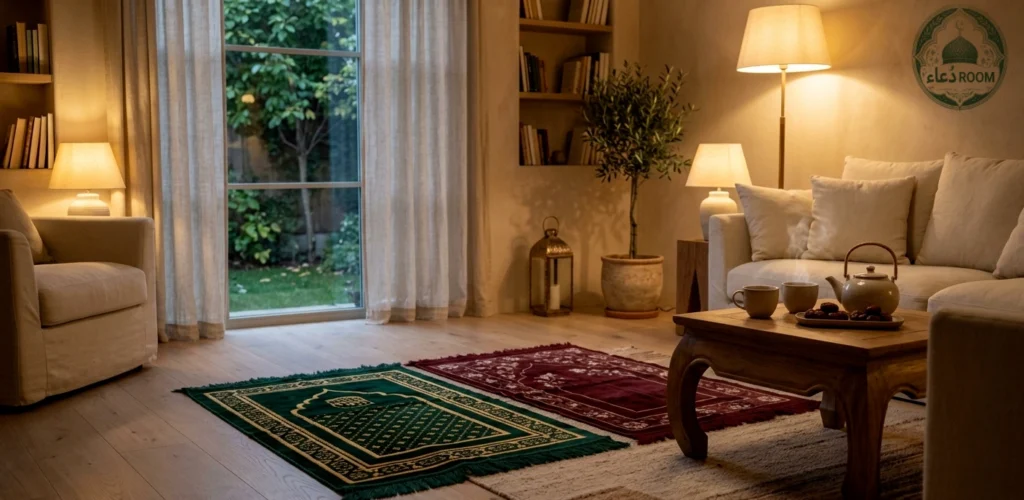
Arguably the most beloved verse on love in the entire Qur’an is found in Surah Ar-Rūm:
“And of His signs is that He created for you from yourselves mates that you may find tranquility in them, and He placed between you affection (mawadda) and mercy (raḥma). Indeed in that are signs for a people who give thought.” — Ar-Rūm 30:21
Three gifts from Allah are described in this single verse:
Sakīnah (Tranquility): The purpose of a spouse, according to this verse, is that you find rest in them — emotional, psychological, and spiritual rest. This is not describing mere physical attraction. It is describing the profound peace that comes from being truly known and accepted by another person.
Mawadda (Affection): This is the warm, tender love — the kind that shows up in small daily acts of care. Saying kind words. Being patient when your spouse is tired. Noticing the little things. The Prophet ﷺ modeled this in how he treated his wives — with humor, gentleness, and consistent affection.
Raḥma (Mercy): Mercy is what sustains a marriage when affection flickers. When there is conflict, illness, loss, or simply the grind of years together — mercy is what keeps two people committed. Raḥma is choosing to be soft when you could be harsh. It is a practice, not just a feeling.
Marriages that are built on mawadda and raḥma are marriages that can weather difficulty. When the romance dims during a hard season, mercy fills the gap. When the couple is tired or struggling, affection rekindles through small gestures. This is the Qur’anic architecture of love.
5. Love in Community: “The Believers Are But Brothers”
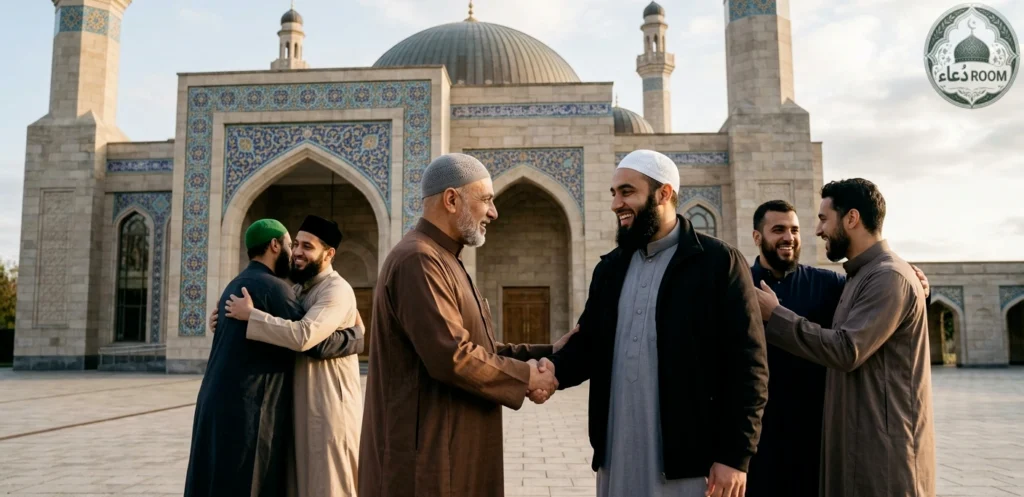
The Qur’an’s vision of love extends far beyond the nuclear family. It envisions an entire community — the Ummah — bound together by a love that is stronger than culture, ethnicity, or language.
“The believers are but brothers, so make settlement between your brothers. And fear Allah that you may receive mercy.” — Al-Ḥujurāt 49:10
“He brought their hearts together. Had you spent all the riches in the earth, you could not have united their hearts. But Allah united them.” — Al-Anfāl 8:63
This second verse is extraordinary. It tells us that the unity and love between believers is literally a miracle — something that human strategy, money, or politics alone cannot produce. It is a gift from Allah that we are custodians of, not creators of.
Practical brotherhood means:
- Protecting your fellow Muslim’s reputation when they are not present
- Giving the benefit of the doubt before assuming ill intent
- Sharing generously, even when resources are tight
- Settling disputes quickly and not letting grievances fester
- Making others feel welcome, seen, and valued
“Never will you attain the good [reward] until you spend [in the way of Allah] from that which you love.” — Āl-‘Imrān 3:92
To love in community means to give from your best — your time, your wealth, your attention, your du’ā for others. It is love made active.
6. Tawakkul: When Love of Allah Becomes Surrender and Peace
Tawakkul (تَوَكُّل) is one of the most misunderstood concepts in Islam. Many people think of it as passive acceptance — “just leave it to Allah.” But the Qur’an paints a completely different picture.
Tawakkul is active surrender: you do everything within your capacity, and then — only then — you release the outcome to Allah with full confidence in His wisdom and care.
“Once you make a decision, put your trust in Allah. Surely Allah loves those who trust in Him.” — Āl-‘Imrān 3:159
Notice the sequence: decide first, then trust. Tawakkul is not a substitute for effort — it is what comes after effort.
“Say, ‘Nothing will ever befall us except what Allah has destined for us. He is our Protector.’ So in Allah let the believers put their trust.” — At-Tawbah 9:51
“And whoever puts their trust in Allah, then He [alone] is sufficient for them. Certainly Allah achieves His Will. Allah has already set a destiny for everything.” — At-Talāq 65:3
This verse — At-Talāq 65:3 — is one of the most comforting in the Qur’an. It carries a direct promise: if you trust Allah, He is enough for you. Sufficient. Kāfi. This is not a metaphor. It is a commitment from Allah ﷻ Himself.
What Tawakkul Looks Like in Daily Life
Tawakkul is not a grand dramatic act. It lives in the small, recurring moments of daily life:
- You prepare for an exam as thoroughly as you can — then sleep, trusting that Allah will provide what your effort cannot.
- You apply for a job with the best version of yourself — then release the anxiety, knowing Allah is Al-Razzāq (The Provider).
- You pursue healing for your illness with the best medical care available — then place your recovery in Allah’s hands.
- When plans collapse and life doesn’t go the way you hoped, you say Hasbunallāhu wa ni’mal wakīl (“Allah is sufficient for us, and He is the best disposer of affairs”) — and mean it.
People who practice tawakkul consistently report a profound reduction in anxiety. Not because their circumstances change necessarily, but because they no longer feel they are carrying the weight of outcomes alone. That weight belongs to Allah ﷻ — and He is infinitely more capable of bearing it.
For daily du’ā that help cultivate tawakkul and trust in Allah, DuaRoom is an excellent resource — with categorized supplications for anxiety, hardship, and seeking Allah’s protection.
7. Peace (Sakīnah) as the Fruit of Love and Tawakkul
The Qur’an uses the word sakīnah — often translated as tranquility, peace, or stillness — to describe a specific spiritual state that Allah ﷻ sends down upon believers.
“He it is Who sent down sakīnah into the hearts of the believers that they might add faith unto their faith.” — Al-Fatḥ 48:4
Sakīnah is not simply the absence of stress. It is a positive presence — a calm that comes from trusting Allah so deeply that external turbulence cannot reach the core of your heart. It is the peace that passes understanding.
This peace is the natural fruit of the three loves we have discussed:
- Love of Allah — when your primary allegiance is to the Creator, the shifting winds of worldly approval and disapproval lose their power over you.
- Love in marriage and family — when mercy and affection govern your home, it becomes a genuine shelter.
- Tawakkul — when you hand the outcomes to Allah, anxiety loosens its grip.
Three Daily Practices That Build Sakīnah
Dhikr (Remembrance): The Qur’an states directly: “Verily, in the remembrance of Allah do hearts find rest” (Ar-Ra’d 13:28). Even five minutes of morning dhikr — SubḥānAllāh, Alḥamdulillāh, Allāhu Akbar — can shift the tone of an entire day.
Reflection on Qur’anic Names of Allah: Each Name of Allah points to a dimension of His reality that directly addresses human fear. Al-Ḥafīẓ (The Protector), Al-Karīm (The Generous), Al-Samī’ (The All-Hearing). Sitting with these Names — understanding their meanings — is a form of love that the heart was made for. Explore the full list of Names and their detailed meanings at DuaRoom’s 99 Names of Allah.
Intentional Du’ā: The Prophet ﷺ taught us that du’ā is the essence of worship. Making specific, heartfelt supplications — rather than rote recitation — builds a relationship with Allah that is personal, direct, and deeply comforting.
8. Love, Peace, and Everyday Life: Practical Integration
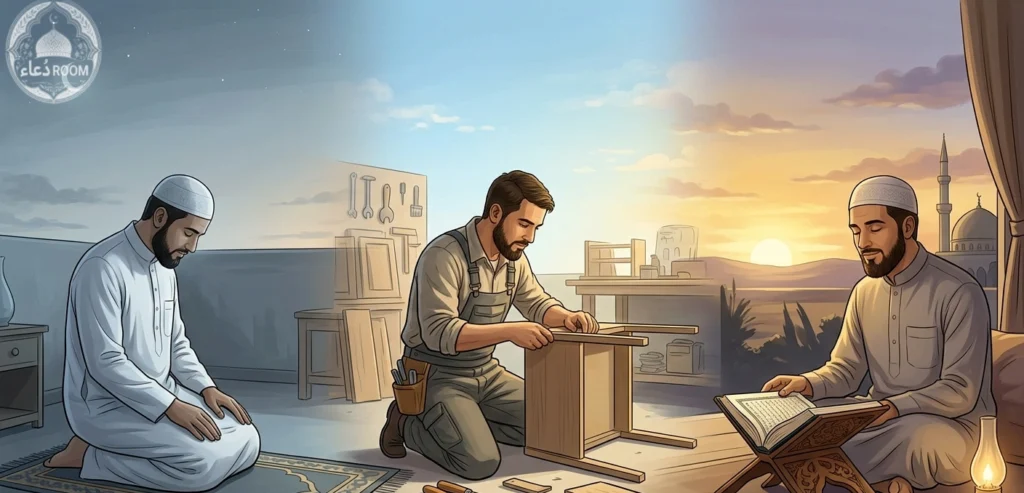
The Qur’an was not revealed as a theoretical text to be studied and shelved. It was revealed to be lived. Here is how the principles we have covered translate into the texture of daily Muslim life:
In the Morning
Begin with intention. Before your phone, before your to-do list — spend five minutes with a short du’ā and a verse from the Qur’an. This anchors your day in love of Allah before the world makes its demands.
In Your Marriage
Practice one act of mawadda every day — a kind word, a small gesture, a moment of genuine attention. And when conflict arises, reach for raḥma first. Ask: “How would I want to be treated right now?” then treat your spouse that way.
In Your Work
Do your best — then practice tawakkul with the results. This is not laziness; it is theological sanity. You were not designed to control outcomes. You were designed to act rightly and trust the One who controls everything.
In Your Worry and Anxiety
Recognize that anxiety is often love or care that has lost its anchor. When you feel it rising, return to At-Tawbah 9:51: “Nothing will ever befall us except what Allah has destined for us. He is our Protector.” Then take the next reasonable step — and leave the rest.
In Your Community
Look for one person each week who you can show genuine brotherhood or sisterhood to. Not grand acts — just real, human connection. A phone call. A meal. Showing up when it matters.
Key Quranic Verses on Love, Tawakkul, and Peace — Summary Table
| Theme | Verse | Reference |
|---|---|---|
| Following Allah’s love | “If you sincerely love Allah, follow me; Allah will love you” | Āl-‘Imrān 3:31 |
| Allah loves the doers of good | “Do good, for Allah certainly loves the good-doers” | Al-Baqarah 2:195 |
| Allah loves the patient | “Allah loves the patient” | Āl-‘Imrān 3:146 |
| Love in marriage | “He placed between you affection and mercy” | Ar-Rūm 30:21 |
| Brotherhood in community | “The believers are but brothers” | Al-Ḥujurāt 49:10 |
| Tawakkul after decision | “Put your trust in Allah. Allah loves those who trust in Him” | Āl-‘Imrān 3:159 |
| Tawakkul and sufficiency | “Whoever puts their trust in Allah, He is sufficient for them” | At-Talāq 65:3 |
| Peace through remembrance | “In the remembrance of Allah do hearts find rest” | Ar-Ra’d 13:28 |
| Sakīnah sent by Allah | “He sent down sakīnah into the hearts of the believers” | Al-Fatḥ 48:4 |
Frequently Asked Questions
What is the most important verse about love in the Qur’an?
Many scholars point to Ar-Rūm 30:21 as the most comprehensive verse on love — covering spousal love, affection (mawadda), mercy (raḥma), and the peace (sakīnah) that comes from a healthy relationship. Āl-‘Imrān 3:31, the āyat al-maḥabba, is also central for understanding the love between Allah and the believer.
What does the Qur’an say about self-love?
The Qur’an does not use the modern language of “self-love,” but it teaches profound self-respect — through the prohibition of self-harm, the command to protect one’s health and honor, and the repeated reminder that the human being is created as Allah’s vicegerent on earth. True self-care in Islam means nurturing your soul through ‘ibādah, protecting your body, and avoiding what harms you.
What is tawakkul and why is it connected to love?
Tawakkul (trust in Allah) is an expression of love for Allah ﷻ. When you genuinely love someone and trust their wisdom and care, you can release control to them. Tawakkul is that release — born from knowing Allah is Al-Wakīl (The Trustworthy Disposer of Affairs) and Al-Wadūd (The Most Loving). It is love made calm.
How do I practice tawakkul when I am very anxious?
Start with action: do what is within your power. Then make a specific du’ā handing the outcome to Allah. Then recite Hasbunallāhu wa ni’mal wakīl. Repeat as needed. Tawakkul is a practice built through repetition — not a switch that flips once. Be patient with yourself.
Let the Qur’an Teach You How to Love
The Qur’an does not present love as a luxury or a feeling reserved for special moments. It presents love — love of Allah, love in marriage, love in community, and love-rooted trust in tawakkul — as the very architecture of a Muslim life well lived.
When love is properly anchored in Allah ﷻ, it becomes incorruptible. It cannot be destroyed by betrayal, loss, or failure — because its source is beyond all of those things. When tawakkul roots itself in that love, anxiety loses its grip. When marriages are built on mawadda and raḥma, they become shelters rather than battlegrounds. When communities operate from brotherhood and generosity, they become forces of healing in the world.
The Qur’an has been speaking about all of this for fourteen centuries. The invitation is always open: pick it up, reflect on its words, and let them change how you love.
May Allah ﷻ place love, mercy, and peace in our hearts, our homes, and our communities. Āmīn.