Barakallahu Feek Meaning: What It Means and How to Reply
You heard someone say “Barakallahu Feek” and want to know what it means. This guide gives you the meaning, the Arabic spelling, and common ways to reply, all in plain words.
Barakallahu Feek Meaning In English
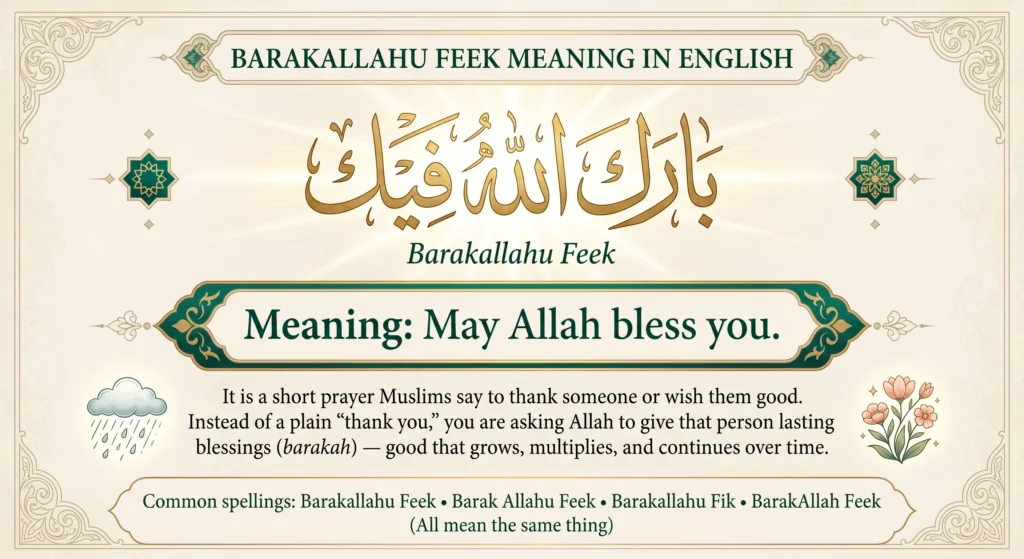
Barakallahu Feek means “May Allah bless you.” It is a short prayer Muslims say to thank someone or wish them good.
The phrase is often used instead of a plain “thank you.” It goes deeper than that. Instead of just thanking a person, you are asking Allah, the Arabic word for God, to give that person blessings. Blessing (barakah) means good that grows and lasts, not just a one-time gift.
Think of the difference this way. If a friend gives you money and you say “thanks,” that covers the moment. If you say “Barakallahu feek” instead, you are asking Allah to make that money useful for a long time — maybe it helps your friend in ways neither of you expected. Barakah is often described as good that keeps multiplying quietly, even in small or ordinary things, rather than good that shows up once and disappears.
You will see it spelled in a few ways:
- Barakallahu Feek
- Barak Allahu Feek
- Barakallahu Fik
- BarakAllah Feek
All of these mean the same thing. They are just different ways to write the same Arabic sound in English letters.
Barakallahu Feek In Arabic
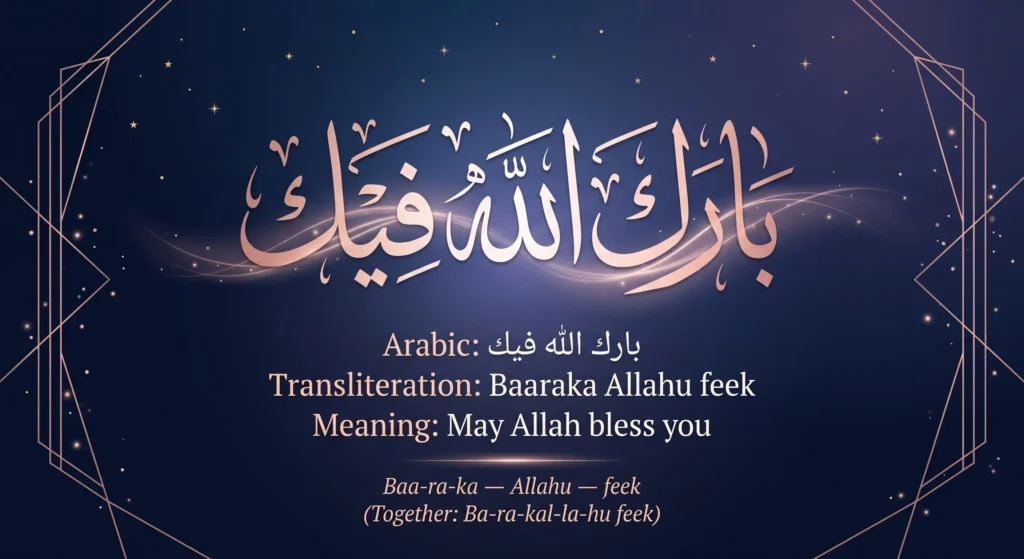
The Arabic spelling is بارك الله فيك.
Arabic: بارك الله فيك Transliteration: Baaraka Allahu feek Meaning: May Allah bless you
Say it in parts: Baa-ra-ka (like “bar-a-ka”) — Allahu (Allah, with “hu” at the end) — feek (like “feek,” rhymes with “week”). Together it flows as “Ba-ra-kal-la-hu feek.”
What Do the Three Words Mean?
The phrase has three Arabic parts, and each one adds meaning. Knowing this helps you understand why it is more than a simple “thanks.”
Together, Barakallahu Feek means “May Allah bless you.” This is why the phrase feels warmer than a thank-you. It’s not about repaying a favor. It’s a prayer asking Allah for good things to grow in someone’s life.
Barakallahu Feek vs. Feeki vs. Feekum
Arabic changes the word “feek” based on who you are talking to. This is one detail most guides skip, but it matters if you want to use the phrase correctly.
If you’re unsure which one to use, “feekum” is a safe, common choice in a group chat or when speaking to more than one person.
When To Say Barakallahu Feek
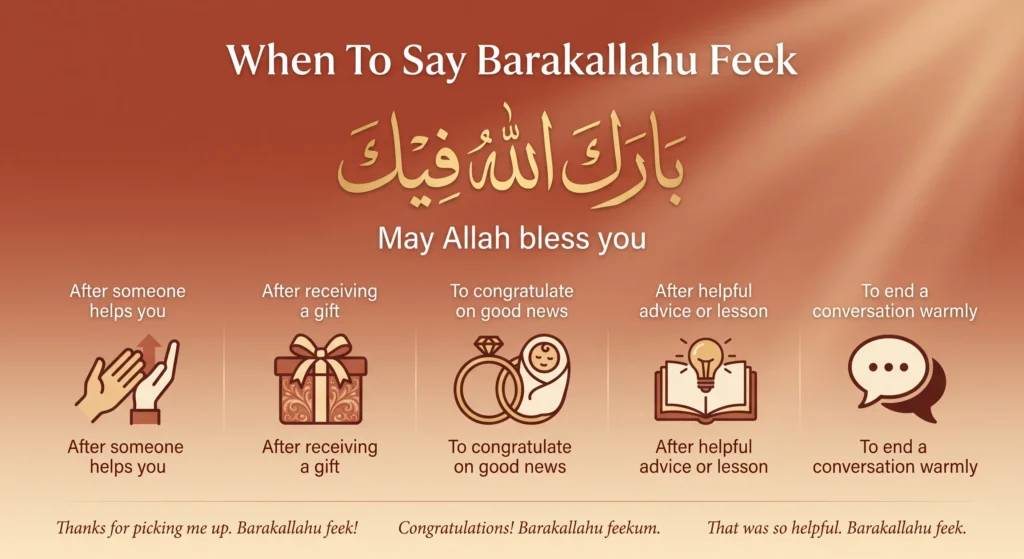
Say it any time you want to thank someone or wish them well, not only after a favor. It fits many everyday moments.
Common times people use it:
- After someone helps you with something, big or small
- After receiving a gift
- To congratulate someone on good news, like a wedding or new baby
- After hearing a helpful talk, lesson, or piece of advice
- As a warm way to end a conversation or message
Example sentences:
- “Thanks for picking me up. Barakallahu feek!”
- “Congratulations on the wedding! Barakallahu feekum to you both.”
- “That was such a helpful class. Barakallahu feek for teaching us.”
How To Reply To Barakallahu Feek
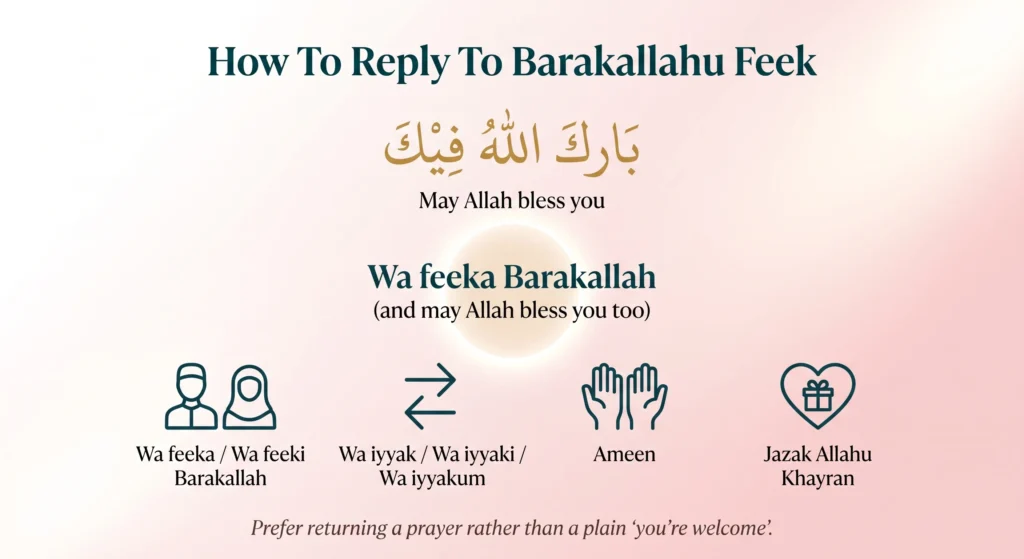
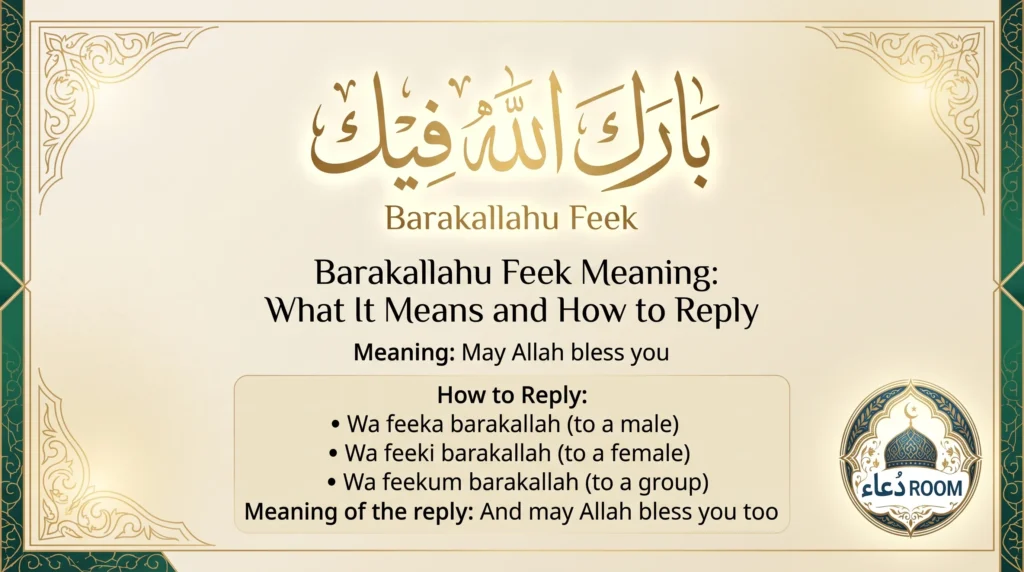
A common reply is “Wa feeka Barakallah,” which means “and may Allah bless you too.”
Other common replies include:
- Wa feeka Barakallah (to a man) / Wa feeki Barakallah (to a woman) — “and in you too, may Allah bless”
- Wa iyyak (to a man) / Wa iyyaki (to a woman) / Wa iyyakum (to a group) — “and you too”
- Ameen — “may it be so,” simply accepting the prayer
- Jazak Allahu Khayran — a thank-you back, if you want to add your own gratitude too
A plain “you’re welcome” is not wrong, but it misses the chance to return the dua. Muslims usually prefer to answer a prayer with another prayer.
Barakallahu Feek vs. Jazakallah Khair: What’s the Difference?
Jazakallah Khair asks Allah to reward someone for something specific they did. Barakallahu Feek asks Allah to put blessing in the person, without needing a specific reason. They overlap, but they are not identical.
| Jazakallah Khair | Barakallahu Feek | |
|---|---|---|
| Literal meaning | “May Allah reward you with good” | “May Allah bless you” |
| Best used when | Someone did a clear favor or deed | Any warm moment — a gift, good news, a compliment, or just gratitude |
| Focus | A reward for an action | Ongoing blessing in the person’s life |
| Common reply | Wa iyyakum (“and you too”) | Wa feeka Barakallah (“and blessing in you too”) |
In short: Jazakallah Khair is reward-focused and tied to an action. Barakallahu Feek is blessing-focused and can stand alone, even without a specific deed behind it. Many Muslims use both together, or interchangeably, and both are correct — they simply carry a slightly different shade of meaning.
Is Barakallahu Feek From the Quran or a Hadith?
The short phrase “Barakallahu Feek” is not a direct quote from the Quran, but a very similar phrase is recorded from the Prophet Muhammad (peace be upon him) in an authentic hadith.
The concept of barakah (blessing) itself is rooted deeply in the Quran. When the Prophet Nuh (Noah), peace be upon him, was told to leave the ark after the flood, Allah said:
“It was said, ‘O Noah, disembark with peace from Us and blessings on you and on the nations descended from those with you.'” — Quran 11:48
This shows that asking Allah for barakah on a person is an old, honored kind of prayer in Islam, going back to the earliest prophets.
A Closely Related Hadith Wording
A closely related wording is reported in a hadith concerning congratulations on marriage. When his relative Aqil bin Abi Talib got married, people wished him well using the old Arabian phrase “bi al-rifa wa al-banin.” The Prophet’s companion told them to say something different instead:
Arabic: بَارَكَ اللَّهُ فِيكُمْ وَبَارَكَ لَكُمْ Transliteration: Barak Allahu fikum, wa baraka lakum Translation: May Allah bless you and bestow blessings upon you.
This hadith is recorded in Sunan an-Nasa’i, Hadith 3371, and it is graded Hasan (sound) by scholars. Note that this cited wording, “Barak Allahu fikum, wa baraka lakum,” is close to but not identical to the shorter modern phrase “Barakallahu Feek.” The hadith shows the Prophet ﷺ recommending this dua when congratulating someone on marriage, and it demonstrates that the core wording — asking Allah to place blessing in a person — goes directly back to his own teaching.
Related Phrases Worth Knowing
Barakallahu Feek fits into a wider family of everyday Islamic phrases. If you want to build a fuller vocabulary for daily gratitude and blessings, a few related reads are worth checking out. Our guide on the meaning of Mashallah covers another phrase often paired with Barakallahu Feek, especially when praising something good. If you want to learn the short but powerful dhikr Muslims say throughout the day, see Subhanallahi wa Bihamdihi.
For deeper spiritual reading connected to blessings and trust in Allah, our post on tawakkul in Islamexplains how relying on Allah connects to phrases like this one. If someone close to you needs a prayer for strength or ease, you may also like Rabbi Yassir Wala Tu’assir. And if you’re teaching children simple daily phrases like this one, our guide on teaching your child salah is a helpful next step.
Barakallahu Feek — Quick Summary
FAQ: Barakallahu Feek Meaning
How do you reply to Barakallahu Feek?
A common reply is “Wa feeka Barakallah” (to a man) or “Wa feeki Barakallah” (to a woman), meaning “and may Allah bless you too.” You can also simply say “Ameen” or “Wa iyyak.”
What is the difference between Barakallahu Feek and Jazakallah Khair?
Jazakallah Khair asks Allah to reward someone for a specific good deed. Barakallahu Feek asks Allah to place ongoing blessing in the person, and it can be said even without a specific favor behind it. Many Muslims use both, and both are correct.
What does Barakallahu Feekum mean?
It means “May Allah bless you all.” It’s the plural form of Barakallahu Feek, used when speaking to more than one person, or as a respectful way to address one person in a formal or group setting.
What does Barakallah mean in Tamil?
The meaning stays the same across languages: “Allah’s blessing.” Tamil-speaking Muslims generally use the Arabic phrase itself in daily conversation, the same way it’s used worldwide, rather than a separate translated phrase.
Is Barakallahu Feek only used to say thank you?
No. While it’s often used instead of “thank you,” it’s also said to congratulate someone, respond to good news, or simply wish someone well, even without a specific reason.
What’s the difference between Barakallahu Feek and Allahumma Barik?
Barakallahu Feek is directed toward a person, asking Allah to bless them. Allahumma Barik is a dua asking Allah to place blessing in something or someone, and it’s commonly said when admiring an item or achievement. The evil-eye connection some scholars draw with Allahumma Barik is a separate topic worth its own detailed, sourced explanation.
Final Thought
Barakallahu Feek is a small phrase that carries a big wish: that the good in someone’s life keeps growing, not just for a moment, but for good. Next time you want to thank someone, try saying it with that meaning in mind. It costs nothing, and it might mean more than you think.